
Reliability and validity of the Thai version of the 2007 revised Developmental Coordination Disorder Questionnaire
Article Sidebar
Main Article Content
Abstract
Background: Developmental coordination disorder (DCD) manifests with clumsiness and affects children’s daily activities, academic achievement, peer acceptance, and self-esteem. Early identification and intervention are crucial for improving quality of life. There is no screening test for DCD in Thailand. The 2007 revised version of the Developmental Coordination Disorder Questionnaire (DCDQ’07) is
a caregiver-report screening test for 5 to 15-year-old children globally used with good sensitivity and specificity.
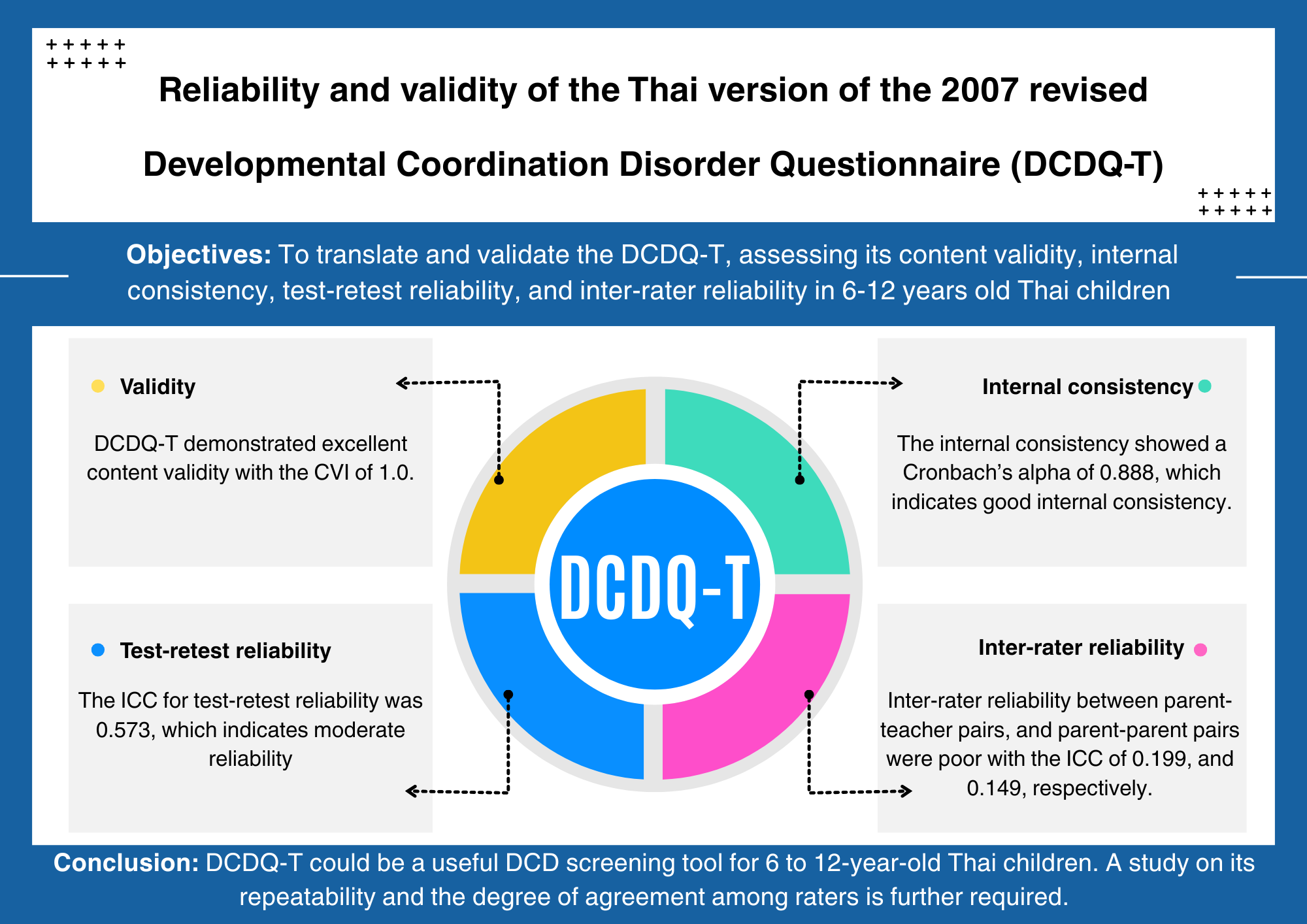
Objectives: To translate and validate the Thai version of the DCDQ’07 (DCDQ-T), assessing its content validity, internal consistency, test-retest reliability, and inter-rater reliability.
Materials and methods: After receiving permission from the original questionnaire developer, forward and backward translation processes were performed. The content validity index (CVI), consisting of item-level CVI (I-CVI) and scale-level CVI, universal agreement method (S-CVI/UA), was evaluated by five experts. Reliability was examined by internal consistency in 88 caregivers of 6 to 12-year-old students without the diagnosis of visual impairment, intellectual disability, and neurologic problems that influence movement, in a primary school in Bangkok, Thailand. Test-retest reliability was investigated three months apart in 85 caregivers. Inter-rater reliability was investigated in 20 pairs of both parents-teachers and parents-parents.
Results: Both the I-CVI and S-CVI/UA of DCDQ-T were 1.0. The internal consistency showed a Cronbach’s alpha of 0.888. The intraclass correlation coefficient of test-retest reliability was 0.573. Inter-rater reliability between parents and teachers, and parents and parents were 0.199, and 0.149, respectively.
Conclusion: DCDQ-T demonstrated an excellent CVI, good internal consistency, moderate test-retest reliability, and poor inter-rater reliability. Therefore, DCDQ-T could be a useful DCD screening tool for 6 to 12-year-old Thai children. However, a study on its repeatability and the degree of agreement among raters is further required.
Article Details

This work is licensed under a Creative Commons Attribution-NonCommercial-NoDerivatives 4.0 International License.
Personal views expressed by the contributors in their articles are not necessarily those of the Journal of Associated Medical Sciences, Faculty of Associated Medical Sciences, Chiang Mai University.
References
American Psychiatric Association. Diagnostic and statistical manual of mental disorders : DSM-5. 5th Ed. Washington DC: American Psychiatric Publishing; 2013: pp 74-7.
Blank R, Barnett AL, Cairney J, Green D, Kirby A,Polatajko H, et al. International clinical practice recommendations on the definition, diagnosis, assessment, intervention, and psychosocial aspects of developmental coordination disorder. Dev Med Child Neurol. 2019; 61(3): 242-85. doi: 10.1111/dmcn.14132.
Lingam R, Hunt L, Golding J, Jongmans M, Emond A. Prevalence of developmental coordination disorder using the DSM-IV at 7 years of age: a UK population-based study. Pediatrics. 2009; 123(4): e693-700. doi: 10.1542/peds.2008-1770.
Kadesjo B, Gillberg C. Developmental coordination disorder in Swedish 7-year-old children. J Am Acad Child Adolesc Psychiatry. 1999; 38(7): 820-8. doi: 10.1097/00004583-199907000-00011.
Paepetch-Suato B, Luangpon N, Kiatkulanusorn S. Development Coordination of Pre-Kindergarten and Kindergarten. Technical Education Journal: King Mongkut’s University of Technology North Bangkok [Internet]. 2019; 10(2): 175-84. Available from: https://ojs.kmutnb.ac.th/index.php/jote/article/view/2889.
Girish S, Raja K, Kamath A. Prevalence of developmental coordination disorder among mainstream school children in India. J Pediatr Rehabil Med. 2016; 9(2): 107-16. doi: 10.3233/PRM-160371.
Harris SR, Mickelson ECR, Zwicker JG. Diagnosis and management of developmental coordination disorder. CMAJ. 2015; 187(9) : 659-65. doi: 10.1503/cmaj.140994.
Fliers E, Rommelse N, Vermeulen SH, Altink M, Buschgens CJ, Faraone SV, et al. Motor coordination problems in children and adolescents with ADHD rated by parents and teachers: effects of age and gender. J Neural Transm (Vienna). 2008; 115: 211-20. doi: 10.1007/s00702-007-0827-0.
Flapper BCT, Schoemaker MM. Developmental coordination disorder in children with specific language impairment: co-morbidity and impact on quality of life. Res Dev Disabil. 2013; 34(2): 756-63. doi: 10.1016/j.ridd.2012.10.014.
Margari L, Buttiglione M, Craig F, Cristella A, de Giambattista C, Matera E, et al. Neuropsychopathological comorbidities in learning disorders. BMC Neurol. 2013; 13: 198. doi: 10.1186/1471-2377-13-198.
Blank R, Smits-Engelsman B, Polatajko H, Wilson P; European Academy for Childhood Disability. European Academy for Childhood Disability (EACD): recommendations on the definition, diagnosis and intervention of developmental coordination disorder (long version). Dev Med Child Neurol. 2012; 54(1): 54-93. doi: 10.1111/j.1469-8749.2011.04171.x.
Chaingam S, Narkpongphun A. Prevalence and associated factors of developmental coordination disorder among patients with deficit hyperactivity disorder at Maharaj Nakorn Chiang Mai Hospital. J Psychiatr Assoc Thailand [Internet]. 2019; 64(4): 309-16. Available from: https://he01.tci-thaijo.org/index.php/JPAT/article/view/231886.
Zwicker JG, Harris SR, Klassen AF. Quality of life domains affected in children with developmental coordination disorder: a systematic review. Child Care Health Dev. 2013; 39(4): 562-80. doi: 10.1111/j.1365-2214.2012.01379.x.
Rahimi-Golkhandan S, Steenbergen B, Piek JP, Wilson PH. Deficits of hot executive function in developmental coordination disorder: sensitivity to positive social cues. Hum Mov Sci. 2014; 38: 209-24. doi: 10.1016/j.humov.2014.09.008.
Leonard HC, Bernardi M, Hill EL, Henry LA. Executive functioning, motor difficulties, and developmental coordination disorder. Dev Neuropsychol. 2015; 40(4): 201-15. doi: 10.1080/87565641.2014.997933.
Henderson SE, Barnett A. Movement Assessment Battery for Children, Thiird edition (MABC-3). Pearson Education, Inc [Internet]. 2023. [cited 2025 Jan. 22].Available from: https://www.pearsonassessments.com/content/dam/school/global/clinical/us/assets/mabc-3/mabc-2-to-3-comparison.pdf.
Bruininks BD, Bruininks RH. Bruininks-Oseretsky Test of Motor Proficiency, Third edition (BOT-3). Pearson Education, Inc. [Internet] 2024. [cited 2025 Jan. 22].Available from: https://www.pearsonassessments.com/store/usassessments/en/Store/Professional-Assessments/Motor-Sensory/Bruininks-Oseretsky-Test-of-Motor-Proficiency-%7C-Third-Edition/p/P100071001.html.
Wilson BN, Crawford SG, Green D, Roberts G, Aylott A, Kaplan BJ. Psychometric properties of the revised developmental coordination disorder questionnaire. Phys Occup Ther Pediatr. 2009; 29(2): 182-202. doi: 10.1080/01942630902784761.
Yildirim CK, Altunalan T, Acar G, Elbasan B, Gucuyener K. Cross-cultural adaptation of the Developmental Coordination Disorder Questionnaire in Turkish children. Percept Mot Skills. 2019; 126(1): 40-9. doi: 10.1177/0031512518809161.
Ray-Kaeser S, Thommen E, Martini R, Jover M, Gurtner B, Bertrand AM. Psychometric assessment of the French European Developmental Coordination Disorder Questionnaire (DCDQ-FE). PLoS One. 2019; 14(5): e0217280. doi: 10.1371/journal.pone.0217280.
Martini R, St-Pierre MF, Wilson BN. French Canadian cross-cultural adaptation of the Developmental Coordination Disorder Questionnaire’07: DCDQ-FC. Can J Occup Ther. 2011; 78(5): 318-27. doi: 10.2182/cjot.2011.78.5.7.
Kennedy-Behr A, Wilson BN, Rodger S, Mickan S. Cross-cultural adaptation of the developmental coordination disorder questionnaire 2007 for German-speaking countries: DCDQ-G. Neuropediatrics. 2013; 44(5): 245-51. doi: 10.1055/s-0033-1347936.
Ko JY, Lee WH, Woon JJ, Kim YA. Development of Korean Version of Developmental Coordination Disorder Questionnaire (DCDQ-K). J Kor Phys Ther [Internet]. 2020; 32(1): 44-51. Available from: https://www.researchgate.net/publication/340052197_Development_of_Korean_the_Version_of_the_Developmental_Coordination_Disorder_Questionnaire_DCDQ-K.
Widyastari DA, Saonuam P, Rasri N, Pongpradit K, Katewongsa P. Prevalence and trends of physical activity in Thai children and young people: pooled panel data analysis from Thailand’s surveillance on physical activity 2012–2020. Int J Environ Res Public Health. 2021; 18(19): 10088. doi: 10.3390/ijerph181910088.
Beaton DE, Bombardier C, Guillemin F, Ferraz MB. Guidelines for the process of cross-cultural adpatation of self-report measures. Spine (Phila Pa 1976). 2000; 25(24): 3816-91. doi: 10.1097/00007632-200012150-00014.
World Health Organization. BMI- for –ages (5-19 years). 2025 [cited 2025 Apr. 15]. Avaliable from: https://www.who.int/tools/growth-reference-data-for-5to19-years/indicators/bmi-for-age.
Taber KS. The use of Cronbach’s alpha when developing and reporting research instruments in science education. Res Sci Educ. 2018; 48: 1273-96. doi: 10.1007/s11165-016-9602-2.
Koo TK, Li MY. A guideline of selecting and reporting Intraclass Correlation Coefficients for reliability research. J Chiropr Med. 2016; 15(2): 155-63. doi: 10.1016/j.jcm.2016.02.012. Epub 2016 Mar 31.
Flatters I, Hill LJ, Williams JH, Barber SE, Mon-Williams M. Manual control age and sex differences in 4- to 11-year-old children. PLoS One. 2014; 9(2): e88692. doi: 10.1371/journal.pone.0088692. eCollection 2014.
