The validity and reliability of the SRS-22r questionnaire in patients with scoliosis receiving physical therapy
Article Sidebar
Main Article Content
Abstract
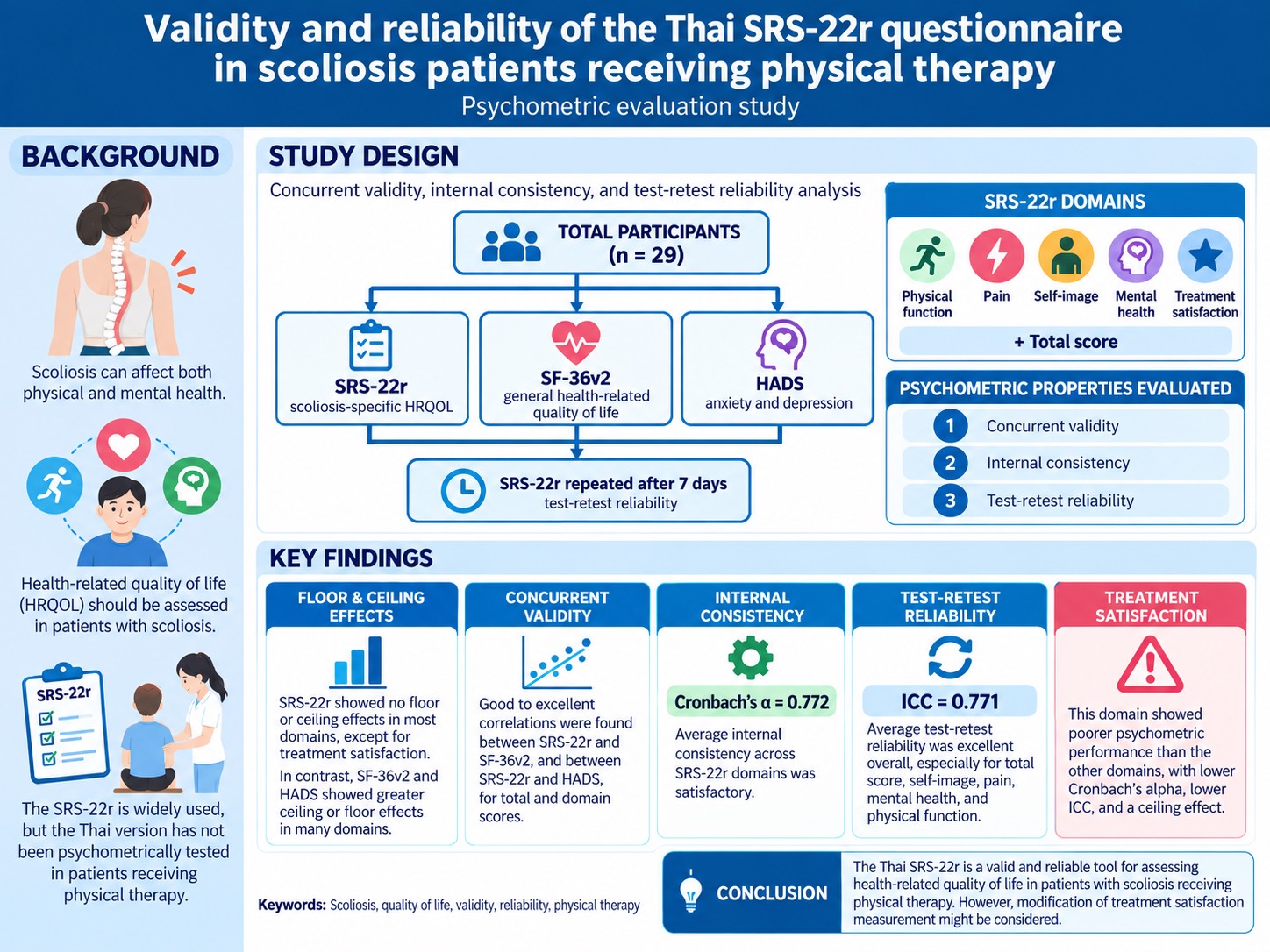
Background: The malalignment of the spine affects both the physical and mental health of patients with scoliosis. The refined version of the Scoliosis Research Society questionnaire (SRS-22r) is a common tool used for assessing the health-related quality of life (HRQOL) in this patient population. However, the Thai version of this questionnaire has not been tested for psychometric properties in scoliosis patients receiving physical therapy.
Objective: This study aimed to evaluate the concurrent validity, internal consistency, and test-retest reliability of the SRS-22r in patients with scoliosis undergoing physical therapy.
Materials and methods: Twenty-nine patients diagnosed with scoliosis responded to three instruments, including the SRS-22r, Short Form 36 version2 (SF-36v2), and the Hospital Anxiety and Depression Scale (HAD). Participants also completed the SRS-22r again seven days later.
Results: The SRS-22r domains showed no floor or ceiling effects, except for treatment satisfaction, while the SF-36v2 and HAD showed greater ceiling or floor effects in many domains. A good to excellent correlation was observed between total scores and domain scores of SRS-22r and SF-36v2, as well as SRS-22r and HADS. The Cronbach’s alpha was satisfactory, with an average of 0.772 for all domains of SRS-22r. The ICCs for the two-time responses of the SRS-22r were excellent for the total score and the self-image, pain, mental health, and physical function domains, with average ICCs of 0.771. The treatment satisfaction domain had lower Cronbach’s alpha, Pearson correlation coefficient, and ICCs than the other domains.
Conclusion: The SRS-22r was valid and reliable when applied to patients receiving physical therapy. However, modifying the treatment satisfaction measure may be considered.
Article Details

This work is licensed under a Creative Commons Attribution-NonCommercial-NoDerivatives 4.0 International License.
Personal views expressed by the contributors in their articles are not necessarily those of the Journal of Associated Medical Sciences, Faculty of Associated Medical Sciences, Chiang Mai University.
References
Konieczny MR, Senyurt H, Krauspe R. Epidemiology of adolescent idiopathic scoliosis. J Child Orthop. 2013; 7(1): 3-9. doi: 10.1007/s11832-012-0457-4.
Dunn J, Henrikson NB, Morrison CC, Blasi PR, Nguyen M, Lin JS. Screening for adolescent idiopathic scoliosis: evidence report and systematic review for the US Preventive Services Task Force. JAMA. 2018; 319(2): 173-87. doi: 10.1001/jama.2017.19342.
Kunakornsawat S, Popan N, Piyaskulkaew C, Pruttikul P, Pluemvitayaporn T, Kittithamvongs P. Prevalence of idiopathic scoliosis in Thai female students aged 11-13 years. J Med Assoc Thai. 2017; 100(5): 533-8.
Sakullertphasuk W, Suwanasri C, Saetang L, Charoenporn P, Thongkaew S, Chaiyakunapruk N. Prevalence of scoliosis among high school students (in Thai). J Med Assoc Thai. 2015; 98 Suppl 5: S18-22.
Théroux J, Le May S, Fortin C, Labelle H. Prevalence and management of back pain in adolescent idiopathic scoliosis patients: a retrospective study. Pain Res Manag. 2015; 20(3): 153-7. doi: 10.1155/2015/303498.
Freidel K, Petermann F, Reichel D, Steiner A, Warschburger P, Weiss HR. Quality of life in women with idiopathic scoliosis. Spine (Phila Pa 1976). 2002; 27(4): E87-91. doi: 10.1097/00007632-200202150-00013.
Reichel D, Schanz J. Developmental psychological aspects of scoliosis treatment. Pediatr Rehabil. 2003; 6(3-4): 221-5. doi: 10.1080/13638490310001636817.
Sanders AE, Andras LM, Iantorno SE, Hamilton A, Choi PD, Skaggs DL. Clinically significant psychological and emotional distress in 32% of adolescent idiopathic scoliosis patients. Spine Deform. 2018; 6(4): 435-40. doi: 10.1016/j.jspd.2017.12.012.
Hannink E, Toye F, Newman M, Barker KL. The experience of living with adolescent idiopathic scoliosis: a qualitative evidence synthesis using meta-ethnography. BMC Pediatr. 2023; 23(1): 373. doi: 10.1186/s12887-023-04183-w.
Brandwijk AC, Heemskerk JL, Willigenburg NW, Altena MC, Kempen DHR. Health-related quality of life of adult, non-surgically treated patients with idiopathic scoliosis and curves above 45°: a cross-sectional study at an average follow-up of 30 years. Eur Spine J. 2023; 32(9): 3084-93. doi: 10.1007/s00586-023-07802-9.
Ragborg LC, Dragsted C, Ohrt-Nissen S, Andersen T, Gehrchen M, Dahl B. Health-related quality of life in patients 40 years after diagnosis of an idiopathic scoliosis. Bone Joint J. 2023; 105-B(2): 166-71. doi: 10.1302/0301-620X.105B2.BJJ-2022-0857.R1.
Asher M, Min Lai S, Burton D, Manna B. Scoliosis Research Society-22 Patient Questionnaire: responsiveness to change associated with surgical treatment. Spine (Phila Pa 1976). 2003; 28(1): 70-3. doi: 10.1097/01.BRS.0000039308.20456.B5.
Monticone M, Ambrosini E, Rocca B, Foti C, Ferrante S. Responsiveness and minimal important changes of the Scoliosis Research Society-22 Patient Questionnaire in subjects with mild adolescent and moderate adult idiopathic scoliosis undergoing multidisciplinary rehabilitation. Spine (Phila Pa 1976). 2017; 42(11): E672-9. doi: 10.1097/BRS.0000000000001925.
Monticone M, Nava C, Leggero V, Ambrosini E, Rocca B, Foti C, et al. Measurement properties of translated versions of the Scoliosis Research Society-22 Patient Questionnaire, SRS-22: a systematic review. Qual Life Res. 2015; 24(8): 1981-98. doi: 10.1007/s11136-015-0935-7.
Haher TR, Gorup JM, Shin TM, Homel P, Merola AA, Grobler LJ, et al. Results of the Scoliosis Research Society instrument for evaluation of surgical outcome in adolescent idiopathic scoliosis. A multicenter study of 244 patients. Spine (Phila Pa 1976). 1999; 24(14): 1435-40. doi: 10.1097/00007632-199907150-00008.
Asher MA, Min Lai S, Burton DC. Further development and validation of the Scoliosis Research Society (SRS) outcomes instrument. Spine (Phila Pa 1976). 2000; 25(18): 2381-6. doi: 10.1097/00007632-200009150-00019.
Asher M, Min Lai S, Burton D, Manna B. The reliability and concurrent validity of the Scoliosis Research Society-22 patient questionnaire for idiopathic scoliosis. Spine (Phila Pa 1976). 2003; 28(1): 63-9. doi: 10.1097/01.BRS.0000039294.61904.57.
Leelapattana P, Keorochana G, Johnson J, Wajanavisit W, Laohacharoensombat W. Reliability and validity of an adapted Thai version of the Scoliosis Research Society-22 questionnaire. J Child Orthop. 2011; 5(1): 35-40. doi: 10.1007/s11832-010-0309-8.
Sathira-Angkura V, Pithankuakul K, Sakulpipatana S, Piyaskulkaew C, Kunakornsawat S. Validity and reliability of an adapted Thai version of Scoliosis Research Society-22 questionnaire for adolescent idiopathic scoliosis. Spine (Phla Pa 1976). 2012; 37(9): 783-7. doi: 10.1097/BRS.0b013e31823485e9.
Samala M, Rakbangboon T, Assawapalangchai S. Translation and test-retest reliability of the Thai version of the Scoliosis Research Society SRS-22r (in Thai). J Physiol Biomed Sci. 2018; 31(2): 51-5.
Mitsiaki I, Thirios A, Panagouli E, Vlachopapadopoulou E, Michos A, Bacopoulou F, et al. Adolescent idiopathic scoliosis and mental health disorders: a narrative review of the literature. Children (Basel). 2022; 9(5): 597. doi: 10.3390/children9050597.
Camarini PM, Rosanova GC, Gabriel BS, Gianini PE, Oliveira AS. The Brazilian version of the SRS-22r questionnaire for idiopathic scoliosis. Braz J Phys Ther. 2013; 17(5): 494-505. doi: 10.1590/S1413-35552012005000115.
Cheung KM, Senkoylu A, Alanay A, Genc Y, Lau S, Luk KD. Reliability and concurrent validity of the adapted Chinese version of Scoliosis Research Society-22 (SRS-22) questionnaire. Spine (Phila Pa 1976). 2007; 32(10): 1141-5. doi: 10.1097/01.brs.0000261562.91037.28.
Monticone M, Baiardi P, Calabrò D, Calabrò F, Foti C. Development of the Italian version of the revised Scoliosis Research Society-22 Patient Questionnaire, SRS-22r-I: cross-cultural adaptation, factor analysis, reliability, and validity. Spine (Phila Pa 1976). 2010; 35(24): E1412-7. doi: 10.1097/BRS.0b013e3181dc2ee6.
Bago J, Climent JM, Ey A, Perez-Grueso FJ, Izquierdo E. The Spanish version of the SRS-22 patient questionnaire for idiopathic scoliosis: transcultural adaptation and reliability analysis. Spine (Phila Pa 1976). 2004; 29(15): 1676-80. doi: 10.1097/01.brs.0000132311.59797.eb.
Alanay A, Cil A, Berk H, Acaroglu RE, Yazici M, Akcali O, et al. Reliability and validity of adapted Turkish version of Scoliosis Research Society-22 (SRS-22) questionnaire. Spine (Phila Pa 1976). 2005; 30(21): 2464-8. doi: 10.1097/01.brs.0000184687.20235.b3.
Lai SM, Asher M, Burton D. Estimating SRS-22 quality of life measures with SF-36: application in idiopathic scoliosis. Spine (Phila Pa 1976). 2006; 31(4): 473-8. doi: 10.1097/01.brs.0000200036.03577.ad.
Li M, Wang CF, Gu SX, Ni JX, Fang XQ, Zhu XD, et al. Adapted simplified Chinese (mainland) version of Scoliosis Research Society-22 questionnaire. Spine (Phila Pa 1976). 2009; 34(12): 1321-4. doi: 10.1097/BRS.0b013e31819e2bb4.
Qiu G, Qiu Y, Zhu Z, Zhu F, Wang Y, Qian B, et al. Re-evaluation of reliability and validity of simplified Chinese version of SRS-22 patient questionnaire: a multicenter study of 333 cases. Spine (Phila Pa 1976). 2011; 36(8): E545-50. doi: 10.1097/BRS.0b013e3181ec387e.
Schlösser TP, Stadhouder A, Schimmel JJ, Lehr AM, van der Heijden GJ, Castelein RM. Reliability and validity of the adapted Dutch version of the revised Scoliosis Research Society 22-item questionnaire. Spine J. 2014; 14(8): 1663-72. doi: 10.1016/j. spinee.2013.10.013.
Lonjon G, Ilharreborde B, Odent T, Moreau S, Glorion C, Mazda K. Reliability and validity of the French-Canadian version of the Scoliosis Research Society 22 questionnaire in France. Spine (Phila Pa 1976). 2014; 39(1): E26-34. doi: 10.1097/BRS.0000000000000067.
Niemeyer T, Schubert C, Halm HF, Herberts T, Leichtle C, Gesicki M. Validity and reliability of an adapted German version of Scoliosis Research Society-22 questionnaire. Spine (Phila Pa 1976). 2009; 34(8): 818-21. doi: 10.1097/BRS.0b013e3181979430.
Antonarakos PD, Katranitsa L, Angelis L, Paganas AN, Bisbinas I, Christodoulou AG. Reliability and validity of the adapted Greek version of Scoliosis Research Society-22 (SRS-22) questionnaire. Scoliosis. 2009; 4(1): 14. doi: 10.1186/1748-7161-4-14.
Potoupnis M, Papavasiliou K, Kenanidis EI, Kapoutsis D, Sayegh FE, Kirkos J, et al. Reliability and concurrent validity of the adapted Greek version of the Scoliosis Research Society-22r questionnaire: a cross-sectional study performed on conservatively treated patients. Hippokratia. 2012; 16(3): 225-9.
Lee JS, Lee DH, Suh KT, Kim JI, Lim JM, Goh TS. Validation of the Korean version of the Scoliosis Research Society-22 questionnaire. Eur Spine J. 2011; 20(10): 1751-6. doi: 10.1007/s00586-011-1779-1.
Mousavi SJ, Mobini B, Mehdian H, Akbarnia BA, Bouzari B, Ganjavian S, et al. Reliability and validity of the Persian version of the Scoliosis Research Society-22r questionnaire. Spine (Phila Pa 1976). 2010; 35(7): 784-9. doi: 10.1097/BRS.0b013e3181bca0ee.
Danielsson AJ, Romberg K. Reliability and validity of the Swedish version of the Scoliosis Research Society-22 (SRS-22r) patient questionnaire for idiopathic scoliosis. Spine (Phila Pa 1976). 2013; 38(21): 1875-84. doi: 10.1097/BRS.0b013e3182a3d0ec.
Zhao L, Zhang Y, Sun X, Du Q, Shang L. The Scoliosis Research Society-22 questionnaire adapted for adolescent idiopathic scoliosis patients in China: reliability and validity analysis. J Child Orthop. 2007; 1(6): 351-5. doi: 10.1007/s11832-007-0063-4.
Beauséjour M, Joncas J, Goulet L, Roy-Beaudry M, Parent S, Labelle H. Reliability and validity of adapted French Canadian version of Scoliosis Research Society Outcomes Questionnaire (SRS-22) in Quebec. Spine (Phila Pa 1976). 2009; 34(6): 623-8. doi: 10.1097/BRS.0b013e3181979401.
Hashimoto H, Sase T, Arai Y, Maruyama T, Isobe K, Shouno Y. Validation of a Japanese version of the Scoliosis Research Society-22 Patient Questionnaire among idiopathic scoliosis patients in Japan. Spine (Phila Pa 1976). 2007; 32(4): E141-6. doi: 10.1097/01.brs.0000255198.81669.1b.
Głowacki M, Misterska E, Laurentowska M, Mankowski P. Polish adaptation of Scoliosis Research Society-22 questionnaire. Spine (Phila Pa 1976). 2009; 34(10): 1060-5. doi: 10.1097/BRS.0b013e31819e2c60.
Rosanova GC, Gabriel BS, Camarini PM, Gianini PE, Coelho DM, Oliveira AS. Concurrent validity of the Brazilian version of SRS-22r with Br-SF-36. Rev Bras Fisioter. 2010; 14(2): 121-6. doi: 10.1590/S1413-35552010000200006.
