
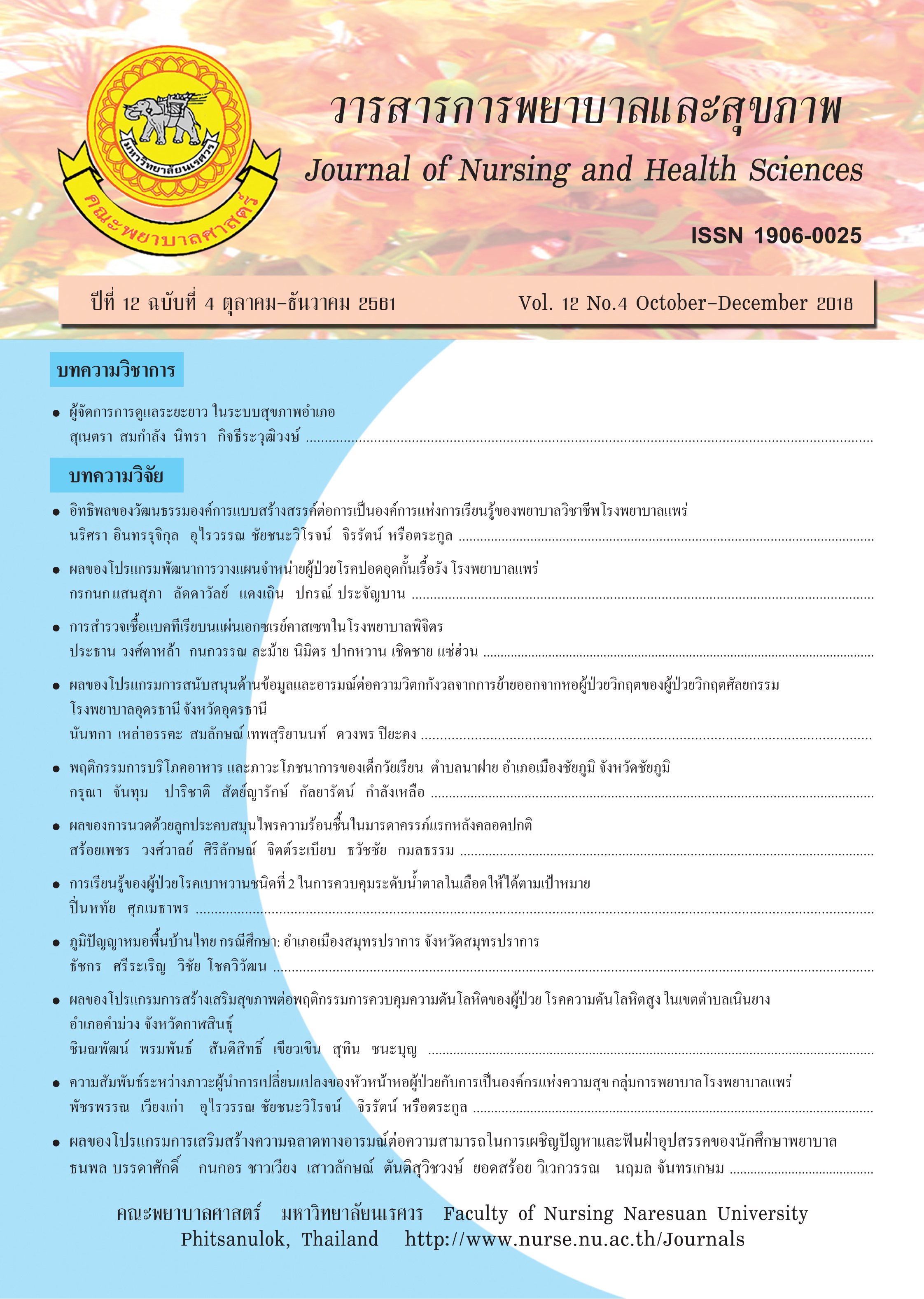
การเรียนรู้ของผู้ป่วยโรคเบาหวานชนิดที่ 2 ในการควบคุมระดับน้ำตาลในเลือดให้ได้ตามเป้าหมาย
Article Sidebar
Main Article Content
บทคัดย่อ
การวิจัยเชิงคุณภาพครั้งนี้ มีวัตถุประสงค์เพื่อศึกษาการเรียนรู้ของผู้ป่วยโรคเบาหวานชนิดที่ 2 ที่เกี่ยวข้องกับการควบคุมระดับน้ำตาลในเลือดให้ได้ตามเป้าหมายการรักษา ด้วยวิธีวิจัยเชิงคุณภาพ แบบพรรณนา เก็บข้อมูลด้วยการสัมภาษณ์เชิงลึกผู้ป่วยโรคเบาหวานชนิดที่ 2 ที่ขึ้นทะเบียนเป็นผู้ป่วยของ คลินิกโรคเบาหวาน โรงพยาบาลชุมชนแห่งหนึ่งในจังหวัดอุตรดิตถ์ และสามารถควบคุมระดับน้ำตาลในเลือด ได้ตามเป้าหมาย จำนวน 23 ราย ข้อมูลวิเคราะห์โดยประยุกต์ใช้วิธีการของโคไลซี (Colaizzi) ผลการวิจัยพบว่า การเรียนรู้ของผู้ป่วยโรคเบาหวานที่เกี่ยวข้องกับการควบคุมระดับน้ำตาลในเลือด ให้ได้ตามเป้าหมายการรักษา ประกอบด้วย 3 ประเด็นหลักคือ (1) การรับรู้ว่าเป็นเบาหวาน (2) การเรียนรู้ ผ่านช่องทางที่หลากหลาย และ (3) การปรับเปลี่ยนพฤติกรรมและมีวิถีชีวิตใหม่ในการอยู่กับเบาหวาน ผลการวิจัยนี้ ให้ความรู้ความเข้าใจเกี่ยวกับการเรียนรู้ของผู้ป่วยโรคเบาหวานในการควบคุมระดับ น้ำตาลในเลือดให้ได้ตามเป้าหมาย พยาบาลและเจ้าหน้าที่สุขภาพสามารถประยุกต์ใช้ความรู้ที่ได้มาช่วย ประเมินและออกแบบการศึกษาโรคเบาหวานที่ส่งเสริมให้ผู้ป่วยสามารถปรับเปลี่ยนพฤติกรรมและควบคุม ระดับน้ำตาลในเลือดได้ตามเป้าหมายการรักษา
Downloads
Article Details
เอกสารอ้างอิง
health examination survey 2014. Nonthaburi:
Health System Research Institute. [In Thai].
Agborsangaya, C. B., Gee, M. E., Johnson, S. T.,
Dunbar, P., Langlois, M. F., Leiter, L.
A…Johnson, J. A. (2013). Determinants of
lifestyle behavior in type 2 diabetes: results of
the 2011 cross-sectional survey on living with
chronic diseases in Canada. BMC Public
Health, 13(1):451 Retrived from http://www.
biomedcentral.com/1471-2458/13/451
American Diabetes Association. (2017). Standards of
medical care in diabetes-2017. Diabetes Care,
40(suppl. 1), S1-S135.
Boren, S. A., Fitzner, K. A., Panhalkar, P. S., &
Specker, J. E. (2009). Costs and benefits
associated with diabetes education: a review of
the literature. The Diabetes Educator, 35(1),
72-96.
Cooper, H. C., Booth, K., & Gill, G. (2003). Patients’
perspectives on diabetes health care education.
Health Education Research, 18(2), 191-206,
Diabetes Association of Thailand (DAT), Endocrine
Society of Thailand, & National Health Security
Office. (2017). Clinical practice guidelines for
management of diabetes 2017. Pathum Thani:
Rom Yen Media. [In Thai].
Driscoll, M. P. (2000). Psychology of learning for
instruction. (3rd ed.). Boston: Allyn and Bacon.
Dube, L., Van den Broucke, S., Housiaux, M., Dhoore,
W., & Rendall-Mkosi, K. (2015). Type 2
diabetes self-management education programs
in high and low mortality developing countries:
a systematic review. The Diabetes Educator,
41(1), 69-85.
Eknithiset, R., Hongsranagon, P., & Havanond, P.
(2010). Knowledge, attitude, and practice
(KAP) of diabetes mellitus type 2 patients in
multidisciplinary program at diabetes mellitus
clinic, Phanomphrai Hospital, Phanomphrai
District, Roi-Et Province, Thailand. Journal of
Health Research, 24(suppl 2), 87-92.
Espeland, M. A., Glick, H. A., Bertoni, A., Brancati, F.,
Bray, G., Clark, J. M… Look AHEAD
Research Group. (2014). Impact of an intensive
lifestyle intervention on use and cost of medical
services among overweight and obese adults
with type 2 diabetes: the action for health in
diabetes. Diabetes Care, 37(9), 2548-2556.
Fan, L., & Sidani, S. (2009). Effectiveness of diabetes
self-management education intervention
elements: a meta-analysis. Canadian Journal
of Diabetes, 33(1), 18-26.
He, X., Li, J., Wang, B., Yao, Q., Li, L., Song, R…
Zhang, J. A. (2017). Diabetes self-management
education reduces risk of all-cause mortality in
type 2 diabetes patients: a systematic review
and meta-analysis. Endocrine, 55(3), 712-731.
Htoo, Z. W., Hsu, W. W., & Rosenkranz, R. (2016).
Systematic review and meta-analysis: is
lifestyle modification effective for glycemic
control among adults with type II diabetes in
Southeast Asia? Diabetes Research and
Clinical Practice, 122, 148-153.
Kneck, A., Fagerberg, I., Eriksson, L. E., & Lundman,
B. (2014). Living with diabetes-development
of learning patterns over 3-year period.
International Journal of Qualitative Research
Studies on Health and Well-being, 9(1). https://
doi.org/10.3402/qhw.v9.24375
Koonce, T. Y., Giuse, N. B., Kusnoor, S. V., Hurley,
S., & Ye, F. (2015). A personalized approach
Eknithiset, R., Hongsranagon, P., & Havanond, P.
(2010). Knowledge, attitude, and practice
(KAP) of diabetes mellitus type 2 patients in
multidisciplinary program at diabetes mellitus
clinic, Phanomphrai Hospital, Phanomphrai
District, Roi-Et Province, Thailand. Journal of
Health Research, 24(suppl 2), 87-92.
Espeland, M. A., Glick, H. A., Bertoni, A., Brancati, F.,
Bray, G., Clark, J. M… Look AHEAD
Research Group. (2014). Impact of an intensive
lifestyle intervention on use and cost of medical
services among overweight and obese adults
with type 2 diabetes: the action for health in
diabetes. Diabetes Care, 37(9), 2548-2556.
Fan, L., & Sidani, S. (2009). Effectiveness of diabetes
self-management education intervention
elements: a meta-analysis. Canadian Journal
of Diabetes, 33(1), 18-26.
He, X., Li, J., Wang, B., Yao, Q., Li, L., Song, R…
Zhang, J. A. (2017). Diabetes self-management
education reduces risk of all-cause mortality in
type 2 diabetes patients: a systematic review
and meta-analysis. Endocrine, 55(3), 712-731.
Htoo, Z. W., Hsu, W. W., & Rosenkranz, R. (2016).
Systematic review and meta-analysis: is
lifestyle modification effective for glycemic
control among adults with type II diabetes in
Southeast Asia? Diabetes Research and
Clinical Practice, 122, 148-153.
Kneck, A., Fagerberg, I., Eriksson, L. E., & Lundman,
B. (2014). Living with diabetes-development
of learning patterns over 3-year period.
International Journal of Qualitative Research
Studies on Health and Well-being, 9(1). https://
doi.org/10.3402/qhw.v9.24375
Koonce, T. Y., Giuse, N. B., Kusnoor, S. V., Hurley,
S., & Ye, F. (2015). A personalized approach
