
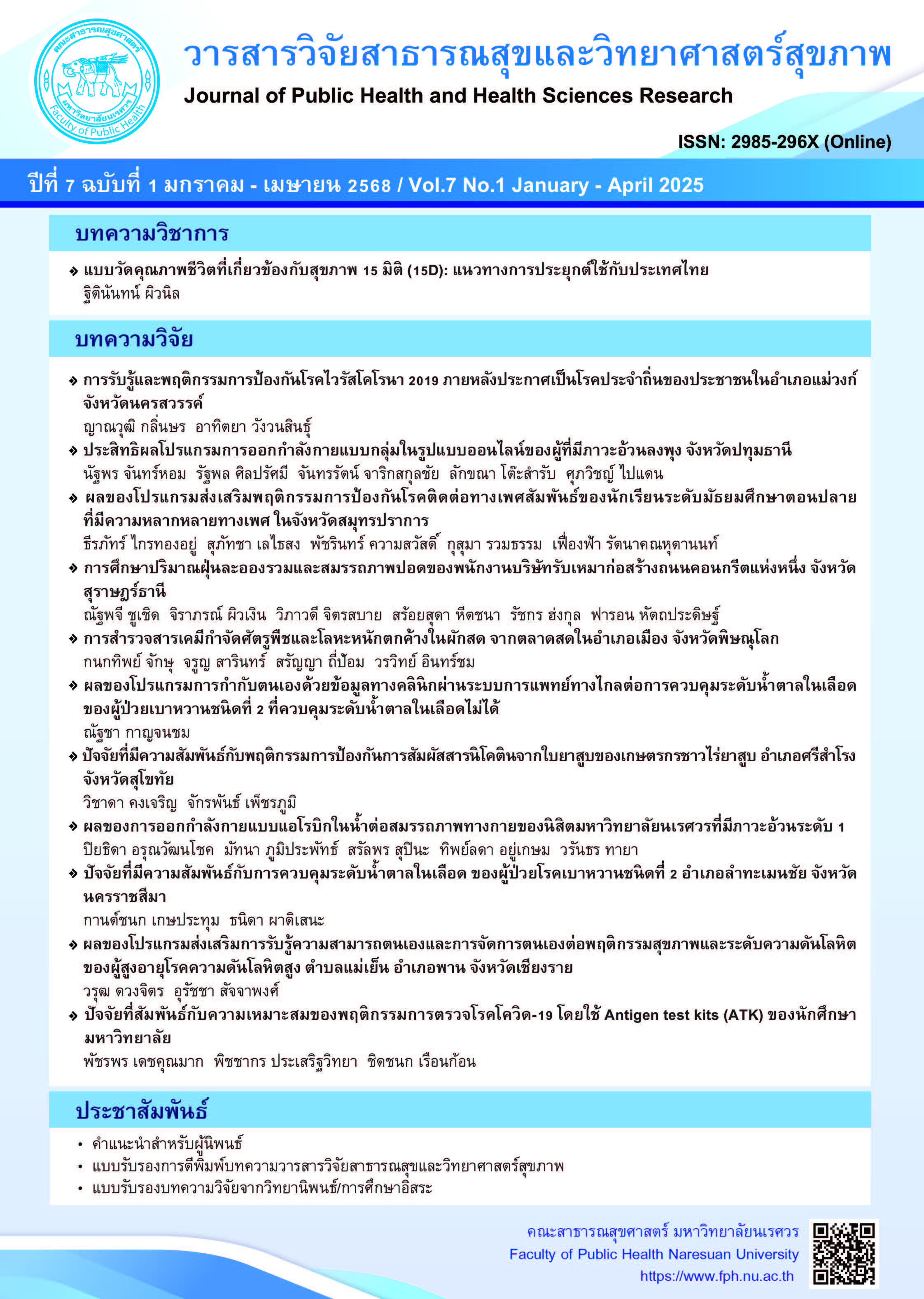
Effect of aquatic aerobic exercise on physical performance in Naresuan University students with class 1 obesity
Keywords:
Aquatic exercise, Class 1 obesity, Physical performance, Body compositionAbstract
The study aimed to evaluate the effects of aquatic exercise on body compositions and physical performances among 14 students at Naresuan University aged 20-24 years with obesity level 1. Participants were randomized into experimental (n = 6) and control (n = 8) groups. The experimental group received a moderate-intensity aquatic exercise program for 50 minutes per session, 3 times per week, for 6 weeks, while the control group did not exercise. Body composition measurements included body weight, Body Mass Index, body fat percentage, and waist circumference. Physical performance assessments included muscle strength, muscle endurance, flexibility, cardiovascular endurance, and lung capacity, measured before and after the exercise program. The differences between groups were analyzed using an independent sample t-test, and within-group differences were analyzed using a paired t-test.
After the exercise program, no significant differences were found in body composition between the groups. However, significant differences were observed in leg muscle strength and endurance at the level 0.05 between groups. Within the experimental group, there were significant differences in waist circumference, lung capacity, flexibility, and cardiovascular endurance at the level 0.05. These findings suggest that aquatic exercise may have a positive effect on leg muscle strength and endurance. However, a 6-week exercise duration may not be sufficient to induce changes in body composition. A longer exercise period is recommended to observe noticeable changes.
References
Abadi, F. H., Elumalai, G., Sankaraval, M., & Ramli, F. A. B. M. (2017). Effects of aqua-aerobic exercise on the cardiovascular fitness and weight loss among obese students. International Journal of Physiotherapy, 4(5), 278-283.
Bergamin, M., Ermolao, A., Tolomio, S., Berton, L., Sergi, G., & Zaccaria, M. (2013). Waterversus land-based exercise in elderly subjects: Effects on physical performance and body composition. Clinical Interventions in Aging, 8, 1109-1117.
Chaolilitkul, N. (2005). A guide to recording and evaluating the consumption of general foods and foods that are sources of calcium. Nonthaburi: Department of Health, Ministry of Public Health. (in Thai)
Costa, R. R., Kanitz, A. C., Reichert, T., Prado, A. K. G., Coconcelli, L., Buttelli, A. C. K., et al. (2018). Water-based aerobic training improves strength parameters and cardiorespiratory outcomes in elderly women. Experimental Gerontology 108, 231-239.
Darby, L. A., & Yaekle, B. C. (2000). Physiological responses during two types of exercise performed on land and in the water. The Journal of Sports Medicine and Physical Fitness 40(4), 303-311.
Depiazzi, J. E., Forbes, R. A., Gibson, N., Smith, N. L., Wilson, A. C., Boyd, R. N., & Hill, K. (2019). The effect of aquatic high-intensity interval training on aerobic performance, strength and body composition in a non-athletic population: Systematic review and metaanalysis. Clinical Rehabilitation, 33(2), 157-170.
Gappmaier, E., Lake, W., Nelson, A. G., & Fisher, A. G. (2006). Aerobic exercise in water versus walking on land: effects on indices of fat reduction and weight loss of obese women. The Journal of Sports Medicine and Physical Fitness, 46(4), 564-569.
GBD 2019 Risk factors collaborators (2020). Global burden of 87 risk factors in 204 countries and territories, 1990-2019: A systematic analysis for the Global Burden of Disease Study 2019. Lancet, 396(0258), 1223-1249.
Ghorbani, F., Heidarimoghadam, R., Karami, M., Fathi, K., Minasian, V., & Bahram, M. E. (2014). The effect of six-week aerobic training program on cardiovascular fitness, body composition and mental health among female students. Journal of Research in Health Science 14(4), 264-267.
Hemara, J. (2018). Principle of physical fitness test. Bangkok: Chulalongkorn University. (in Thai)
Hosiso, M., Rani, S., & Rekoninne, S. (2013). Effects of aerobic exercise on improving health related physical fitness components of Dilla University sedentary female community. International Journal of Scientific and Research Publications, 3(12), 1-6.
John, D. O., Tella, B. A., Olawale, O. A., John, J. N., Adeyemo, T. A., & Okezue, O. C. (2018). Effects of a 6-week aerobic exercise programme on the cardiovascular parameters, body composition, and quality of life of people living with human immune virus. Journal of Exercise Rehabilitation, 14(5), 891-889.
Kanjanasorn, W. (2019). Aerobic exercise: Exercise for prevention of Noncommunicable diseases. Journal of Education Khon Kaen University, 42(4), 35-49. (in Thai)
Karoonngamphan, M., Suvaree, S., & Numfone, N. (2012). Health behaviors and health status of workers: A case study of workplaces in Sathorn District, Bangkok Metropolitan. Songklanagarind Journal of Nursing, 32(3), 51-66. (in Thai)
Kongjarern, S. (2017). Obesity: Silent killer in the digital Era. EAU Heritage Journal Science and Technology, 11(3), 22-29. (in Thai)
Konno, J. (2005). Ai Chi as a sequence of postural control movements (Ai Chi KATA’s pdf). Retrieved March 5, 2025, from https://clinicalaichi.org/ai-chi-as-a-sequence-ofpostural-control-movements/
Lee, B.-A., & Oh, D.-J. (2014). The effects of aquatic exercise on body composition, physical fitness, and vascular compliance of obese elementary students. Journal of Exercise Rehabilitation, 10(3), 184-190.
Lim, J.-Y., Tchai, E., & Jang, S.-N. (2010). Effectiveness of aquatic exercise for obese patients with knee osteoarthritis: A randomized controlled trial. Physical Medicine and Rehabilitation, 2(8), 723-731.
Lopera, C. A., Silva, D. F. D., Bianchini, J. A. A., Locateli, J. C., Moreira, A. C. T., Dada, R. P.,et al. (2016). Effect of water-versus land-based exercise training as a component of a multidisciplinary intervention program for overweight and obese adolescents. Physiology & Behavior, 165, 365-373.
Milford, F. (2008, June 25). H2O workouts : Basic water workout. In F. Milford (Ed.). Retrieved February15, 2020, from https://books.google.co.th/books?id=nWzZughvFZwC&pg.
Milford, F. (2012, June 22a). H2O workouts : Half noodle. Retrieved February 15, 2020, from https://books.google.co.th/books?id=GcqjBAAAQBAJ&pg= PA5&dq= H2O+workout&hl=t h&sa=X&ved=0ahUKEwi-kNurjfLnAhWF7XMBHTqOCGQQ6AEINjAC#v=onepage&q=H2O%20workout&f=false
Milford, F. (2012, June 22b). H2O workouts : Resource guide for aquatic fitness instructors basic instructor certification. Retrieved March 5, 2025, from https://www.google.com.tw/books/edition/H2O_Workouts_Resource_Guide_for_Aquatic/cmztBAAAQBAJ?hl=th&gbpv=1&dq=H2O+workouts+:+resource+guide+for+aquatic+fitness+ instructors+basic+instructor+certification.&pg= PA73&printsec=frontcover
Milford, F. (2012, June 22c). H2O workouts : Using the pool noodle. Retrieved March 5, 2025, from https://books.google.co.th/books?id=z8mjBAAAQBAJ&pg=PA43&hl=th&source=gbs_selected_pages&cad=3#v=onepage&q&f=true.
Milford, F. (2012, June 22d). H2O Workouts: Pool pretzel Retrieved February 15, 2020, from https://books.google.co.th/books?id=9MmjBAAA QBAJ&pg=PA#v=onepage&q&f=false
No-In, K. (2017). Overweight and obesity among Thai school-aged children and adolescents. Journal of The Royal Thai Army Nurses, 18(2), 1-8.
Pondongnok, S., Wichai, J., & Tornraj, T. (2015). Metabolic syndrome. Khon Kaen: Srinagarind Hospital, Khon Kaen University. (in Thai)
Potongsunun, P. (2010). Hydrotherapy: Benefits, indications, contraindications and cautions. In T. Thaneerat (Ed.), The usage of water for health (2 ed., pp. 224-339). Nonthaburi: Department of Thai Traditional and Alternative Medicine, Ministry of Health. (in Thai)
Psycharakis, S. G., Coleman, S. G. S., Linton, L., Kaliarntas, K., & Valentin, S. (2019). Muscle activity during aquatic and land exercises in people with and without low back pain. Physical Therapy, 99(3), 297-310.
Samahito, S., Bhathrobhas, V., Sasimontonkul, S., Sriyapai, U., Tienkaew, N., Pheakprakong, P., & Noikasem, S. (2013). Test and standard of physical fitness of people aged 19-59 years. Bangkok: Sport Science Bureau, Department of Physical Education, Ministry of Tourism and Sports. (in Thai)
Schultes, B., Frick, J., Ernst, B., Stefan, N., & Fritsche, A. (2010). The effect of 6-weeks of aerobic exercise training on serum fetuin-a levels in non-diabetic obese women. Experimental and Clinical Endocrinology & Diabetes, 118(10), 754-756.
Somlaw, N. (2015). Clinical practice guideline for obesity. In C. Suankratay (Ed.), Health equity through innovation and collaboration 2015 (pp. 573-581). Bangkok: P.E.Living Co, Ltd. (in Thai)
Taechangam, S. (2003). Adequate dietary for all ages. Nonthaburi: War Veterans Organization of Thailand. (in Thai)
Wang, T. -J., Belza, B., Thompson, F. E., Whitney, J. D., & Bennett, K. (2007). Effects of aquatic exercise on flexibility, strength and aerobic fitness in adults with osteoarthritis of the hip or knee. Journal of Advanced Nursing, 57(2), 141-152.
Wichai, A., Hataichanok, P., & Warapone, S. (2021). National health examination survey (NHES) 6 (2019-2020). Bangkok: Aksorn Graphic and Design publishing. (in Thai)
Wiklund, P., Alen, M., Munukk, E., Cheng, S. M., Yu, B., Pekkala, S., & Cheng, S. (2014). Metabolic response to 6-week aerobic exercise training and dieting in previously sedentary overweight and obese premenopausal women: A randomized trial. Journal of Sport and Health Science, 3(3), 217-224.
Winderl, A. M. (2018). The 21 best stretching exercises for better flexibility Retrieved February 15, 2020, from https://www.self.com/gallery/essential-stretches-slideshow
Wongphaet, P., Jipraphai, C., Kantaratanakul, V., & Chira-Adisai, W. (1998). The study of correlation among rate of perceived exertion from Translated Borg’s Scale, Intensity of exercise and heart rate. Journal of Thai Rehabilitation, 7(3), 121-125. (in Thai)
World Health Organization. (2024, March 1, 2024). Obesity and overweight. Retrieved October 26, 2024, from https://www.who.int/healthtopics/obesity#tab=tab_1
Wouters, E. J., Nunen, A. M. V., Geenen, R., Kolotkin, R. L., & Vingerhoets, A. J. (2010). Effects of aqua jogging in obese adults: A pilot study. Journal of Obesity, 231074. doi: 10.1155/2010/231074.
Downloads
Published
How to Cite
Issue
Section
License
Copyright (c) 2025 Journal of Public Health and Health Sciences Research

This work is licensed under a Creative Commons Attribution-NonCommercial-NoDerivatives 4.0 International License.
The published article is copyrighted by the Journal of Public Health and Health Sciences Research.
The statements that appear in each article in this academic and research journal are the personal opinions of each author and are not related to Naresuan University and other faculty members in the university. Responsibilities regarding each article are the responsibility of each author.


