
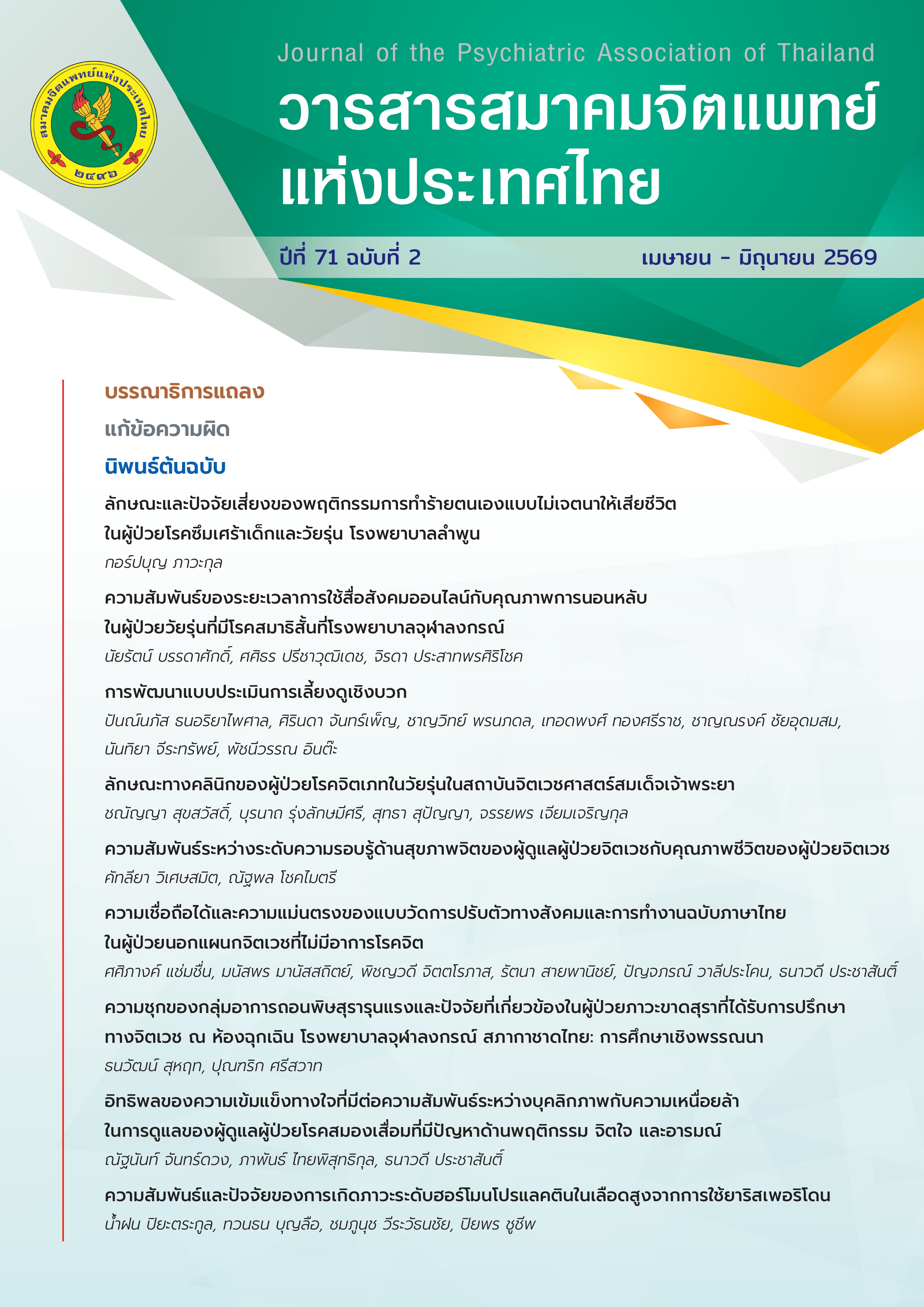
Reliability and Validity of the Thai Version of the Work and Social Adjustment Scale in Non-Psychotic Psychiatric Outpatients
Article Sidebar
Main Article Content
Abstract
Objective: To develop and evaluate the reliability, validity, and sensitivity to change of the Thai version of the Work and Social Adjustment Scale (WSAS) in non-psychotic psychiatric outpatients.
Methods: This study used secondary data derived from 159 non-psychotic psychiatric outpatients (age 18 - 65 years) who visited the psychiatric outpatient clinics at Ramathibodi Hospital and Chakri Naruebodindra Medical Institute. The participants completed the WSAS, Patient Health Questionnaire-9 (PHQ-9), Generalized Anxiety Disorder-7 (GAD-7), and World Health Organization-5 Well-Being Index (WHO-5) at their first visit to the clinics and 6 - 8 weeks later. Internal consistency was assessed using Cronbach’s alpha. Construct validity was assessed using confirmatory factor analysis (CFA). Convergent validity was examined using Spearman’s rank correlations between WSAS and measures of depression (PHQ-9), anxiety (GAD-7), and well-being (WHO-5). Sensitivity to change was evaluated by comparing the changes in WSAS scores between treatment responders, defined as those with ≥50% reduction in PHQ-9 or GAD-7 scores, and non-responders, using the Mann–Whitney U test.
Results: The mean age (standard deviation, SD) of participants was 33.9 (12.8) years. Most were female (73.0%). The WSAS demonstrated excellent internal consistency (Cronbach’s α = 0.897). CFA revealed an excellent fit for a modified one-factor model, allowing correlated errors between Items 3 (social leisure activities) and 5 (close relationship) (χ² (4) = 2.12, p = .714, CFI = 1.000, TLI = 1.010, RMSEA = 0.000 [90% CI: 0.000, 0.089], SRMR = 0.010), and large standardized factor loadings of all 5 items (range: .709 - .838, all ps < .001). The total scores of WSAS were strongly positively correlated with depressive symptoms (PHQ-9: ρ = 0.717, p < .001) and anxiety symptoms (GAD-7: ρ = 0.662, p < .001), and moderately negatively correlated with well-being (WHO-5: ρ = -0.552, p < .001). Assessing sensitivity to changes showed that treatment responders showed greater reductions in WSAS scores from baseline compared with non-responders (p < .001).
Conclusion: The WSAS is a reliable, valid, and clinically sensitive measure of functional impairment in Thai non-psychotic psychiatric outpatients. Its strong psychometric properties and responsiveness to clinical change support its use in routine outcome monitoring and evaluation of treatment-related functional recovery in Thai mental health settings.
Article Details

This work is licensed under a Creative Commons Attribution-NonCommercial-NoDerivatives 4.0 International License.
Articles submitted for consideration must not have been previously published or accepted for publication in any other journal, and must not be under review by any other journal.
References
IsHak WW, Mirocha J, Dang J, Vanle B, Metrikin B, Tessema K, et al. Quality of life and functioning impairments across psychiatric disorders in adults presenting for outpatient psychiatric evaluation and treatment. Psychiatr Res Clin Pract 2024;6:68–77.
Barnett PA, Gotlib IH. Psychosocial functioning and depression: distinguishing among antecedents, concomitants, and consequences. Psychol Bull 1988;104:97–126.
Mundt JC, Marks IM, Shear MK, Greist JH. The Work and Social Adjustment Scale: a simple measure of impairment in functioning. Br J Psychiatry 2002;180:461–4.
Thandi G, Fear NT, Chalder T. A comparison of the Work and Social Adjustment Scale across different patient populations using Rasch analysis and exploratory factor analysis. J Psychosom Res 2017;92:45–51.
De Los Reyes A, Cook C, Sullivan M, Morrell N, Wang M, Gresham FM, et al. The Work and Social Adjustment Scale for youth: psychometric properties of the teacher version and evidence of contextual variability in psychosocial impairments. Psychol Assess 2022;34(8):777–90.
Jassi A, Lenhard F, Krebs G, Gumpert M, Jolstedt M, Andrén P, et al. The Work and Social Adjustment Scale, youth and parent versions: psychometric evaluation of a brief measure of functional impairment in young people. Child Psychiatry Hum Dev 2020;51:453–66.
Cella M, Sharpe M, Chalder T. Measuring disability in patients with chronic fatigue syndrome: reliability and validity of the Work and Social Adjustment Scale. J Psychosom Res 2011;71:124–8.
Zahra D, Qureshi A, Henley W, Taylor R, Quinn C, Pooler J, et al. The Work and Social Adjustment Scale: reliability, sensitivity and value. Int J Psychiatry Clin Pract 2014;18:131–8.
Hovmand O, Reinholt N, Christensen B, Bach B, Eskildsen A, Arendt M, et al. Utility of the Work and Social Adjustment Scale in predicting long-term sick leave in Danish patients with emotional disorders. Nord J Psychiatry 2023;78:1–9.
Pedersen G, Kvarstein EH, Wilberg T. The Work and Social Adjustment Scale: psychometric properties and validity among males and females, and outpatients with and without personality disorders. Pers Ment Health 2017;11:215–28.
Lundqvist J, Lindberg M, Brattmyr M, Havnen A, Hjemdal O, Solem S. The Work and Social Adjustment Scale: an investigation of reliability, validity, and associations with clinical characteristics in psychiatric outpatients. PLoS One 2024;19(10):e0311420.
Caetano S, Marques M, De Melo A, Ferreira A, Xavier S, Queirós A, et al. Assessing functional impairment in university students: psychometric study of the Portuguese Work and Social Adjustment Scale in a help-seeking sample. Psychol Pract Res J 2024;7(1):1-9.
Echezarraga A, Calvete E, Las Hayas C. Validation of the Spanish version of the Work and Social Adjustment Scale in a clinical population with bipolar disorder. J Psychosoc Nurs Ment Health Serv 2019;57:44–51.
Vázquez Morejón A, Vázquez-Morejón R, Conde Álvarez P. Work and Social Adjustment Scale: psychometric characteristics of a Spanish adaptation in a clinical population. Behav Cogn Psychother 2021;49:764–8.
Heissel A, Bollmann J, Kangas M, Abula K, Rapp M, Sánchez A. Validation of the German version of the Work and Social Adjustment Scale in a sample of depressed patients. BMC Health Serv Res 2021;21:560.
Shih SCS, Chan ASM, Yeung EYY, Tsang JST, Wong CW, Lam LCW. Psychometric properties of the Chinese version of the Work and Social Adjustment Scale for outpatients with common mental disorders: classical test theory and Rasch analysis. East Asian Arch Psychiatry 2021;31:97–104.
Gagnier JJ, de Arruda GT, Terwee CB, Mokkink LB, Prinsen CAC, Alonso J, et al. COSMIN reporting guideline for studies on measurement properties of patient-reported outcome measures: version 2.0. Qual Life Res 2025;34(7):1901–11.
Wild D, Grove A, Martin M, Eremenco S, McElroy S, Verjee-Lorenz A, Erikson P. Principles of good practice for the translation and cultural adaptation process for patient-reported outcomes (PRO) measures: report of the ISPOR Task Force for Translation and Cultural Adaptation. Value Health 2005;8(2):94–104.
Lotrakul M, Sumrithe S, Saipanish R. Reliability and validity of the Thai version of the PHQ-9. BMC Psychiatry 2008;8(1):1-7.
Spitzer RL, Kroenke K, Williams JB, Löwe B. A brief measure for assessing generalized anxiety disorder: the GAD-7. Arch Intern Med 2006;166(10):1092-7.
Saipanish R, Lotrakul M, Sumrithe S. Reliability and validity of the Thai version of the WHO‐Five Well‐Being Index in primary care patients. Psychiatry Clin Neurosci 2009;63(2):141-6.
Sathyanarayana S, Mohanasundaram T. Fit indices in structural equation modeling and confirmatory factor analysis: reporting guidelines. Asian J Econ Bus Account 2024;24(7):561–77.
Dagnan D, Saunders R, Stott J, Thwaites R, Hatton C. Psychometric properties of the nine-item Patient Health Questionnaire, seven-item Generalized Anxiety Disorder scale, and the Work and Social Adjustment Scale with people with intellectual disabilities. J Intellect Disabil Res 2025;69:1–12.
Zimmerman M, Martinez JA, Attiullah N, Friedman M, Toba C, Boerescu DA, Rahgeb M. Why do some depressed outpatients who are in remission according to the Hamilton Depression Rating Scale not consider themselves to be in remission? J Clin Psychiatry 2012;73:790–5.
