
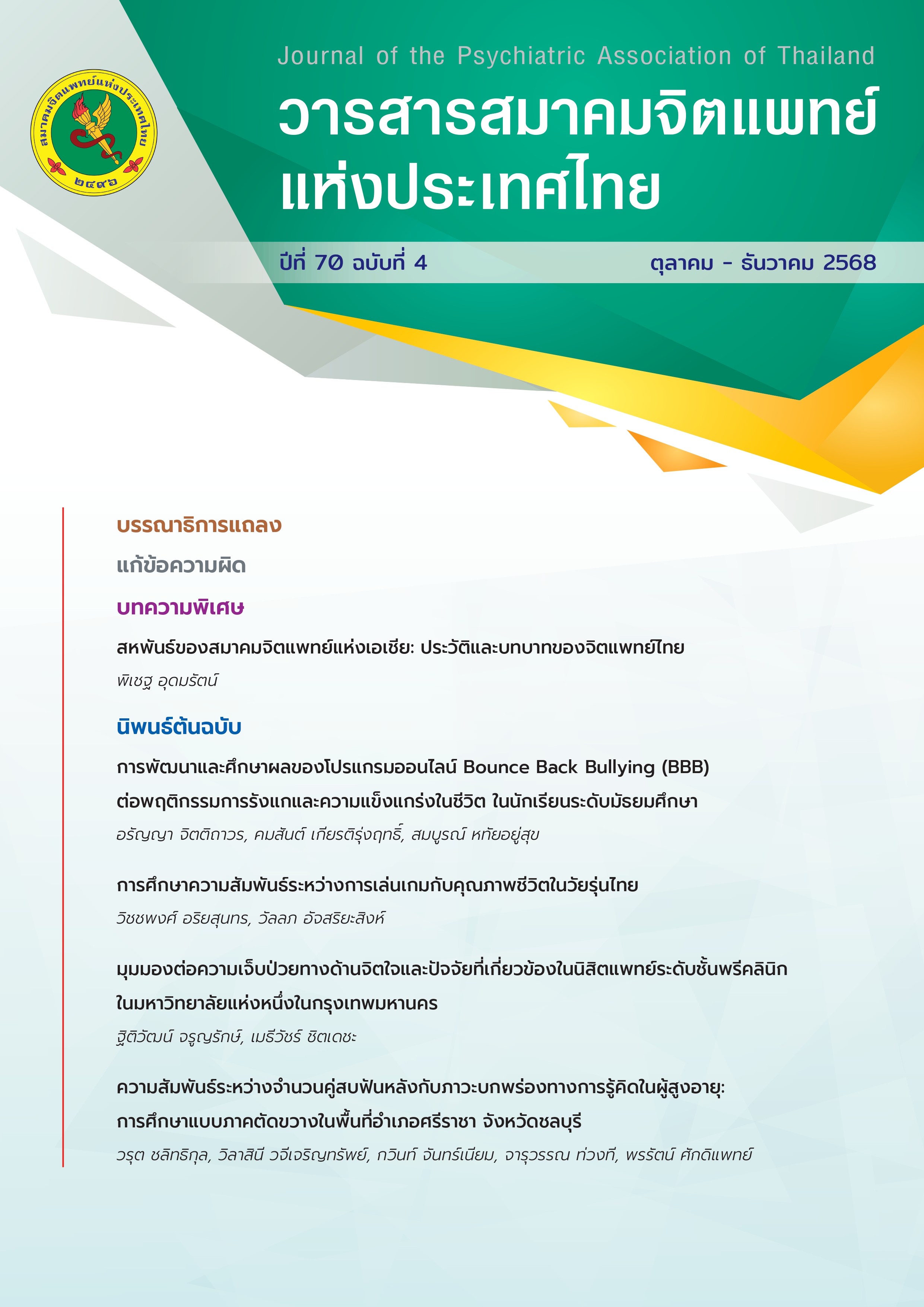
Association between the Number of Posterior Occlusal Pairs and Cognitive Impairment in Older Adults: A Cross-sectional Study in Si Racha District, Chonburi Province
Article Sidebar
Main Article Content
Abstract
Objective: This study aimed to investigate the relationship between the number of posterior occlusal pairs, and cognitive impairment among older adults in Si Racha District, Chonburi Province.
Methods: This cross-sectional analytical study was conducted among older adults (aged 60 and above) in Si Racha District, Chonburi Province, from September to October 2019. A total of 270 participants were recruited using a multi-stage sampling method. Data were collected via a general information questionnaire, cognitive screening using the Thai version of the Mini-Cog, and an oral examination by a single, calibrated dentist to record the number of functional teeth and posterior occlusal pairs. The relationship was analyzed using logistic regression.
Results: The prevalence of cognitive impairment was 65.6%. Multiple logistic regression analysis identified factors significantly associated with cognitive impairment: age (adjusted OR = 12.158, 95% CI: 2.629 - 40.732), education level (adjusted OR = 3.306, 95% CI: 1.528 - 7.152), and the number of posterior occluding pairs (adjusted OR = 1.964, 95% CI: 1.134 - 3.400).
Conclusion: This study demonstrates the association between the number of posterior occlusal pairs and cognitive impairment. These findings highlight the necessity of integrating oral health strategies, particularly the promotion of oral health to maintain functional masticatory teeth, into public health programs for dementia prevention and health promotion among older adults and middle-aged adult populations in Thailand.
Article Details

This work is licensed under a Creative Commons Attribution-NonCommercial-NoDerivatives 4.0 International License.
Articles submitted for consideration must not have been previously published or accepted for publication in any other journal, and must not be under review by any other journal.
References
Department of Older Persons. Situation of the Thai older persons 2022. Bangkok: Amarin Corporations Public Company Limited; 2023.
Bureau of Dental Health. Report of the 9th national oral health survey, Thailand 2023. Nonthaburi: Bureau of Dental Health; 2024.
Hongseethong N, Kamsa-ard S, Noisombut R, Savisit R. Association between the categories of tooth loss by Eichner’s index and impacts on oral health-related quality of life among elderly. Khon Kaen Dent J 2018; 21(1): 10-2.
Qi X, Zhu Z, Plassman BL, Wu B. Dose-response meta-analysis on tooth loss with the risk of cognitive impairment and dementia. J Am Med Dir Assoc 2021; 22(10): 2039-45.
Chuhuaicura P, Dias FJ, Arias A, Lezcano MF, Fuentes R. Mastication as a protective factor of the cognitive decline in adults: a qualitative systematic review. Int Dent J 2020; 69(5): 334-40.
Holmer J, Eriksdotter M, Schultzberg M, Pussinen PJ, Buhlin K. Association between periodontitis and risk of Alzheimer's disease, mild cognitive impairment and subjective cognitive decline: A case-control study. J Clin Periodontol 2018; 45(11): 1287-98.
Chatta S, Pitiphat W, Chaijit R. Oral health status of elderly with cognitive impairment. Khon Kaen Dent J 2021; 24(2): 61-70.
Jitapunkul S, Kunanusont C, Phoolcharoen W, Suriyawongpaisal P. Prevalence estimation of dementia among Thai elderly: a national survey. J Med Assoc Thai 2001; 84(4): 461-7.
Wongsaree C. Current situation in dementia syndrome on older person in Thailand: Issues and trends in nursing care. EAU Heritage Journal Science and Technology 2018; 12(1): 47-58.
Chonburi Provincial Public Health Office. Document for the inspection of the Ministry of Public Health, Chonburi Province, Rounds 1-61. Chonburi: Thai Arsa Service Bangsaen; 2018.
Youngyoo P, Jankham S, Muangpaisan W, Siritipakorn P, Pisansalakij D, Pengson N, et al. Problems in care of people with dementia and caregivers' needs. J Gerontol Geriatr Med 2017; 16: 57-69.
Pisalsarakij D, Siritipakorn P, Muangpaisan W. Effects of the caregivers training program on quality of life and caregiver burden of caregivers of persons with dementia. Journal of Health Sciences and Wellness 2020; 38(2): 63-72.
Suwan A, Trakulsithichoke S. Prevalence and factors associated with dementia among elderly in Lukhok subdistrict, Muang district, Pathumtani province. APHEIT Journal 2016; 5(2): 21-32.
Trongsakul S, Lambert R, Clark A, Wongpakaran N, Cross J. Development of the Thai version of Mini-Cog, a brief cognitive screening test. Geriatr Gerontol Int 2015; 15: 594-600.
Abayomi SN, Sritharan P, Yan E, Saripella A, Alhamdah Y, Englesakis M, et al. The diagnostic accuracy of the Mini-Cog screening tool for the detection of cognitive impairment-A systematic review and meta-analysis. PLoS One 2024;19(3):e0298686.
Kim H, Chey J. Effects of education, literacy, and dementia on the clock drawing test performance. J Int Neuropsychol Soc 2010; 16(6): 1138-46.
Corrada MM, Brookmeyer R, Paganini-Hill A, Berlau D, Kawas CH. Dementia incidence continues to increase with age in the oldest old: the 90+ study. Ann Neurol 2010; 67(1): 114-21.
Kramarow EA. Diagnosed dementia in adults age 65 and older: United States, 2022. National health statistics reports; no 203. Hyattsville, MD: National Center for Health Statistics; 2024.
Hwangbo S, Lee JY, Han G, Chun MY, Jang H, Seo SW, et al. Dementia incidence and population-attributable fraction for dementia risk factors in Republic of Korea: a 12-year longitudinal follow-up study of a national cohort. Front Aging Neurosci 2023; 15.
Caamaño-Isorna F, Corral M, Montes-Martínez A, Takkouche B. Education and dementia: a meta-analytic study. Neuroepidemiology 2006;26(4):226-32.
Meng X, D'Arcy C. Education and dementia in the context of the cognitive reserve hypothesis: a systematic review with meta-analyses and qualitative analyses. PLoS One 2012; 7(6): e38268.
Liu Y, Lu G, Liu L, He Y, Gong W. Cognitive reserve over the life course and risk of dementia: a systematic review and meta-analysis. Front Aging Neurosci 2024;16.
Rattanawat W, Nakawiro D, Visajan P. Prevalence of mild cognitive impairment (MCI) in pre-retirement period of hospital staff. J Psychiatr Assoc Thailand 2018; 63(1): 55-64.
Takeuchi K, Izumi M, Furuta M, Takeshita T, Shibata Y, Kageyama S, et al. Posterior teeth occlusion associated with cognitive function in nursing home older residents: a cross-sectional observational study. PLoS One 2015; 10(10): e0141737.
Winning L, Naseer A, De Looze C, Knight SP, Kenny RA, O'Connell B. Tooth loss and cognitive decline in community dwelling older Irish adults: a cross-sectional cohort study. J Dent 2022; 119: 104077.
Chen H, Iinuma M, Onozuka M, Kubo KY. Chewing maintains hippocampus-dependent cognitive function. Int J Med Sci. 2015; 12(6): 502-9.
Delwel S, Scherder EJA, Perez RSGM, Hertogh CMPM, Maier AB, Lobbezoo F. Oral function of older people with mild cognitive impairment or dementia. J Oral Rehabil 2018; 45(12): 990-7.
Loda I, D'Angelo E, Marzetti E, Kerminen H. Prevention, assessment, and management of malnutrition in older adults with early stages of cognitive disorders. Nutrients 2024; 16(11): 1566.
Wang RP, Ho YS, Leung WK, Goto T, Chang RC. Systemic inflammation linking chronic periodontitis to cognitive decline. Brain Behav Immun 2019; 81: 63-73.
Hosoi T, Morokuma M, Shibuya N, Yoneyama Y. Influence of denture treatment on brain function activity. Jpn Dent Sci Rev 2011; 47(1): 56-66.
Ahmed SE, Mohan J, Kalaignan P, Kandasamy S, Raju R, Champakesan B. Influence of dental prostheses on cognitive functioning in elderly population: a systematic review. J Family Med Prim Care 2021; 10(8): 2742-9.
Pieper NT, Grossi CM, Chan WY, Loke YK, Savva GM, Haroulis C, et al. Anticholinergic drugs and incident dementia, mild cognitive impairment and cognitive decline: a meta-analysis. Age Ageing 2020; 49(6): 939-47.
Hou JH, Sun SL, Tan CC, Huang YM, Tan L, Xu W, Relationships of hypnotics with incident dementia and Alzheimer's disease: a longitudinal study and meta-analysis. J Prev Alzheimers Dis 2024; 11(1): 117-29.
