Efficacy of Magnesium Supplementation in the Prevention of Acute Kidney Injury
Article Sidebar
Main Article Content
Abstract
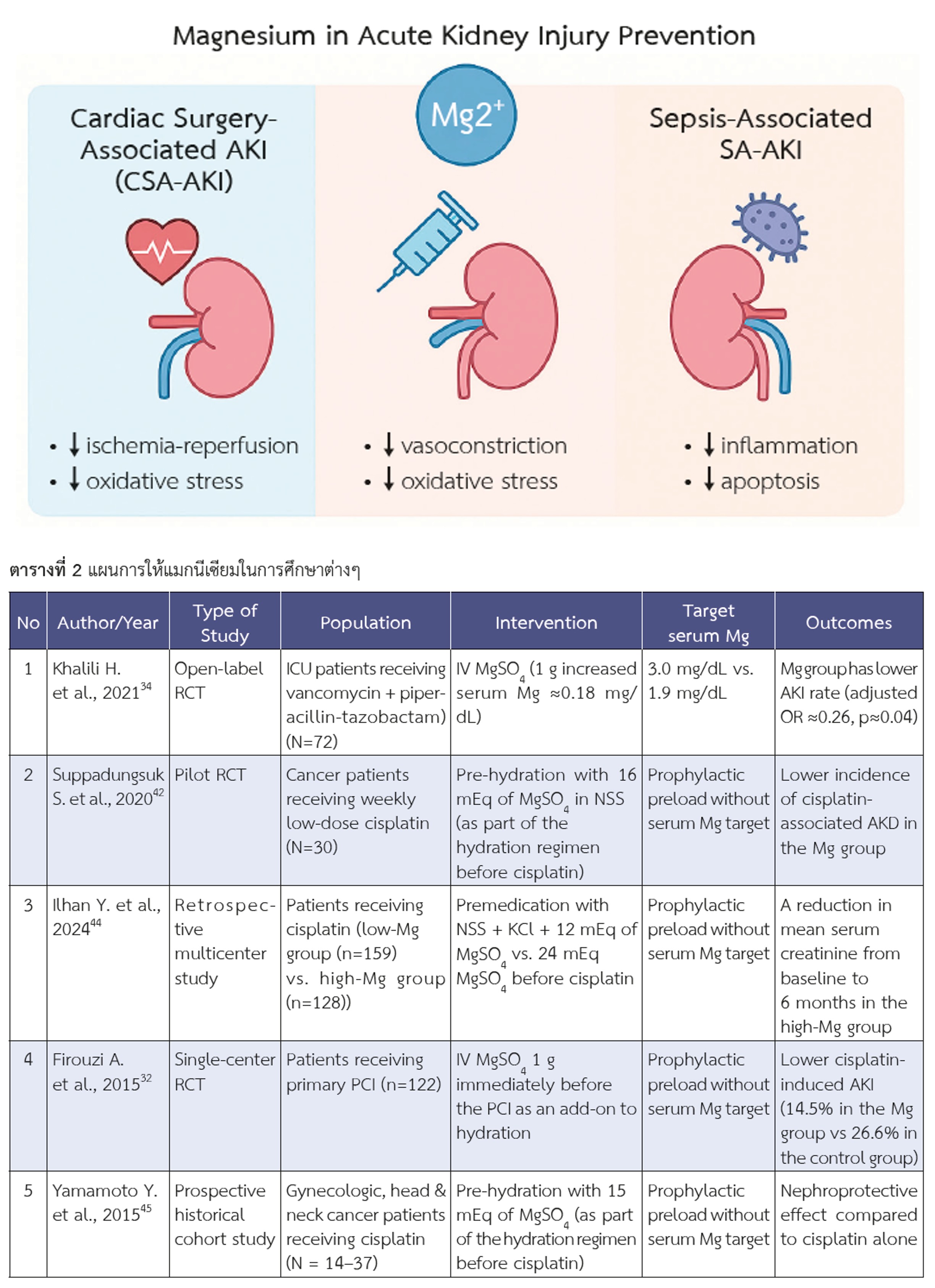
Acute kidney injury (AKI) is associated with high mortality and progression to chronic kidney disease, and increasing evidence indicates that hypomagnesemia may contribute to the risk of AKI while magnesium supplementation may provide nephroprotective effects. This review summarizes experimental and clinical data demonstrating that magnesium confers renal protection through multiple mechanisms, including improved renal blood flow, attenuation of oxidative stress and apoptosis, suppression of inflammation, and preservation of mitochondrial function. Clinical evidence suggests that magnesium supplementation reduces the incidence of AKI in patients undergoing cardiac surgery, contrast exposure, cisplatin or colistin therapy, and critically ill populations, and is also associated with lower mortality and decreased need for renal replacement therapy. Magnesium supplementation thus represents a safe, cost-effective, and promising strategy for preventing AKI, although large-scale randomized controlled trials are still warranted to confirm its long-term efficacy and safety.
Article Details

This work is licensed under a Creative Commons Attribution-NonCommercial-NoDerivatives 4.0 International License.
This article is published under CC BY-NC-ND 4.0 license, which allows for non-commercial reuse of the published paper as long as the published paper is fully attributed. Anyone can share (copy and redistribute) the material in any medium or format without having to ask permission from the author or the Nephrology Society of Thailand.
References
Kellum JA, Lameire N, Group KAGW. Diagnosis, evaluation, and management of acute kidney injury: a KDIGO summary (Part 1). Crit Care 2013;17(1):204. doi: 10.1186/cc11454.
Hoste EAJ, Kellum JA, Selby NM, Zarbock A, Palevsky PM, Bagshaw SM, et al. Global epidemiology and outcomes of acute kidney injury. Nat Rev Nephrol 2018;14(10):607–25. doi: 10.1038/s41581-018-0052-0.
Zuk A, Bonventre JV. Acute Kidney Injury. Annu Rev Med 2016;67:293–307. doi: 10.1146/annurev-med-050214-013407.
de Baaij JH, Hoenderop JG, Bindels RJ. Magnesium in man: implications for health and disease. Physiol Rev 2015;95(1):1–46. doi: 10.1152/physrev.00012.2014.
Alves SC, Tomasi CD, Constantino L, Giombelli V, Candal R, Bristot Mde L, et al. Hypomagnesemia as a risk factor for the non-recovery of the renal function in critically ill patients with acute kidney injury. Nephrol Dial Transplant 2013;28(4):910–6. doi: 10.1093/ndt/gfs268.
AlShanableh Z, Ray EC. Magnesium in hypertension: mechanisms and clinical implications. Front Physiol 2024;15:1363975. doi: 10.3389/fphys.2024.1363975.
Ho HJ, Shirakawa H. Oxidative Stress and Mitochondrial Dysfunction in Chronic Kidney Disease. Cells 2022;12(1):88. doi: 10.3390/cells12010088.
Ashique S, Kumar S, Hussain A, Mishra N, Garg A, Gowda BHJ, et al. A narrative review on the role of magnesium in immune regulation, inflammation, infectious diseases, and cancer. J Health Popul Nutr 2023;42(1):74. doi: 10.1186/s41043-023-00423-0.
Grober U, Schmidt J, Kisters K. Magnesium in Prevention and Therapy. Nutrients 2015;7(9):8199–226. doi: 10.3390/nu7095388.
Ahmed F, Mohammed A. Magnesium: The Forgotten Electrolyte-A Review on Hypomagnesemia. Med Sci (Basel) 2019;7(4). doi: 10.3390/medsci7040056.
Yamazaki D, Funato Y, Miura J, Sato S, Toyosawa S, Furutani K, et al. Basolateral Mg2+ extrusion via CNNM4 mediates transcellular Mg2+ transport across epithelia: a mouse model. PLoS Genet 2013;9(12):e1003983. doi: 10.1371/journal. pgen.1003983.
Hanna RM, Ahdoot RS, Kalantar-Zadeh K, Ghobry L, Kurtz I. Calcium Transport in the Kidney and Disease Processes. Front Endocrinol (Lausanne) 2021;12:762130. doi: 10.3389/fendo.2021.762130.
Liu M, Dudley SC, Jr. Magnesium Homeostasis and Magnesium Transporters in Human Health. Nutrients 2025;17(5):920. doi: 10.3390/nu17050920.
Marques B, Klein M, da Cunha MR, de Souza Mattos S, de Paula Nogueira L, de Paula T, et al. Effects of Oral Magnesium Supplementation on Vascular Function: A Systematic Review and Meta-analysis of Randomized Controlled Trials. High Blood Press Cardiovasc Prev 2020;27(1):19–28. doi: 10.1007/s40292-019-00355-z.
Zheltova AA, Kharitonova MV, Iezhitsa IN, Spasov AA. Magnesium deficiency and oxidative stress: an update. Biomedicine (Taipei) 2016;6(4):20. doi: 10.7603/s40681-016-0020-6.
Sakaguchi Y. The emerging role of magnesium in CKD. Clin Exp Nephrol 2022;26(5):379–84. doi: 10.1007/s10157-022-02182-4.
Floege J. Magnesium in CKD: more than a calcification inhibitor? J Nephrol 2015;28(3):269–77. doi: 10.1007/s40620-014-0140-6.
Hansen BA, Bruserud O. Hypomagnesemia in critically ill patients. J Intensive Care 2018;6:21. doi: 10.1186/s40560-018-0291-y.
Tangvoraphonkchai K, Davenport A. Magnesium and Cardiovascular Disease. Adv Chronic Kidney Dis 2018;25(3):251–60. doi: 10.1053/j.ackd.2018.02.010.
Liu M, Dudley SC, Jr. Magnesium, Oxidative Stress, Inflammation, and Cardiovascular Disease. Antioxidants (Basel) 2020;9(10). doi: 10.3390/antiox9100907.
Minaei M, Eidi A, Mortazavi P, Asghari A. Protective effect of nano magnesium oxide on renal ischemia/reperfusion injury in male Wistar rats. Magnes Res 2024;37(4):189–202. doi: 10.1684/mrh.2024.0539.
Mazur A, Maier JA, Rock E, Gueux E, Nowacki W, Rayssiguier Y. Magnesium and the inflammatory response: potential physiopathological implications. Arch Biochem Biophys 2007;458(1):48–56. doi: 10.1016/j.abb.2006.03.031.
Akan M, Ozbilgin S, Boztas N, Celik A, Ozkardesler S, Ergur BU, et al. Effect of magnesium sulfate on renal ischemia-reperfusion injury in streptozotocin-induced diabetic rats. Eur Rev Med Pharmacol Sci 2016;20(8):1642–55.
Watanabe M, Nakamura K, Kato M, Okada T, Iesaki T. Chronic magnesium deficiency causes reversible mitochondrial permeability transition pore opening and impairs hypoxia tolerance in the rat heart. J Pharmacol Sci 2022;148(2):238–47. doi: 10.1016/j.jphs.2021.12.002.
Yamanaka R, Tabata S, Shindo Y, Hotta K, Suzuki K, Soga T, et al. Mitochondrial Mg(2+) homeostasis decides cellular energy metabolism and vulnerability to stress. Sci Rep 2016;6(1):30027. doi: 10.1038/srep30027.
Wang M, Yang L, Yang J, Zhou Y, Wang C. Magnesium lithospermate B attenuates renal injury in 5/6 renal ablation/infarction rats by mitochondrial pathway of apoptosis. Biomed Pharmacother 2019;118:109316. doi: 10.1016/j.biopha.2019.109316.
Perazella MA. Drug-induced acute kidney injury: diverse mechanisms of tubular injury. Curr Opin Crit Care 2019;25(6):550–7. doi: 10.1097/MCC.0000000000000653.
Pabla N, Dong Z. Cisplatin nephrotoxicity: mechanisms and renoprotective strategies. Kidney Int 2008;73(9):994–1007. doi: 10.1038/sj.ki.5002786.
Mergenhagen KA, Borton AR. Vancomycin nephrotoxicity: a review. J Pharm Pract 2014;27(6):545–53. doi: 10.1177/0897190014546114.
Ribeiro HS, Burdmann EA, Vieira EA, Ferreira ML, Ferreira AP, Inda-Filho AJ. Association of magnesium abnormalities at intensive care unit admission with kidney outcomes and mortality: a prospective cohort study. Clin Exp Nephrol 2022;26(10):997–1004. doi: 10.1007/s10157-022-02245-6.
Koh HB, Jung CY, Kim HW, Kwon JY, Kim NH, Kim HJ, et al. Preoperative Ionized Magnesium Levels and Risk of Acute Kidney Injury After Cardiac Surgery. Am J Kidney Dis 2022;80(5):629–37 e1. doi: 10.1053/j.ajkd.2022.03.004.
Firouzi A, Maadani M, Kiani R, Shakerian F, Sanati HR, Zahedmehr A, et al. Intravenous magnesium sulfate: new method in prevention of contrast-induced nephropathy in primary percutaneous coronary intervention. Int Urol Nephrol 2015;47(3):521–5. doi: 10.1007/s11255-014-0890-z.
Gu WJ, Duan XJ, Liu XZ, Cen Y, Tao LY, Lyu J, et al. Association of magnesium sulfate use with mortality in critically ill patients with sepsis: a retrospective propensity score-matched cohort study. Br J Anaesth 2023;131(5):861–70. doi: 10.1016/j.bja.2023.08.005.
Khalili H, Rahmani H, Mohammadi M, Salehi M, Mostafavi Z. Intravenous magnesium sulfate for prevention of vancomycin plus piperacillin-tazobactam induced acute kidney injury in critically ill patients: An open-label, placebo-controlled, randomized clinical trial. Daru 2021;29(2):341–51. doi: 10.1007/s40199-021-00411-x.
Oh TK, Oh AY, Ryu JH, Koo BW, Lee YJ, Do SH. Retrospective analysis of the association between intraoperative magnesium sulfate infusion and postoperative acute kidney injury after major laparoscopic abdominal surgery. Sci Rep 2019;9(1):2833. doi: 10.1038/s41598-019-39106-4.
Liu Z, Wang R, He M, Kang Y. Hypomagnesemia Is Associated with the Acute Kidney Injury in Traumatic Brain Injury Patients: A Pilot Study. Brain Sci 2023;13(4). doi: 10.3390/brainsci13040593.
Xiong C, Shi S, Cao L, Wang H, Tian L, Jia Y, et al. Association of early postoperative serum magnesium with acute kidney injury after cardiac surgery. Ren Fail 2023;45(1):2170244. doi: 10.1080/0886022X.2023.2170244.
Shen D, Wang Y, Xu J, Li Y, Chen X, Guo M, et al. The Effect of Admission Serum Magnesium on the Acute Kidney Injury Among Patients with Malignancy. Cancer Manag Res 2020;12:7199–207. doi: 10.2147/CMAR.S262674.
Gupta S, Glezerman IG, Hirsch JS, Chewcharat A, Wells SL, Ortega JL, et al. Intravenous Magnesium and Cisplatin-Associated Acute Kidney Injury. JAMA Oncol 2025;11(6):636–43. doi: 10.1001/jamaoncol.2025.0756.
Lin B, Xiao W, Huang P, Lin X, Lin Y, Lin J, et al. Association between serum magnesium concentrations and the risk of developing acute kidney injury in patients with cirrhosis: a retrospective cohort study based on the MIMIC-IV database. Ren Fail 2024;46(2):2368088. doi: 10.1080/0886022X.2024.2368088.
Hosseini S, Alavi Darzam I, Amirdosara M, Zangi M, Sahraei Z. Evaluating the effects of intravenous magnesium sulfate for prevention of colistin induced acute kidney injury: an open-label, placebo-controlled, block randomized clinical trial. Naunyn Schmiedebergs Arch Pharmacol 2025;398(4):4559–70. doi: 10.1007/s00210-024-03583-w.
Suppadungsuk S, Phitakwatchara W, Reungwetwattana T, Pathumarak A, Phakdeekitcharoen B, Kitiyakara C, et al. Preloading magnesium attenuates cisplatin-associated nephrotoxicity: pilot randomized controlled trial (PRAGMATIC study). ESMO Open 2022;7(1):100351. doi: 10.1016/j.esmoop.2021.100351.
Yavuz YC, Cetin N, Menevse E, Cizmecioglu A, Celik E, Biyik Z, et al. Can magnesium sulfate prophylaxis reduce colistin nephrotoxicity? Nefrologia (Engl Ed) 2021;41(6):661–9. doi: 10.1016/j.nefroe.2022.01.005.
Ilhan Y, Onder AH, Ozbay MF, Karakaya G, Sezgin Goksu S, Ozturk B, et al. Protective effect of magnesium preloading on cisplatin-induced nephrotoxicity: which dose is more suitable? Eur Rev Med Pharmacol Sci 2024;28(9):3403–13. doi: 10.26355/eurrev_202405_36185.
Yamamoto Y, Watanabe K, Tsukiyama I, Matsushita H, Yabushita H, Matsuura K, et al. Nephroprotective effects of hydration with magnesium in patients with cervical cancer receiving cisplatin. Anticancer Res 2015;35(4):2199–204.
