
Kidney Health for All: Caring for People, Protecting the Planet
Article Sidebar
Main Article Content
Abstract
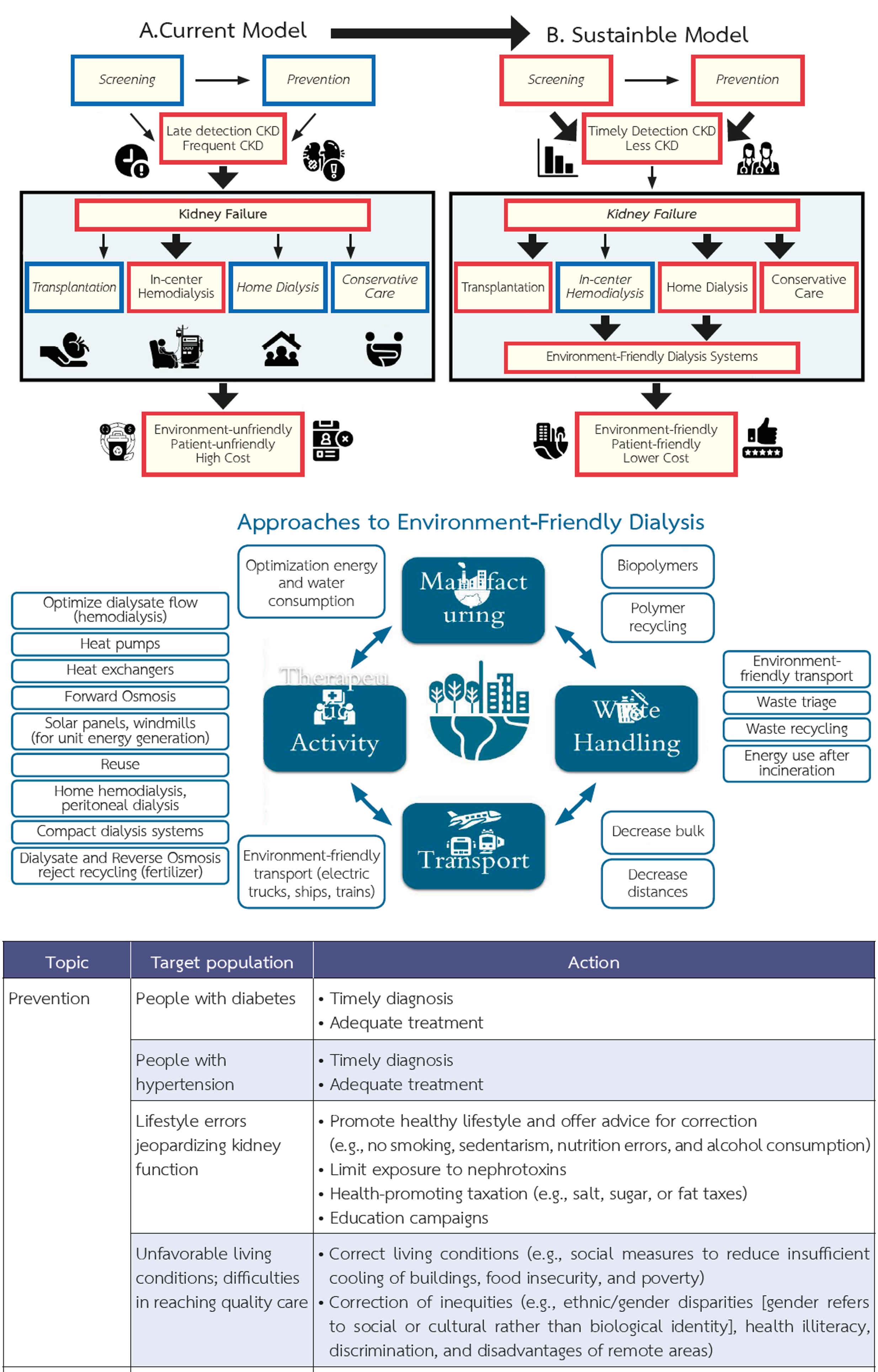
The current kidney care model - focused on late-stage disease and in-center hemodialysis - is unsustainable, because of costs, environmental burden, poor outcomes, and reduced quality of life. The 78th World Health Assembly’s recognition of kidney disease as a serious health threat presents a critical opportunity to reshape kidney care. Aligned with this, the 2026 World Kidney Day theme, “Kidney Health for All: Caring for People, Protecting the Planet”, calls for a systematic change. A sustainable model must prioritize early detection and prevention, reducing the need for kidney replacement therapy. Transplantation and home dialysis benefit people with kidney failure, the environment, and society. Dialysis itself must become more eco-friendly without compromising care quality, recognizing that planetary perturbations in turn affect kidney health. Conservative care should also be considered, particularly for elderly and frail patients, if the quality-of-life benefits outweigh the perspectives offered by dialysis. Achieving this shift requires coordinated action across all stakeholders: educating and engaging the public, policymakers, and health professionals to raise awareness of the threat of kidney disease, and an urgent move toward patient-centered care.
Article Details

This work is licensed under a Creative Commons Attribution-NonCommercial-NoDerivatives 4.0 International License.
This article is published under CC BY-NC-ND 4.0 license, which allows for non-commercial reuse of the published paper as long as the published paper is fully attributed. Anyone can share (copy and redistribute) the material in any medium or format without having to ask permission from the author or the Nephrology Society of Thailand.
References
Francis A, Harhay MN, Ong ACM, et al. Chronic kidney disease and the global public health agenda: an international consensus. Nat Rev Nephrol. 2024;20:473–85. doi: 10.1038/s41581-024-00820-6
GBD 2023 Kidney Failure with Replacment Therapy Collaborators. Global, regional, and national prevalence of kidney failure with replacement therapy and associated aetiologies, 1990-2023: a systematic analysis for the Global Burden of Disease Study 2023. Lancet Glob Health. 2025;13:e1378–e1395. doi: 10.1016/S2214-109X(25)00198-6
Vanholder R, Annemans L, Bello AK, et al. Fighting the unbearable lightness of neglecting kidney health: the decade of the kidney. Clin Kidney J. 2021;14:1719–30. doi:10.1093/ckj/sfab070
Vanholder R, Annemans L, Braks M, et al. Inequities in kidney health and kidney care. Nat Rev Nephrol. 2023;19:694–708. doi: 10.1038/s41581-023-00745-6
World Health Organization. Reducing the burden of noncommunicable diseases through promotion of kidney health and strengthening prevention and control of kidney disease. Accessed January 12, 2026. https://apps.who.int/gb/ebwha/pdf_files/EB156/B156_(20)-en.pdf.
Vanholder R, Agar J, Braks M, et al. The European Green Deal and nephrology: a call for action by the European Kidney Health Alliance. Nephrol Dial Transplant. 2023;38:1080–88. doi: 10.1093/ndt/gfac160
Vanholder R, Coppo R, Bos WJW, et al. A policy call to address rare kidney disease in health care plans. Clin J Am Soc Nephrol. 2023;18:1510–18. doi: 10.2215/cjn.0000000000000220
Gregg EW. Diabetes-related disability as a target for prevention. Lancet Diabetes Endocrinol. 2013;1:81–2. doi: 10.1016/s2213-8587(13)70054-8
Vanholder R, Annemans L, Brown E, et al. Reducing the costs of chronic kidney disease while delivering quality health care: a call to action. Nat Rev Nephrol. 2017;13:393–409. doi: 10.1038/nrneph.2017.63
World Kidney Day. 8 golden rules animated visuals. Accessed January 12, 2026. https://www.worldkidneyday.org/facts/8-golden-rules/
Norton JM, Moxey-Mims MM, Eggers PW, et al. Social determinants of racial disparities in CKD. J Am Soc Nephrol. 2016;27:2576–95. doi: 10.1681/asn.2016010027
Ferro CJ, Wanner C, Luyckx V, et al. ABCDE to identify and prevent chronic kidney disease: a call to action. Nephrol Dial Transplant. 2025;40:1786–98. doi: 10.1093/ndt/gfaf057
Heerspink HJ, Desai M, Jardine M, et al. Canagliflozin slows progression of renal function decline independently of glycemic effects. J Am Soc Nephrol. 2017;28:368–75. doi: 10.1681/asn.2016030278
Cordero L, Ortiz A. Albuminuria-based universal screening for CKD should be implemented now in high-income countries. Kidney Int. 2025;108:754–9. doi: 10.1016/j.kint.2025.04.037
Stehle T, Delanaye P. Which is the best glomerular filtration marker: creatinine, cystatin C or both? Eur J Clin Invest. 2024;54:e14278. doi: 10.1111/eci.14278
van Mil D, Kieneker LM, Evers-Roeten B, et al. Participation rate and yield of two home-based screening methods to detect increased albuminuria in the general population in the Netherlands (THOMAS): a prospective, randomised, open-label implementation study. Lancet. 2023;402:1052–64. doi: 10.1016/s0140-6736(23)00876-0
Tangri N, Alvarez CS, Arnold M, et al. Suboptimal monitoring and management in patients with unrecorded stage 3 chronic kidney disease in real-world settings: insights from REVEAL-CKD. Eur J Clin Invest. 2024;54:e14282. doi: 10.1111/eci.14282
Pouwels X, van Mil D, Kieneker LM, et al. Cost-effectiveness of home-based screening of the general population for albuminuria to prevent progression of cardiovascular and kidney disease. EClinicalMedicine. 2024;68:102414. doi: 10.1016/j.eclinm.2023.102414
Chavarina KK, Lou-Meda R, Luyckx VA. Strategic rebalancing of kidney-related investments is key to implementing the WHO kidney health resolution. Nat Rev Nephrol. 2025;21:813–4. doi: 10.1038/s41581-025-01017-1
Kidney Disease Screening and Awareness Program. Together we fight kidney disease. Accessed January 12, 2026. www.kdsap.org.
Afkarian M, Sachs MC, Kestenbaum B, et al. Kidney disease and increased mortality risk in type 2 diabetes. J Am Soc Nephrol. 2013;24:302–8. doi: 10.1681/asn.2012070718
Wan EYF, Yu EYT, Chin WY, et al. Burden of CKD and cardiovascular disease on life expectancy and health service utilization: a cohort study of Hong Kong Chinese hypertensive patients. J Am Soc Nephrol. 2019;30:1991–9. doi: 10.1681/asn.2018101037
Luyckx VA, Ulasi II. Kidney disease must be counted everywhere. Lancet. 2025;406:2401–2403. doi: 10.1016/s0140-6736(25)01941-5
Kidney Disease: Improving Global Outcomes (KDIGO) CKD Work Group. KDIGO 2024 Clinical Practice Guideline for the Evaluation and Management of Chronic Kidney Disease. Kidney Int. 2024;105(4S):S117–S314. doi: 10.22141/2307-1257.13.2.2024.456
Rama Krishna C, Venkateswar S, Bogdan M, et al. Pointof-care testing and integrated digital health technology for CKD screening in high-risk populations of India. Kidney Int Rep. 2025;10:2128–39.doi: 10.1016/j.ekir.2025.04.014
Guedes M, Dias PT, Rea RR, et al. Patterns of kidney function and risk assessment in a nationwide laboratory database: the Brazilian CHECK-CKD study. BMC Nephrol. 2024;25:191. doi: 10.1186/s12882-024-03588-w
Hajat S, Casula A, Murage P, et al. Ambient heat and acute kidney injury: case-crossover analysis of 1 354 675 automated e-alert episodes linked to high-resolution climate data. Lancet Planet Health. 2024;8:e156–e162. doi: 10.1016/s2542-5196(24)00008-1
Maline GE, Goldfarb DS. Climate change and kidney stones. Curr Opin Nephrol Hypertension. 2024;33:89–96. doi: 10.1097/mnh.0000000000000931
Gopalakrishnan N, Sudharshini S, Sakthirajan R, et al. CKDu-AGRI study-a population-based cross-sectional study of chronic kidney disease and chronic kidney disease of unknown aetiology among agricultural workers in Tamil Nadu, India. Lancet Reg Health Southeast Asia. 2025;42:100683. doi: 10.1016/j.lansea.2025.100683
Garcia-Trabanino RA. The human burden of Mesoamerican nephropathy: diagnosis and treatment in a complex web of socioeconomics, context, and stigma. Semin Nephrol. 2025;45:151601. doi: 10.1016/j.semnephrol.2025.151601
Chretien JP, Anyamba A, Small J, et al. Global climate anomalies and potential infectious disease risks: 2014-2015. PLoS Curr. 2015;7:ecurrents.outbreaks.95fbc4a8fb4695e049b aabfc2fc8289f. doi: 10.1371/currents.outbreaks.95fbc4a8fb4695e049baabfc2fc8289f
Bowe B, Artimovich E, Xie Y, et al. The global and national burden of chronic kidney disease attributable to ambient fine particulate matter air pollution: a modelling study. BMJ Glob Health. 2020;5:e002063. doi: 10.1136/bmjgh-2019-002063
World Meteorological Organization, World Health Organization. Alliance for Transformative Action on Climate and Health (ATACH) meeting on accessing climate finance for health. Accessed January 12, 2026. https://climahealth.info/alliancefor-transformative-action-on-climate-and-health-atachmeeting-on-accessing-climate-finance-for-health/.
Talbot B, Fletcher RA, Neal B, et al. The potential for reducing greenhouse gas emissions through disease prevention: a secondary analysis of data from the CREDENCE trial. Lancet Planet Health. 2024;8:e1055–e1064. doi: 10.1016/s2542-5196(24)00281-x
Evaluation of the Effects of Canagliflozin on Renal and Cardiovascular Outcomes in Participants With Diabetic Nephropathy (CREDENCE). ClinicalTrials.gov identifier: NCT02065791. Updated December 5, 2019. https://clinicaltrials.gov/study/NCT02065791
Vanholder R, Dominguez-Gil B, Busic M, et al. Organ donation and transplantation: a multi-stakeholder call to action. Nat Rev Nephrol. 2021;17:554–568. doi: 10.1038/s41581-021-00425-3
Tonelli M, Wiebe N, Knoll G, et al. Systematic review: kidney transplantation compared with dialysis in clinically relevant outcomes. Am J Transplant. 2011;11:2093–9. doi: 10.1111/j.1600-6143.2011.03686.x
Schaapherder A, Wijermars LGM, de Vries DK, et al. Equivalent long-term transplantation outcomes for kidneys donated after brain death and cardiac death: conclusions from a nationwide evaluation. EClinicalMedicine. 2018;4-5:25–31. doi: 10.1016/j.eclinm.2018.09.007
Azegami T, Kounoue N, Sofue T, et al. Efficacy of pre-emptive kidney transplantation for adults with end-stage kidney disease: a systematic review and meta-analysis. Renal Fail. 2023;45:2169618. doi: 10.1080/0886022x.2023.2169618
Achkar KA, Abdelnour LM, Abu Jawdeh BG, et al. Evaluation and long-term follow-up of living kidney donors. Adv Kidney Dis Health. 2024;31:400–7. doi: 10.1053/j.akdh.2024.04.003
Barraclough KA, Agar JWM. Green nephrology. Nat Rev Nephrol. 2020;16:257–68. doi: 10.1038/s41581-019-0245-1
Lenzen M, Malik A, Li M, et al. The environmental footprint of health care: a global assessment. Lancet Planet Health. 2020;4:e271–e279. doi: 10.1016/s2542-5196(20)30121-2
Connor A, Lillywhite R, Cooke MW. The carbon footprint of a renal service in the United Kingdom. QJM. 2010;103:965–75. doi: 10.1093/qjmed/hcq150
Piccoli GB, Nazha M, Ferraresi M, et al. Eco-dialysis: the financial and ecological costs of dialysis waste products: is a “cradle-to-cradle” model feasible for planet-friendly haemodialysis waste management? Nephrol Dial Transplant. 2015;30:1018–27. doi: 10.1093/ndt/gfv031
Tarrass F, Benjelloun M, Benjelloun O. Recycling wastewater after hemodialysis: an environmental analysis for alternative water sources in arid regions. Am J Kidney Dis. 2008;52:154–8. doi: 10.1053/j.ajkd.2008.03.022
McAlister S, Talbot B, Knight J, et al. The carbon footprint of peritoneal dialysis in Australia. J Am Soc Nephrol. 2024;35:1095–1103. doi: 10.1681/asn.0000000000000361
Barraclough KA, Talbot B, Knight J, et al. Carbon emissions from different dialysis modalities: a life cycle assessment. Am J Kidney Dis. 2025;86:465–74.e1. doi: 10.1053/j.ajkd.2025.04.019
Solomon D, Arumugam V, Sakthirajan R, et al. A pilot study on the safety and adequacy of a novel ecofriendly hemodialysis prescription-green nephrology. Kidney Int Rep. 2024;9:1496–1503. doi: 10.1016/j.ekir.2024.02.014
Ramada DL, de Vries J, Vollenbroek J, et al. Portable, wearable and implantable artificial kidney systems: needs, opportunities and challenges. Nat Rev Nephrol. 2023;19:481–90. doi: 10.1038/s41581-023-00726-9
Lunney M, Bello AK, Levin A, et al. Availability, accessibility, and quality of conservative kidney management worldwide. Clin J Am Soc Nephrol. 2020;16:79–87. doi: 10.2215/cjn.09070620
Kurella Tamura M, Covinsky KE, Chertow GM, et al. Functional status of elderly adults before and after initiation of dialysis. N Engl J Med. 2009;361:1539–47. doi: 10.1056/nejmoa0904655
Morton RL, Snelling P, Webster AC, et al. Factors influencing patient choice of dialysis versus conservative care to treat end-stage kidney disease. CMAJ. 2012;184:E277–E283. doi: 10.1503/cmaj.111355
Stel VS, de Jong RW, Kramer A, et al. Supplemented ERA-EDTA Registry data evaluated the frequency of dialysis, kidney transplantation, and comprehensive conservative management for patients with kidney failure in Europe. Kidney Int. 2021;100:182–95. doi: 10.1016/j.kint.2020.12.010
de Jong RW, Stel VS, Rahmel A, et al. Patient-reported factors influencing the choice of their kidney replacement treatment modality. Nephrol Dial Transplant. 2022;37:477–88. doi: 10.1093/ndt/gfab059
Joosten EA, DeFuentes-Merillas L, de Weert GH, et al. Systematic review of the effects of shared decision-making on patient satisfaction, treatment adherence and health status. Psychother Psychosom. 2008;77:219–26. doi: 10.1159/000126073
European Patients Academy on Therapeutic Innovation (EUPATI). Education that empowers. Accessed January 12, 2026. https://eupati.eu/
Sever MS, Luyckx V, Tonelli M, et al. Disasters and kidney care: pitfalls and solutions. Nat Rev Nephrol. 2023;19:672–86. doi: 10.1038/s41581-023-00743-8
Pawlowicz-Szlarska E, Vanholder R, Sever MS, et al. Distribution, preparedness and management of Ukrainian adult refugees on dialysis-an international survey by the Renal Disaster Relief Task Force of the European Renal Association. Nephrol Dial Transplant. 2023;38:2407–15. doi: 10.1093/ndt/gfad073
