
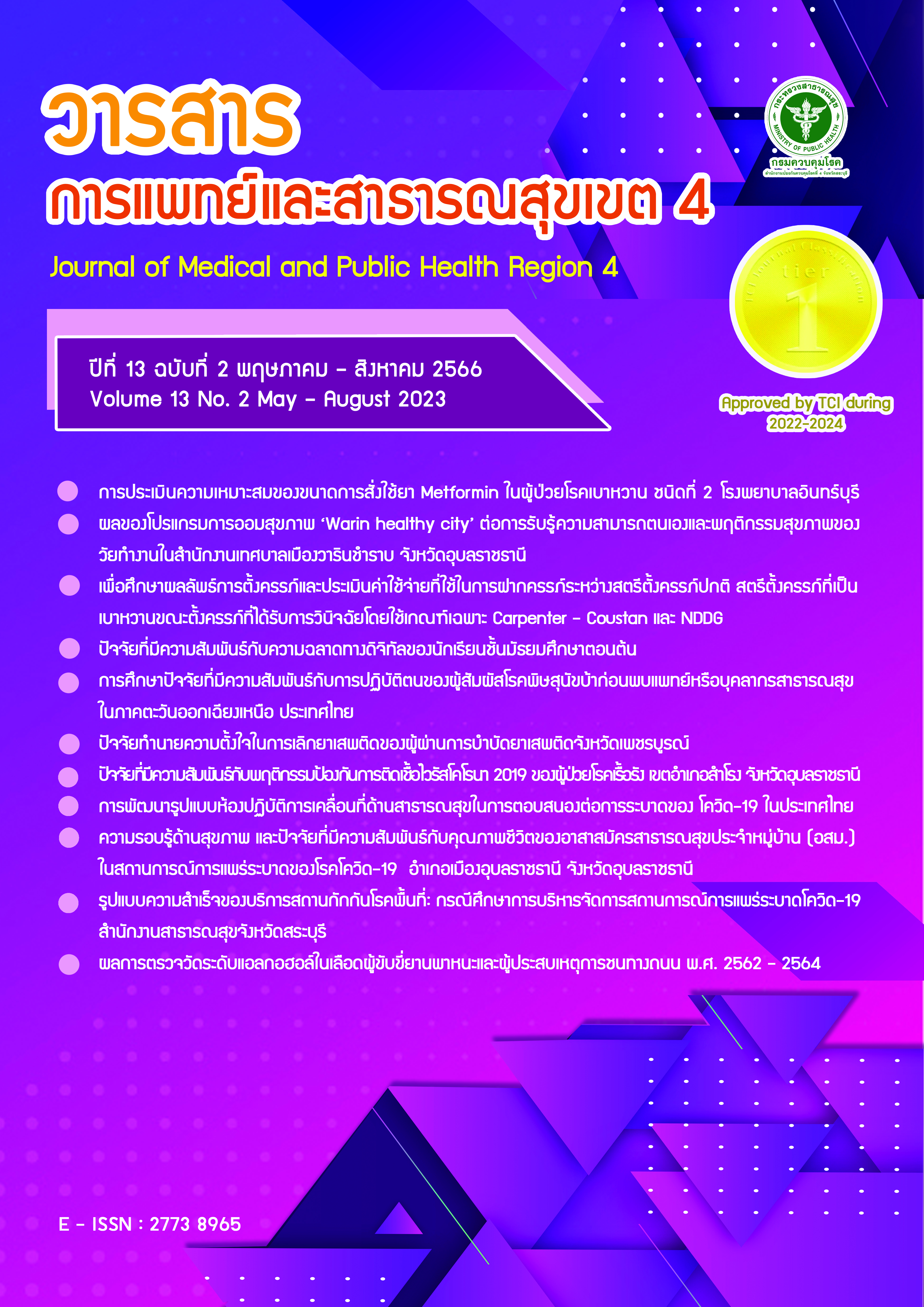
รูปแบบความสำเร็จของบริการสถานกักกันโรคพื้นที่: กรณีศึกษาการบริหารจัดการสถานการณ์การแพร่ระบาดโควิด-19 สำนักงานสาธารณสุขจังหวัดสระบุรี
Article Sidebar
Main Article Content
บทคัดย่อ
การศึกษาเชิงคุณภาพนี้มีวัตถุประสงค์เพื่อศึกษารูปแบบความสำเร็จของการบริการสถานกักกันโรคพื้นที่ ของจังหวัดสระบุรี คัดเลือกกลุ่มตัวอย่างแบบเจาะจง เก็บรวบรวมข้อมูลจากการสนทนากลุ่มของผู้ประกอบการโรงแรม 12 คน ผู้ให้บริการสุขภาพ 13 คน ผู้มีหน้าที่และอำนาจตามกฎหมาย 8 คน สัมภาษณ์เชิงลึกผู้บริหาร 3 คน และรายงานเอกสารที่เกี่ยวข้อง วิเคราะห์ข้อมูลด้วยการวิเคราะห์เนื้อหา (Content analysis) ข้อค้นพบที่ได้จากการศึกษา คือ 1) กระบวนการจัดตั้งสถานกักกันโรคที่ทางราชการกำหนด 2) แนวคิดที่ใช้ในการให้บริการ 3) ผลดีที่ได้จากการมีสถานกักกัน คือ ตัดวงจรการแพร่ระบาด ผู้ประกอบการมีความรู้สึกภูมิใจ ดีใจ มีความสุขที่ได้มีส่วนร่วม องค์การบริหารส่วนจังหวัดสระบุรีเป็นต้นแบบที่ดีของการสนับสนุนงบประมาณที่มากเพียงพอ ประชาชนมีความรู้เกี่ยวกับการป้องกันการแพร่ระบาดของโรค และ 4) ข้อเสนอแนะ คือ หากมีการระบาดซ้ำควรจัดทำระบบการปฐมนิเทศเจ้าหน้าที่ใหม่ที่เข้าปฏิบัติงาน การป้องกันการหลบหนี การจัดหางานให้ผู้ที่ได้รับการกักตัว การวิเคราะห์ต้นทุนค่าใช้จ่าย และการจัดการขยะตกค้าง สรุปรูปแบบความสำเร็จของการให้บริการสถานกักกันโรคซึ่งทางราชการกำหนดเกิดจากการมีส่วนร่วมของทุกภาคีเครือข่ายทางสังคม
Article Details

อนุญาตภายใต้เงื่อนไข Creative Commons Attribution-NonCommercial-NoDerivatives 4.0 International License.
เอกสารอ้างอิง
World Health Organization. WHO Coronavirus (COVID-19) Dashboard [Internet]. 2022 [cited 2022 Mar 23]; Available from: https://covid19.who.int/?mapFilter=vaccinations.
Ministry of Public Health, Department of Disease Control. Guideline for disease control in Quarantine Version 3.0 (2020). Bangkok The Printing Office Agency to assist veterans in Royal Shu patham; 2020. (in Thai)
Taghrir, M. H., Akbarialiabad, H., & Marzaleh, M. A. Efficacy of mass quarantine as leverage of health system governance during COVID-19 outbreak: a mini policy review. Archives of Iranian medicine.2020;23:265.
Patel A, Patel S, Fulzele P, Mohod S, Chhabra KG. Quarantine an effective mode for control of the spread of COVID19? A review. J Family Med Prim Care 2020;9(8):3867-71. DOI: 10.4103/jfmpc.jfmpc_785_20
Wongputh P, Udplong A, Apidechkul T. COVID-19 State Quarantine Operation at a Local Setting: Implementation Evaluation. J Health Sci Altern Med 2021; 3:16-22. DOI: 10.14456/jhsam.2021.4
World Health Organization. Monitoring the building blocks of health systems: a handbook of indicators and their measurement strategies; 2020 [cited 2022 Dec 20]. Available from: https://apps.who.int/iris/bitstream/handle/10665/258734/9789241564052-eng.pdf
Nicola, M., Sohrabi, C., Mathew, G., Kerwan, A., Al-Jabir, A., Griffin, M, et al. Health policy and leadership models during the COVID-19 pandemic: A review. International journal of surgery.2020;81:122-9.
Prinja S. Role of ideas and ideologies in evidence-based health policy. Iran J Public Health 2010;39:64-9.
Negro-Calduch, E., Azzopardi-Muscat, N., Nitzan, D., Pebody, R., Jorgensen, P., & Novillo-Ortiz, D. Health Information Systems in the COVID-19 Pandemic: A Short Survey of Experiences and Lessons Learned From the European Region. Frontiers in public health, 9. 2021.
Meeprasert A. Lessons learned from the success of health network for community drug safety surveillance in Singburi Province. Journal of Medical and Public Health Region 4 2019; 10:43-55.
Royal Gazette. The National Economic and Social Development Plan. [Internet]. 2022 [cited 2023 Mar 23]; Available from: https://www.nesdc.go.th/ewt_dl_link.php?nid=13150.
