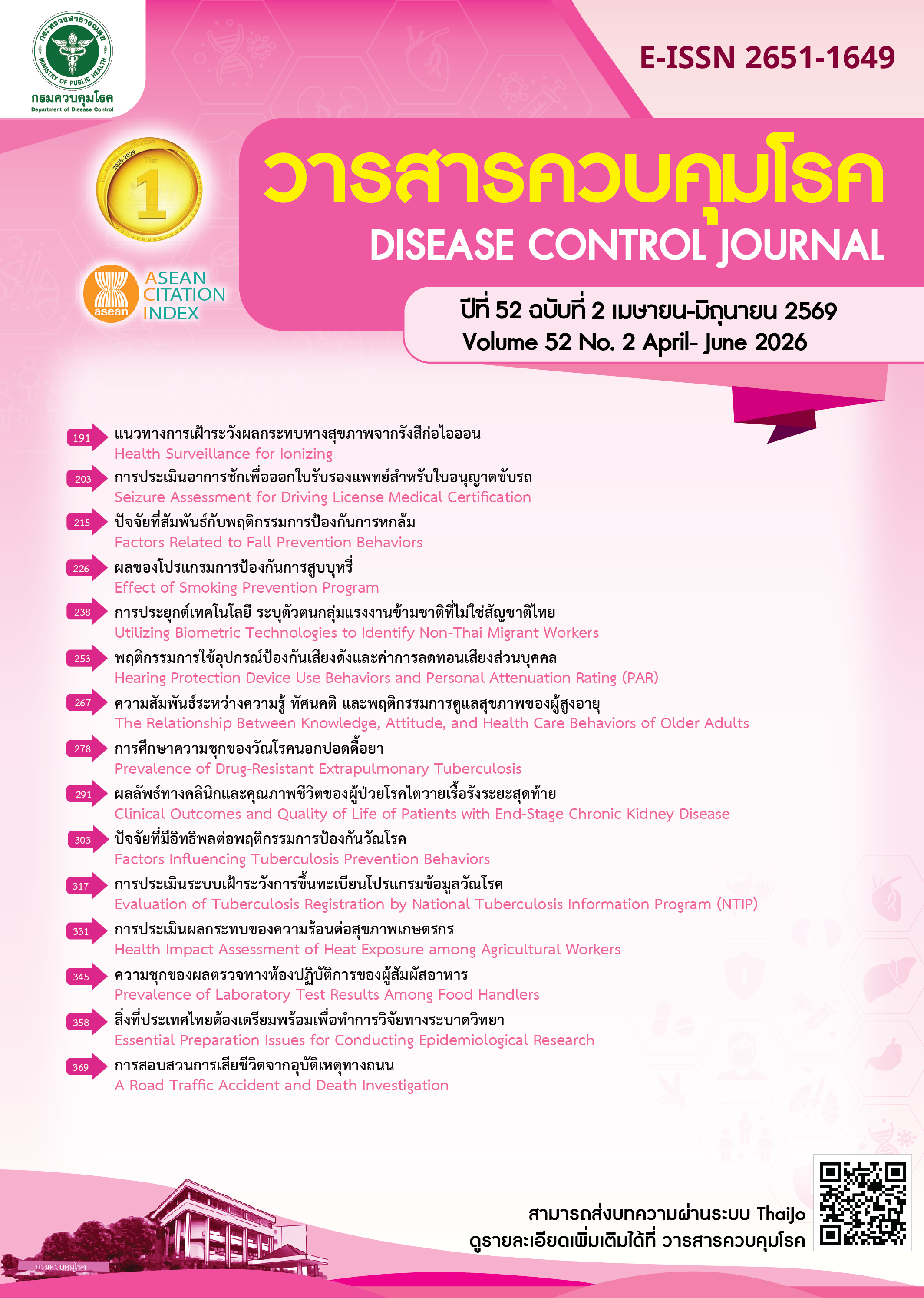
สิ่งที่ประเทศไทยต้องเตรียมพร้อมเพื่อทำการวิจัยทางระบาดวิทยาของโรคติดต่อไม่ทราบสาเหตุในสถานการณ์การระบาด
DOI:
https://doi.org/10.14456/dcj.2026.29คำสำคัญ:
โรคติดต่อไม่ทราบสาเหตุ, disease X, โครงร่างวิจัย, ภาวะฉุกเฉิน, ระบาดวิทยาบทคัดย่อ
ประชาคมโลกได้เผชิญกับการระบาดของโรคติดต่ออุบัติใหม่มาหลายครั้ง โดยพบว่าแนวโน้มของการระบาดมีความถี่เพิ่มขึ้นนับตั้งแต่ปี 1997 องค์การอนามัยโลกได้ชี้ให้เห็นความจำเป็นพร้อมทั้งให้ข้อเสนอแนะให้การเตรียมพร้อมรองรับโรคติดต่อไม่ทราบสาเหตุ หรือ Disease X ซึ่งถือได้ว่าคือระยะแรกของการพบโรคติดต่ออุบัติใหม่ บทเรียนสำคัญอันหนึ่งของประเทศไทยในการตอบสนองต่อการระบาดของโรคติดต่ออุบัติใหม่ คือ การสร้างองค์ความรู้เพื่อใช้ในการตัดสินใจเชิงนโยบายในระยะต้นของการระบาดไม่สามารถดำเนินการได้ทันเวลา ชุดความรู้ทางด้านระบาดวิทยาที่ได้จากการสอบสวนการระบาดมักจะตอบคำถามได้ไม่ชัดเจนและครอบคลุม การใช้กระบวนการวิจัยที่มีการจัดเตรียมโครงร่างการดำเนินงานที่เป็นระบบน่าจะทำให้ได้องค์ความรู้ที่จัดการข้อจำกัดของการดำเนินงานได้มากขึ้น โครงการ “การจัดทำโครงร่างวิจัยและเครือข่ายนักวิจัยเพื่อศึกษาลักษณะทางระบาดวิทยาของผู้ป่วยโรคติดต่ออุบัติใหม่ 100 รายแรกของประเทศไทย (Disease X project)” ได้ถูกจัดทำขึ้นโดยมีเป้าหมายให้เกิดเครือข่ายการวิจัยและโครงร่างการวิจัยที่พร้อมใช้ดำเนินการเมื่อพบ Disease X การดำเนินโครงการใช้เวลา 18 เดือน กิจกรรมประกอบด้วย การทบทวนวรรณกรรม การจัดประชุมกำหนดประเด็นขอบเขตโรคที่สำคัญ การประชุมเชิงปฏิบัติการกับผู้เชี่ยวชาญและผู้เกี่ยวข้องเพื่อจัดทำโครงร่างการวิจัย ผลการดำเนินการพบว่า กลุ่มโรคที่ควรให้ความสำคัญในการเตรียมพร้อมรับการระบาด มี 4 กลุ่ม ได้แก่ โรคติดต่อทางอาหารและน้ำ โรคติดต่อทางเดินหายใจ โรคติดเชื้อในระบบประสาทส่วนกลาง และโรคติดเชื้อที่ก่อให้เกิดภาวะเลือดออกผิดปกติ โดยรูปแบบการดำเนินงานสามารถใช้การยกระดับคุณภาพการเฝ้าระวังและสอบสวนทางระบาดวิทยา หรือใช้การวิจัย แต่ทั้งสองวิธีการยังมีสิ่งที่ต้องจัดเตรียมเพิ่มเติมหากต้องการดำเนินการให้ได้ตามวัตถุประสงค์และมาตรฐานสากล การสอบสวนทางระบาดวิทยาขาดการควบคุมกำกับเรื่องจริยธรรมและการเคารพสิทธิบุคคลที่ชัดเจน ส่วนการพิจารณาของคณะกรรมการจริยธรรมการวิจัยในคนของแต่ละสถาบันมีความแตกต่างกัน กระบวนการพิจารณาและกำกับทางด้านจริยธรรมการวิจัยในสถานการณ์ระบาดควรได้มีการออกแบบและทดลองดำเนินการอย่างจริงจัง ประเด็นที่ท้าทายที่สุดในการดำเนินการคือการส่งต่อองค์ความรู้ บทเรียนการดำเนินงาน และแนวทางปฏิบัติขององค์กรหน่วยงานจากรุ่นสู่รุ่น เนื่องจากวงรอบการพบโรคติดต่ออุบัติใหม่มักจะเกิดขึ้นราว 10-20 ปี เมื่อการระบาดผ่านไปความรู้แนวทางการดำเนินงานมักจะเลือนหายหรือเปลี่ยนแปลงไป จนไม่สามารถตอบสนองเหตุการณ์โดยยึดหลักวิชาการและหลักฐานเชิงประจักษ์ สิ่งที่ประเทศไทยควรดำเนินการเพื่อให้พร้อมตอบสนองโรคติดตเชื้อที่ไม่ทราบสาเหตุ จึงประกอบด้วย การสนับสนุนให้เครือข่ายการวิจัยโรคติดต่ออุบัติใหม่ให้มีกิจกรรมร่วมกันอย่างเข้มแข็งและต่อเนื่อง การทบทวนและออกแบบการกำกับจริยธรรมการวิจัยให้เอื้อต่อการดำเนินงานในสถานการณ์เร่งด่วน การยกระดับการเฝ้าระวังและสอบสวนโรคให้มีคุณภาพมากขึ้น ลดข้อจำกัดหรือ limitation ของการสอบสวน เพื่อให้สามารถสร้างองค์ความรู้ที่ชัดเจนได้ทันเวลา
Downloads
เอกสารอ้างอิง
Wilder-Smith A, Osman S. Public health emergencies of international concern: a historic overview. J. Travel Med. 2020;27(8):taaa227. doi: 10.1093/jtm/taaa227
Xing W, Hejblum G, Leung GM, Valleron AJ. Anatomy of the epidemiological literature on the 2003 SARS outbreaks in Hong Kong and Toronto: a time-stratified review. PLoS Med 2010;7(5):e1000272. doi: 10.1371/journal.pmed.1000272
CEPI 2.0 and the 100 days mission. Coalition for Epidemic Preparedness Innovation [Internet]. Washington; 2021 [cited 2025 Dec 15]. Available from: https://static.cepi.net/downloads/2023-12/CEPI-2022-2026-Strategy-v3-Jan21_0.pdf
Songsiriwilai S. Lesson learned from Covid-19 Health is the new nation wealth [Internet]. 2021 [cited 2025 Dec 15]. Available from: https://www.stkc.go.th/sites/default/files/flip_ebook/catalogs/640727_20/pdf/save/bk_1.pdf
World Health Organization. 2018 annual review of diseases prioritized under the Research and Development Blueprint [Internet]. Geneva; 2018. [cited 2025 Dec 15]. Available from: https://www.who.int/news-room/events/detail/2018/02/06/default-calendar/2018-annual-review-of-diseases-prioritized-under-the-research-anddevelopment-blueprint
Mehand MS, Al-Shorbaji F, Millett P, Murgue B. The WHO R&D Blueprint: 2018 review of emerging infectious diseases requiring urgent research and development efforts. Antiviral Res. 2018;159;63-7. doi: 10.1016/j.antiviral.2018.09.009
World Health Organization. Pathogens prioritization a scientific framework for epidemic and pandemic research preparedness [Internet]. Geneva; 2024 Jun [cited 2024 Sep 15]. Available from: https://www.who.int/publications/m/item/pathogens-prioritization-a-scientific-framework-for-epidemic-and-pandemic-research-preparedness
World Health Organization. International health regulations (2005). 3rd ed. Geneva: WHO Press; 2016.
World Health Organization. Pandemic influenza preparedness framework partnership contribution high-Level implementation plan III 2024-2030. Geneva; 2023.
World Health Organization. An R&D blueprint for action to prevent epidemics [Internet]. Geneva: WHO Press; 2016 [cited 2024 Oct 6]. Available from: https://cdn.who.int/media/docs/default-source/blue-print/an-randd-blueprint-for-action-to-prevent-epidemics.pdf
World Health Organization. Pandemic influenza risk management [Internet]. Geneva; 2017 [cited 2024 Oct 6]. Available from: https://iris.who.int/server/api/core/bitstreams/21170012-dcb2-4283-af0d-5c1eb5edff32/content
World Health Organization. Pathogens prioritization: a scientific framework for epidemic and pandemic research preparedness [Internet]. Geneva; 2024 Jul [cited 2025 Dec 6]. Available from: https://www.who.int/publications/m/item/pathogens-prioritization-a-scientific-framework-for-epidemic-and-pandemic-research-preparedness
WHO Headquarters (HQ) WW. 2019 novel coronavirus (2019-nCoV): strategic preparedness and response plan [Internet]. World Health Organization, editor. Geneva; 2020 [cited 2024 Oct 6]. Available from: https://www.who.int/publications/i/item/strategic-preparedness-and-response-plan-for-the-new-coronavirus
World Health Organization. Preparedness and resilience for emerging threats [Internet]. Geneva; 2023 [cited 2024 Oct 6]. Available from: https://www.who.int/initiatives/preparedness-and-resilience-for-emerging-threats
Bergeri I, Boddington NL, Lewis HC, Subissi L, von Dobschuetz S, Rodriguez A, et al. WHO’s Investigations and Studies, Unity Studies: A global initiative creating equitable opportunities for enhanced surveillance, operational research, capacity building, and global knowledge sharing. Influenza Other Respir Viruses. 2024;18:e13256. doi:10.1111/irv.13256
World Health Organization. The first few x cases and contacts (FFX) investigation template protocol for respiratory pathogens with pandemic potential [Internet]. 2023 [cited 2024 Sep 14]. Available from: https://cdn.who.int/media/docs/default-source/documents/epp/respiratory-unity-study/unity-studies_g2_ffx.pdf?sfvrsn=de40952_2.
Hanshaoworakul W, Thamavijaya P, Supanchaimart R, Jiraphongsa C. Epidemiological research during public health emergency. In Kunanusont C, editors. Covid-19 Epidemiological lesson learned [Internet]. 2024 [cited 2024 Sep 14]. Available from: https://ihppthaigov.net/publication/covid19
World Health Organization. Key criteria for the ethical acceptability of controlled human infection studies during public health emergencies. Geneva: WHO; 2025.
Centers for Disease Control and Prevention (US). Lesson 6: Investigating an outbreak. section 2: steps of an outbreak Investigation [Internet]. Atlanta: CDC; 2012 [cited 2026 Jan 7]. Available from: https://archive.cdc.gov/www_cdc_gov/csels/dsepd/ss1978/lesson6/section2.html
Perrocheau A, Jephcott F, Asgari-Jirhanden N, Greig J, Peyraud N, Tempowski J. Investigating outbreaks of initially unknown aetiology in complex settings: findings and recommendations from 10 case studies. Int Health. 2023 Sep 1;15(5):537-46. doi: 10.1093/inthealth/ihac088
Sigfrid L, Maskell K, Bannister PG, Ismail SA, Collinson S, Regmi S, et al. Addressing challenges for clinical research responses to emerging epidemics and pandemics: a scoping review. BMC Med. 2020;18(1):190 doi: 10.1186/s12916-020-01624-8
Breiman RF, Osoro E, Reithinger R, Wang D, Diamond M, Van Voorhis WC, et al. Importance of outbreak response research in bridging knowledge gaps on emerging infectious diseases. BMJ Glob Health [Internet]. 2025 Jun 4 [cited 2026 Jan 13];10(6):e018297. Available from: https://gh.bmj.com/content/10/6/e018297
Papwijitsil R, Suangtho P, Jaiyong R, Thananun S, Wareewanit K, Angthong T, et al. An investigation of coronavirus disease (COVID-19) in a Chinese tourist, January-February 2020: Surgical mask wearing in pre-physical distancing strategy. OSIR J [Internet]. 2020 [cited 2026 Jan 7];13(2):55–63. Available from: https://he02.tci-thaijo.org/index.php/OSIR/article/view/262820
Department of Disease Control (TH). Criteria for financial support for laboratory confirmation in surveillance and investigation for communicable diseases [Internet]. Nonthaburi: Department of disease control Ministry of Public health; 2022 [cited 2026 Jan 7]. Available from: https://www.ddc.moph.go.th/uploads/files/1560620201112090630.pdf (in Thai)
Department of disease control (TH). Criteria for investigation team deployment (JRT/SAT/DERT) [Internet]. Nonthaburi: Department of disease control Ministry of Public health; 2022 [cited 2026 Jan 7]. Available from: https://ddc.moph.go.th/uploads/ckeditor2//files/เงื่อนไขการออกสอบสวนโรคของทีมปฏิบัติการ_09102025.pdf (in Thai)
ดาวน์โหลด
เผยแพร่แล้ว
รูปแบบการอ้างอิง
ฉบับ
ประเภทบทความ
สัญญาอนุญาต
ลิขสิทธิ์ (c) 2026 วารสารควบคุมโรค

อนุญาตภายใต้เงื่อนไข Creative Commons Attribution-NonCommercial-NoDerivatives 4.0 International License.
บทความที่ลงพิมพ์ในวารสารควบคุมโรค ถือว่าเป็นผลงานทางวิชาการหรือการวิจัย และวิเคราะห์ตลอดจนเป็นความเห็นส่วนตัวของผู้เขียน ไม่ใช่ความเห็นของกรมควบคุมโรค ประเทศไทย หรือกองบรรณาธิการแต่ประการใด ผู้เขียนจำต้องรับผิดชอบต่อบทความของตน