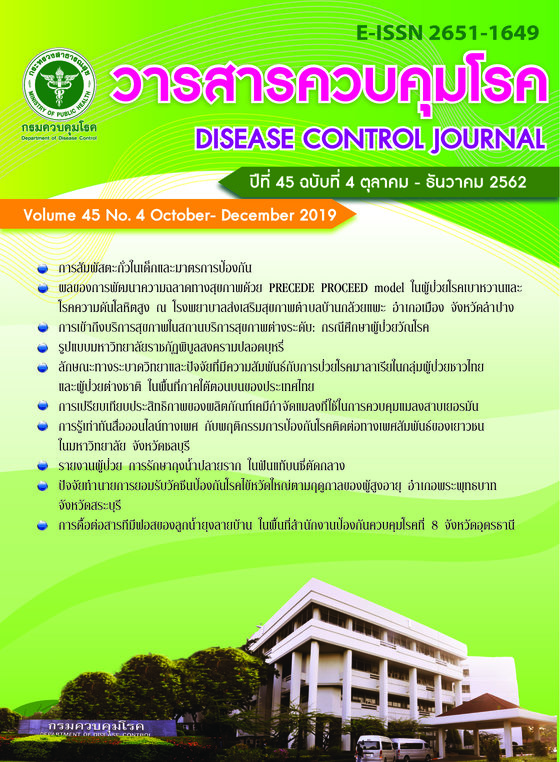
การสัมผัสตะกั่วในเด็กและมาตรการป้องกัน
DOI:
https://doi.org/10.14456/dcj.2019.31คำสำคัญ:
เด็ก, การสัมผัสสารตะกั่ว, มาตรการป้องกันสารตะกั่วบทคัดย่อ
ตะกั่วเป็นสารพิษในสิ่งแวดล้อมที่ทำให้เกิดภาวะบกพร่องทางสติปัญญาในเด็ก องค์การอนามัยโลกได้จัดโรคปัญญาอ่อนจากสารตะกั่วเป็นโรครุนแรงมากที่สุดชนิดหนึ่งเนื่องจากมีผลกระทบต่อสุขภาพเด็กอย่างถาวร นอกจากนี้สารตะกั่วยังก่อให้เกิดภาวะความเป็นพิษในหลายระบบอวัยวะ เด็กสามารถสัมผัสสารตะกั่วในสิ่งแวดล้อมและผลิตภัณฑ์ของใช้โดยผ่านทางการกินหรือการหายใจ อย่างไรก็ตามสารตะกั่วไม่มีระดับที่ปลอดภัย การสัมผัสสารตะกั่วแบบเรื้อรังแม้ในระดับต่ำจะส่งผลกระทบต่อสุขภาพในระยะยาว และยังเป็นเรื่องยากในการตรวจพบอาการและอาการแสดงเริ่มแรก การวิเคราะห์ระดับสารตะกั่วในเลือดเป็นมาตรการที่นิยมใช้ในการเฝ้าระวังภาวะความเป็นพิษจากสารตะกั่ว มีรายงานการตรวจพบสารตะกั่วในเลือดของเด็กในหลายประเทศ โดยเฉพาะในพื้นที่ที่มีความเสี่ยงสูง สำหรับประเทศไทยหลังจากใช้มาตรการทางกฎหมายยกเลิกการใช้น้ำมันที่มีสารตะกั่ว ทำให้ระดับตะกั่วในเลือดของเด็กมีแนวโน้มลดลง แต่ยังมีรายงานระดับสารตะกั่วในเลือดสูงกว่าระดับอ้างอิง โดยเฉพาะในเด็กที่อาศัยอยู่ในเขตพื้นที่อุตสาหกรรม การประมงและเหมืองแร่ อย่างไรก็ตาม ข้อมูลการเฝ้าระวังการสัมผัสสารตะกั่วในเด็กพื้นที่อื่น ๆ ยังมีไม่เพียงพอ รวมทั้งมาตรการควบคุมป้องกันเพิ่มเติมยังมีจำกัด ในขณะที่เด็กทุกคนมีความเสี่ยงในการสัมผัสสารตะกั่ว บทความฉบับนี้จึงมีวัตถุประสงค์เพื่อบ่งชี้แหล่งการรับสัมผัสสารตะกั่ว ปัจจัยที่มีผลต่อการรับสัมผัสสารตะกั่ว สถานการณ์ปัญหาสารตะกั่วในเด็ก การเสนอแนะมาตรการควบคุมป้องกัน และความคุ้มค่าทางเศรษฐกิจของการกำหนดมาตรการป้องกัน
Downloads
เอกสารอ้างอิง
2. Jain A, Wolfe LC, Jain G. Impact of lead intoxication in children with iron deficiency anemia in low- and middle-income countries. Blood 2013;122:2288-9.
3. World Health Organization. Childhood lead poisoning [Internet]. Geneva: World Health Organization; 2016 [cited 2018 Oct 15]. 68 p. Available from: https://www.who.int/ceh/publications/leadguidance.pdf
4. Dai Y, Huo X, Zhang Y, Yang T, Li M, Xu X. Elevated lead levels and changes in blood morphology and erythrocyte CR1 in preschool children from an e-waste area. Sci Total Environ 2017;592:51-9.
5. Yabe J, Nakayama SMM, Ikenaka Y, Yohannes YB, Bortey-Sam N, Oroszlany B, et al. Lead poisoning in children from townships in the vicinity of a lead–zinc mine in Kabwe, Zambia. Chemosphere 2015;119:941-7.
6. Bureau of Occupational and Environmental Disease. Situation and guidelines for lead surveillance programe in early childhood. Developing guidelines for monitoring health impacts from environmental pollution in risk areas meeting; 2015 Oct 15-16; Twin Lotus Hotel. Nakhon Si Thammarat: Department of Disease Control; 1995. (in Thai)
7. Maharachpong N, Geater A, Chongsuvivatwong V. Environmental and childhood lead contamination in the proximity of boat-repair yards in southern Thailand--I: pattern and factors related to soil and household dust lead levels. Environ Res 2006;3:294-303.
8. Mathee A, Khan T, Naicker N, Kootbodien T, Naidoo S, Becker P. Lead exposure in young school children in South African subsistence fishing communities. Environ Res 2013;126:179-83.
9. Centers for Disease Control and Prevention. Blood lead levels in children Fact Sheet [Internet]. 2012 [cited 2018 Oct 15]. Available from: https://www.cdc.gov/nceh/lead/acclpp/lead_levels_in_children_fact_sheet.pdf
10. Tantanasrikul S, Chaivisuth B, Siriratanapreuk S, Padungtod C, Pleubreukan R, Boonnark T, et al. The management of environmental lead exposure in the pediatric population: from Clitty Creek, Thailand. J Med Assoc Thai 2002;852:S762-8.
11. O'Connor D, Hou D, Ye J, Zhang Y, Ok YS, Song Y, et al. Lead-based paint remains a major public health concern: a critical review of global production, trade, use, exposure, health risk, and implications. Environ Int 2018;121:85-101.
12. Health Information System Development Office. "Children toys" danger that should not be overlooked ! [Internet]. [cited 2019 Oct 19]. Available from: https://hiso.or.th/hiso/tonkit/tonkits_38.php (in Thai)
13. Child Safety Promotion and Injury Prevention Research Center. Lead in paint, prevent Thai children from mental retardation from lead poisoning [Internet]. [cited 2018 Oct 15]. Available from: https://csip.org/wordpress/2015/05/07/ (in Thai)
14. Bureau of Laboratory Personel Development. Collaboration between Department of Science Service and Rayong Provincial Health Office to determine the causes of elevated blood lead level among schoolchildren in Rayong province. BLPD Newsletter [Internet]. 2012 [cited 2018 Oct 15];5:4-5. Available from: https://blpd.dss.go.th/training/dwdocuments/enews/blpdenews_09_55.pdf (in Thai)
15. Ecological Alert and Recovery – Thailand (EARTH). The results of lead content study in commercially available building oil paints [Internet]. [cited 2018 Oct 15]. Available from: https://www.tcijthai.com/news/2013/22/scoop/3271 (in Thai)
16. Gibson JL. A plea for painted railings and painted walls of rooms as the source of lead poisoning amongst Queensland children. 1904. Public Health Rep 2005;120:301-4.
17. Kordas K, Burganowski R, Roy A, Peregalli F, Baccino V, Barcia E, et al. Nutritional status and diet as predictors of children's lead concentrations in blood and urine. Environ Int 2018;111:43-51.
18. Wheeler DC, Jones RM, Schootman M, Nelson EJ. Explaining variation in elevated blood lead levels among children in Minnesota using neighborhood socioeconomic variables. Sci Total Environ 2019;650:970-7.
19. Yarnwaidsakul K, Saetia W. Preventative model for lead exposure in children at child development centres based on community participation in the upper southern Thailand. Disease Control Journal 2018;44:217-26. (in Thai)
20. Tirima S, Bartrem C, von Lindern I, von Braun M, Lind D, Anka SM, et al. Food contamination as a pathway for lead exposure in children during the 2010-2013 lead poisoning epidemic in Zamfara, Nigeria. J Environ Sci 2018;67:260-72.
21. Leibler JH, Basra K, Ireland T, McDonagh A, Ressijac C, Heiger-Bernays, et al. Lead exposure to children from consumption of backyard chicken eggs. Environ Res 2018;167:445-52.
22. Jarvis P, Quy K, Macadam J, Edwards M, Smith M. Intake of lead (Pb) from tap water of homes with leaded and low lead plumbing systems. Sci Total Environ 2018;644:1346-56.
23. Namihira D, Saldivar L, Pustilnik N, Carreón GJ, Salinas ME. Lead in human blood and milk from nursing women living near a smelter in Mexico City. J Toxicol Environ Health 1993;38:225-32.
24. Bureau of Occupational and Environmental Diseases. Guidelines for surveillance and prevention of lead exposure among pre-school children, Fiscal Year 2015 [Internet]. Nonthaburi: Bureau of Occupational and Environmental Diseases; 2014 Dec [cited 2019 Jun 8]. 91 p. Available from: https://envocc.ddc.moph.go.th/uploads/media/4.(ver%2016_1_15).pdf (in Thai)
25. Chuenngam A. Lead level in environment of large childcare centers, Office of Disease Prevention and Control 10th Ubon Ratchatani. Office of Disease Prevention and Control 10th Journal 2016;14:5-14. (in Thai)
26. Peng T, O'Connor D, Zhao B, Jin Y, Zhang Y, Tian L, et al. Spatial distribution of lead contamination in soil and equipment dust at children's playgrounds in Beijing, China. Environ Pollut 2019;245:363-70.
27. Ruengsitagoon W, Anorat R, Pearruksa P. Determination of lead, arsenic, cadmium, copper, and zinc in traditional medicines by atomic absorption spectrophotometry. KKU Res J 2005;10:135-40. (in Thai)
28. Gardener H, Bowen J, Callan SP. Lead and cadmium contamination in a large sample of United States infant formulas and baby foods. Sci Total Environ 2019;651:822-7.
29. Siripanich S. Situation of lead exposure among children in Thailand, 1986-2013. Weekly epidemiological surveillance report, Thailand. 2014;45:529-33. (in Thai)
30. Sun X, Li X, Liu D, Yang T, Zhao Y, Wu T, et al. Use of a survey to assess the environmental exposure and family perception to lead in children (<6 Years) in Four Valley Cities, Northwestern China. Int J Environ Res Public Health 2018;15:1-26.
31. Pongkaset A. Risk assessment and risk management of lead and arsenic poisoning in childhood through public participation in communities near abandoned tin mine, southern Thailand [dissertation]. Songkla: Prince of songkla university; 2016. 145 p. (in Thai)
32. Hwang Y-H, Hsiao CK, Lin PW. Globally temporal transitions of blood lead levels of preschool children across countries of different categories of Human Development Index. Sci Total Environ 2019;659:1395-402.
33. Zheng L, Wu K, Li Y, Qi Z, Han D, Zhang B, et al. Blood lead and cadmium levels and relevant factors among children from an e-waste recycling town in China. Environ Res 2008;108:15-20.
34. Liu Y, Huo X, Xu L, Wei X, Wu W, Wu X, et al. Hearing loss in children with e-waste lead and cadmium exposure. Sci Total Environ 2018;624:621-27.
35. Pan S, Lin L, Zeng F, Zhang J, Dong G, Yang B, et al. Effects of lead, cadmium, arsenic, and mercury co-exposure on children's intelligence quotient in an industrialized area of southern China. Environ Pollu 2018;235:47-54.
36. Gómez HF, Borgialli DA, Sharman M, Shah KK, Scolpino AJ, Oleske JM, et al. Blood lead levels of children in Flint, Michigan: 2006-2016. J Pediatr 2018;197:158-64.
37. Green D, Sullivan M, Cooper N, Dean A, Marquez C. A pilot study of children's blood lead levels in Mount Isa, Queensland. Int J Environ Res Public Health 2017;14:1567.
38. Ferri F, Candela S, Bedeschi E, Picciati AM, Davoli V, Rinaldi L, et al. Blood lead levels in children from a ceramic center with respect to residence and parental occupation. Ann Ist Super Sanita 1998;34:105-11.
39. Landrigan PJ, Schechter CB, Lipton JM, Fahs MC, Schwartz J. Environmental pollutants and disease in American children: estimates of morbidity, mortality, and costs for lead poisoning, asthma, cancer, and developmental disabilities. Environ Health Perspect 2002;110:721-8.
40. Wattanasit P. Hypertension in children and adolescents: a literature review. Songklanagarind Journal of Nursing 2016;36:234-46. (in Thai)
41. Rogan WJ, Dietrich KN, Ware JH, Dockery DW, Salganik M, Radcliffe J, et al. The effect of chelation therapy with succimer on neuropsychological development in children exposed to lead. N Engl J Med 2001;19:1421-6.
42. Hong SB, Im MH, Kim JW, Park EJ, Shin MS, Kim BN, et al. Environmental lead exposure and attention deficit/hyperactivity disorder symptom domains in a community sample of South Korean school-age children. Environ Health Perspect 2015;123:271-6.
43. Visanuyothin T, Pavasuthipaisit C, Wachiradilok P, Arunruang P, Buranasuksakul T. The prevalence of attention deficit/hyperactivity disorder in Thailand. Journal of Mental Health of Thailand 2013;21:66-75. (in Thai)
44. Lanphear BP, Dietrich KN, Berger O. Prevention of lead toxicity in US children. Ambul Pediatr 2003;3:27-36.
45. Ruangkanchanasetr S, Suepiantham J, Tapsart C, Sangsajja C. Blood lead level in Bangkok children. J Med Assoc Thai 1999;82:S154-61.
46. Punnakanta L. Lead intoxication and national human resources. National Defence College of Thailand Document 1998;18:10-3. (in Thai)
47. Ecological Alert and Recovery - Thailand. The progress of lead content control legislation for commercially available paints and adaptation of business operators [Internet]. [cited 2018 Oct 15]. Available from: https://www. isranews.org/thaireform-other-news/download/10146/39262/18.html (in Thai)
48. The Royal College of Pediatricians of Thailand and Pediatric Society of Thailand. Guideline in child health supervision [Internet]. [cited 2018 Oct 15]. Available from: https://www.thaipediatrics.org/file_upload/files/Guideline_in_Child_Health_Supervision_Part_3.pdf (in Thai)
49. Attina TM, Trasande L. Economic costs of childhood lead exposure in low- and middle-income countries. Environ Health Perspect 2013;121:1097-102.
ดาวน์โหลด
เผยแพร่แล้ว
รูปแบบการอ้างอิง
ฉบับ
ประเภทบทความ
สัญญาอนุญาต
บทความที่ลงพิมพ์ในวารสารควบคุมโรค ถือว่าเป็นผลงานทางวิชาการหรือการวิจัย และวิเคราะห์ตลอดจนเป็นความเห็นส่วนตัวของผู้เขียน ไม่ใช่ความเห็นของกรมควบคุมโรค ประเทศไทย หรือกองบรรณาธิการแต่ประการใด ผู้เขียนจำต้องรับผิดชอบต่อบทความของตน