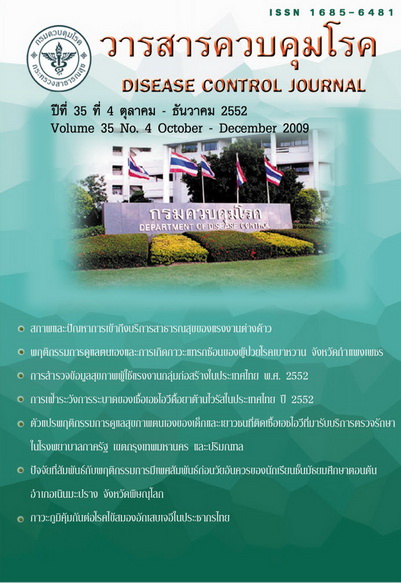
ภาวะภูมิคุ้มกันต่อโรคไข้สมองอักเสบเจอี ในประชากรไทย
คำสำคัญ:
ไข้สมองอักเสบเจอี, ความชุกของระดับภูมิคุ้มกัน Keywordsบทคัดย่อ
การศึกษานี้เป็นการตรวจวิเคราะห์ทางห้องปฏิบัติการเพื่อหาภาวะภูมิคุ้มกันต่อโรคไข้สมองอักเสบเจอี โดยใช้ตัวอย่างน้ำเหลือง ซึ่งเก็บรวบรวมจากประชากรใน 4 ภูมิภาคของประเทศไทยในปี 2547 พบความชุกของระดับภูมิคุ้มกันที่ระดับ Geometric mean titre (GMT) >1:10 ซึ่งสามารถป้องกันโรคได้โดยรวมเป็นร้อยละ 75 โดยความชุกในกลุ่มเด็กอายุต่ำกว่า 2 ปีเป็นร้อยละ 32 กลุ่มเด็กอายุ 2-9 ปีเป็นร้อยละ 69 แต่ลดต่ำลงเป็นร้อยละ 61 ในกลุ่มอายุ 10-15 ปี และสูงขึ้นในกลุ่มอายุที่มากขึ้น เป็นร้อยละ 77 ในกลุ่มอายุ 25-29 ปี ส่วนความชุกในกลุ่มผู้ใหญ่อายุ 40 ปีขึ้นไปมีมากกว่าร้อยละ 90 ค่าเฉลี่ย GMT รายกลุ่มอายุ มีแนวโน้มสอดคล้องกับความชุกของระดับภูมิคุ้มกันที่สามารถป้องกันโรคได้ ในเด็กอายุต่ำกว่า 5 ปีที่ได้รับวัคซีนครบ 2 และ 3 เข็ม มีภูมิคุ้มกันซึ่งสามารถป้องกันโรคไข้สมองอักเสบเจอีได้ เป็น ร้อยละ 65 และ 84 ตามลำดับ แนวโน้มความชุกของระดับภูมิคุ้มกันที่ป้องกันโรคได้ ที่เพิ่มขึ้นตามอายุ สะท้อนให้เห็นสภาวะในประเทศไทย ว่ามีโรคไข้สมองอักเสบเจอีชุกชุมมากในอดีต และยังคงมีโรคอยู่ในพื้นที่ในปัจจุบัน สำหรับการให้บริการวัคซีนแม้จะช่วยให้ระดับภูมิคุ้มกันที่ป้องกันโรคได้ในเด็กสูงขึ้น แต่ยังคงต่ำกว่าเกณฑ์ ซึ่งอาจเกิดจากความครอบคลุมวัคซีนต่ำ หรือปัญหาในการบริการในพื้นที่ ที่อาจทำให้ประสิทธิภาพวัคซีนลดลง
Downloads
เอกสารอ้างอิง
2. Rosen L. The natural history of Japanese encephalitis virus. Annu Rev Microbiol. 1986; 40:395-414.
3. Soman RS, Rodrigues FM, Guttikar SN, Guru PY. Experimental viraemia and transmission of Japanese encephalitis virus by mosquitoes in ardeid birds. Indian J Med Res 66:709-718, 1977.
4. WHO position paper: Japanese encephalitis vaccines, Weekly Epidemiological Record 1998. 73:337-344.
5. Halstead SB, Grosz CR. Subclinical Japanese encephalitis. I. Infection of Americans with limited residence in Korea. Am J Hyg. 1962; 75:190-201.
6. Gajana A, Thenmozhi V, Samuel PP, Reuben R. A community-based study of subclinical flavivirus infections in children in an area of Tamil Nadu, India, where Japanese encephalitis in endemic. Bull World Health Organization. 1995; 73: 237-244.
7. American Academy of Pediatrics. Arboviruses : In Pickering LK, ed. Red Book: 2003 Report of the Committee on Infectious Disease. 26th ed. Elk grove Village, IL: American Academy of Pediatrics; 2003: 200-205.
8. Grossman RA, Edelman R, Willhight M, Pantuwatana S, Udomsakdi S. Study of Japanese encephalitis virus in Chiang Mai Valley, Thailand. Am J Epidemiol. 1973; 98: 133-149.
9. Chunsuttiwat S, Warachi P. Japanese encephalitis in Thailand. Southeast Asian J Trop Med Public Health. 1995; 26(S3): 43-46.
10. Rojanasuphot S, Nachiangmai P, Srijaggrawalong A, Nimmannitya S. Implimentation of simultaneous Japanese encephalitis vaccine in the expanded program of immunization of infants. Mosq Borne Dis Bull. 1992; 9: 86-92.
11. Chongsrisawat V, Yoocharoen P, Theamboonlers A, Tharmaphornpilas P, Warinsathien P, Sinlaparatsamee S, Paupunwatana S, et al. Hepatitis B seroprevalence in Thailand: 12 years after hepatitis B vaccine integration into the national expanded programme on immunization. Trop Med Int Health. 2006; 11: 1496-502.
12. Raharjo E, Tadano M, Okamato Y, Okuno Y. Development of a micro-neutralization test for chikungunya virus. Biken J 1986; 29: 27-30.
13. Yamada KI., Takasaki T., Nawa M. and Kurane I. Virus isolation as one of the diagnosis methods for dengue virus infection. J Clinical Virol 2002; 24: 203-9.
14. สำนักระบาดวิทยา กรมควบคุมโรค. รายงานเฝ้าระวังโรคไข้สมองอักเสบ. จาก URL :http://203.157.15.4/surdata/ disease.php?dcontent=graph&ds=28 , ข้อมูล ณ.วันที่ 27 พฤษภาคม 2552.
15. สำนักโรคติดต่อทั่วไป กรมควบคุมโรค. การสำรวจความครอบคลุมของการได้รับวัคซีนขั้นพื้นฐาน และวัคซีนโปลิโอในการรณรงค์ พ.ศ.2546. พิมพ์ครั้งที่ 1 กรุงเทพมหานคร: สำนักงานกิจการโรงพิมพ์องค์การสงเคราะห์ทหารผ่านศึก; 2547. 64-65.
16. Nimmannitya S, Hutamai S, Kalayanarooj S, Rojanasuphot S. A field study on Nakayama and Beijing strains of Japanese encephalitis vaccine. Southeast Asia J Trop Med Public Health 1995; 26: 689-693.
17. Rojanasuphot S, Charoensuk O, Ungchusak K, Srijaggrawalwong A, Panthumachinda B. A field trial of inactivated mouse brain Japanese encephalitis vaccine produced in Thailand. Mosquito Borne Dis Bull 1991; 8: 11-16.
18. Tseng HF, Tan HF, Chang CK, Huang WL, Ho WC. Seroepidemiology study of Japanese encephalitis neutralizing antibodies in southern Taiwan: A comparative study between urban city and country townships. Am J Infect Control 2003; 31: 435-40.
ดาวน์โหลด
เผยแพร่แล้ว
รูปแบบการอ้างอิง
ฉบับ
ประเภทบทความ
สัญญาอนุญาต
บทความที่ลงพิมพ์ในวารสารควบคุมโรค ถือว่าเป็นผลงานทางวิชาการหรือการวิจัย และวิเคราะห์ตลอดจนเป็นความเห็นส่วนตัวของผู้เขียน ไม่ใช่ความเห็นของกรมควบคุมโรค ประเทศไทย หรือกองบรรณาธิการแต่ประการใด ผู้เขียนจำต้องรับผิดชอบต่อบทความของตน