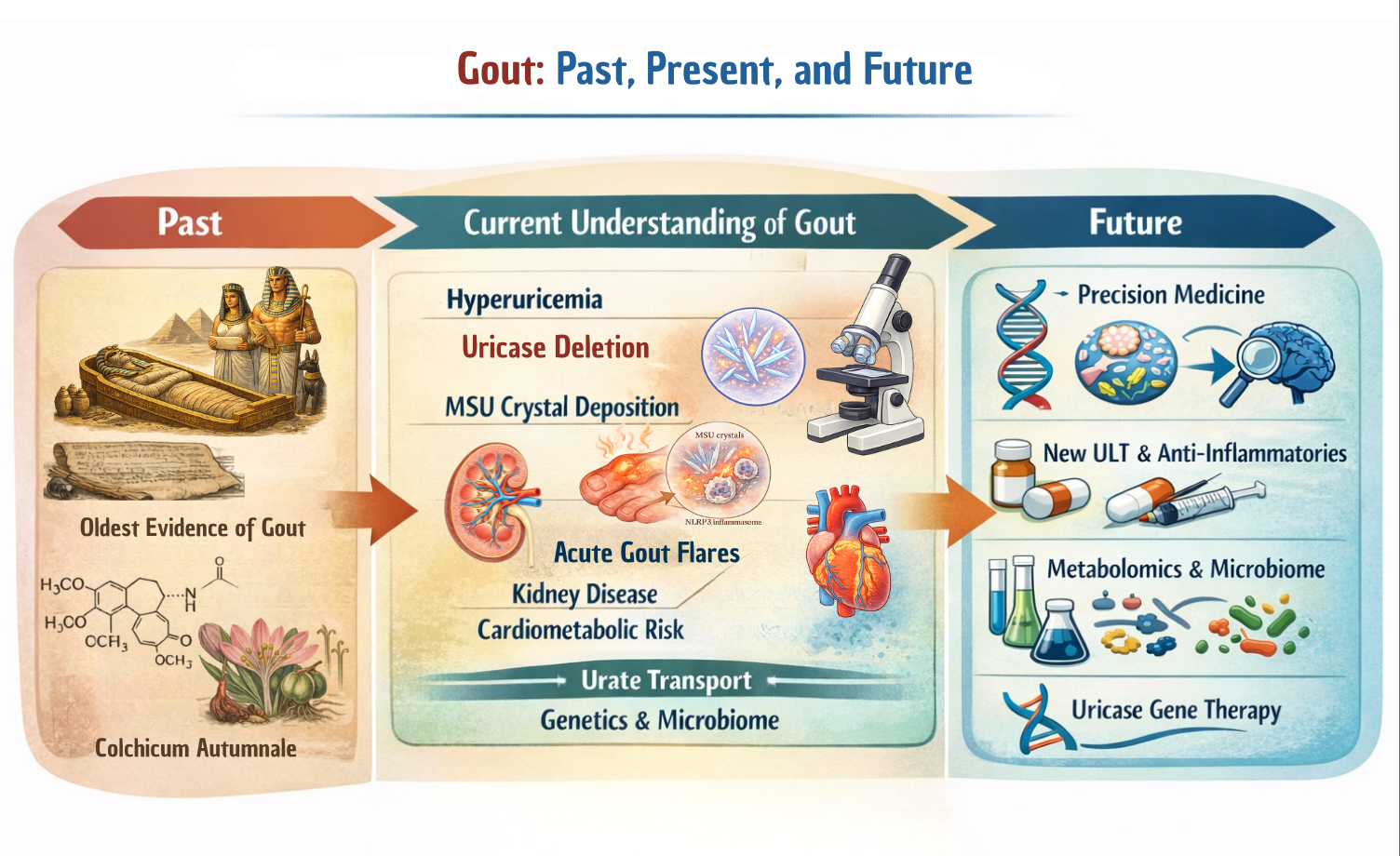
Gout Through the Ages: Past, Present, and Future
DOI:
https://doi.org/10.12982/BSCM.2026.35Keywords:
Gout, Hyperuricemia, Uric acid, Treatment, ManagementAbstract
Gout is a disease unique to humans, resulting from the evolutionary loss of functional uricase, the enzyme that converts uric acid to the more soluble allantoin. This loss causes elevation of serum uric acid (SUA). With sustained hyperuricemia, deposition of monosodium urate (MSU) crystals in and around joints and extra-articular tissues occurs. Clinically, gout manifests as recurrent episodes of acute inflammatory arthritis and, when untreated or undertreated, may progress to more frequent flares, tophus formation, and structural joint damage. Persistent hyperuricemia is also linked to nephrolithiasis, chronic kidney disease progression, and increased cardiometabolic burden. This review summarizes gout across the past, the present, and the future. Historical perspectives span early descriptions dating to the Egyptian period and extend through the period just prior to the discovery of light microscopy that led to enabling identification of MSU crystals. The modern era is reviewed through the development of classification criteria; mechanisms of MSU crystal-induced inflammation; genetic determinants of urate homeostasis; and the roles of renal and intestinal urate transport in hyperuricemia. Metabolomic signatures and gut microbiota are discussed alongside current approaches to urate- lowering therapy (ULT) and flare prevention. Future directions include precision, individualized medicine integrating clinical features with molecular and imaging data to improve risk stratification and guide therapy. They also include targeted anti-inflammatory strategies, newer ULT and uricosuric agents, and the application of metabolomics and microbiome science. Finally, the long-term possibility of uricase gene restoration as a transformative approach to reconstitute urate metabolism and potentially modify disease course is discussed.
References
Ames BN, Cathcart R, Schwiers E, Hochstein P. Uric acid provides an antioxidant defense in humans against oxidant- and radical-caused aging and cancer: a hypothesis. Proc Natl Acad Sci U S A. 1981;78:6858-62.
Watanabe S, Kang DH, Feng L, Nakagawa T, Kanellis J, Lan H, et al. Uric acid, hominoid evolution, and the pathogenesis of salt-sensitivity. Hypertension. 2002; 40:355-60.
Kittredge WE, Downs R. The role of gout in the formation of urinary calculi. J Urol. 1952;67:841-9.
Smith GE, Jones FW. The archeological survey of Nu bia, report for 1907–89, Vol. 2. Cairo, National Printing Department: 1910, p. 44 and 2691910.
Makenzie CR. Gout and hyperuricemia: an historical perspective. Curr Treat Opin Rheum. 2015;1:119-30.
de Santo NG. Gout from the corpus hippocraticum to the renaissance: the role of galen. [Internet]. [cited 2026 February 20]. Available from: https://giornaleitalianodinefrologia.it/en/2025/04/42-02-2025-14
Nriagu JO. Saturnine gout among Roman aristocrats. Did lead poisoning contribute to the fall of the Empire? N Engl J Med. 1983;308:660-3.
Helfgott SM. Was gout rampant among the Romans? The Rheumatologist. 2013;1:1-13.
Metwaly AM, Ghoneim MM, Eissa IH, Elsehemy IA, Mostafa AE, Hegazy MM, et al. Traditional ancient Egyptian medicine: A review. Saudi J Biol Sci. 2021;28: 5823-32.
Gritzalis KC, Karamanou M, Androutsos G. Gout in the writings of eminent ancient Greek and Byzantine physicians. Acta Med Hist Adriat. 2011;9:83-8.
Nuki G, Simkin PA. A concise history of gout and hyperuricemia and their treatment. Arthritis Res Ther. 2006;8_Suppl 1:S1.
Jessup AJC, Coroneo MT. Examining the fabric of the eye: Antoni van Leeuwenhoek, the draper and ocular microscopist. Surv Ophthalmol. 2025;70:833-9.
Woolaston WH. On gouty and urinary concretions. Philosoph Trans R Soc Lond. 1787;87:386-415.
Hickman RJ. Understanding the role of uric acid in gout. The Rheumatologist. 2022;9:1-14.
McCarty DJ, Hollander JL. Identification of urate crystals in gouty synovial fluid. Ann Intern Med. 1961;54: 452-60.
Faires JS, McCarty DJ. Acute arthritis in man and dog after intrasynovial injection of sodium urate crystals. Lancet. 1962;10:682-4.
Kellgren JH. The epidemiology of chronic rheumatism. Oxford: Blackwell Scientific, 1963.
Decker JL. Report from the subcommittee on diagnostic criteria for gout. In: Bennett PH, Wood PHN, editors. Population studies of the rheumatic diseases. Proceedings of the Third International Symposium, New York, June 5-10, 1966. Amsterdam: Excerpta Medica Foundation, 1968:385-7.
Wallace SL, Robinson H, Masi AT, Decker JL, McCarty DJ, Yu TF. Preliminary criteria for the classification of the acute arthritis of primary gout. Arthritis Rheum. 1977;20:895-900.
Pelaez-Ballestas I, Hernandez Cuevas C, Burgos-Vargas R, Hernandez Roque L, Teran L, Espinoza J, et al. Diagnosis of chronic gout: evaluating the american college of rheumatology proposal, European league against rheumatism recommendations, and clinical judgment. J Rheumatol. 2010;37:1743-8.
Janssens HJ, Fransen J, van de Lisdonk EH, van Riel PL, van Weel C, Janssen M. A diagnostic rule for acute gouty arthritis in primary care without joint fluid analysis. Arch Intern Med. 2010;170:1120-6.
Neogi T, Jansen TL, Dalbeth N, Fransen J, Schumacher HR, Berendsen D, et al. 2015 Gout Classification Criteria: an American College of Rheumatology/European League Against Rheumatism collaborative initiative. Arthritis Rheumatol. 2015;67:2557-68.
Dalbeth N, Fransen J, Jansen TL, Neogi T, Schumacher HR, Taylor WJ. New classification criteria for gout: a framework for progress. Rheumatology (Oxford). 2013;52:1748-53.
Louthrenoo W, Jatuworapruk K, Lhakum P, Pattamapaspong N. Performance of the 2015 American College of Rheumatology/European League Against Rheumatism gout classification criteria in Thai patients. Rheumatol Int. 2017;37:705-11.
McQueen FM, Doyle A, Dalbeth N. Imaging in the crystal arthropathies. Rheum Dis Clin North Am. 2014; 40:231-49.
Pattamapaspong N, Vuthiwong W, Kanthawang T, Louthrenoo W. Value of ultrasonography in the diagnosis of gout in patients presenting with acute arthritis. Skeletal Radiol. 2017;46:759-67.
Pascart T, Richette P, Bousson V, Ottaviani S, Ea HK, Liote F, et al. Time-course of tophus resolution on Dual-energy CT and ultrasound after 24-months of a treat-to-target strategy: Results from GOUT-DECTUS study. Joint Bone Spine. 2025;92:105892.
Wyngaarden JB. Gout. Adv Metab Disord. 1965;2:1-78.
Lesch M, Nyhan WL. A familial disorder of uric acid metabolism and central nervous system function. Am J Med. 1964;36:561-70.
Seegmiller JE, Rosenbloom FM, Kelley WN. Enzyme defect associated with a sex-linked human neurological disorder and excessive purine synthesis. Science. 1967;155:1682-4.
Schumacher HR, Phelps P. Sequential changes in human polymorphonuclear leukocytes after urate crystal phagocytosis. An electron microscopic study. Arthritis Rheum. 1971;14:513-26.
Spilberg I. Current concepts of the mechanism of acute inflammation in gouty arthritis. Arthritis Rheum. 1975;18:129-34.
So AK, Martinon F. Inflammation in gout: mechanisms and therapeutic targets. Nat Rev Rheumatol. 2017;13: 639-47.
Punzi L, Scanu A, Ramonda R, Oliviero F. Gout as autoinflammatory disease: new mechanisms for more appropriated treatment targets. Autoimmun Rev. 2012;12:66-71.
Busso N, So A. Mechanisms of inflammation in gout. Arthritis Res Ther. 2010;12:206. PubMed PMID: 20441605
Akahoshi T, Murakami Y, Kitasato H. Recent advances in crystal-induced acute inflammation. Curr Opin Rheumatol. 2007;19:146-50.
Wu M, Tian Y, Wang Q, Guo C. Gout: a disease involved with complicated immunoinflammatory responses: a narrative review. Clin Rheumatol. 2020;39:2849-59.
Steiger S, Harper JL. Mechanisms of spontaneous resolution of acute gouty inflammation. Curr Rheumatol Rep. 2014;16:392. PubMed PMID: 24343224
Benn CL, Dua P, Gurrell R, Loudon P, Pike A, Storer RI, et al. Physiology of Hyperuricemia and Urate-Lowering Treatments. Front Med (Lausanne). 2018;5:160. PubMed PMID: 29904633
Cho C, Kim B, Kim DS, Hwang MY, Shim I, Song M, et al. Large-scale cross-ancestry genome-wide meta-analysis of serum urate. Nat Commun. 2024;15:3441. PubMed PMID: 38658550
Du L, Zong Y, Li H, Wang Q, Xie L, Yang B, et al. Hyperuricemia and its related diseases: mechanisms and advances in therapy. Signal Transduct Target Ther. 2024;9:212. PubMed PMID: 39191722
Reginato AM, Mount DB, Yang I, Choi HK. The genetics of hyperuricaemia and gout. Nat Rev Rheumatol. 2012;8:610-21.
Ichida K, Matsuo H, Takada T, Nakayama A, Murakami K, Shimizu T, et al. Decreased extra-renal urate excretion is a common cause of hyperuricemia. Nat Commun. 2012;3:764. PubMed PMID: 22473008
Tong S, Zhang P, Cheng Q, Chen M, Chen X, Wang Z, et al. The role of gut microbiota in gout: Is gut microbiota a potential target for gout treatment. Front Cell Infect Microbiol. 2022;12:1051682. PubMed PMID: 36506033
Xing Z, Xu Y, Jiang W, Gao M, Shen G, Liu Y, et al. The regulation of gut microbiota and urate lowering: A study on the mechanisms of action of probiotics and plant components. Pharmanutrition. 2025;33:100450.
Yang J, Chen J, Liu Z, Qu Y, Yue X, Yuan B, et al. The role of the intestinal microbiome in the pathogenesis and treatment of hyperuricemia: A review. Food Sci Nutr. 2025;13:e70982. PubMed PMID: 41078442
Karamanou M, Tsoucalas G, Pantos K, Androutos G. Isolating colchicine in 19th century: An old drug revisited. Curr Pharm Des. 2018;24:654-8.
Wallace SI, Bernstein D, Diamond H. Diagnostic value of the colchicine therapeutic trial. JAMA. 1967;199: 525-8.
Terkeltaub RA, Furst DE, Bennett K, Kook KA, Crockett RS, Davis MW. High versus low dosing of oral colchicine for early acute gout flare: Twenty-four-hour outcome of the first multicenter, randomized, double-blind, placebo-controlled, parallel-group, dose-comparison colchicine study. Arthritis Rheum. 2010;62:1060-8.
Laosuksri P, Phrintrakul N, Gumtorntip W, Na-Nan K, Wongthanee A, Kasitanon N, et al. Non-loading versus loading low-dose colchicine in acute crystal-associated arthritis: A double-blinded randomized controlled study. Int J Rheum Dis. 2023;26:2478-88.
Wallace SL. The treatment of gout. Arthritis Rheum. 1972;15:317-23.
Lees P, Toutain PL. Pharmacokinetics, pharmacodynamics, metabolism, toxicology and residues of phenylbutazone in humans and horses. Vet J. 2013;196: 294-303.
Rubin BR, Burton R, Navarra S, Antigua J, Londono J, Pryhuber KG, et al. Efficacy and safety profile of treatment with etoricoxib 120 mg once daily compared with indomethacin 50 mg three times daily in acute gout: a randomized controlled trial. Arthritis Rheum. 2004;50:598-606.
Schumacher HR, Berger MF, Li-Yu J, Perez-Ruiz F, Burgos-Vargas R, Li C. Efficacy and tolerability of celecoxib in the treatment of acute gouty arthritis: a randomized controlled trial. J Rheumatol. 2012;39:1859-66.
Kiltz U, Smolen J, Bardin T, Cohen Solal A, Dalbeth N, Doherty M, et al. Treat-to-target (T2T) recommendations for gout. Ann Rheum Dis. 2017;76:632-8.
Jansen TL, Janssen M. The American College of Physicians and the 2017 guideline for the management of acute and recurrent gout: treat to avoiding symptoms versus treat to target. Clin Rheumatol. 2017;36:2399-402.
Tabi-Amponsah AD, Stewart S, Stamp LK, Taylor WJ, Terkeltaub R, Dalbeth N. The Gout, Hyperuricemia and Crystal-Associated Disease Network (G-CAN) definition of clinical remission in gout. Ann Rheum Dis. 2026;85:186-94.
FitzGerald JD, Dalbeth N, Mikuls T, Brignardello-Petersen R, Guyatt G, Abeles AM, et al. 2020 American College of Rheumatology Guideline for the Management of Gout. Arthritis Care Res (Hoboken). 2020;72: 744-60.
Richette P, Doherty M, Pascual E, Barskova V, Becce F, Castaneda-Sanabria J, et al. 2016 updated EULAR evidence-based recommendations for the management of gout. Ann Rheum Dis. 2017;76:29-42.
Lorenzo JPP, Sollano M, Salido EO, Li-Yu J, Tankeh-Torres SA, Wulansari Manuaba IAR, et al. 2021 Asia-Pacific League of Associations for Rheumatology clinical practice guideline for treatment of gout. Int J Rheum Dis. 2022;25:7-20.
Pham HT, Tran MH, Mai Hoang TV, Nguyen AH, Tran MH. HLA-B*58:01 genotyping prevalence and the association with allopurinol-induced severe cutaneous adverse reactions: a living systematic review and meta-analysis. Sci Rep. 2025;15:30742. PubMed PMID: 40841814
Zhou Y, Krebs K, Milani L, Lauschke VM. Global frequencies of clinically important HLA alleles and their implications for the cost-effectiveness of preemptive pharmacogenetic testing. Clin Pharmacol Ther. 2021; 109:160-74.
Cheng H, Yan D, Zuo X, Liu J, Liu W, Zhang Y. A retrospective investigation of HLA-B*5801 in hyperuricemia patients in a Han population of China. Pharmacogenet Genomics. 2018;28:117-24.
Chong HY, Lim YH, Prawjaeng J, Tassaneeyakul W, Mohamed Z, Chaiyakunapruk N. Cost-effectiveness analysis of HLA-B*58: 01 genetic testing before initiation of allopurinol therapy to prevent allopurinol-induced Stevens-Johnson syndrome/toxic epidermal necrolysis in a Malaysian population. Pharmacogenet Genomics. 2018;28:56-67.
Dilokthornsakul P, Louthrenoo W, Yadee J, Siripaitoon B, Jatuworapruk K, Vannaprasaht S, et al. An Updated Economic Evaluation of HLA-B*58:01 Genotype Testing in Gouty Patients for Preventing Severe Allopurinol Hypersensitivity in Thailand. ACR Open Rheumatol. 2025;7:e70093. PubMed PMID: 40829930
Ke CH, Chung WH, Wen YH, Huang YB, Chuang HY, Tain YL, et al. Cost-effectiveness Analysis for Genotyping before Allopurinol Treatment to Prevent Severe Cutaneous Adverse Drug Reactions. J Rheumatol 2017;44:835-43.
Park DJ, Kang JH, Lee JW, Lee KE, Wen L, Kim TJ, et al. Cost-effectiveness analysis of HLA-B5801 genotyping in the treatment of gout patients with chronic renal insufficiency in Korea. Arthritis Care Res (Hoboken). 2015;67:280-7.
Teng GG, Tan-Koi WC, Dong D, Sung C. Is HLA-B*58:01 genotyping cost effective in guiding allopurinol use in gout patients with chronic kidney disease? Pharmacogenomics. 2020;21:279-91.
Jatuworapruk K. Updates from the APLAR gout registry. Present at 27th Asia Pacific Leagues of Association for Rheumatology Congress, Fukuoka, Japan, 5 September 2025. Available at: https://aplar.app.swapcard.com/event/aplar-2025/planning/UGxhbm5pbmdfMjcxMzgyNw==. https://aplar.app.swapcard.com/event/aplar-2025/planning/UGxhbm5pbmdfMjcxMzgyNw==
Choi ST, Song JS, Kim SJ, Kim CH, Moon SJ. The Utility of the Random Urine Uric Acid-to-Creatinine Ratio for Patients with Gout Who Need Uricosuric Agents: Retrospective Cross-Sectional Study. J Korean Med Sci. 2020;35:e95. PubMed PMID: 32242346
Abhishek A, Courtney P, Jenkins W, Sandoval-Plata G, Jones AC, Zhang W, et al. Brief Report: Monosodium Urate Monohydrate Crystal Deposits Are Common in Asymptomatic Sons of Patients With Gout: The Sons of Gout Study. Arthritis Rheumatol. 2018;70:1847-52.
Wang P, Smith SE, Garg R, Lu F, Wohlfahrt A, Campos A, et al. Identification of monosodium urate crystal deposits in patients with asymptomatic hyperuricemia using dual-energy CT. RMD Open. 2018;4: e000593. PMID: 29556417
Patti GJ, Yanes O, Siuzdak G. Innovation: Metabolomics: the apogee of the omics trilogy. Nat Rev Mol Cell Biol. 2012;13:263-9.
Sun W, Li R, Dalbeth N, Cui L, Liu Z, Wang C, et al. Metabolomic profiles underlying gout flares: a prospective study of people with gout. RMD Open. 2025;11:e005278. PubMed PMID: 40345707
Muntiu M, Joosten LAB, T.O. Cs. Gout basic research: 2023 in review. Gout Urate Cryst Depos Dis. 2024;2: 220-35.
Punzi L, Scagnellato L, Galozzi P, Baggio C, Damasco A, Oliviero F, et al. Gout: one year in review 2025. Clin Exp Rheumatol. 2025;43:799-808.
Minekar A, Shinde S, Chougule N. Nanoparticles in pharmaceutical applications: Current trends and future prospects. Int J Pharm Sci. 2024;2:857-67.
Herdiana Y, Wardhana YW, Kurniawansyah IS, Gozali D, Wathoni N, Sofian FF. Current Status of Gout Arthritis: Current approaches to gout arthritis treatment: nanoparticles delivery systems approach. Pharmaceutics. 2025;17.
Yamada N, Iwamoto C, Kano H, Yamaoka N, Fukuuchi T, Kaneko K, et al. Evaluation of purine utilization by Lactobacillus gasseri strains with potential to decrease the absorption of food-derived purines in the human intestine. Nucleosides Nucleotides Nucleic Acids. 2016;35:670-6.
Yamanaka H, Taniguchi A, Tsuboi H, Kano H, Asami Y. Hypouricaemic effects of yoghurt containing Lactobacillus gasseri PA-3 in patients with hyperuricaemia and/or gout: A randomised, double-blind, placebo-controlled study. Mod Rheumatol. 2019;29:146-50.
Wu XW, Muzny DM, Lee CC, Caskey CT. Two independent mutational events in the loss of urate oxidase during hominoid evolution. J Mol Evol. 1992;34:78-84.
Zhang C, Fan K, Zhang W, Zhu R, Zhang L, Wei D. Structure-based characterization of canine-human chimeric uricases and its evolutionary implications. Biochimie. 2012;94:1412-20.
Doudna JA. The promise and challenge of therapeutic genome editing. Nature. 2020;578:229-36.
de Lima Balico L, Gaucher EA. CRISPR-Cas9-mediated reactivation of the uricase pseudogene in human cells prevents acute hyperuricemia. Mol Ther Nucleic Acids. 2021;25:578-84.
de Lima Balico L, Gaucher EA. Genomic insertion of ancestral uricase into human liver cells to determine metabolic consequences of pseudogenization. Sci Rep. 2025;15:26093. PubMed PMID: 40681749
Pinz MP, Medeiros I, Carvalho L, Meotti FC. Is uric acid a true antioxidant? Identification of uric acid oxidation products and their biological effects. Redox Rep. 2025;30:2498105. PubMed PMID: 40415203
Sautin YY, Johnson RJ. Uric acid: the oxidant-antioxidant paradox. Nucleosides Nucleotides Nucleic Acids. 2008;27:608-19.
Tovchiga OV, Shtrygol SY. Uric acid and central nervous system functioning ((A literature review). Biol Bull Rev. 2014;4:210-21.
Inouye E, Park KS, Asaka A. Blood uric acid level and IQ: a study in twin families. Acta Genet Med Gemellol (Roma). 1984;33:237-42.
Park KS, Inouye E, Asaka A. Plasma and urine uric acid levels: heritability estimates and correlation with IQ. Jinrui Idengaku Zasshi. 1980;25:193-202.
Paatil U, Divekar S, Vaida S, Ruikar VM, Patwardhan MS. Study of serum uric acid and its correlation with intelligence quotient and other parameters in normal healthy adults. Int J Recent Trends Sci Tach. 2013; 6:64-6.
Xue L, Liu Y, Xue H, Xue J, Sun K, Wu L, et al. Low uric acid is a risk factor in mild cognitive impairment. Neuropsychiatr Dis Treat. 2017;13:2363-7.
Rabbani MG, Alif SM, Tran C, Rickard AJ, Demos L, McNeil JJ, et al. Higher serum uric acid levels and risk of all-cause mortality in general population: a systematic review and meta-analysis. Metabol Open. 2025;26:100371.
Rahimi-Sakak F, Maroofi M, Rahmani J, Bellissimo N, Hekmatdoost A. Serum uric acid and risk of cardiovascular mortality: a systematic review and dose-response meta-analysis of cohort studies of over a million participants. BMC Cardiovasc Disord. 2019;19:218. PubMed PMID: 31615412
Lee YH, Song GG. Effect of urate-lowering therapy on all-cause and CVD-specific mortality in gout and hyperuricemia: a meta-analysis. Z Rheumatol. 2024;83:338-44.
Alrouji M, Al-Kuraishy HM, Al-Gareeb AI, Alshammari MS, Alexiou A, Papadakis M, et al. Role of uric acid in neurodegenerative diseases, focusing on Alzheimer and Parkinson disease: A new perspective. Neuropsychopharmacol Rep. 2024;44:639-49.
Liu H, Reynolds GP. A review of the evidence for a protective role of uric acid in Parkinson’s disease. NPJ Parkinsons Dis. 2025;11:325. PubMed PMID: 41257856
Topiwala A, Mankia K, Bell S, Webb A, Ebmeier KP, Howard I, et al. Association of gout with brain reserve and vulnerability to neurodegenerative disease. Nat Commun. 2023;14:2844. PubMed PMID: 37202397
Verhaaren BF, Vernooij MW, Dehghan A, Vrooman HA, de Boer R, Hofman A, et al. The relation of uric acid to brain atrophy and cognition: the Rotterdam Scan Study. Neuroepidemiology. 2013;41:29-34.
Otani N, Hoshiyama E, Ouchi M, Takekawa H, Suzuki K. Uric acid and neurological disease: a narrative review. Front Neurol. 2023;14:1164756. PubMed PMID: 37333005