Prevalence of Neurological Abnormalities from Neuroimaging in Acute Acquired Comitant Esotropia
DOI:
https://doi.org/10.12982/BSCM.2026.37Keywords:
Strabismus, Esotropia, Acute Acquired Comitant Esotropia, Neurologic Manifestations, NeuroimagingAbstract
Objective This study aimed to determine the prevalence and characteristics of patients with acute acquired comitant esotropia (AACE) who had abnormal findings on neuroimaging.
Methods A retrospective review of data from patients diagnosed with AACE who had an onset age of greater than six months, cycloplegic refraction of less than +3.00 spherical diopters, and had undergone neuroimaging between 2014 and 2024 was conducted.
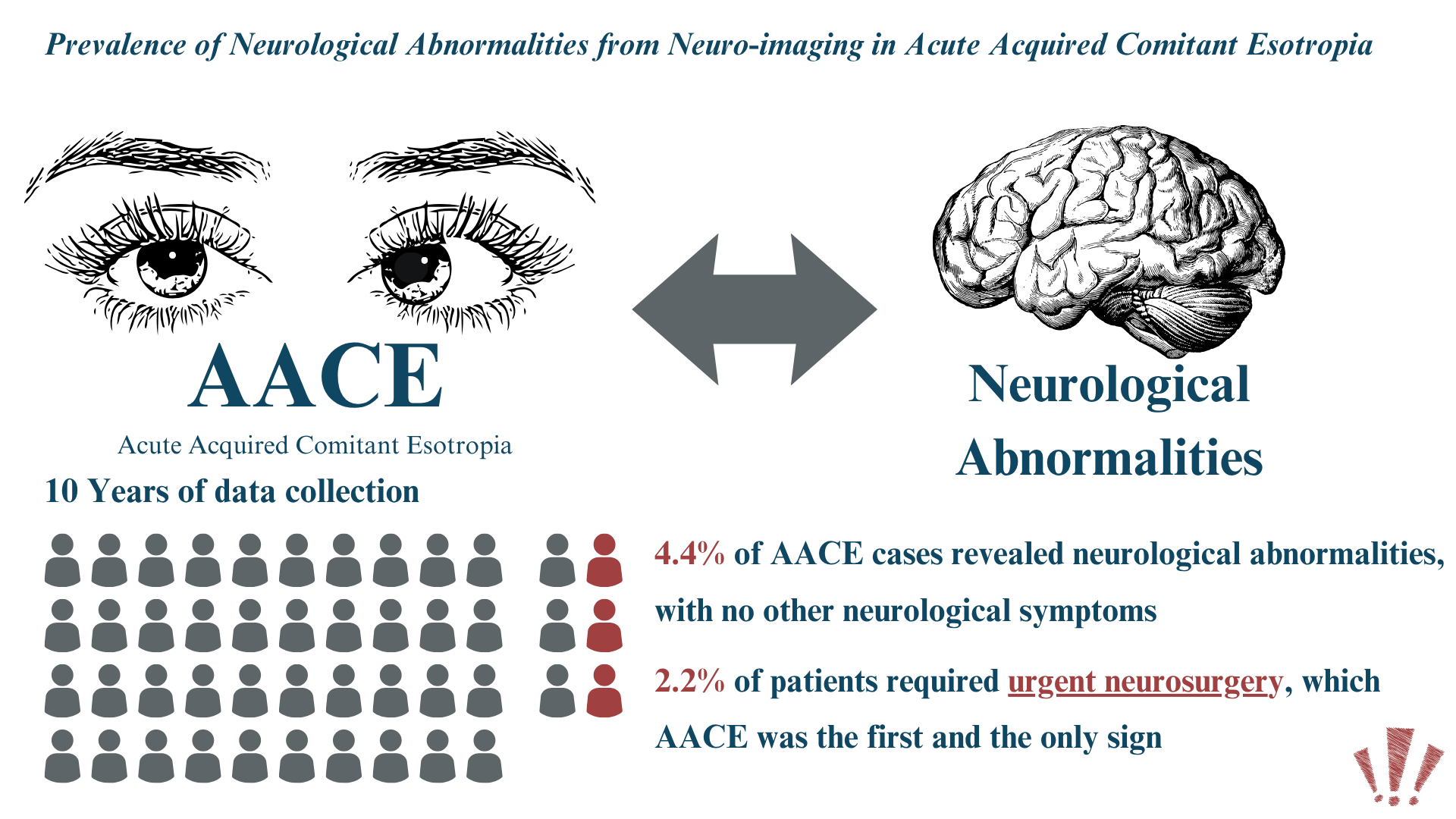
Results A total of 45 patients, 28 males (62.2%) were included in the study. The overall mean age was 10.2 years, and the mean angle of deviation was 36.11 prism diopters (PD) for distance and 36.1 PD for near. Of the 45 patients, 43 (95.6%) had normal neuroimaging and 2 (4.4%) had abnormal neuroimaging. Abnormal findings consisted of a small vascular anomaly in one patient and an arachnoid cyst in another. The mean age at onset was 5.5 years in the abnormal neuroimaging group and 8.8 years in the normal neuroimaging group (p = 0.46). The mean near angle of deviation was 27.5 PD versus 36.8 PD (p = 0.21) in patients with abnormal and normal neuroimaging, respectively. The mean distance deviation was 25 PD and 36.9 PD (p = 0.19) in the abnormal and the normal neuroimaging group, respectively. No patients demonstrated associated abnormal neurological symptoms or signs.
Conclusions No predictive factors associated with abnormal neurological findings were identified as statistically significant. Despite the infrequency of abnormal neuroimaging findings in AACE and the absence of identified predictive factors, clinicians should remain aware of the possibility of underlying brain abnormalities.
References
Mittendorf L, Bernhard MK, Sterker I, Kiess W, Gburek-Augustat J, Merkenschlager A. Still an unsolved question: the place of cranial magnetic resonance imaging in acute acquired concomitant esotropia. Children (Basel). 2024;11:519. PubMed PMID: 38790514
Buch H, Vinding T. Acute acquired comitant esotropia of childhood: a classification based on 48 children. Acta Ophthalmol. 2015;93:568-74.
Neena R, Giridhar A. Acute acquired comitant esotropia in children: A benign entity or an ominous sign? Kerala Journal of Ophthalmology. 2019;31:33-8.
Nishikawa N, Sato M. Acute acquired comitant esotropia: Current understanding of its etiological classification and treatment strategies. Taiwan J Ophthalmol. 2025;15:79-87.
Lekskul A, Chotkajornkiat N, Wuthisiri W, Tangtammaruk P. Acute acquired comitant esotropia: etiology, clinical course, and management. Clin Ophthalmol. 2021;15:1567-72.
Gilbert AL, Koo EB, Heidary G. Evaluation and management of acute acquired comitant esotropia in children. Semin Ophthalmol. 2017;32:8-13.
Neena R, Remya S, Anantharaman G. Acute acquired comitant esotropia precipitated by excessive near work during the COVID-19-induced home confinement. Indian J Ophthalmol. 2022;70:1359-64.
Burian HM, Miller JE. Comitant convergent strabismus with acute onset. Am J Ophthalmol. 1958;45(4 Pt 2):55-64.
Hoyt CS, Good WV. Acute onset concomitant esotropia: when is it a sign of serious neurological disease? Br J Ophthalmol. 1995;79:498-501.
Nouraeinejad A. Neurological pathologies in acute acquired comitant esotropia. Graefes Arch Clin Exp Ophthalmol. 2023;261:3347-54.
Osborne D, Richardson-May J, Bush K, Evans M, West SK, May K, et al. Four cases of acute comitant esotropia associated with diffuse intrinsic pontine glioma in children. Strabismus. 2023;31:26-30.
Williams AS, Hoyt CS. Acute comitant esotropia in children with brain tumors. Arch Ophthalmol. 1989; 107:376-8.
Surachatkumtonekul T, Khiewwan N, Hokierti K, Saksiriwuttho P. Neuroimaging findings in acquired esotropia patients at Siriraj Hospital from 2009–2020. Siriraj Medical Journal. 2023;75:508-12.
Nouraeinejad A. Neurological pathologies associated with acute acquired comitant esotropia. Int J Neurosci. 2024;134:1026-7.
Dotan G, Keshet Y, Qureshi HM, Friling R, Yahalom C. When pediatric acute acquired comitant esotropia is not caused by a neurological disease. J AAPOS. 2020; 24:5 e1-5 e.
Montriwet M. Possibility of neurological diseases associated with acute acquired comitant esotropia. Korean Journal of Ophthalmology. 2023;37:120-7.
Ahmed S, Young JD. Late onset esotropia in monozygous twins. Br J Ophthalmol. 1993;77:189-91.
Clark AC, Nelson LB, Simon JW, Wagner R, Rubin SE. Acute acquired comitant esotropia. Br J Ophthalmol. 1989;73:636-8.
Goldman HD, Nelson LB. Acute acquired comitant esotropia. Ann Ophthalmol. 1985;17:777-8.
Lyons CJ, Tiffin PA, Oystreck D. Acute acquired comitant esotropia: a prospective study. Eye (Lond). 1999; 13(Pt 5):617-20.
Chen J, Deng D, Sun Y, Shen T, Cao G, Yan J, et al. Acute acquired concomitant esotropia: clinical features, classification, and etiology. Medicine (Baltimore). 2015;94:e2273. PubMed PMID: 26705210
Fu T, Wang J, Levin M, Xi P, Li D, Li J. Clinical features of acute acquired comitant esotropia in the Chinese populations. Medicine (Baltimore). 2017;96:e8528. PubMed PMID: 29145257
Kemmanu V, Hegde K, Seetharam R, Shetty BK. Varied aetiology of acute acquired comitant esotropia: A case series. Oman J Ophthalmol. 2012;5:103-5.
Wu Y, Feng X, Li J, Chang M, Wang J, Yan H. Prismatic treatment of acute acquired concomitant esotropia of 25 prism diopters or less. BMC Ophthalmol. 2022;22:276. PubMed PMID: 35751048
Guo S, Zhou Y, Xi S, Zhao C, Wen W. Advances in the diagnosis and treatment of acute acquired comitant esotropia. Int Ophthalmol. 2024;44:315. PubMed PMID: 38967725
Simon AL, Borchert M. Etiology and prognosis of acute, late-onset esotropia. Ophthalmology. 1997; 104:1348-52.
Lee HJ, Kim SJ. Clinical characteristics and surgical outcomes of adults with acute acquired comitant esotropia. Jpn J Ophthalmol. 2019;63:483-9.
Erkan Turan K, Kansu T. Acute acquired comitant esotropia in adults: is it neurologic or not? J Ophthalmol. 2016;2016:2856128. PubMed PMID: 28018672
Dragomir MS, Merticariu M, Merticariu CI. Management of acute acquired comitant esotropia in children. Rom J Ophthalmol. 2023;67:87-91.
Merino P, Freire M, Yanez-Merino J, Gomez de Liano P. Surgical outcomes of acquired acute comitant esotropia. Causes and classification. Arch Soc Esp Oftalmol (Engl Ed). 2022;97:558-64.
Iimori H, Suzuki H, Komori M, Hikoya A, Hotta Y, Sato M. Clinical findings of acute acquired comitant esotropia in young patients. Jpn J Ophthalmol. 2022; 66:87-93.
Ota J, Ando R, Motegi H, Sugino H, Mitsuhashi T, Ishida S. Acute acquired comitant esotropia associated with Lhermitte-Duclos disease: a case report. J Med Case Rep. 2024;18:365.
Meng Y, Hu X, Huang X, Zhao Y, Ye M, Yi B, et al. Clinical characteristics and aetiology of acute acquired comitant esotropia. Clin Exp Optom. 2022;105:293-7.
Cote E, Reginald YA, Wan MJ. Risk of serious intracranial pathology in children presenting with acute acquired comitant esotropia. Can J Ophthalmol. 2024; 59:e819-e23.
Yagasaki A, Miyase T, Sakai S, Mochizuki K, Sakaguchi H, Yagasaki T, et al. Two Pediatric Patients with Acute Acquired Comitant Esotropia as the First Symptom of Brainstem Tumor: A Case Report. Case Rep Ophthalmol. 2023;14:613-9.
Astle WF, Miller SJ. Acute comitant esotropia: a sign of intracranial disease. Can J Ophthalmol. 1994;29:151-4.
Srimanan W. Comparing park table - augmented and standard surgical doses in acute acquired comitant esotropia: a retrospective analysis. Clin Ophthalmol. 2025;19:2211-20.
Wen W, Farzavandi SK, Sato M, Quah BL, Ko ST, Surendran TS, et al. Clinical practices on acute acquired comitant esotropia: A consensus statement proposed by the Council of Asia-Pacific Strabismus and Pediatric Ophthalmology Society. Asia Pac J Ophthalmol (Phila). 2025;14:100134. PubMed PMID: 39805428