Comparative Assessment of Serum Vitamin D and Calcium Levels in Hypothyroid Patients in Albayda, Libya
DOI:
https://doi.org/10.12982/BSCM.2026.32Keywords:
vitamin D, calcium, hypothyroidism, vitamin d deficiency, AlbaydaAbstract
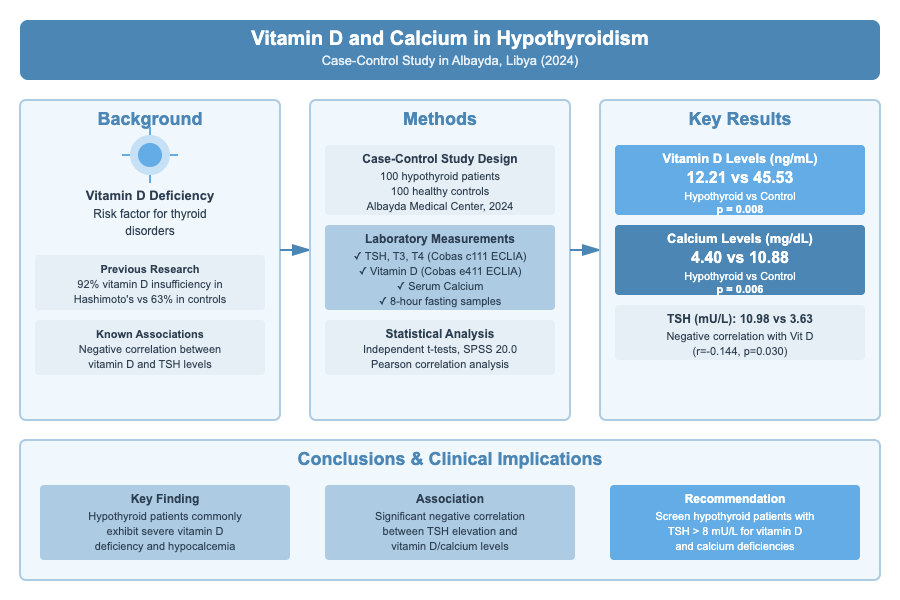
Objective Vitamin D is essential for the proper functioning of numerous organs, including the thyroid gland. For that reason, a deficiency in vitamin D is considered a potential risk factor for developing various thyroid disorders, particularly hypothyroidism. The present study aimed to evaluate the serum concentrations of vitamin D and calcium in individuals who have been diagnosed with primary hypothyroidism.
Methods The research was conducted on a cohort of 100 hypothyroid patients at the Department of Internal Medicine, Albayda Medical Center, in Albayda, Libya. Serum levels of vitamin D, calcium, and thyroid profiles (thyroid stimulating hormone (TSH), T3, and T4) were measured in all participants. A control group consisting of 100 healthy individuals was used for comparison. Statistical analysis was performed using SPSS software version 20.0 with independent t-tests and Pearson correlation analysis.
Results Our findings indicate that the serum levels of vitamin D and calcium were significantly lower among the hypothyroid group compared to the control group (12.21 ± 2.02 ng/mL and 4.40 ± 1.24 mg/dL vs 45.53 ± 10.51 ng/mL and 10.88 ± 1.45 mg/dL, p = 0.008 and 0.006, respectively). However, we noticed non-significant differences in changes in the serum levels of vitamin D and calcium between males and females in the hypothyroid group (p = 0.578 and 0.410, respectively). Pearson correlation analysis indicated that the TSH levels of the hypothyroid group had statistically significant negative correlations with the serum vitamin D and calcium levels (r = −0.144, p = 0.030 and r = −0.145, p = 0.029, respectively).
Conclusions Based on these results, it is strongly advised that individuals with hypothyroidism be screened for vitamin D and calcium deficiencies and, if necessary, receive appropriate supplementation.
References
Institute of Medicine (US) Committee to Review Dietary Reference Intakes for Vitamin D and Calcium. Dietary Reference Intakes for Calcium and Vitamin D. Ross AC, Taylor CL, Yaktine AL, Del Valle HB, editors. Washington (DC): National Academies Press (US); 2011. PMID: 21796828.
Kalpana CA, Babita Devi N, Ghosh S, Rashidinejad A. Vitamin D: Chemical Composition, Sources, Delivery, and Uses. Handbook of Food Bioactive Ingredients; 2023.
Bikle DD. Vitamin D: Production, metabolism, and mechanism of action. 2025 Jun 15. In: Feingold KR, Adler RA, Ahmed SF, Anawalt B, Blackman MR, Chrousos G, et al. editors. Endotext. South Dartmouth (MA): MDText.com; 2000–. PMID: 25905172.
Khan YS, Farhana A. Histology, thyroid gland. In: StatPearls. Treasure Island (FL): StatPearls Publishing; 2026.
Nussey S, Whitehead S. Endocrinology: An Integrated Approach. Chapter 3, The thyroid gland. Oxford: BIOS Scientific Publishers; 2001.
Młynarska E, Lisińska W, Hossa K, Krupińska N, Jakubowska P, Rysz J, Franczyk B. Vitamin D and chronic disorders: a review of metabolic and cardiovascular diseases. pharmaceuticals (Basel). 2025 Sep 29;18(10):1467.PubMed PMID: 41155582
Tang J, Shan S, Li F, Yun P. Effects of vitamin D supplementation on autoantibodies and thyroid function in patients with Hashimoto’s thyroiditis: a systematic review and meta-analysis. Medicine. 2023;102:e36759. PubMed PMID: 38206745
Todorova M, Gerova D. Vitamin D insufficiency/deficiency as a risk factor for Hashimoto’s thyroiditis. Clinica Chimica Acta. 2024;558:118165.
Khamisi S, Lundqvist M, Rasmusson AJ, Engström BE, Karlsson FA, Ljunggren Ö. Vitamin D and bone metabolism in Graves’ disease: a prospective study. J Endocrinol Invest. 2023;46:425-33.
Lanzolla G, Di Matteo L, Comi S, Cosentino G, Menconi F, Maglionico MN, et al. Absence of a relationship between vitamin D and Graves’ orbitopathy. J Endocrinol Invest. 2023;46:1717-21.
Appunni S, Rubens M, Ramamoorthy V, Saxena A, Tonse R, Veledar E, et al. Association between vitamin D deficiency and hypothyroidism: results from the National Health and Nutrition Examination Survey (NHANES) 2007-2012. BMC Endocr Disord. 2021;21:224. PubMed PMID: 34772378
Babić Leko M, Jureško I, Rozić I, Pleić N, Gunjača I, Zemunik T. Vitamin D and the thyroid: a critical review of the current evidence. Int J Mol Sci. 2023;24: 3586. PubMed PMID: 36835005
Ashok T, Palyam V, Azam AT, Odeyinka O, Alhashimi R, Thoota S, et al. Relationship between vitamin D and thyroid: an enigma. Cureus. 2022;7:267-75.
Li Q, Bi R. Relationship between serum 25-hydroxyvitamin D deficiency and thyroid disease in postmenopausal women with type 2 diabetes mellitus. Diabetes Metab Syndr Obes. 2023;16:1407-14.
Madkhali Y, Janakiraman B, Alsubaie F, Albalawi O, Alrashidy S, Alturki M, et al. Prevalence and trends of vitamin D deficiency in a Saudi Arabian population: a five-years retrospective study from 2017 to 2021. Front Public Health. 2025; 13:1535980. PubMed PMID: 40356842
Naseri M, Mohammadi MH, Soltani NN, Lashgari KH, Dehghani N. Prevalence of vitamin D deficiency and associate factors in healthy Iranian Children and adolescents: a systematic review. Health Provid. 2024;4:11-27.
Qanbar MM, Soylu S, Teksöz S. The effect of preoperative vitamin D values on hypocalcemia after total thyroidectomy. Turkish Journal of Surgery. 2024;40: 296-302.
Aghapour B, Kheirouri S, Alizadeh M, Khodayari‐Zarnaq R. Vitamin D deficiency prevention policies in Iran: a retrospective policy analysis. Front Nutr. 2023;10:1249402. PubMed PMID: 37680901
Salman S, Khouzami M, Harb M, Saleh B, Boushnak MO, Moussa MK, et al. Prevalence and predictors of vitamin D inadequacy: a sample of 2,547 patients in a mediterranean country. Cureus. 2021;13:e14881. PubMed PMID: 34104607
Faid FE, Alsheekh AM, Abais MF, Eljamay SM. Vitamin D deficiency relationship with age and gender. Derna Academy Journal for Applied Sciences. 2024;3:153-60.