Antimutagenic Potential of Piper sarmentosum Leaf Extracts: Insights from Culinary Preparation
DOI:
https://doi.org/10.12982/BSCM.2026.19Keywords:
P. sarmentosum, Wild betel, Salmonella mutation assay, antioxidant, antimutagenicityAbstract
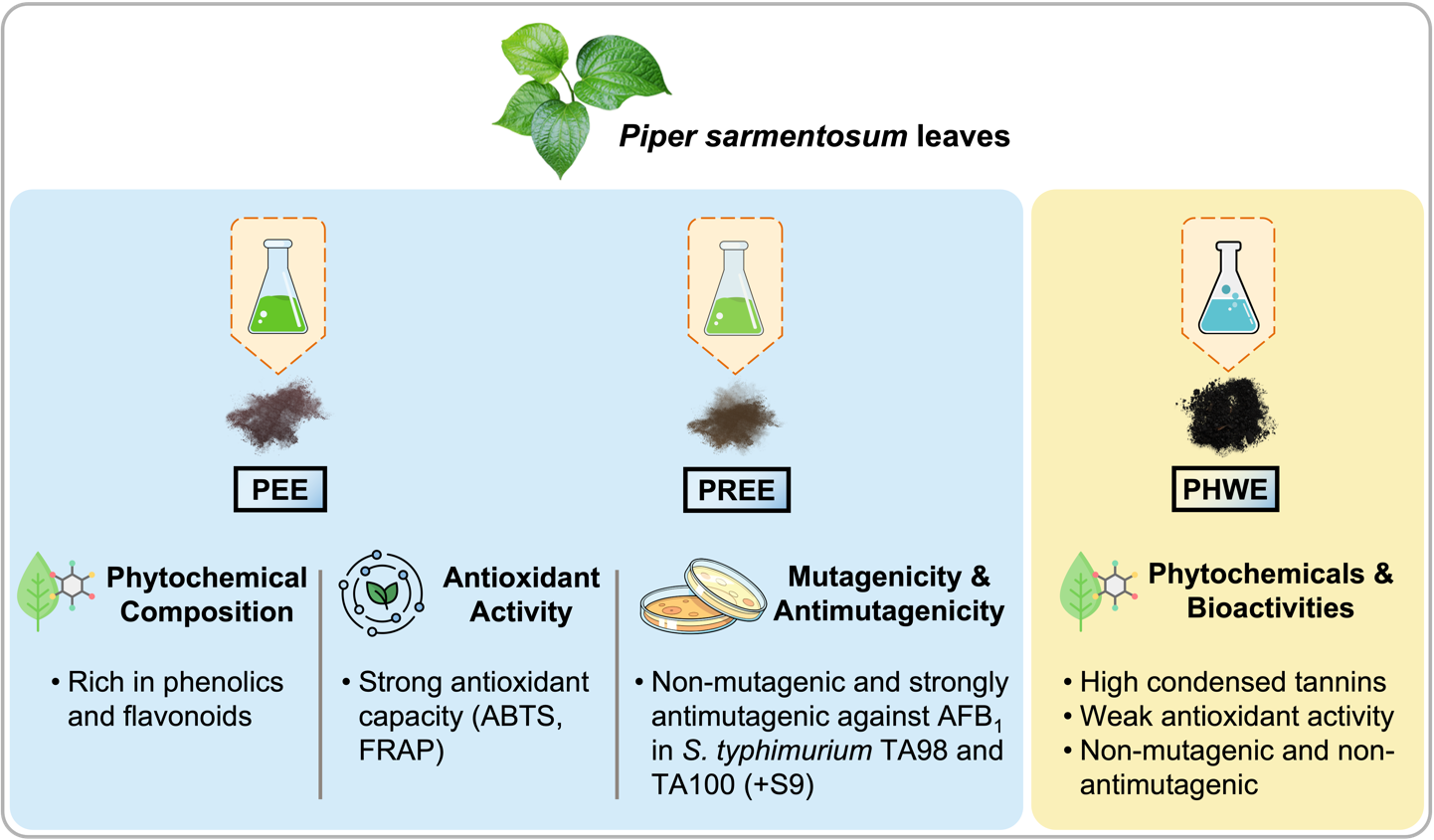
Objective Piper sarmentosum Roxb., a traditional vegetable in Lanna and Thai cuisine, is valued for its flavor but its health-promoting properties after cooking remain unclear. This study investigated the phytochemical profiles, antioxidant capacity, and mutagenicity of its leaf extracts prepared to mimic typical culinary practices.
Methods Three P. sarmentosum extracts were prepared: an ethanolic extract of uncooked leaves (PEE), a hot water extract simulating curry broth (PHWE), and an ethanolic extract of boiled leaf residues representing the cooked leaves in curry (PREE). Their chemical composition, antioxidant activity, and antimutagenic effects were evaluated.
Results The extracts showed distinct phytochemical patterns. PEE and PREE were rich in phenolics and flavonoids, yielding strong antioxidant activity in ABTS and FRAP assays. PHWE contained higher levels of condensed tannins, reflecting the extraction of water-soluble compounds. None of the extracts showed mutagenicity in the Salmonella assay. Notably, PEE and PREE displayed significant antimutagenic activity against aflatoxin B1 (AFB1) in Salmonella typhimurium strains TA98 and TA100 with metabolic activation.
Conclusions P. sarmentosum leaves retain considerable antioxidant and antimutagenic potential after cooking, highlighting their value as a safe and functional food ingredient with potential health benefits.
References
Buathong R, Duangsrisai S. Plant ingredients in Thai food: a well-rounded diet for natural bioactive associated with medicinal properties. PeerJ. 2023;11:e14568. PubMed PMID: 36879911
Chanwitheesuk A, Teerawutgulrag A, Rakariyatham N. Screening of antioxidant activity and antioxidant compounds of some edible plants of Thailand. Food Chem. 2005;92:491-7.
Sanusi NA, Umar RA, Zahary MN, Rohin MAK, Pauzi MR, Ismail S. Chemical compositions and antimicrobial properties of Piper sarmentosum—a review. IOSR-JDMS. 2017;16:62-5.
Yeo ETY, Wong KWL, See ML, Wong KY, Gan SY, Chan EWL. Piper sarmentosum Roxb. confers neuroprotection on beta-amyloid (A)-induced microglia-mediated neuroinflammation and attenuates tau hyperphosphorylation in SH-SY5Y cells. J Ethnopharmacol. 2018;217:187-94.
Sun X, Chen W, Dai W, Xin H, Rahmand K, Wang Y, et al. Piper sarmentosum Roxb.: A review on its botany, traditional uses, phytochemistry, and pharmacological activities. J Ethnopharmacol. 2020;263:112897. PubMed PMID: 32620264
Nguyen N, Nguyen V, Van N, Vo T, editors. Bioactive compounds and antioxidant activity of leaves from Piper sarmentosum piperaceae. IOP Conference Series: Materials Science and Engineering. 2020; 991:012028. IOP Publishing.
Ismail SM, Chua KH, Aminuddin A, Ugusman A. Piper sarmentosum as an antioxidant: A systematic review. Sains Malays. 2018.
Liao C-Y, Lee C-C, Tsai C-c, Hsueh C-W, Wang C-C, Chen I, et al. Novel investigations of flavonoids as chemopreventive agents for hepatocellular carcinoma. Biomed Res Int. 2015;2015:840542. PubMed PMID: 26858957
Chanprapai P, Chavasiri W. Antimicrobial activity from Piper sarmentosum Roxb. against rice pathogenic bacteria and fungi. J Integr Agric. 2017;16:2513-24.
Ware I, Franke K, Dube M, Ali El Enshasy H, Wessjohann LA. Characterization and bioactive potential of secondary metabolites isolated from Piper sarmentosum Roxb. Int J Mol Sci. 2023;24: 1328. PubMed PMID: 36674844
Md Salleh M, Aminuddin A, Hamid AA, Salamt N, Japar Sidik FZ, Ugusman A. Piper sarmentosum Roxb. attenuates vascular endothelial dysfunction in nicotine-induced rats. Front Pharmacol. 2021;12:667102. PubMed PMID: 34194328
Akmal MN, Abdel Aziz I, Nur Azlina MF. Piper sarmentosum Roxb. methanolic extract prevents stress-induced gastric ulcer by modulating oxidative stress and inflammation. Front Pharmacol. 2022;13:971443. PubMed PMID: 36712695
Zakaria ZA, Patahuddin H, Mohamad AS, Israf DA, Sulaiman MR. In vivo anti-nociceptive and anti-inflammatory activities of the aqueous extract of the leaves of Piper sarmentosum. J Ethnopharmacol. 2010;128:42-8.
Ugusman A, Zakaria Z, Hui CK, Nordin NA, Mahdy ZA. Flavonoids of Piper sarmentosum and its cytoprotective effects against oxidative stress. EXCLI J. 2012;11:705-14.
Tammasakchai A, Peungvicha P, Temsiririrkkul R, Siripong P, Puchadapirom P. Non-mutagenic and genotoxic effects of water extract of Piper sarmentosum using Ames and micronucleus assay. Songklanakarin J Sci Technol. 2021;43:203-9.
Chaiwangyen W, Khantamat O, Pintha K, Kangwan N, Onsa-Ard A, Nuntaboon P, et al. Cleistocalyx nervosum var. paniala mitigates oxidative stress and inflammation induced by PM(10) soluble extract in trophoblast cells via miR-146a-5p. Sci Rep. 2024;14:24265. PubMed PMID: 39414845
Kalaji HM, Dąbrowski P, Cetner MD, Samborska IA, Łukasik I, Brestic M, et al. A comparison between different chlorophyll content meters under nutrient deficiency conditions. J Plant Nutr. 2017;40:1024-34.
Inboot W, Taya S, Chailungka A, Meepowpan P, Wongpoomchai R. Genotoxicity and antigenotoxicity of the methanol extract of Cleistocalyx nervosum var. paniala seed using a Salmonella mutation assay and rat liver micronucleus tests. Mol Cell Toxicol. 2012;8:19-24.
Suttisansanee U, Thiyajai P, Chalermchaiwat P, Wongwathanarat K, Pruesapan K, Charoenkiatkul S, et al. Phytochemicals and in-vitro bioactivities of aqueous ethanolic extracts from common vegetables in Thai food. Plants. 2021;10:1563. PubMed PMID: 34451608
Pontiki E, Hadjipavlou-Litina D, Litinas K, Geromichalos G. Novel cinnamic acid derivatives as antioxidant and anticancer agents: design, synthesis and modeling studies. Molecules. 2014;19:9655-74.
Kashyap P, Shikha D, Thakur M, Aneja A. Functionality of apigenin as a potent antioxidant with emphasis on bioavailability, metabolism, action mechanism and in-vitro and in-vivo studies: A review. J Food Biochem. 2022;46:e13950. PubMed PMID: 34569073
Salehi B, Venditti A, Sharifi-Rad M, Kręgiel D, Sharifi-Rad J, Durazzo A, et al. The therapeutic potential of apigenin. Int J Mol Sci. 2019;20:1305. PubMed PMID: 30875872
Purba RAP, Paengkoum S, Paengkoum P. Development of a simple high-performance liquid chromatography-based method to quantify synergistic compounds and their composition in dried leaf extracts of Piper sarmentosum Roxb. Separations. 2021;8:152.
Ferruzzi MG, Blakeslee J. Digestion, absorption, and cancer preventative activity of dietary chlorophyll derivatives. Nutr Res. 2007;27:1-12.
Galasso C, Corinaldesi C, Sansone C. Carotenoids from marine organisms: Biological functions and industrial applications. Antioxidants. 2017;6:96. PubMed PMID: 29168774
Munteanu IG, Apetrei C. Analytical methods used in determining antioxidant activity: A review. Int J Mol Sci. 2021;22:3380. PubMed PMID: 33806141
Słoczyńska K, Powroźnik B, Pękala E, Waszkielewicz AM. Antimutagenic compounds and their possible mechanisms of action. J Appl Genet. 2014;55:273-85.
Guzelmeric E, Sipahi H, Ozhan Y, Hamitoglu M, Helvacioglu S, Duz G, et al. Comprehensive estrogenic/anti-estrogenic, anticancer, mutagenic/anti-mutagenic, and genotoxic/anti-genotoxic activity studies on chemically characterized black poplar and Eurasian aspen propolis types. J Pharm Biomed Anal. 2023;226:115241. PubMed PMID: 36641962
Choi K-C, Lee B-S, Chung W-T, Choi M-S, Lee J-C. Protective effects of apigenin and quercetin on aflatoxin B1-induced immunotoxicity in mice. Food Sci Biotechnol. 2010;19:987-92.
Owumi SE, Ajakaiye B, Akinwunmi AO, Nwozo SO, Oyelere AK. The hydrophobic extract of Sorghum bicolor (L. Moench) enriched in apigenin-protected rats against Aflatoxin B(1)-associated hepatorenal derangement. Molecules. 2023;28:3013. PubMed PMID: 37049776
De Mejía EG, Ramos‐Gómez M, Loarca‐Piña G. Antimutagenic activity of natural xanthophylls against aflatoxin B1 in Salmonella typhimurium. Environmental and Molecular Mutagenesis. 1997;30:346-53.
Bhattacharya S. Natural antimutagens: a review. J Med Plants Res. 2011;5:116-26.
Joshi T, Deepa PR, Sharma PK. Effect of different proportions of phenolics on antioxidant potential: pointers for bioactive synergy/antagonism in foods and nutraceuticals. Proceedings of the National Academy of Sciences, India Section B: Biol Sci. 2022;92:939-46.