Pseudomonas Putida Bacteraemia in a Haemodialysis Patient from Karnataka, India: A Rare Case Report
DOI:
https://doi.org/10.12982/BSCM.2026.40Keywords:
bacteraemia, chronic kidney disease, haemodialysis, opportunistic infection, Pseudomonas putidaAbstract
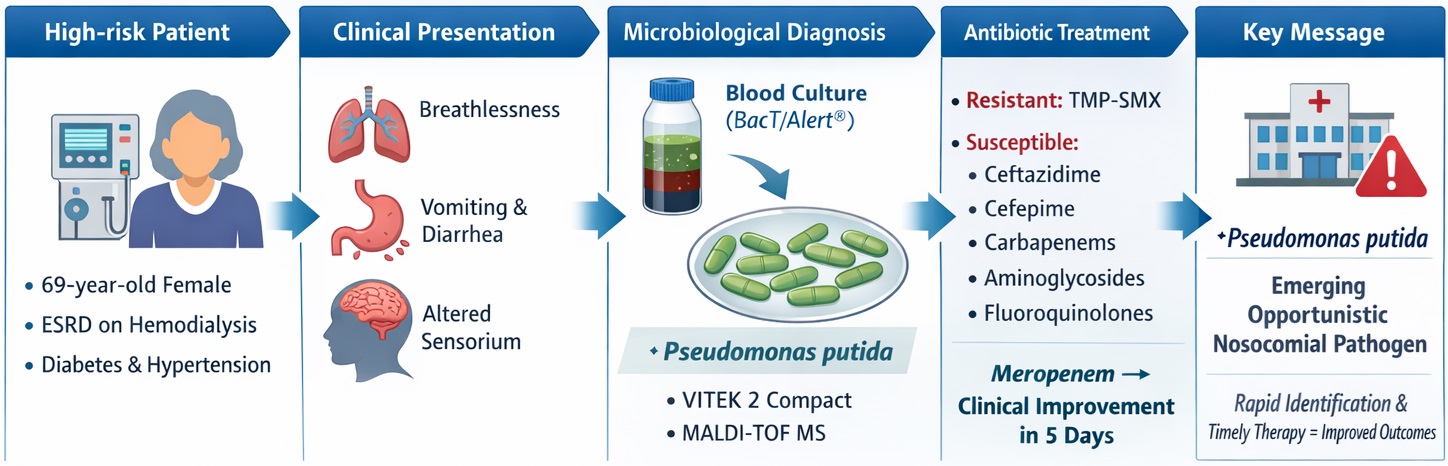
Pseudomonas putida is a Gram-negative, non-fermenting bacillus traditionally considered a low-virulence environmental organism, but increasingly recognized as an emerging opportunistic pathogen in healthcare settings. Infections are most often reported in immunocompromised patients, particularly those with end-stage renal disease (ESRD), diabetes, malignancies, or indwelling medical devices. We report a case of P. putida bacteremia in a 69-year-old female with ESRD on maintenance haemodialysis, type 2 diabetes mellitus, and hypertension, who presented with acute breathlessness, vomiting, diarrhea, and altered sensorium. Blood cultures performed using the BacT/Alert® system grew P. putida, confirmed by VITEK 2 Compact and MALDI-ToF. The isolate was resistant to trimethoprim/sulfamethoxazole but remained susceptible to ceftazidime, cefepime, carbapenems, aminoglycosides, and fluoroquinolones. Empiric meropenem therapy was continued upon identification, leading to marked clinical improvement within five days. Four cycles of haemodialysis were administered; however, the patient was discharged against medical advice due to financial constraints, and follow-up cultures could not be obtained. This case underscores the clinical significance of P. putida as an emerging nosocomial pathogen in patients with multiple comorbidities. Rapid identification, timely initiation of effective empiric therapy, and antimicrobial stewardship are essential to improve patient outcomes and mitigate complications, particularly as multidrug-resistant strains of P. putida are increasingly reported worldwide.
References
Peter S, Oberhettinger P, Schuele L, Dinkelacker A, Vogel W, Dörfel D, et al. Genomic characterisation of clinical and environmental Pseudomonas putida group strains and determination of their role in the transfer of antimicrobial resistance genes to Pseudomonas aeruginosa. BMC Genomics. 2017;18:859. PubMed PMID: 29126393
Rodriguez A, Escobar S, Gomez E, Santos VE, Garcia-Ochoa F. Behavior of several Pseudomonas putida strains growth under different agitation and oxygen supply conditions. Biotechnol Prog. 2018;34:900-9.
Devarajan N, Köhler T, Sivalingam P, van Delden C, Mulaji CK, Mpiana PT, et al. Antibiotic resistant Pseudomonas spp. in the aquatic environment: A prevalence study under tropical and temperate climate conditions. Water Res. 2017;115:256-65.
Tan G, Xi Y, Yuan P, Sun Z, Yang D. Risk factors and antimicrobial resistance profiles of Pseudomonas putida infection in Central China, 2010-2017. Medicine (Baltimore). 2019;98:e17812. PubMed PMID: 31689866
Rowe D, Patel S, Lakhmani V, Patel H. A rare presentation of Pseudomonas putida bacteremia secondary to skin and soft tissue infection. J Community Hosp Intern Med Perspect. 2025;15:115-7.
Shriwastav VR, Rathi P, Siddiqui KA. A rare case of Pseudomonas putida bacteremia in a patient with cirrhosis of liver. J Assoc Physicians India. 2024;72:98-9.
Liu H, Li S, Xie X, Shi Q. Pseudomonas putida actively forms biofilms to protect the population under antibiotic stress. Environ Pollut. 2021;270:116261. PubMed PMID: 33359874
Clinical and Laboratory Standards Institute (CLSI). Performance Standards for Antimicrobial Susceptibility Testing. 34th ed. CLSI supplement M100. Wayne, PA: CLSI; 2024.
Singh P, Montano A, Bostick A. Rapid severe sepsis from Pseudomonas fluorescens/putida bacteremia due to skin and soft tissue infection – a case report. Ann Med Surg (Lond). 2021 ;70:102845. PubMed PMID: 34540222
Yoshino Y, Kitazawa T, Kamimura M, Tatsuno K, Ota Y, Yotsuyanagi H. Pseudomonas putida bacteremia in adult patients: five case reports and a review of the literature. J Infect Chemother. 2011;17:278-82.
Fanelli F, Caputo L, Quintieri L. Phenotypic and genomic characterization of Pseudomonas putida ITEM 17297 spoiler of fresh vegetables: Focus on biofilm and antibiotic resistance interaction. Curr Res Food Sci. 2021;4:74-82.
Salabei JK, Fishman TJ, Marachi A, Lopez VM, Bazikian Y, Calestino M. Bullous cellulitis caused by Pseudomonas putida in a patient with end-stage renal disease. IDCases. 2020;20:e00735. PubMed PMID: 32154107
Baykal H, Çelik D, Ülger AF, Vezir S, Güngör MÖ. Clinical features, risk factors, and antimicrobial resistance of pseudomonas putida isolates. Medicine (Baltimore). 2022 Dec 2;101:e32145. PubMed PMID: 36482647
Usta Atmaca H, Akbas F. A extensively drug-resistant Pseudomonas putida bacteremia that was resolved spontaneously. J Infect Dev Ctries. 2019;13:577-580.
Petrova A, Ivanov IN, Paunov L, Uchikov A, Stoikov I, Kantardjiev T, et al. First VIM-producing representative of Pseudomonas putida group from the largest Bulgarian hospital. Folia Med (Plovdiv). 2024;66:905-10.
Baran W, Adamek E, Ziemiańska J, Sobczak A. Effects of the presence of sulfonamides in the environment and their influence on human health. J Hazard Mater. 2011;196:1-15.
Cortazzo V, Agosta M, Gaspari S, Vrenna G, Lucignano B, Onori M, et al. First case of VIM-1-like-producing Pseudomonas putida bacteremia in an oncohematological pediatric patient in Italy. Antibiotics (Basel). 2023;12:1033. PubMed PMID: 37370352