Biochemical and Genetic Determinants of Early Cardiovascular and Hepatic Dysfunction: A Focus on ADIPOQ Expression
DOI:
https://doi.org/10.12982/BSCM.2026.17Keywords:
ADIPOQ Gene Expression, Adiponectin, non-alcoholic fatty liver disease, cardiovascular disease, inflammationAbstract
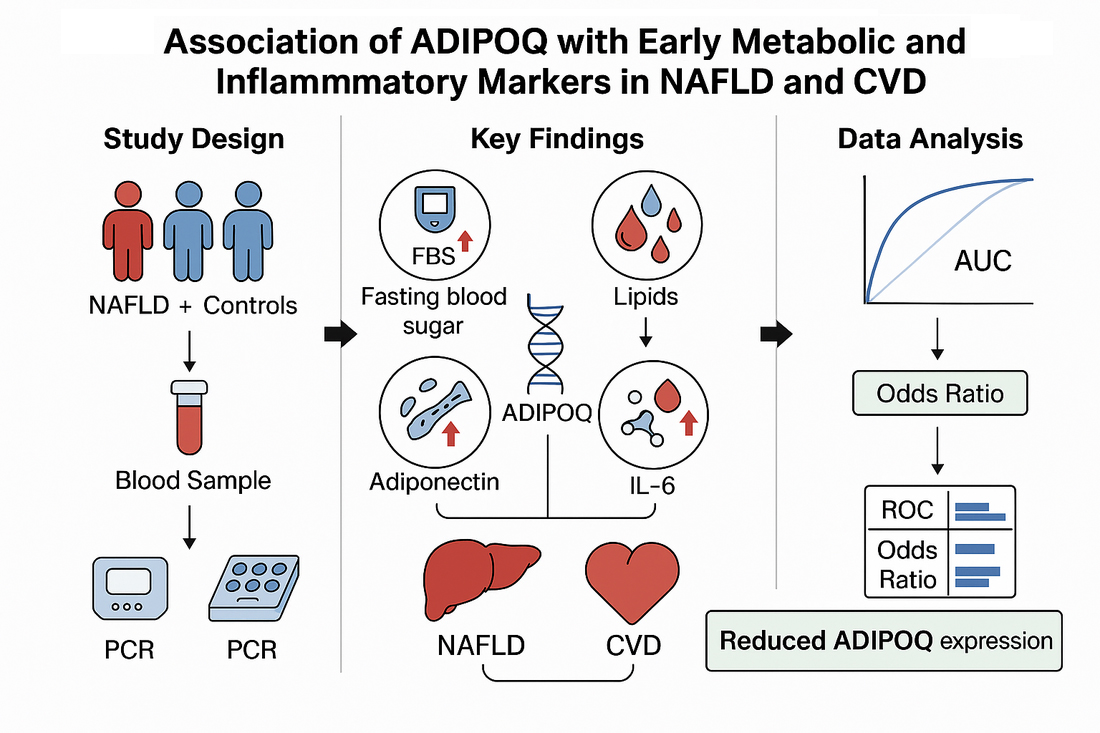
Objective Non-alcoholic fatty liver disease (NAFLD) and cardiovascular disease (CVD) frequently coexist due to common metabolic dysfunctions such as insulin resistance, chronic inflammation, and dyslipidemia. Adipo-nectin, encoded by the ADIPOQ gene, is an anti-inflammatory adipokine vital for glucose and lipid regulation. Reduced adiponectin levels and certain ADIPOQ gene variants (e.g., rs266729, rs2241766) have been linked to both NAFLD and CVD progression. This study aims to evaluate the association between ADIPOQ gene expression and early biochemical markers of hepatic and cardiovascular dysfunction.
Methods A case-control study (n = 300) was conducted in Thiruvananthapuram, Kerala, India (2022-2024), analyzing blood samples for fasting blood sugar (FBS), lipid profile, malondialdehyde (MDA), interleukin-6 (IL-6), and ADIPOQ expression (RT-PCR). Statistical analyses included receiver operating characteristic (ROC) curves and quantile regression using Stata 17.0.
Results Cases exhibited significantly elevated FBS, triglycerides (TG), low-density lipoprotein (LDL), MDA, and IL-6, along with reduced high- density lipoprotein (HDL) and adiponectin levels (p < 0.05). ADIPOQ gene expression was markedly downregulated, particularly in individuals with both NAFLD and CVD. A positive correlation was observed between ADIPOQ expression and HDL, and a negative correlation with IL-6. Reduced ADIPOQ expression showed an association with risk in unadjusted analysis, but this association was not statistically significant after adjustment (OR = 0.0220). Nevertheless, ROC analysis indicated potential diagnostic utility.
Conclusions Reduced ADIPOQ expression is significantly associated with early metabolic and inflammatory markers in NAFLD and CVD. These findings highlight the potential utility of ADIPOQ as a biomarker for early detection and targeted prevention strategies in at-risk populations.
References
Younossi ZM, Zelber-Sagi S, Henry L, Gerber LH. Lifestyle interventions in nonalcoholic fatty liver disease. Nat Rev Gastroenterol Hepatol. 2023;20:708-22.
Polyzos SA, Mousiolis A, Mintziori G, Goulis DG. Nonalcoholic fatty liver disease in males with low testosterone concentrations. Diabetes Metab Syndr. 2020; 14:1571-7.
Pehlivan S, Senkal N, Oyaci Y, Kose M, Pehlivan M, Hasanoglu Sayin S, Medetalibeyoglu A, Serin I, Tukek T. Metabolic syndrome and effect of gene polymorphisms: ADIPOQ, AGT, AGTR1, AGTR2, ApoC-III, NR3C1 and GNB3 gene polymorphisms. Mol Biol Rep. 2025;52:422. PubMed PMID: 40272664
Zheng H, Sechi LA, Navarese EP, Casu G, Vidili G. Metabolic dysfunction-associated steatotic liver disease and cardiovascular risk: a comprehensive review. Cardiovasc Diabetol. 2024;23:346. PubMed PMID: 39342178
Chait A, Den Hartigh LJ. Adipose tissue distribution, inflammation and its metabolic consequences, including diabetes and cardiovascular disease. Front Cardiovasc Med. 2020;7:522637. PubMed PMID: 32158768
Lee TB Jr, Kueh MT, Jain V, Razavi AC, Alebna P, Chew NW, Mehta A. Biomarkers of hepatic dysfunction and cardiovascular risk. Curr Cardiol Rep. 2023;25:1783-95.
Wang MJ, Zhang HL, Chen F, Guo XJ, Liu QG, Hou J. The double-edged effects of IL-6 in liver regeneration, aging, inflammation, and diseases. Exp Hematol Oncol. 2024;13:62. PubMed PMID: 38890694
Saki S, Saki N, Poustchi H, Malekzadeh R. Assessment of genetic aspects of non-alcoholic fatty liver and premature cardiovascular events. Middle East J Dig Dis. 2020;12:65-88.
Gruzdeva OV, Dyleva YA, Belik EV, Sinitsky MY, Kozyrin KA, Barbarash OL. Characteristics of adipocytokine expression by local fat depots of the heart: Relationship with the main risk factors for cardiovascular diseases. Front Endocrinol (Lausanne). 2022;13:991902. PubMed PMID: 36157437
Błażejewska W, Dąbrowska J, Michałowska J, Bogdański P. The Role of Adiponectin and ADIPOQ Variation in Metabolic Syndrome: A Narrative Review. Genes. 2025;16:699. PubMed PMID: 40565591
de Luis Roman D, Izaola Jauregui O, Primo Martin D. The polymorphism rs17300539 in the adiponectin promoter gene is related to metabolic syndrome, insulin resistance, and adiponectin levels in Caucasian patients with obesity. Nutrients. 2023;15:5028. PubMed PMID: 38140287
Meshkani R, Adeli K. Hepatic insulin resistance, metabolic syndrome, and cardiovascular disease. Clin Biochem. 2009;42:1331-46.
Zhang S, Hong F, Ma C, Yang S. Hepatic lipid metabolism disorder and atherosclerosis. Endocr Metab Immune Disord Drug Targets. 2022;22:590-600.
Kim EJ, Kim BH, Seo HS, Lee YJ, Kim HH, Son HH, Choi MH. Cholesterol-induced non-alcoholic fatty liver disease and atherosclerosis aggravated by systemic inflammation. PLoS One. 2014;9:e97841. PubMed PMID: 24901254
Banerjee P, Gaddam N, Chandler V, Chakraborty S. Oxidative stress-induced liver damage and remodeling of the liver vasculature. Am J Pathol. 2023;193: 1400-14.
Vairappan B. Endothelial dysfunction in cirrhosis: Role of inflammation and oxidative stress. World J Hepatol. 2015;7:443-59.
Méndez-Sánchez N, Chávez-Tapia NC, Villa AR, Sánchez-Lara K, Zamora-Valdés D, Ramos MH, Uribe M. Adiponectin as a protective factor in hepatic steatosis. World J Gastroenterol. 2005;11(12):1737. PubMed PMID: 15793855
Matsuda M, Shimomura I. Roles of adiponectin and oxidative stress in obesity-associated metabolic and cardiovascular diseases. Rev Endocr Metab Disord. 2014;15:1-10. PubMed PMID: PMID: 24026768
Okamoto Y. Adiponectin provides cardiovascular protection in metabolic syndrome. Cardiol Res Pract. 2011;2011:313179. PubMed PMID: PMID: 21318102