Prediction of Low Birth Weight From Quadruple Screening in Sanpatong Hospital, Chiang Mai
DOI:
https://doi.org/10.12982/BSCM.2026.45Keywords:
low birth weight, quadruple test, prediction model, alpha- fetoprotein, β-hCGAbstract
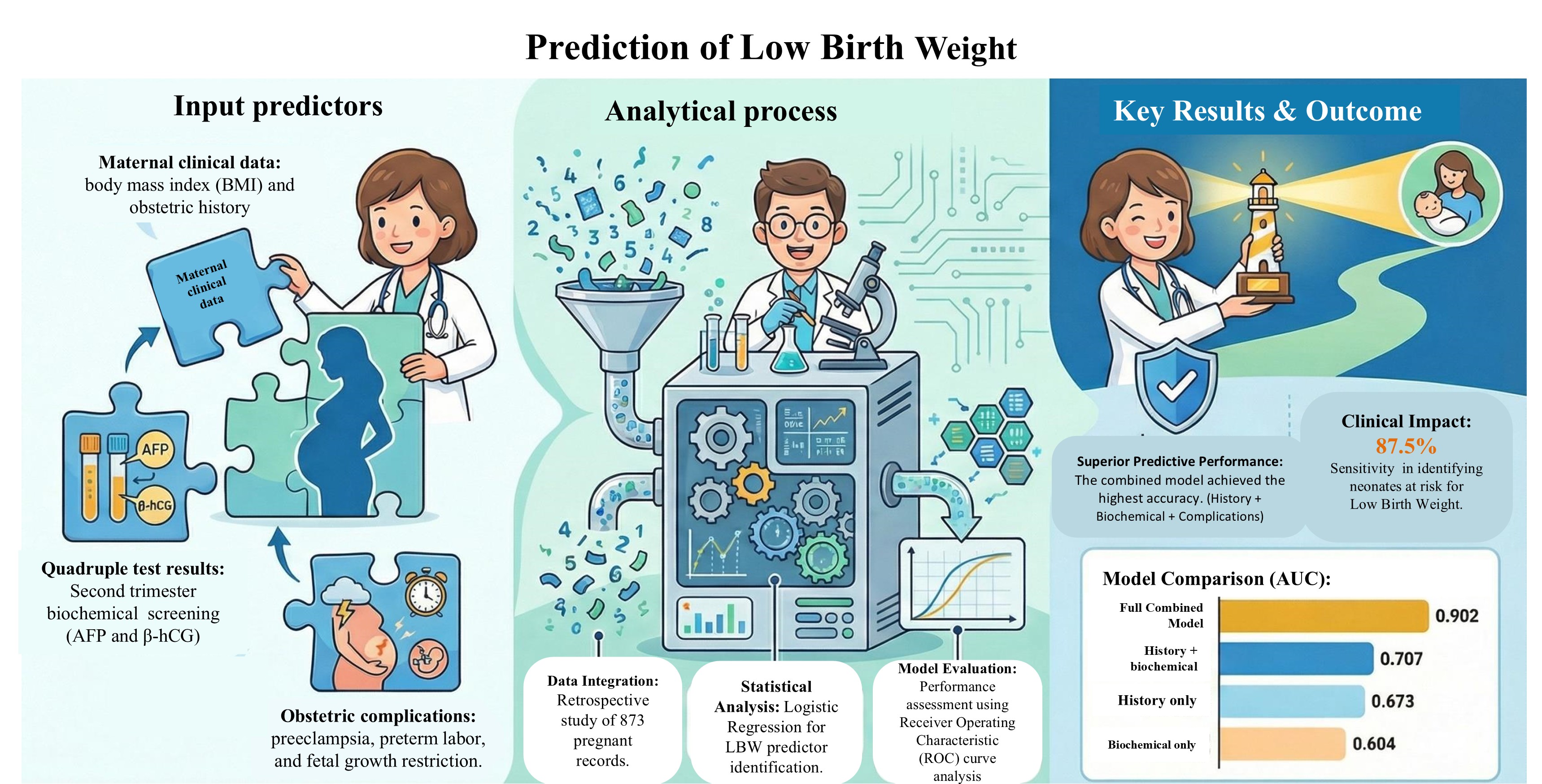
Objective This study aimed to develop a predictive model for low birth weight (LBW) using maternal history and the second trimester biochemical quadruple screening test in singleton pregnancies delivered at Sanpatong Hospital, Chiang Mai, Thailand.
Methods: This retrospective cohort study collected data from medical records of 873 singleton pregnancy women who underwent the quadruple test at 14-16 weeks of gestation and delivered at Sanpatong Hospital between October 1, 2016, and September 30, 2023. Data collected included maternal characteristics, quadruple test results, obstetric complications, and birth weight. Multivariable logistic regression was used to analyze associations between various factors and LBW. Model performance was evaluated using receiver operating characteristic (ROC) curve analysis.
Results: The incidence of LBW was 6.76% (59 out of 873 deliveries). Significant factors associated with LBW in multivariable analysis included maternal body mass index (BMI) (AOR = 0.924, p = 0.018), nulliparity (AOR = 0.524, p = 0.021), high-risk quadruple test for aneuploidy (AOR = 16.061, p = 0.006), preeclampsia (AOR = 3.573, p = 0.007), preterm labor (AOR = 36.526, p < 0.001), fetal growth restriction (AOR=45.726, p < 0.001), MoM of AFP (AOR = 2.598, p = 0.001), and MoM of -hCG (AOR = 1.352, p = 0.003). Four predictive models were developed: history-only (AUC = 0.673), biochemical-only (MoM of AFP and -hCG; AUC = 0.604), a combined model (history + biochemical; AUC = 0.707), and a full combined model (history + biochemical + complication; AUC = 0.902). The full combined model demonstrated superior performance in predicting LBW.
Conclusions: The full combined model incorporating clinical history and quadruple test biochemical markers (AFP and -hCG) effectively predicts LBW. These findings suggest the potential for early identification of at-risk pregnancies, enabling timely interventions to improve maternal and neonatal outcomes.
References
World Health Organization. Global nutrition targets 2025: low birth weight policy brief (WHO/NMH/NHD/14.5). Geneva: World Health Organization; 2014.
Khunpradit S. Low birthweight: Fetal origins of adult disease. Chula Med J. 2004;48:309-22.
Department of Health, Ministry of public health, Thailand. Low birth weight rate by health region [Internet]. 2023 [cited 2024 Jul, 16]. Available from: https://dashboard.anamai.moph.go.th/dashboard/lbwr/index?year=2022
Malhotra J, Garg R. Understanding biochemical markers for antenatal screening. Donald School J Ultrasound Obstet Gynecol. 2010;4:333-5.
Afaya A, Adongo AR, Azongo TB, Yakong VN, Konlan KD, Agbinku E, et al. Maternal risk factors and neonatal outcomes associated with low birth weight in a secondary referral hospital in Ghana. Heliyon. 2021;7:e06962. PubMed PMID: 34007935
Ashraf T, Hanif A, Naing NN, Wan-Afah N. Prevalence and risk factors of low birth weight: A systematic review. Sci Int (Lahore). 2020;32:621–5.
K C A, Basel PL, Singh S. Low birth weight and its associated risk factors: Health facility-based case-control study. PLoS One. 2020;15:e0234907.
Committee on Practice Bulletins—Obstetrics, Committee on Genetics, and Society for Maternal-Fetal Medicine. Screening for fetal chromosome abnormalities. Obstet Gynecol. 2020;136:e48–e69.
Suwanwanich M. Predicting adverse pregnancy outcomes based on maternal serum markers in quad test. Biomed Sci Clin Med. 2023;62:46-51.
Krantz D, Hallahan T, Janik D, Carmichael J. Maternal serum screening markers and adverse outcome: A new perspective. J Clin Med. 2014;3:693-712.
Karlı P, Ayan D, Guner E, Ozdemir AZ, Kara OF. The role of 2nd trimester screening test parameters in predicting the birth weight in pregnancy. JOJ Case Stud. 2018;8:555738.
Puntachai P, Wanapirak C, Sirichotiyakul S, Tongprasert F, Srisupundit K, Luewan S, et al. Associations between pregnancy outcomes and unexplained high and low maternal serum alpha-fetoprotein levels. Arch Gynecol Obstet. 2015;292:81-5.
Pradhan A, Mishra P, Tiwari S, Gupta A. Prediction of low birth weight by quadruple parameters in high-risk pregnancies. Int J Appl Basic Med Res. 2022;12:277-83.
Yazdani S, Rouholahnejad R, Asnifi N, Sharbatdaran M, Zakershob M, Bouzari Z. Correlation of pregnancy outcome with quadruple screening test at second trimester. Med J Islam Repub Iran. 2015;29:281.