Multimode Evaluation of Pulmonary Rehabilitation in Newly Diagnosed Tuberculosis Patients using chest imaging, Respiratory Culture-Based Microbiome Profiling, and Inflammatory Biomarkers
DOI:
https://doi.org/10.12982/BSCM.2026.21Keywords:
pulmonary rehabilitation, tuberculosis, inflammatory biomarkers, microbiome, lung function, exercise capacityAbstract
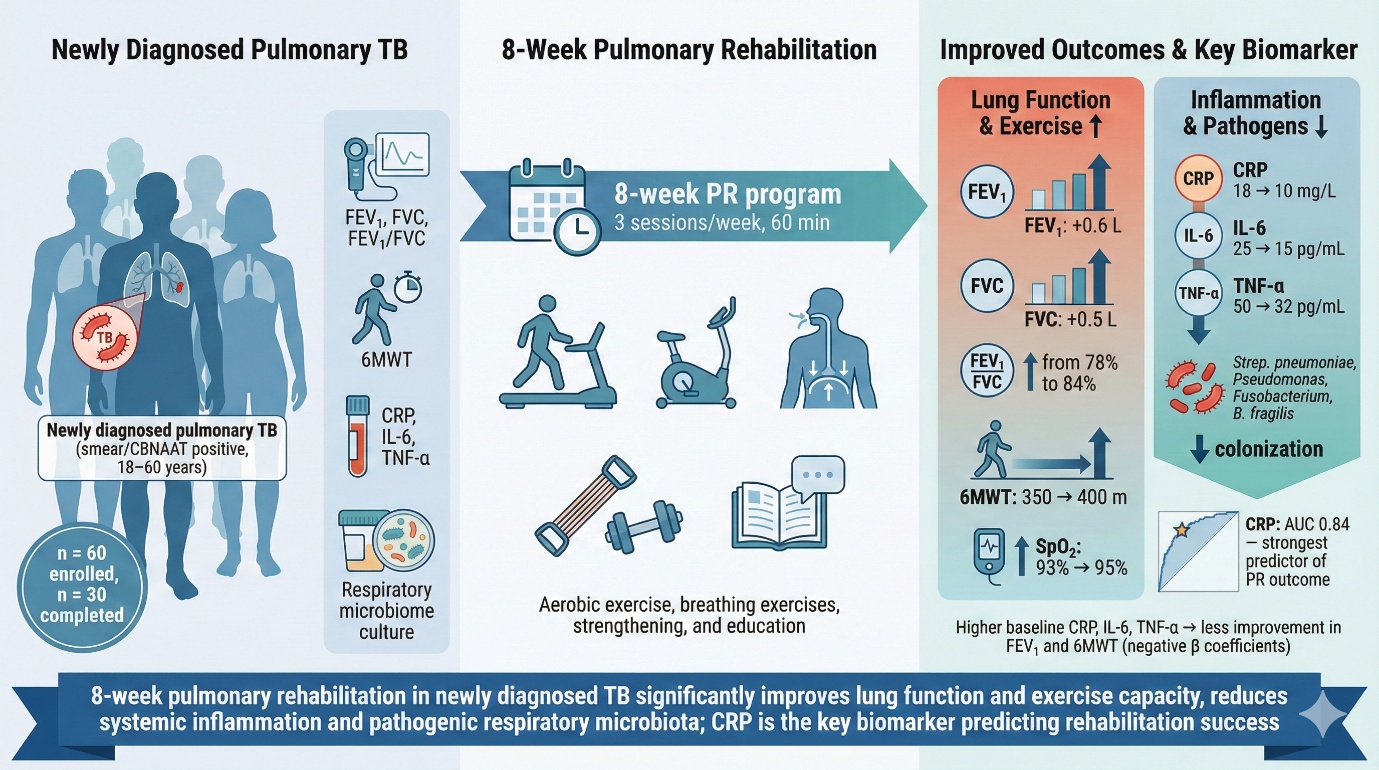
Objective Pulmonary rehabilitation (PR) plays a vital role in enhancing lung function and exercise capacity in individuals with pulmonary conditions. This study evaluated the clinical effectiveness of an 8-week PR program in newly diagnosed pulmonary tuberculosis (TB) patients through the assessment of lung function, exercise capacity, inflammatory biomarkers, and respiratory microbiome changes.
Methods Sixty newly diagnosed TB patients were enrolled, with 30 completing the 8-week PR program. Pulmonary function (FEV1, FVC, FEV1/FVC) and exercise capacity (6-minute walk test, 6MWT) were measured before and after PR. Inflammatory biomarkers (CRP, IL-6, TNF-a) and sputum microbiome profiles were assessed. ROC curves and multiple
regression models identified biomarkers that were predictive of functional improvement.
Results PR led to significant improvements: FEV1 increased from 2.50 ± 0.60 L to 3.10 ± 0.50 L (p < 0.001), FVC from 3.20 ± 0.70 L to 3.70 ± 0.60 L (p = 0.002), and 6MWT distance from 350.00 ± 40.00 m to 400.00 ± 50.00 m (p = 0.003). Oxygen saturation improved from 93.00 ± 2.00% to 95.00 ± 1.00% (p = 0.022). Inflammatory markers decreased significantly: CRP 18.00 ± 7.00 to 10.00 ± 5.00 mg/L (p < 0.001), IL-6 25.00 ± 8.00 to 15.00 ± 6.00 pg/mL (p < 0.001), and TNF- 50.00 ± 20.00 to 32.00 ± 15.00 pg/mL (p = 0.002). ROC analysis identified CRP as the strongest predictor of improvement (AUC = 0.84). Multiple regression confirmed CRP as an independent predictor of lung function and exercise capacity gains.
Conclusions An 8-week PR program significantly improved lung function, exercise capacity, and reduced systemic inflammation in TB patients, with CRP emerging as a key biomarker for predicting rehabilitation outcomes.
References
Singh S, Zahiruddin QS, Lakhanpal S, Ballal S, Kumar S, Bhat M, et al. Wealth-based inequalities in tuberculosis prevalence among households having children and young adults in India: insights from Indian demographic and health surveys (2015-2021). BMC Infect Dis. 2025;25:21. PubMed PMID: 39755594
Gai X, Allwood B, Sun Y. Post-tuberculosis lung disease and chronic obstructive pulmonary disease. Chin Med J (Engl). 2023;136:1923-8.
Nightingale R, Carlin F, Meghji J, McMullen K, Evans D, van der Zalm MM, et al. Post-TB health and wellbeing. Int J Tuberc Lung Dis. 2023;27:248-83.
Tonga KO, Oliver BG. Effectiveness of pulmonary rehabilitation for chronic obstructive pulmonary disease therapy: focusing on traditional medical practices. J Clin Med. 2023;12:4815. PubMed PMID: 37510930
Chen H, Qi T, Guo S, Zhang X, Zhan M, Liu S, et al. Integrating respiratory microbiome and host immune response through machine learning for respiratory tract infection diagnosis. NPJ Biofilms Microbiomes. 2024;10:83. PubMed PMID: 39266570
Pollock A, Baer G, Campbell P, Choo PL, Forster A, Morris J, et al. Physical rehabilitation approaches for the recovery of function and mobility following stroke. Cochrane Database Syst Rev. 2014;2014:CD001920. PubMed PMID: 24756870
Mehrholz J, Thomas S, Elsner B. Treadmill training and body weight support for walking after stroke. Cochrane Database Syst Rev. 2017;8(8):CD002840. PubMed PMID: 28815562
Salisbury DL, Whipple MO, Burt M, Brown R, Mays RJ, Bakken M, et al. Experience implementing supervised exercise therapy for peripheral artery disease. J Clin Exerc Physiol. 2019;8:1-12.
Graham BL, Steenbruggen I, Miller MR, Barjaktarevic IZ, Cooper BG, Hall GL, et al. Standardization of Spirometry 2019 Update. An Official American Thoracic Society and European Respiratory Society Technical Statement. Am J Respir Crit Care Med. 2019;200:e70-e88. PubMed PMID: 31613151
Agarwala P, Salzman SH. Six-Minute Walk Test: clinical role, technique, coding, and reimbursement. Chest. 2020;157:603-11.
Vettoretti S, Caldiroli L, Molinari P, Villa A, Corsi Romanelli MM, Vianello E, et al. Exploring the interplay between glycated albumin, AGEs, and inflammation in old patients with CKD. Metabolites. 2025;15(8):515. PubMed PMID: 40863134
Raghubanshi BR, Karki BMS. Bacteriology of sputum samples: a descriptive cross-sectional study in a tertiary care hospital. JNMA J Nepal Med Assoc. 2020;58: 24-8.
Ahmed R, Hamdy O, Alatawi A, Alhowidi A, Al-Dahshan N, Alkadah AN, et al. The role of inflammatory biomarkers in predicting postoperative fever following flexible ureteroscopy. Medicina (Kaunas). 2025;61: 1366. PubMed PMID: 40870412
Brydges CR. Effect size guidelines, sample size calculations, and statistical power in gerontology. Innov Aging. 2019;3:igz036. PubMed PMID: 32360589
Mtei FJ, Meadows I, Msaji K, Thobias F, Liyoyo A, Kimaro A, et al. Pulmonary rehabilitation for post-TB lung disease led by TB survivors. Public Health Action. 2025;15:82-7.
Zhu Q, Zhu J, Wang X, Xu Q. A meta analysis of physical exercise on improving lung function and quality of life among asthma patients. J Asthma Allergy. 2022;15:939-55.
Scheffer DDL, Latini A. Exercise-induced immune system response: Anti-inflammatory status on peripheral and central organs. Biochim Biophys Acta Mol Basis Dis. 2020;1866:165823. PubMed PMID: 32360589
Gupta R, Ruppel GL, Espiritu JRD. Exercise-induced oxygen desaturation during the 6-Minute Walk Test. Med Sci (Basel). 2020;8:8. PubMed PMID: 32023887
Pickard JM, Zeng MY, Caruso R, Núñez G. Gut microbiota: Role in pathogen colonization, immune responses, and inflammatory disease. Immunol Rev. 2017;279:70-89.
Stefanescu S, Cocoș R, Turcu-Stiolica A, Shelby ES, Matei M, Subtirelu MS, et al. Prediction of treatment outcome with inflammatory biomarkers after 2 months of therapy in pulmonary tuberculosis patients: preliminary results. Pathogens. 2021;10:789. PubMed PMID: 34206598.