Evaluation of Cardiovascular Biomarkers and Lipid Profiles in Diabetic Patients Undergoing Coronary Artery Bypass Grafting (CABG) Surgery Compared to a Control Group
DOI:
https://doi.org/10.12982/BSCM.2026.31คำสำคัญ:
homocysteine, high-density lipoprotein cholesterol, type 2 diabetes, coronary artery disease, biomarkersบทคัดย่อ
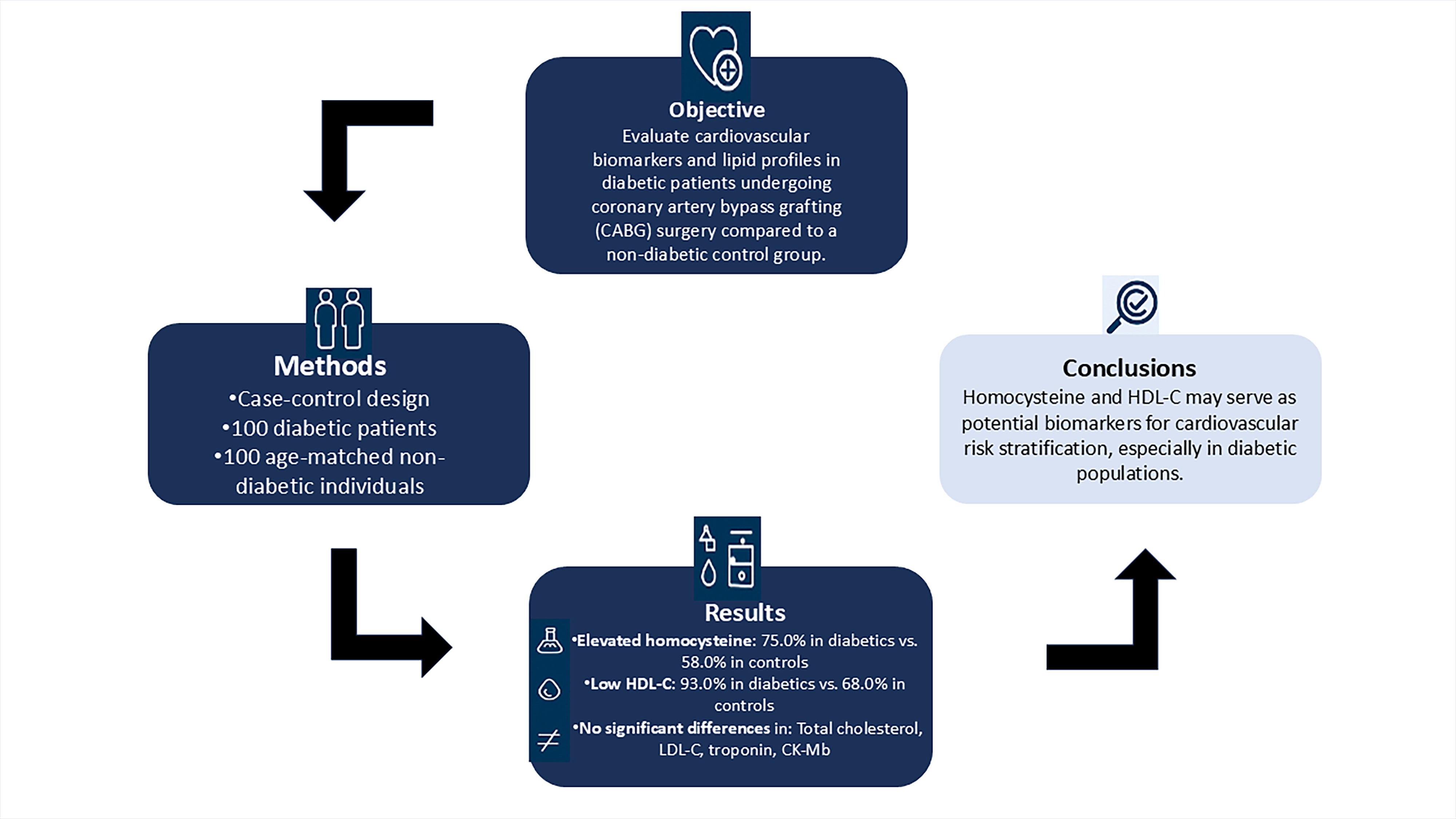
Objective Cardiovascular diseases (CVDs), particularly coronary artery disease (CAD), remain among the leading causes of morbidity and mortality worldwide. Type 2 diabetes mellitus (T2DM) significantly accelerates the progression of CAD through metabolic disturbances, including dyslipidemia and elevated homocysteine levels. This study aimed to evaluate cardiovascular biomarkers and lipid profiles in diabetic patients undergoing coronary artery bypass grafting (CABG) surgery, compared to a non-diabetic control group.
Methods A total of 200 participants were included in this study, consisting of 100 patients with type 2 diabetes who had undergone CABG or angioplasty, and 100 age‑matched individuals with type 2 diabetes without any history of cardiovascular disease, who served as controls.
Results Homocysteine levels were elevated in 75.0% of diabetic patients versus 58.0% of controls (p = 0.03). Low high-density lipoprotein cholesterol (HDL-C) was observed in 93.0% of diabetics compared to 68.0% of controls (p = 0.01). No statistically significant differences were found in total cholesterol, low-density lipoprotein cholesterol (LDL-C), troponin, or CK-Mb levels between groups (p > 0.05). These findings suggest that hyperhomocysteinemia and low HDL-C are significantly associated with CAD in diabetic populations. The presence of elevated homocysteine in a substantial proportion of the control group may reflect subclinical metabolic dysfunction or undiagnosed risk factors, warranting further investigation.
Conclusions These results underscore the potential utility of homocysteine and HDL-C as biomarkers in cardiovascular risk stratification. Their integration into routine screening protocols may enhance early detection and preventive strategies, particularly in high-risk or resource- limited settings.
เอกสารอ้างอิง
Minja NW, Nakagaayi D, Aliku T, Zhang W, Ssinabulya I, Nabaale J, et al. Cardiovascular diseases in Africa in the twenty-first century: Gaps and priorities going forward. Front Cardiovasc Med. 2022;9:1008335. PubMed PMID: 36440012
Beki J. Coronary artery disease. Eurasian Journal of Chemical, Medicinal and Petroleum Research. 2023; 2:203-11.
Shirvani S, Halvaeezade M, Avazzade M, Golbashirzadeh M, Moradzadegan AJE, Science M. Investigating the synergistic effects of gamma-glutamyl transferase with homocysteine, ferritin, and uric acid in patients with type II diabetes mellitus. Endocrine and Metabolic Science. 2025;17:100211.
Jakubowski H, Witucki Ł. Homocysteine metabolites, endothelial dysfunction, and cardiovascular disease. Int J Mol Sci. 2025;26:746. PubMed PMID: 39859460
Tomić M, Vrabec R, Ljubić S, Bulum T, Rahelić D. Plasma homocysteine is associated with nonproliferative retinopathy in patients with type 2 diabetes without renal disease. Diabetes Metab Syndr. 2022;16:102355. PubMed PMID: 34920196
Smith AD, Refsum HJJoim. Homocysteine–from disease biomarker to disease prevention. J Intern Med. 2021;290:826-54.
Figorilli F, Mannarino MR, Sahebkar A, Pirro MJERoCT. Lipid profile screening and ASCVD prevention. Expert Rev Cardiovasc Ther. 2023;21:463-71.
Kosmas CE, Rodriguez Polanco S, Bousvarou MD, Papakonstantinou EJ, Peña Genao E, Guzman E, et al. The triglyceride/high-density lipoprotein cholesterol (TG/HDL-C) ratio as a risk marker for metabolic syndrome and cardiovascular disease. Diagnostics (Basel). 2023;13:929. PubMed PMID: 36900073
Georgoulis M, Chrysohoou C, Georgousopoulou E, Damigou E, Skoumas I, Pitsavos C, et al. Long-term prognostic value of LDL-C, HDL-C, lp (a) and TG levels on cardiovascular disease incidence, by body weight status, dietary habits and lipid-lowering treatment: the ATTICA epidemiological cohort study (2002–2012). Lipids Health Dis. 2022;21:141. PubMed PMID: 36529737
Kim SY, Lee J-P, Shin W-R, Oh I-H, Ahn J-Y, Kim Y-HJM, et al. Cardiac biomarkers and detection methods for myocardial infarction. Mol Cell Toxicol. 2022;18:443-55.
Cacciatore S, Spadafora L, Bernardi M, Galli M, Betti M, Perone F, et al. Management of coronary artery disease in older adults: recent advances and gaps in evidence. J Clin Med. 2023;12:5233. PubMed PMID: 37629275
Hayden MRJM. Overview and new insights into the metabolic syndrome: risk factors and emerging variables in the development of type 2 diabetes and cerebrocardiovascular disease. Medicina (Kaunas). 2023;59:561. PubMed PMID: 36984562
Matsushita K, Ballew SH, Wang AY-M, Kalyesubula R, Schaeffner E, Agarwal RJNRN. Epidemiology and risk of cardiovascular disease in populations with chronic kidney disease. Nat Rev Nephrol. 2022;18:696-707.
Majumder TH. An approach to determine the prevalence and factors associated with prediabetes and diabetes mellitus among young adults [dissertation]. Dhaka (BD): East West University; 2022.
Jyotsna F, Ahmed A, Kumar K, Kaur P, Chaudhary MH, Kumar S, et al. Exploring the complex connection between diabetes and cardiovascular disease: analyzing approaches to mitigate cardiovascular risk in patients with diabetes. Cureus. 2023;15:e43882. PubMed PMID: 37746454
Zadabbas H, Golbashirzadeh M, Moradzadegan AJJoE, Metabolism. Exploring cystatin C as an early indicator of end-stage diabetic nephropathy in patients with type 2 diabetes. J Clin Endocrinol Metab. 2024;14:240-9.
Yeromenko Y, Lavie L, Levy YJN, Homocysteine and cardiovascular risk in patients with diabetes mellitus. Nutr Metab Cardiovasc Dis. 2001;11:108-16.
Schnyder G, Roffi M, Flammer Y, Pin R, Hess OJEhj. Association of plasma homocysteine with restenosis after percutaneous coronary angioplasty. Eur Heart J. 2002;23:726-33.
Zhanxuan W. Mass spectrometry-based metabolomics as a tool for biomarker discovery and diagnosing metabolic health [dissertation]. Palmerston North (NZ): Massey University; 2021.
von Eckardstein A, Nordestgaard BG, Remaley AT, Catapano ALJEhj. High-density lipoprotein revisited: biological functions and clinical relevance. Eur Heart J. 2023;44:1394-407.
Desai NR, Wade RL, Xiang P, Pinto L, Nunna S, Wang X, et al. Low‐density lipoprotein cholesterol lowering in real‐world patients treated with evolocumab. Clin Cardiol. 2021;44:715-22.
Jiang X-C, Liang Z-D, Chen D-L, Jia J-P, Hu J-R, Hu LJCl. Correlation of homocysteine, AHSG, CRP with insulin resistance, 25-(OH) 2-VitD, blood lipids in gestational diabetes patients. Clin Lab. 2021;67. PubMed PMID: 33616345
Skorupski WJ, Kaluzna-Oleksy M, Mitkowski P, Skorupski W, Grajek S, Pyda M, et al. Peri-procedural troponin elevation after percutaneous coronary intervention for left main coronary artery disease. J Clin Med. 2022;12(1):244. PubMed PMID: 36615044.
Abubakar M, Irfan U, Abdelkhalek A, Javed I, Khokhar MI, Shakil F, et al. Comprehensive quality analysis of conventional and novel biomarkers in diagnosing and predicting prognosis of coronary artery disease, acute coronary syndrome, and heart failure, a comprehensive literature review. J Cardiovasc Transl Res. 2024;17:1258-85.
Molina CR, Mathur A, Soykan C, Sathe A, Kunhiraman L. Risk factor interactions, non-high-density lipoprotein cholesterol to apolipoprotein B ratio, and severity of coronary arteriosclerosis in South Asian individuals: an observational cohort study. J Am Heart Assoc. 2023;12:e027697. PubMed PMID: 37183833
Didangelos T, Karlafti E, Kotzakioulafi E, Margariti E, Giannoulaki P, Batanis G, et al. Vitamin B12 supplementation in diabetic neuropathy: a 1-year, randomized, double-blind, placebo-controlled trial. Nutrients. 2021;13:395. PubMed PMID: 33513879