Influence of the Frequency of Speech Therapy on the Velopharyngeal Gap in Cleft Lip and Palate Patients After Primary Palatoplasty
DOI:
https://doi.org/10.12982/BSCM.2026.30Keywords:
frequency of speech therapy, velopharyngeal gap, primary palatoplasty, cleft lip and cleft palate, isolated cleft palateAbstract
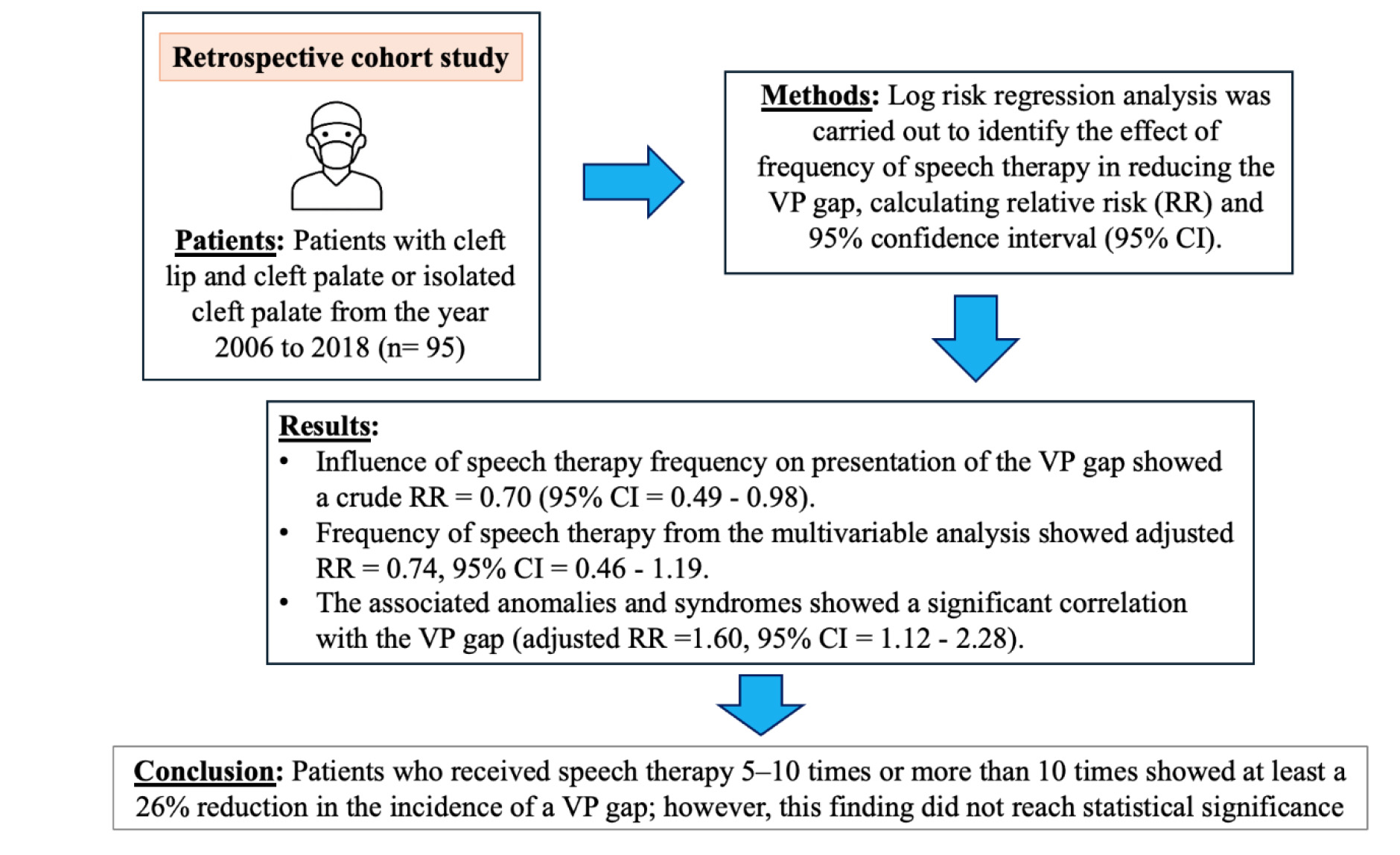
Objective The craniofacial conditions of cleft lip and cleft palate (CLP) have been found to be common worldwide, especially in Asia and Thailand. Nevertheless, there are few studies of the association between the frequency of speech therapy and the impact on the velopharyngeal (VP) gap and speech outcome. This study aimed to evaluate the association between the frequency of speech therapy and the VP gap after primary palatoplasty.
Methods This retrospective cohort study collected data on 95 patients with CLP or isolated cleft palate who underwent primary palatoplasty at Maharaj Nakorn Chiang Mai Hospital between 2006 and 2018. Log risk regression analysis was carried out to identify the effect of frequency of speech therapy in reducing the VP gap including relative risk (RR) and 95% confidence interval (95%CI).
Results From univariable analysis, influence of speech therapy frequency on the presence of a VP gap showed a crude RR = 0.70 (95%CI = 0.49-0.98). Additionally, the frequency of speech therapy in the multivariable analysis showed an adjusted RR = 0.74, 95%CI = 0.46-1.19. The associated anomalies and syndromes showed a statistically significant correlation with a VP gap (adjusted RR = 1.60, 95%CI = 1.12-2.28).
Conclusion Patients who receive speech therapy 5-10 times or more showed a decrease in the incidence of a VP gap of at least 26%; however, this did not reach statistical significance. Nevertheless, it is recommended that speech therapy with cleft lip and cleft palate patients should be continued for at least 5 to 10 sessions.
References
Surgeons ASoP. Cleft lip and palate repair correcting abnormal development 2021 [Internet]. American Society of Plastic Surgeons. 2021 [cited 2021 Dec 19]. Available from: https://www.plasticsurgery.org/reconstructive-procedures/cleft-lip-and-palate-repair
Detpithak A. NR, N. Y. Incidence of cleft lip and/or cleft palate of live births in Chiang Mai from 2015-2019. Th Dent PH J. 2020;25:41-9.
Speech Development Related to Cleft Palate. St. Paul, MN: Children’s MINNESOTA [Internet]. 2017 [cited 2021 Dec 21]. Available from: https://www.childrensmn.org/references/pfs/rehabpublic/cleft-palate-speech-development.pdf
Prathanee B, Pumnum T, C. S. Types of articulation errors in individuals with cleft lip and palate. J Med Assoc Thai. 2013;96:81-90.
Pediatric Cleft Palate Repair – Palatoplasty [Internet]. St. Peterburg, FL: Pediatric Ear, Nose & Throat Specialists. 2010 [cited 2022 Jan 10]. Available from: https://pediatric-ent.com/cleft-palate-repair-palatoplasty
Campbell A, Costello BJ, RL. R. Cleft lip and palate surgery: an update of clinical outcomes for primary repair. Oral Maxillofac Surg Clin North Am. 2010;22:43-58.
Yellinedi R, MR. D. Is there an optimal resting velopharyngeal gap in operated cleft palate patients? Indian J Plast Surg. 2013;46:87-91.
Kummer AW, Briggs M, L. L. The relationship between the characteristics of speech and velopharyngeal gap size. Cleft Palate Craniofac J. 2003;40:590-6.
Leclerc JE, Godbout A, Arteau-Gauthier I, Lacour S, Abel K, McConnell EM. We can predict postpalatoplasty velopharyngeal insufficiency in cleft palate patients. Laryngoscope. 2014;124:561-9.
Tache A, Maryn Y, Mommaerts MY. Need for velopharyngeal surgery after primary palatoplasty in cleft patients. A retrospective cohort study and review of literature. Ann Med Surg (Lond). 2021;69:102707. PubMed PMID: 34429961
Sie KC, Tampakopoulou DA, Sorom J, Gruss JS, Eblen LE. Results with Furlow palatoplasty in management of velopharyngeal insufficiency. Plast Reconstr Surg. 2001;108:17-25; discussion 26-9.
Yang Y, Jiang L, Liu Q, Wang G, Chen Y, Wan T. [Duration of speech therapy in patients with or without velopharyngeal insufficency after palatoplasty]. Zhonghua Kou Qiang Yi Xue Za Zhi. 2014;49:715-8. (in Chinese)
Saqulain G, Mumtaz N, Ahmed J Evaluation of outcome of Palatoplasty in patients with Isolated Cleft Palate Defect: A Retrospective Observational study. Isra Med Journal. 2021;13:119-22.
Kocaaslan FND, Sendur S, Koçak I, Çelebiler Ö. The Comparison of Pierre Robin Sequence and Non-Syndromic Cleft Palate. J Craniofac Surg. 2020;31:226-9.