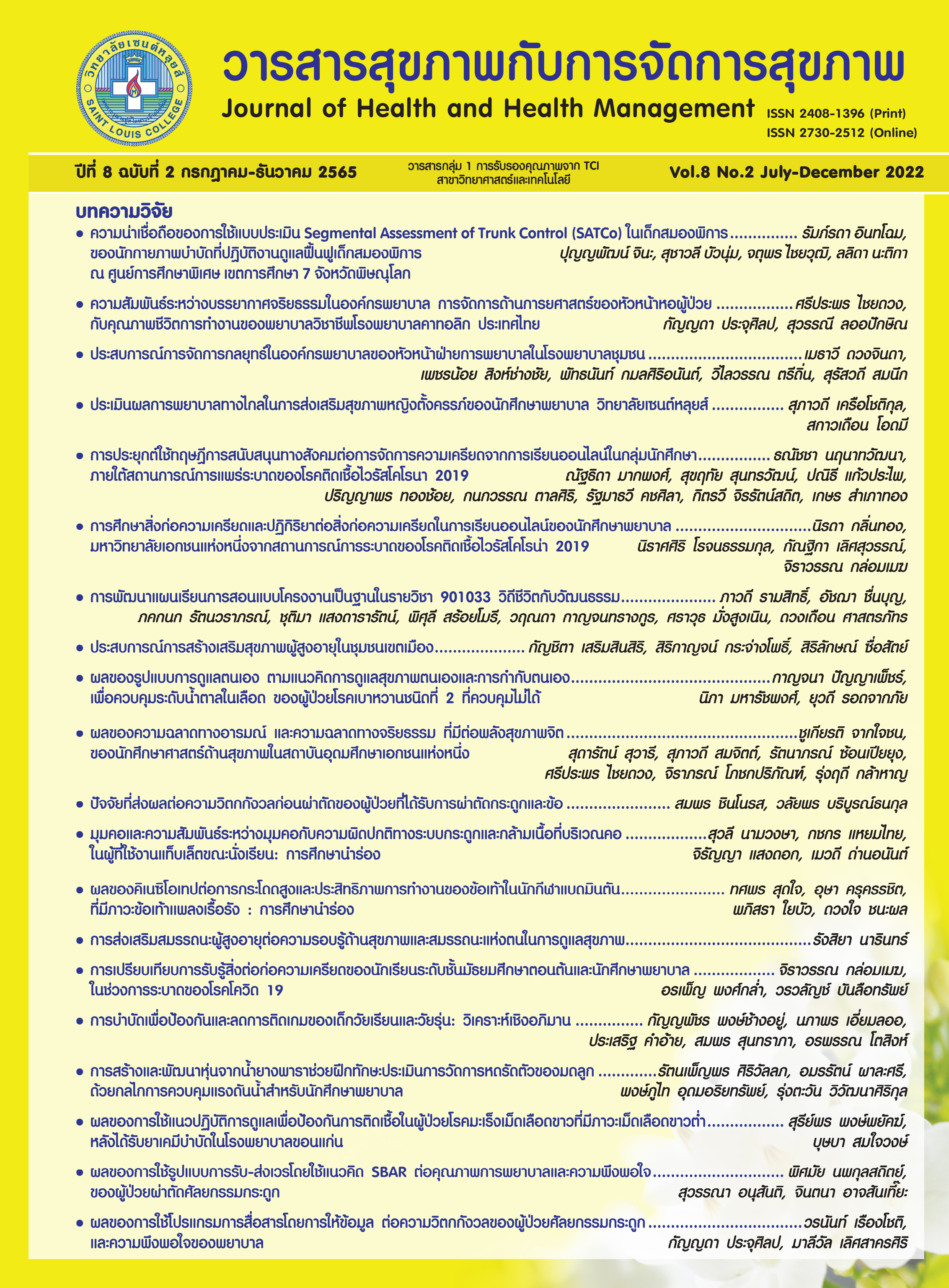
ความน่าเชื่อถือของการใช้แบบประเมิน Segmental Assessment of Trunk Control (SATCo) ในเด็กสมองพิการของนักกายภาพบำบัดที่ปฏิบัติงานดูแลฟื้นฟูเด็กสมองพิการ ณ ศูนย์การศึกษาพิเศษ เขตการศึกษา 7 จังหวัดพิษณุโลก
คำสำคัญ:
ความน่าเชื่อถือภายในผู้ทดสอบ, ความน่าเชื่อถือระหว่างผู้ทดสอบ, เด็กสมองพิการ, แบบประเมิน Segmental Assessment of Trunk Controlบทคัดย่อ
งานวิจัยนี้มีวัตถุประสงค์เพื่อหาความน่าเชื่อถือภายในผู้ประเมินและระหว่างผู้ประเมิน ในการประเมิน การควบคุมกล้ามเนื้อลำตัวแบบแยกส่วนในเด็กสมองพิการด้วยแบบประเมิน Segmental Assessment of Trunk Control (SATCo) อาสาสมัครคือเด็กสมองพิการ จำนวน 30 คน อายุเฉลี่ย 10.1 ± 4.11 ปี ที่มีระดับความสามารถ ในการเคลื่อนไหว ตามเกณฑ์ Gross motor Function Classification System (GMFCS) ระดับ II-V ผู้ประเมิน 2 คน ทำการทดสอบแบบประเมิน SATCo ใน 3 หัวข้อการทดสอบ (อยู่นิ่ง มีการเคลื่อนไหว มีการให้แรงผลัก) ผู้ประเมินให้คะแนนการทดสอบจำนวน 2 ครั้ง จากภาพวีดีทัศน์ที่ถูกบันทึกไว้ โดยการให้คะแนน ครั้งที่ 2 เว้นระยะห่างจากการให้คะแนนครั้งที่ 1 เป็นระยะเวลา 2 สัปดาห์ วิเคราะห์หาค่าความน่าเชื่อถือภายใน ผู้ประเมิน และระหว่างผู้ประเมิน ด้วยสถิติสัมประสิทธิ์สหสัมพันธ์ภายในชั้น (intraclass correlation coefficient) (ICC 3, k) และ (ICC 2, k) กำหนดค่านัยสำคัญทางสถิติที่ p<0.05 ผลการวิจัยพบว่าแบบประเมิน SATCo มีความน่าเชื่อถือภายในผู้ประเมินในทุกหัวข้อทดสอบ ในระดับดีมาก [ICC (3, k) 0.90-1.00] และมีค่าความ น่าเชื่อถือระหว่างผู้ประเมินในทุกหัวข้อทดสอบ ในระดับดีมาก [ICC (2, k) 0.93-0.99] สรุปว่าผู้ประเมินของ การใช้แบบประเมิน SATCo สามารถประเมินความสามารถในการควบคุมลำตัวแบบแยกส่วนได้อย่างน่าเชื่อถือ
เอกสารอ้างอิง
Aneksan, B. (2020). Postural adjustment and balance. In: Jalayondega, C., & Pichaiyongwongdee, S (Eds.) Physical therapy assessment for patients with neurological conditions. (pp.106-116). Nakhonpathom: Printery company.
Butler, P., Saavedra, M. S., Sofranac, M. M., Jarvis, M. S., & Woollacott, M. (2010). Refinement, reliability and validity of the segmental assessment of trunk control (SATCo). Pediatric physical therapy: the official publication of the Section on Pediatrics of the American Physical Therapy Association, 22(3), 246.257.
Curtis, D. J., Butler, P., Saavedra, S., Bencke, J., Kallemose, T., Sonne-Holm, S., & Woollacott, M. (2015). The central role of trunk control in the gross motor function of children with cerebral palsy: a retrospective cross-sectional study. Developmental medicine & child neurology, 57(4), 351-357.
Curtis, D. J., Woollacott, M., Bencke, J., Lauridsen, H. B., Saavedra, S., Bandholm, T., & Sonne-Holm, S. (2018). The functional effect of segmental trunk and head control training in moderateto- severe cerebral palsy: A randomized controlled trial. Developmental neurorehabilitation, 21(2), 91-100.
Field, D., & Livingstone, R. (2013). Clinical tools that measure sitting posture, seated postural control or functional abilities in children with motor impairments: a systematic review. Clinical rehabilitation, 27(11), 994-1004.
Flores, M., Mitchell, K., Bickley, C., & Da Silva, C. P. (2020). Psychometric properties of segmental assessment of trunk control in infants and toddlers with down syndrome. Pediatric Physical Therapy, 32(3), 250-256.
Hansen, L., Erhardsen, K. T., Bencke, J., Magnusson, S. P., & Curtis, D. J. (2018). The reliability of the Segmental Assessment of Trunk Control (SATCo) in children with cerebral palsy. Physical & Occupational Therapy in Pediatrics, 38(3), 291-304.
Mendoza, S. M., Gomez-Coesa, A., & Montesinos, M. (2015). Association between gross motor function and postural control in sit-ting in children with cerebral palsy: a correlational study in Spain. BMC pediatric, (124), 1-7
Pavao, S. L., dos Santos, A. N., Woollacott, M. H., & Rocha, N. A. (2013). Assessment of postural control in children with cerebral palsy: a review. Research in Developmental Disabilities, 34(5), 1367-1375. .
Pin, T. W., Butler, P. B., Cheung, H. M., & Shum, S. L. F. (2018). Segmental Assessment of Trunk Control in infants from 4 to 9 months of age-a psychometric study. BMC pediatrics, 18(1), 1-8.
Pin, T. W., Butler, P. B., Cheung, H. M., & Shum, S. L. (2020). Longitudinal development of segmental runk control in full term and preterm infants - a pilot study: part I. Developmental Neurorehabilitation, 23(3), 185-192.
Portney, L. G. & Watkins, M. P. Reliability of measurements. In: Foundations of clinical research applications to practice. USA: Pearson Prentice Hall; 2009. P. 77-96.
Rosenbaum, P. (2003). Cerebral palsy: what parents and doctors want to know. British Medical Journal, 3(326), 970-974.
Sa, C. D., Fagundes, I. K., Araujo, T. B., Oliveira, A. S., & Favero, F. M. (2016). The relevance of trunk evaluation in duchenne muscular dystrophy: the segmental assessment of trunk control. Arquivos de neuro-psiquiatria, 74(10), 791-795.
Saavedra, S. L., & Woollacott, M. H. (2015). Segmental contributions to trunk control in children with moderate-to-severe cerebral palsy. Archives of physical medicine and rehabilitation, 96(6), 1088-1097.
Sangkarit, N., Tapanya, W., Kumful, S., Prangkeaw, P., & Aoratai, A. (2018). Correlation of segmental of trunk control and functional balance in children with inadequate trunk control. Thai Journal of Physical Therapy, 41(1), 1-15.
Shumway-Cook, A., & Woollacott, M. H. (2007). Development of postural control. In: Motor control: translating research into clinical practice. Philadelphia: Lippincott Williams & Wilkins.
Singer, H. S., Mink, J. W., Gilbert, D. L., & Jankovic, J. (2010). Movement disorders in childhood. USA: Elsevier Mosby.
edla, J., & Reddy, R. (2021). Evaluation of psychometric properties of the segmental assessment of trunk control (SATCo) in children with spastic quadriplegic cerebral palsy. Nigerian Journal of Clinical Practice, 24(7), 1077-1081.
ดาวน์โหลด
เผยแพร่แล้ว
รูปแบบการอ้างอิง
ฉบับ
ประเภทบทความ
สัญญาอนุญาต
ลิขสิทธิ์ (c) 2022 วารสารสุขภาพกับการจัดการสุขภาพ

อนุญาตภายใต้เงื่อนไข Creative Commons Attribution-NonCommercial-NoDerivatives 4.0 International License.