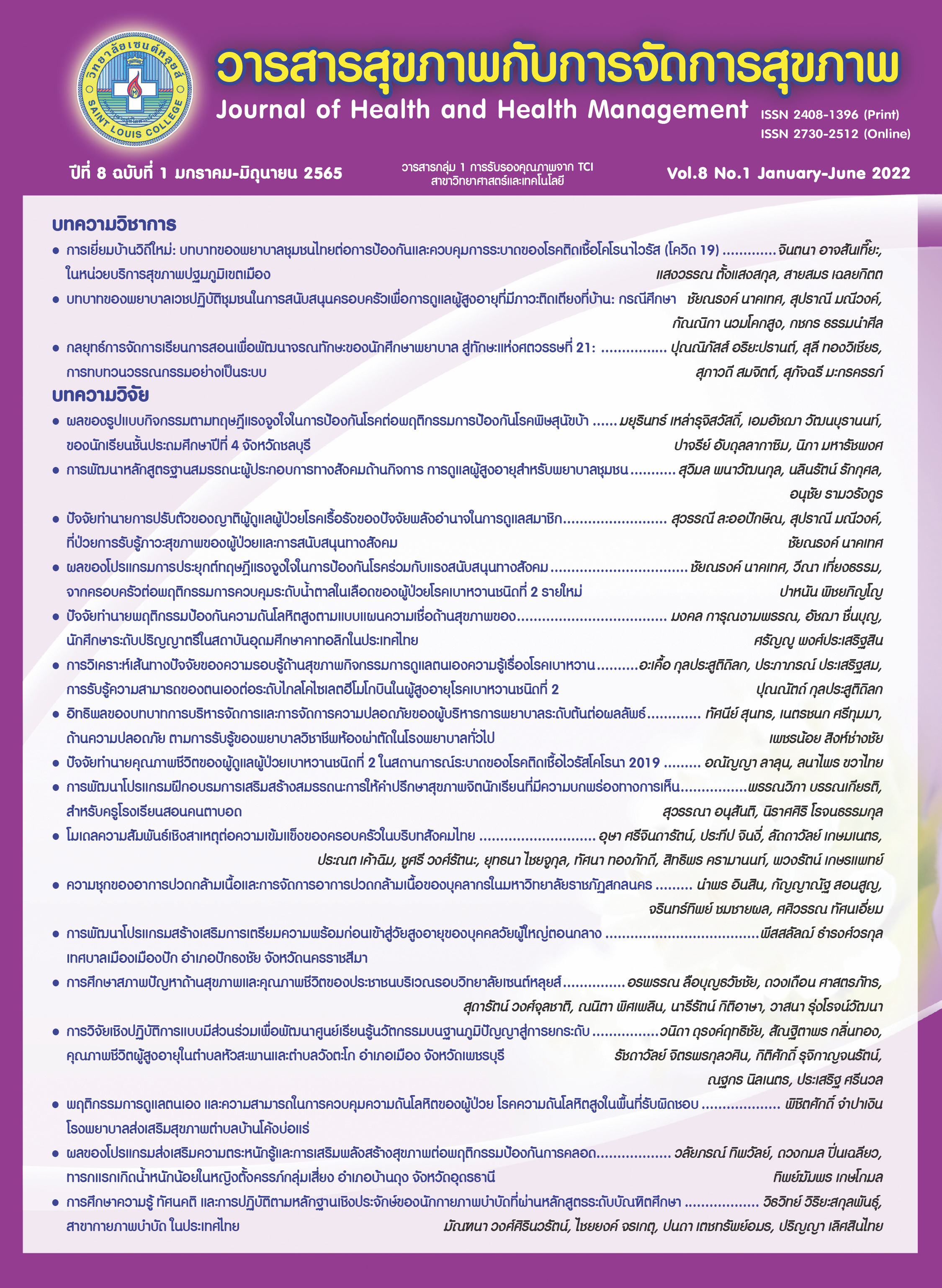
การศึกษาความรู้ ทัศนคติ และการปฏิบัติตามหลักฐานเชิงประจักษ์ของนักกายภาพบำบัดที่ผ่านหลักสูตรระดับบัณฑิตศึกษา สาขากายภาพบำบัด ในประเทศไทย
คำสำคัญ:
การปฏิบัติตามหลักฐานเชิงประจักษ์, กายภาพบำบัด, หลักสูตรระดับบัณฑิตศึกษา, การสำรวจบทคัดย่อ
การใช้หลักฐานเชิงประจักษ์ (EBP) มีความสำคัญในการพัฒนาคุณภาพการรักษาผู้ป่วยในทางกายภาพบำบัด การศึกษานี้จึงมีวัตถุประสงค์เพื่อ 1) สำรวจระดับความรู้ ทัศนคติ และพฤติกรรม (KAP) เกี่ยวกับการปฏิบัติตาม EBP และศึกษาความสัมพันธ์ระหว่างตัวแปรดังกล่าวของนักกายภาพบำบัดที่ผ่านการเรียนการสอนและการปฏิบัติตาม EBP จากหลักสูตรระดับบัณฑิตศึกษา สาขากายภาพบำบัด ในประเทศไทย และ 2) ศึกษาความ สัมพันธ์ระหว่างข้อมูลคุณลักษณะผู้ตอบแบบสอบถามกับระดับความรู้ ทัศนคติ และพฤติกรรมเกี่ยวกับการปฏิบัติตาม EBP โดยสำรวจความคิดเห็นด้วยแบบสอบถามผ่านช่องทางอินเตอร์เน็ต จากกลุ่มตัวอย่างจำนวน 215 คน มีผู้ตอบกลับ จำนวน 82 คน (อัตราตอบกลับ 38.14%) รายงานผลการตอบกลับด้วยสถิติเชิงพรรณนา สถิติสัมประสิทธิ์สหสัมพันธ์แบบสเปียร์แมนและสถิติไคสแควร์ใช้ทดสอบค่าความ สัมพันธ์ ผลการศึกษาพบว่านักกายภาพบำบัดมีระดับความรู้ดี ระดับทัศนคติอยู่ในระดับดีมาก และระดับพฤติกรรมการปฏิบัติตาม EBP อยู่ในระดับบ่อยมาก ระดับความรู้มีความสัมพันธ์เชิงบวกทั้งระดับทัศนคติ (ระดับปานกลาง, rs = 0.724, p < 0.001) และ ระดับพฤติกรรม (ระดับตํ่า, rs = 0.454, p < 0.001) ระดับทัศนคติพบว่ามีความสัมพันธ์เชิงบวกระดับปานกลางกับระดับพฤติกรรมตาม EBP (rs = 0.749, p < 0.001) และพบว่าคุณลักษณะบุคคลและการทำงาน (ได้แก่ ระดับการศึกษา ลักษณะการทำงาน จำนวนผู้ป่วยโดยเฉลี่ยต่อวัน) มีความสัมพันธ์กับระดับความรู้ ระดับทัศนคติ และระดับพฤติกรรมเกี่ยวกับการปฏิบัติตาม EBP ของนักกายภาพบำบัดที่สำเร็จการศึกษาจากหลักสูตรระดับบัณฑิตศึกษา สาขากายภาพบำบัด (ตั้งแต่ปี พ.ศ. 2545 ถึง พ.ศ. 2562) ในประเทศไทย ดังนั้นการบรรจุรายวิชาการปฏิบัติตาม EBP ในหลักสูตรแกนของระดับบัณฑิตศึกษาสาขากายภาพบำบัดจึงมีความสำคัญในการพัฒนาคุณภาพการรักษาผู้ป่วยในระบบการศึกษา ทางกายภาพบำบัด
เอกสารอ้างอิง
Alrowayeh, H.N., Buabbas, A.J., Alshatti, T.A., AlSaleh, F.M., & Abulhasan, J.F. (2019). Evidence-based physical therapy practice in the State of Kuwait: A Survey of attitudes, beliefs, knowledge, skills, and barriers. JMIR Medical Education, 5(1), e12795. https://doi.org/10.2196/12795
Bajracharya, S., Tharu, N.S., & Bokalial, D. (2019). Knowledge, attitude and barrier to evidence-based practice among physiotherapists in selected districts of Nepal. Journal of Nepal Health Research Council, 17(2), 215-221. https://doi.org/10.33314/jnhrc.v0i0.1711
Bloom, B.S. (1975). Taxonomy of educational objectives: The classification of educational goals. Handbook I: Cognitive domain. New York: David McKay Company.
Cochran, W.G. (1963). Sampling technique (2nded). New York: John Wiley and Sons.
Hinkle, D.E. (1998). Applied statistics for the behavioral sciences. Boston: Houghton Mifflin.
Israel, G.D. (1992). Sampling the evidence of extension program impact. Program evaluation and organizational development, IFAS, University of Florida, PEOD-6. Retrieved from: https://www.tarleton.edu/academicassessment/documents/samplesize.pdf
Jette, D.U., Bacon, K., Batty, C., Carlson, M., Ferland, A., Hemingway, R.D., . . . Volk, D. (2003). Evidence-based practice: beliefs, attitudes, knowledge, and behaviors of physical therapists. Physical Therapy, 83(9), 786-805. https://doi.org/10.1093/ptj/83.9.786
Joseph, P. M. (2011). Knowledge, attitudes, and practices of physiotherapists regarding their role in health promotion in Gauteng Province, South Africa (Doctoral dissertation, University of Limpopo (Medunsa Campus)).
Manns, P. J., Norton, A. V., & Darrah, J. (2015). Cross-sectional study to examine evidence-based practice skills and behaviors of physical therapy graduates: is there a knowledge-to-practice gap?. Physical Therapy, 95(4), 568-578. https://doi.org/10.2522/ptj.20130450
Moolsin, W. (2012). Principles of research and statistical analysis with SPSS for research purposes (1rded). Bangkok: Software Industry Promotion Agency.
Office of The Higher Education Commission. (n.d.). National qualifications framework for higher education 2013. Retrieved from: https://www.ops.go.th/images/2563/tqf-hed/46f2014123010571573.pdf
Rattanamanee, N., & Phasunon, P. (2019). Response rate in quantitative research. Journal of Humanities and Social Sciences Thonburi University, 13(3), 181-188.
Sackett, D.L., Strauss, D.E., Richardson, W.S., Rosenberg, W., & Haynes, R.B. (2000). Evidence-based medicine: How to practice and teach EBM (2nd ed). New York: Churchill Livingstone.
Sota, C. (2011). Concept theory and application for health behavioral development (3rded). Khon Kean: Health education promotion program, Faculty of Public Health, Khon Kean University.
Vongsirinavarat, M., Mathiyakom, W., Krityakiarana, W., Hengsomboon, N., & Kraiwong, R. (2020). Survey of attitudes, knowledge, and barriers to evidence-based practice among thai physical therapists. Internet Journal of Allied Health Sciences and Practice, 18(4), 1-15. https://doi.org/10.46743/1540-580X/2020.1878
World Confederation for Physical Therapy. (2011). Education, policy statement: EBP. Retrieved from: https://world.physio/sites/default/files/2020-04/PS-2019-Education.pdf
ดาวน์โหลด
เผยแพร่แล้ว
รูปแบบการอ้างอิง
ฉบับ
ประเภทบทความ
สัญญาอนุญาต
ลิขสิทธิ์ (c) 2022 วารสารสุขภาพกับการจัดการสุขภาพ

อนุญาตภายใต้เงื่อนไข Creative Commons Attribution-NonCommercial-NoDerivatives 4.0 International License.