Dialysis Management during Flooding Disasters: Operational Strategies and Lessons Learned from Songklanagarind Hospital
Dialysis Management during Flooding Disasters: Lessons from Songklanagarind Hospital
DOI:
https://doi.org/10.31584/jhsmr.20261499Keywords:
dialysis service continuity, disaster preparedness, flood disaster, healthcare system resilience, maintenance hemodialysisAbstract
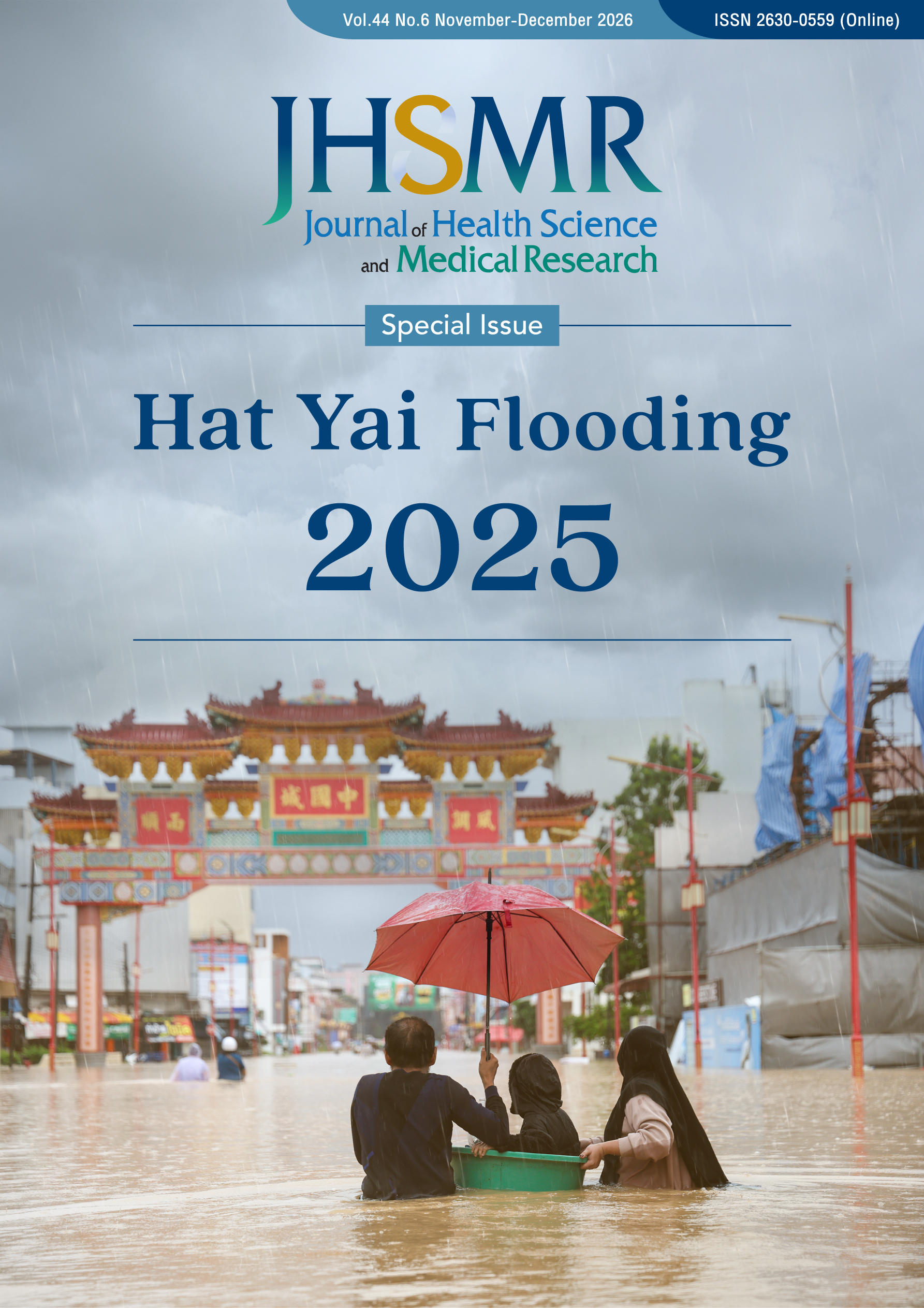
Flooding disasters are a major threat to the continuity of dialysis services, leading to disruptions in infrastructure, transportation, water supply, electricity, and the healthcare workforce. Dialysis care is particularly vulnerable because kidney replacement therapy is time-sensitive and dependent on complex technical systems and trained personnel. Previous disaster experiences have demonstrated increased healthcare utilization and adverse outcomes when maintenance hemodialysis is interrupted. This narrative review summarizes key principles for dialysis management during flooding disasters across preparedness, response, and recovery phases, with primary emphasis on maintenance hemodialysis and hospital-based kidney replacement therapy, and a focused discussion of peritoneal dialysis. We also present an operational case experience from Songklanagarind Hospital during regional flooding in November 2025, where services were reorganized into a dual-track model consisting of acute inpatient kidney replacement therapy and triage-based outpatient maintenance hemodialysis. Nephrologists and dialysis nurses coordinated clinical prioritization and operational continuity in order to support dialysis delivery under severe logistical constraints.
References
Kopp JB, Ball LK, Cohen A, Kenney RJ, Lempert KD, Miller PE, et al. Kidney patient care in disasters: lessons from the hurricanes and earthquake of 2005. Clin J Am Soc Nephrol 2007;2:814-24.
Anderson AH, Cohen AJ, Kutner NG, Kopp JB, Kimmel PL, Muntner P. Missed dialysis sessions and hospitalization in hemodialysis patients after Hurricane Katrina. Kidney Int 2009;75:1202-8.
Kenney RJ. Emergency preparedness concepts for dialysis facilities: reawakened after Hurricane Katrina. Clin J Am Soc Nephrol 2007;2:809-13.
Murakami N, Siktel HB, Lucido D, Winchester JF, Harbord NB. Disaster preparedness and awareness of patients on hemodialysis after Hurricane Sandy. Clin J Am Soc Nephrol 2015;10:1389-96.
Centers for Disease Control and Prevention. Guidance for Healthcare Water System Repair and Recovery Following a Boil Water Alert or Disruption of Water Supply. Atlanta: CDC; 2024.
Centers for Disease Control and Prevention. Water Use in Dialysis. Atlanta: CDC; 2024.
Bonilla-Félix M, Suárez-Rivera M. Disaster management in a nephrology service: lessons learned from Hurricane Maria. Blood Purif 2019;47:199-204.
Dent L, Finne K, Lurie N. Progress in emergency preparedness for dialysis care 10 years after Hurricane Katrina. Am J Kidney Dis 2015;66:742-4.
Sever MŞ, Vanholder R, Lameire N. Disaster preparedness for people with kidney disease and kidney healthcare providers. Curr Opin Nephrol Hypertens 2024;33:613-20.
Kidney Disease: Improving Global Outcomes (KDIGO) Acute Kidney Injury Work Group. KDIGO Clinical Practice Guideline for Acute Kidney Injury. Kidney Int Suppl 2012;2:1-138.
Sahutoglu T, Danis R, Pembegul I, Ozturk I, Huzmeli C, Tugcu M, et al. Resilience and challenges of peritoneal dialysis survivors in the aftermath of the 2023 Kahramanmaraş earthquake. Ther Apher Dial 2024;28:648-56.
Downloads
Published
How to Cite
Issue
Section
License
Copyright (c) 2026 Prince of Songkla University, Thailand

This work is licensed under a Creative Commons Attribution-NonCommercial-NoDerivatives 4.0 International License.