
Influence of Eu2O3 incorporation on the gamma-ray shielding performance of germanoborate glasses
Article Sidebar
Main Article Content
Abstract
Background: The widespread use of ionizing radiation in medical and industrial applications has increased the demand for effective and lead-free radiation shielding materials. Rare earth doped glass systems have attracted attention due to their optical transparency and favorable attenuation properties.
Objectives: This study investigates the physical and gamma-ray shielding properties of Eu2O3-doped germanoborate glasses.
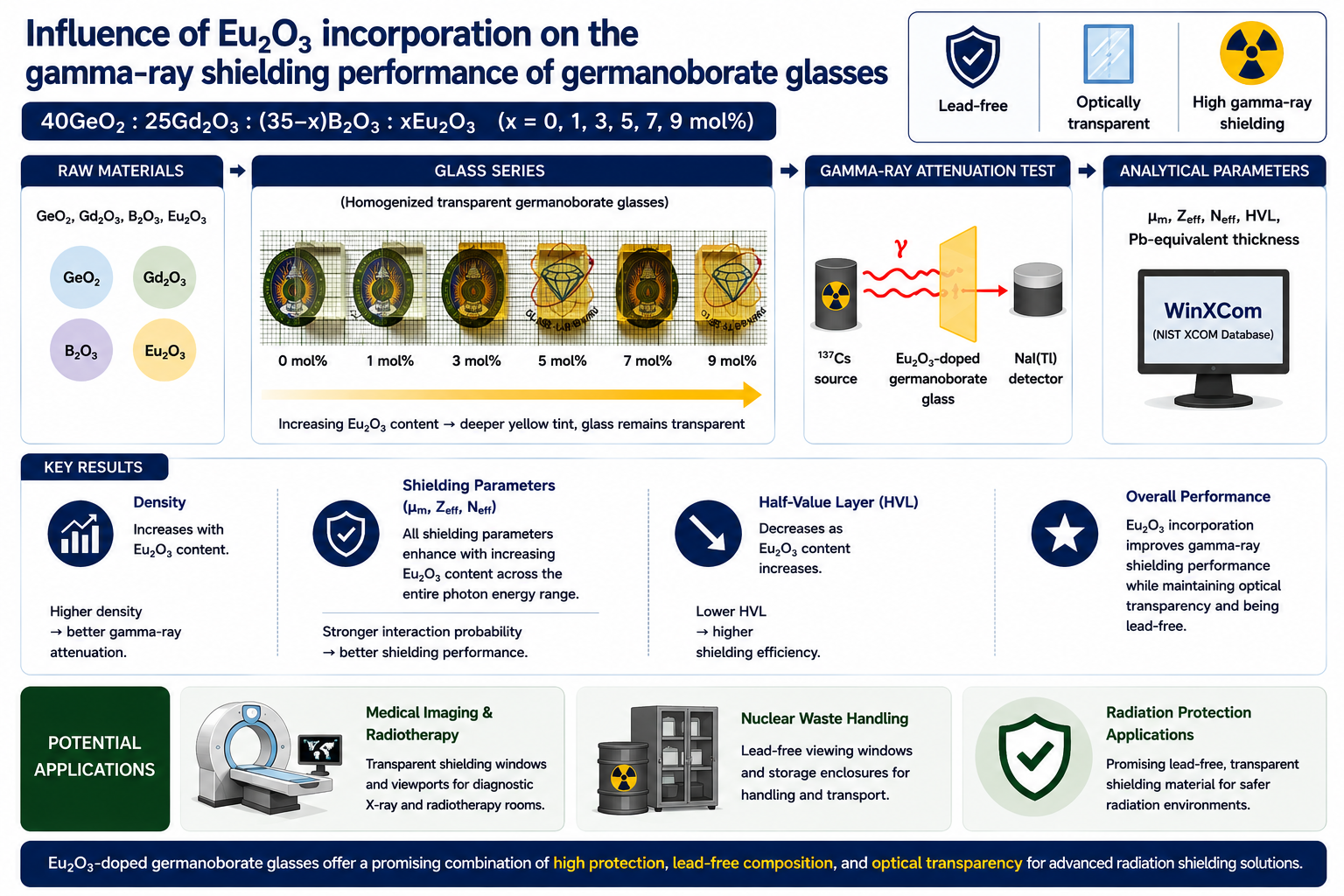
Materials and methods: Glasses with the composition 40GeO2: 25Gd2O3: (35-x)B2O3: xEu2O3 (x=0, 1, 3, 5, 7 and 9 mol%) were prepared using the melt-quenching method. Density and molar volume were evaluated experimentally, while shielding parameters, including mass attenuation coefficients (μm), the effective atomic number (Zeff), the effective electron density (Neff), and half-value layers (HVL) and Pb equivalent thickness, were calculated using the WinXCom program.
Results: The density of the glasses increased with increasing Eu2O3 concentration, while the shielding parameters exhibited strong energy dependence according to dominant photon interaction mechanisms. Distinct K-absorption edges of Eu and Gd were observed near 0.04852 MeV and 0.05024 MeV, respectively. The incorporation of Eu2O3 slightly enhanced the attenuation parameters and reduced the HVL values, indicating improved gamma-ray shielding performance.
Conclusion: The developed Eu2O3-doped germanoborate glasses demonstrate promising physical and radiation shielding properties, suggesting their potential as transparent and lead-free shielding materials for medical and industrial applications.
Article Details

This work is licensed under a Creative Commons Attribution-NonCommercial-NoDerivatives 4.0 International License.
Personal views expressed by the contributors in their articles are not necessarily those of the Journal of Associated Medical Sciences, Faculty of Associated Medical Sciences, Chiang Mai University.
References
Safari A, Rafie P, Taeb S, Najafi M, Mortazavi SMJ. Development of lead-free materials for radiation shielding in medical settings: a review. J Biomed Phys Eng. 2024; 14(3): 229-44. doi.org/10.31661/jbpe.v0i0.2404-1742.
Juhim F, Chee FP, Awang A, Moh PY, Mohd Salleh KA, Ibrahim S, et al. Study of gamma radiation shielding on tellurite glass containing TiO2 and Al2O3 nanoparticles. Heliyon. 2023; 9(11): e22529. doi.org/10.1016/j.heliyon.2023.e22529.
Geist WH, Santi PA, Swinhoe MT, editors. Nondestructive assay of nuclear materials for safeguards and security. Cham: Springer; 2024. doi.org/10.1007/978-3-031-58277-6.
Uosif MAM, Issa SAM, Ene A, Ivanov V, Mostafa AMA, Atta A, et al. Optimal composition for radiation shielding in BTCu-x glass systems as determined by FLUKA simulation. J Mater Res Technol. 2023; 25: 2088-96. doi.org/10.1016/j.jmrt.2023.06.107.
Yasmin S, Kamislioglu M, Sayyed MI. Assessment of radiation shielding performance of Li2O-BaOBi2O3-P2O5 glass systems within the energy range from 0.081 MeV to 1.332 MeV via MCNP6 code. Optik. 2023; 274: 170529. doi.org/10.1016/j.ijleo.2023.170529.
Al-Buriahi MS, Kurtulus R, Eke C, Alomairy S, Olarinoye IO. An insight into advanced glass systems for radiation shielding applications: a review on different modifiers and heavy metal oxides-based glasses. Heliyon. 2024; 10(22): e40249. doi.org/10.1016/j.heliyon.2024.e40249.
Hongtong W, Kaewjaeng S, Kothan S, Meejitpaisan P, Cheewasukhanont W, Limkitjaroenporn P, et al. Development of gadolinium doped calcium phosphate oxyfluoride glasses for X-ray shielding materials. Mater Today Proc. 2018; 5(6): 14063-8. doi.org/10.1016/j.matpr.2018.02.062.
Felix AT, Ton ND, Luan NT, Kim HJ. Luminescence and scintillation properties of Eu3+ doped lithium borate glass. New Phys Sae Mulli. 2025; 75(8): 595-601. doi.org/10.3938/NPSM.75.595.
ALMisned G, Tekin HO, Ene A, Issa SAM, Kilic G, Zakaly HMH. A closer look on nuclear radiation shielding properties of Eu3+ doped heavy metal oxide glasses: impact of Al2O3/PbO substitution. Materials (Basel). 2021; 14(18): 5334. doi.org/10.3390/ma14185334.
Abou Hussein EM, Shaban SE, Rammah YS, Misbah MH, Marzouk MA. Newly developed CeO2 and Gd2O3-reinforced borosilicate glasses from municipal waste ash and their optical, structural, and gamma-ray shielding properties. Sci Rep. 2024; 14(1): 13673. doi.org/10.1038/s41598-024-63207-4.
Gerward L, Guilbert N, Jensen KB, Levring H. WinXCom- a program for calculating X-ray attenuation coefficients. Radiat Phys Chem. 2004; 71(3-4): 653-4. doi.org/10.1016/j.radphyschem.2004.04.040.
Humaid M, Asad J, Aboalatta A, Shaat SKK, Musleh H, Ramadan K, et al. Gamma and neutron shielding properties of lead-borosilicate shielded glass; novel technique of solid waste recycling. Constr Build Mater. 2023; 375: 130896. doi.org/10.1016/j.conbuildmat.2023.130896.
Elmahroug Y, Tellili B, Souga C. Determination of total mass attenuation coefficients, effective atomic numbers and electron densities for different shielding materials. Ann Nucl Energy. 2015; 75: 268-74. doi.org/10.1016/j.anucene.2014.08.015.
Kolavekar SB, Hiremath GB, Patil PN, Badiger NM, Ayachit NH. Investigation of gamma-ray shielding parameters of bismuth phospho-tellurite glasses doped with varying Sm2O3. Heliyon. 2022; 8(11): e11788. doi.org/10.1016/j.heliyon.2022.e11788.
Mukamil S, Ullah I, Sarumaha C, Wabaidur SM, Islam MA, Khattak SA, et al. Lead-borate glass system doped with Sm3+ ions for the X-ray shielding applications. Results Phys. 2022; 43: 106121. doi.org/10.1016/j.rinp.2022.106121.
Gerward L, Guilbert N, Jensen KB, Levring H. X-ray absorption in matter. Reengineering XCOM. Radiat Phys Chem. 2001; 60(1-2): 23-4. doi.org/10.1016/S0969-806X(00)00324-8.
Madshal MA, El-Damrawi G, Abdelghany AM, Abdelghany MI. Structural studies and physical properties of Gd2O3-doped borate glass. J Mater Sci Mater Electron. 2021; 32(11): 14642-53. doi.org/10.1007/s10854-021-06022-1.
Chandra Shekhar Reddy M, Prabhakar Reddy A, Krishnamurthy Goud K, Appa Rao B. Physical and optical properties of PbO-Sb2O3-B2O3 glasses doped with Gd2O3. Mater Today Proc. 2016; 3(10): 3970-5. doi.org/10.1016/j.matpr.2016.11.058.
El-Khayatt AM, Saudi HA, AlRowis NH. Synthesis and characterization of zinc-lead-phosphate glasses doped with europium for radiation shielding. Sustainability. 2023; 15(12): 9245. doi.org/10.3390/su15129245.
Hussein KI, Alqahtani MS, Meshawi AA, Alzahrani KJ, Zahran HY, Alshehri AM, et al. Evaluation of the radiation shielding properties of a tellurite glass system modified with sodium oxide. Materials (Basel). 2022; 15(9): 3172. doi.org/10.3390/ma15093172.
Al-Buriahi MS, Alajerami YSM, Abouhaswa AS, Alalawi A, Nutaro T, Tonguc B. Effect of chromium oxide on the physical, optical, and radiation shielding properties of lead sodium borate glasses. J Non Cryst Solids. 2020; 544: 120171. doi.org/10.1016/j.jnoncrysol.2020.120171.
Madbouly AM, Alazab HA, Borham E, Ezz-ElDin FM. Study of gamma radiation dosimeter and radiation shielding parameters of commercial window glass. Appl Phys A. 2021; 127(10): 761.doi.org/10.1007/s00339-021-04889-9.
Singh K, Singh H, Sharma V, Nathuram R, Khanna A, Kumar R, et al. Gamma-ray attenuation coefficients in bismuth borate glasses. Nucl Instrum Methods Phys Res B. 2002; 194(1): 1-6. doi.org/10.1016/S0168-583X(02)00498-6.
Hussein EMA, Madbouly AM. Chemical and radiation shielding effectiveness of some heavy metal oxide glasses for immobilizing radioactive wastes. J Aust Ceram Soc. 2024; 60(1): 127-42. doi.org/10.1007/s41779-023-00951-2.
