
Percentile-based infrared thermography for community screening of foot thermal abnormalities
Article Sidebar
Main Article Content
Abstract
Background: Screening support of foot health abnormalities is essential for preventing complications associated with vascular and metabolic disorders. Infrared thermography provides a noninvasive method for assessing spatial temperature variations related to microvascular perfusion and inflammatory processes; however, standardized frameworks for interpretation in community settings remain limited.
Objectives: To develop a percentile-based thermographic framework for evaluating foot thermal patterns and to investigate the relationship between thermographic indices and underlying vascular-ischemic and metabolicinflammatory processes in a community population.
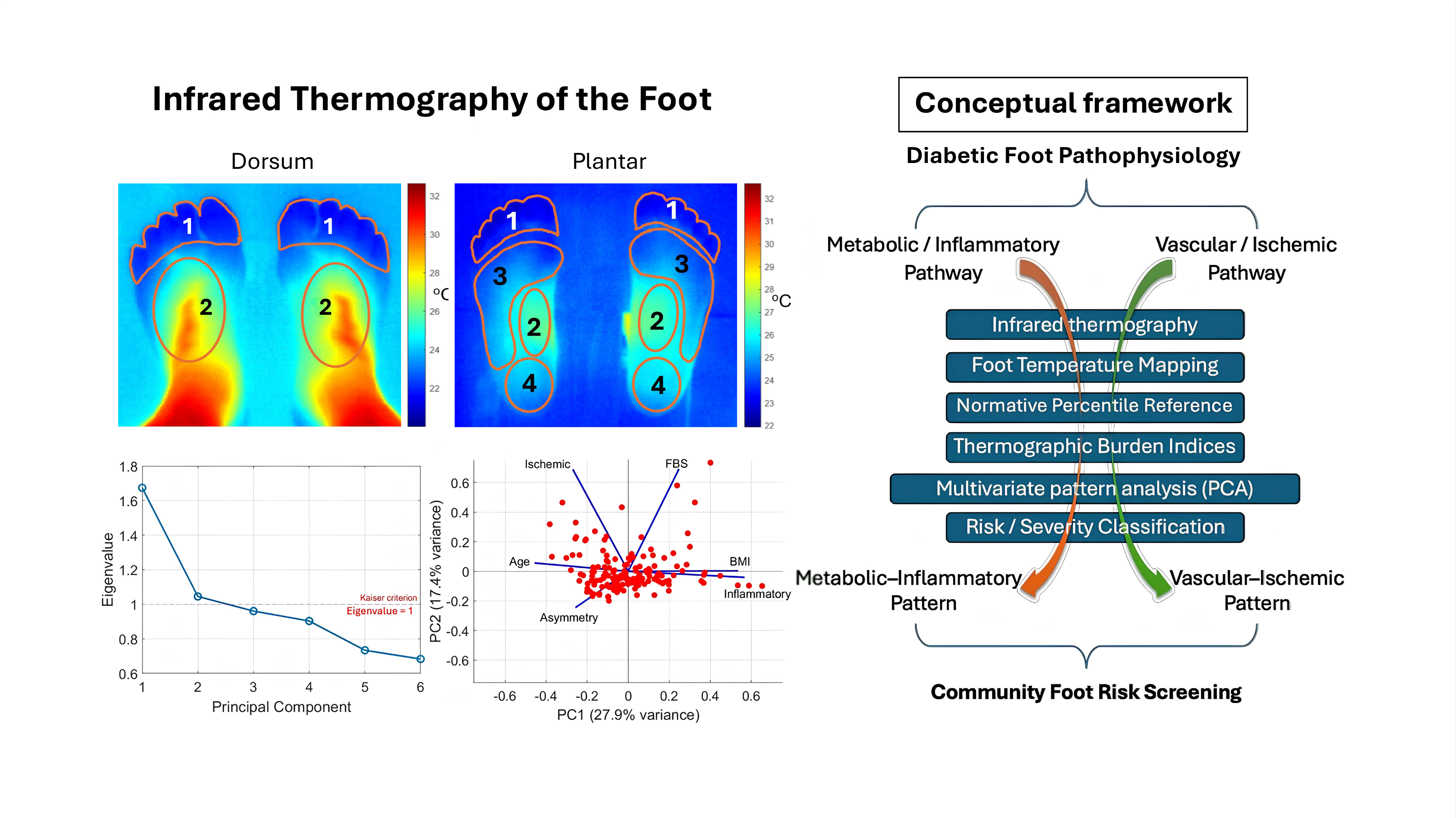
Materials and methods: Plantar foot temperature images were obtained using infrared thermography. Normative temperature references were established, and thermographic burden indices representing ischemic and inflammatory patterns were derived based on percentile thresholds. Principal component analysis (PCA) and logistic regression were performed to identify thermographic patterns and evaluate predictive performance.
Results: Most participants demonstrated low thermographic burden, while a subset exhibited elevated indices. PCA identified two principal components corresponding to metabolic-inflammatory and vascular-ischemic dimensions. The combined thermographic model demonstrated moderate discriminative performance (AUC=0.714, 95% CI: 0.631-0.790), with a sensitivity of 74.2% and specificity of 65.0% at the optimal cutoff.
Conclusion: A percentile-based thermographic framework enables objective characterization of foot thermal abnormalities and provides insight into vascular-ischemic and metabolic-inflammatory thermal patterns. The integration of thermographic indices with multivariate and predictive analyses supports their potential as noninvasive tools for risk stratification and community-based screening of foot health abnormalities.
Article Details

This work is licensed under a Creative Commons Attribution-NonCommercial-NoDerivatives 4.0 International License.
Personal views expressed by the contributors in their articles are not necessarily those of the Journal of Associated Medical Sciences, Faculty of Associated Medical Sciences, Chiang Mai University.
References
Soyoye DO, Abiodun OO, Ikem RT, Kolawole BA, Akintomide AO. Diabetes and peripheral artery disease: A review. World J Diabetes. 2021; 12(6): 827-38. doi: 10.4239/wjd.v12.i6.827.
Armstrong DG, Holtz-Neiderer K, Wendel C, Mohler MJ, Kimbriel HR, Lavery LA. Skin temperature monitoring reduces the risk for diabetic foot ulceration in high-risk patients. Am J Med. 2007; 120(12): 1042-6. doi: 10.1016/j.amjmed.2007.06.028.
Ring EF, Ammer K. Infrared thermal imaging in medicine. Physiol Meas. 2012; 33(3): R33-46. doi: 10.1088/0967-3334/33/3/R33.
Brothers NI, Rebman A, Zenilman JM, Aucott J. Use of infrared thermography in visualizing erythema migrans. Cureus. 2025; 17(8): e89242. doi: 10.7759/cureus.89242.
Lahiri BB, Bagavathiappan S, Jayakumar T, Philip J. Medical applications of infrared thermography: A review. Infrared Phys Technol. 2012; 55(4): 221-35. doi: 10.1016/j.infrared.2012.03.007.
Lavery LA, Higgins KR, Lanctot DR, Constantinides GP, Zamorano RG, Armstrong DG, et al. Home monitoring of foot skin temperatures to prevent ulceration. Diabetes Care. 2004; 27(11): 2642-7. doi: 10.2337/diacare.27.11.2642.
Armstrong DG, Lavery LA, Liswood PJ, Todd WF, Tredwell JA. Infrared dermal thermometry for the high-risk diabetic foot. Phys Ther. 1997; 77(2): 169-75; discussion 76-7. doi: 10.1093/ptj/77.2.169.
Faus Camarena M, Izquierdo-Renau M, Julian-Rochina I, Arrebola M, Miralles M. Update on the use of infrared thermography in the early detection of diabetic foot complications: A bibliographic review. Sensors (Basel). 2023; 24(1). doi: 10.3390/s24010252.
Castillo-Morquecho R, Guevara E, Ramirez-GarciaLuna JL, Martinez-Jimenez MA, Medina-Rangel MG, Kolosovas-Machuca ES. Digital infrared thermography and machine learning for diabetic foot assessment: thermal patterns and classification. J Diabetes Metab Disord. 2024; 23(2): 1967-76. doi: 10.1007/s40200-024-01452-0.
Liew H, Tang W, Plassmann P, Machin G, Simpson R, Edmonds ME, et al. Infrared thermography shows that a temperature difference of 2.2 degrees C (4 degrees F) or greater between corresponding sites of neuropathic feet does not always lead to a diabetic foot ulcer. J Diabetes Sci Technol. 2025; 19(6): 1624-34. doi: 10.1177/19322968241249970.
Li PL, Yick KL, Yip J, Ng SP. Influence of upper footwear material properties on foot skin temperature, humidity and perceived comfort of older individuals. Int J Environ Res Public Health. 2022;19(17). doi: 10.3390/ijerph191710861.
Lavery LA, Higgins KR, Lanctot DR, Constantinides GP, Zamorano RG, Athanasiou KA, et al. Preventing diabetic foot ulcer recurrence in high-risk patients: use of temperature monitoring as a self-assessment tool. Diabetes Care. 2007; 30(1): 14-20. doi: 10.2337/dc06-1600.
Politi S, Aloisi A, Jr., Bartoli V, Guglietta A, Magnifica F. Infrared thermography images acquisition for a technical perspective in screening and diagnostic processes: Protocol standardized acquisition. Cureus. 2021; 13(11): e19931. doi: 10.7759/cureus.9931.
Gatt A, Formosa C, Cassar K, Camilleri KP, De Raffaele C, Mizzi A, et al. Thermographic patterns of the upper and lower limbs: baseline data. Int J Vasc Med. 2015; 2015: 831369. doi: 10.1155/2015/831369.
Pepe MS. The statistical evaluation of medical tests for classification and prediction: Oxford University Press; 2003. Available from: https://doi.org/10.1093/oso/9780198509844.001.0001.
Group WHOMGRS. WHO Child Growth Standards based on length/height, weight and age. Acta Paediatr Suppl. 2006; 450: 76-85. doi: 10.1111/j.16512227.2006.tb02378.x.
Kuczmarski RJ, Ogden CL, Grummer-Strawn LM, Flegal KM, Guo SS, Wei R, et al. CDC growth charts: United States. Adv Data. 2000; 314: 1-27.
Altman DG, Bland JM. Statistics notes: the normal distribution. BMJ. 1995; 310(6975): 298. doi: 10.1136/bmj.310.6975.298.
van Netten JJ, van Baal JG, Liu C, van der Heijden F, Bus SA. Infrared thermal imaging for automated detection of diabetic foot complications. J Diabetes Sci Technol. 2013; 7(5): 1122-9. doi: 10.1177/193229681300700504.
Ilo A, Romsi P, Makela J. Infrared thermography and vascular disorders in diabetic feet. J Diabetes Sci Technol. 2020; 14(1): 28-36. doi: 10.1177/1932296819871270.
