
Design and preliminary study of VP1-encoding mRNA-lipid nanoparticles for Enterovirus 71
Article Sidebar
Main Article Content
Abstract
Background: Hand, foot, and mouth disease (HFMD) remains a major public health concern in the Asia-Pacific region, with Enterovirus 71 (EV71) being a major cause of severe neurological complications in children. The genetic diversity of EV71 highlights the need for adaptable vaccine platforms.
Objective: This study aimed to design and preliminarily evaluate an EV71 VP1-encoding mRNA-lipid nanoparticle (mRNA-LNP) construct as an antigen delivery approach for EV71 vaccine development.
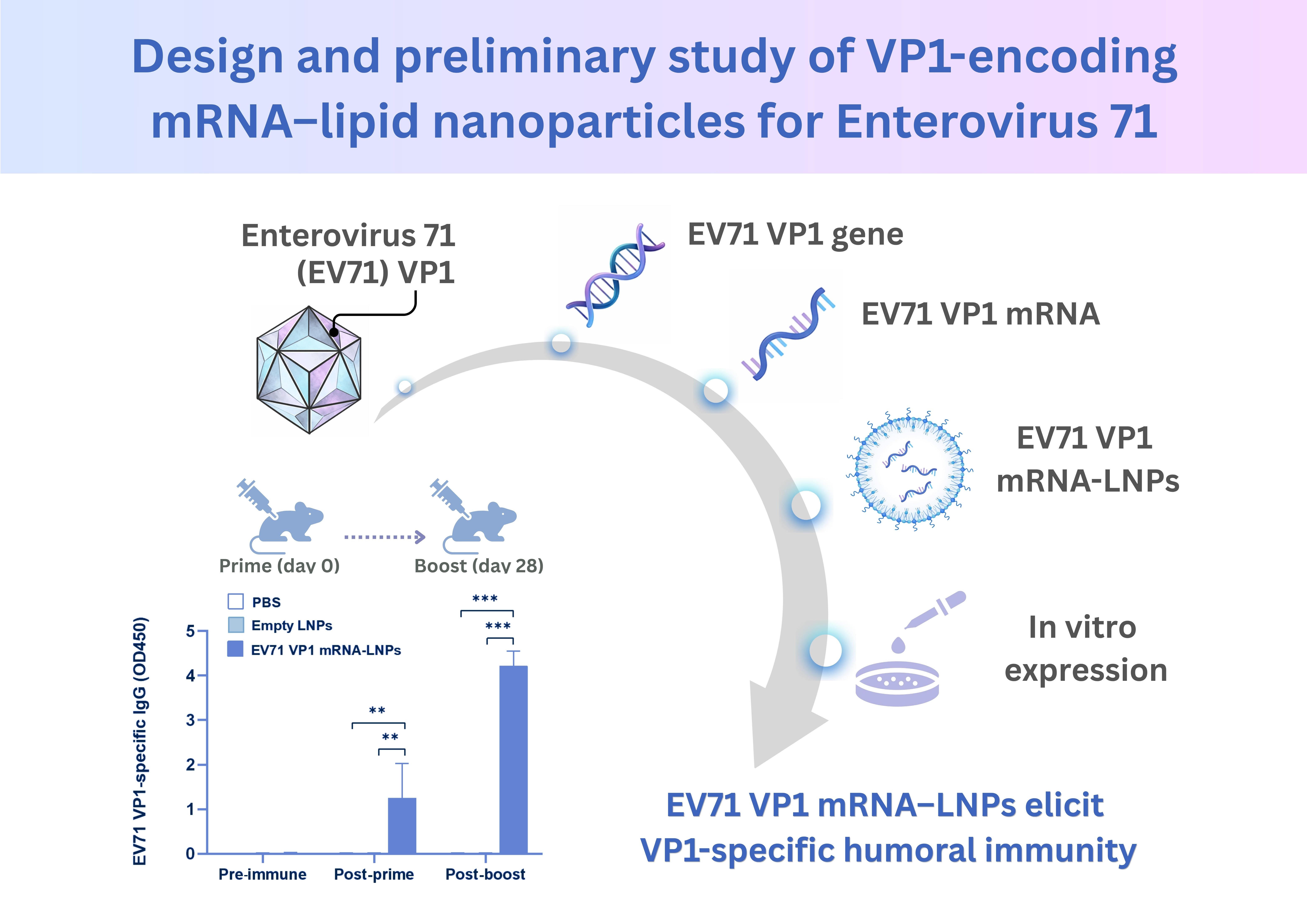
Materials and methods: A codon-optimized VP1 mRNA was synthesized by in vitro transcription and formulated into lipid nanoparticles via microfluidic mixing. Physicochemical properties were characterized, and in vitro expression was assessed in FreeStyle 293F cells by western blot and immunofluorescence. VP1-specific humoral immune responses were evaluated in BALB/c mice following a prime-boost immunization regimen using ELISA.
Results: The mRNA-LNPs exhibited a mean particle size of 99.24±0.46 nm, a low polydispersity index (0.041±0.004), a slightly negative zeta potential (-20.54±0.98 mV), and an encapsulation efficiency of 92.56±1.53%. In vitro studies demonstrated VP1 protein expression following mRNA delivery. Immunization induced VP1-specific IgG responses, with antibody levels significantly increased after prime (1.254±0.775) and boost (4.225±0.322) compared with control groups (p<0.01 and p<0.001, respectively). Endpoint titers increased from a geometric mean titer of 2,000 (95% CI: 901.50-4,437.00) after priming to 256,000 following booster immunization.
Conclusion: This study demonstrates that EV71 VP1 mRNA-LNPs induce antigen-specific humoral immune responses in mice, providing preliminary evidence of their potential as an antigen delivery approach for EV71 and supporting further studies in vaccine development.
Article Details

This work is licensed under a Creative Commons Attribution-NonCommercial-NoDerivatives 4.0 International License.
Personal views expressed by the contributors in their articles are not necessarily those of the Journal of Associated Medical Sciences, Faculty of Associated Medical Sciences, Chiang Mai University.
References
Bifani AM, Tee HK, Antanasijevic A, Clément S, Tapparel C. Enterovirus A71 priorities, challenges, and future opportunities in humoral immunity and vaccine development. npj Vaccines. 2025; 10: 194. doi: 10.1038/s41541-025-01184-z.
Yi EJ, Shin YJ, Kim JH, Kim TG, Chang SY. Enterovirus 71 infection and vaccines. Clin Exp Vaccine Res. 2017; 6(1): 4-14. doi: 10.7774/cevr.2017.6.1.4.
Noisumdaeng P, Sangsiriwut K, Prasertsopon J, Klinmalai C, Payungporn S, Mungaomklang A, et al. Complete genome analysis demonstrates multiple introductions of enterovirus 71 and coxsackievirus A16 recombinant strains into Thailand during the past decade. Emerg Microbes Infect. 2018; 7(1): 1-12. doi: 10.1038/s41426-018-0215-x.
Noisumdaeng P, Puthavathana P. Molecular evolutionary dynamics of enterovirus A71, coxsackievirus A16 and coxsackievirus A6 causing hand, foot and mouth disease in Thailand, 2000-2022. Sci Rep. 2023;13: 17359. doi: 10.1038/s41598-023-44644-z.
Yan X, Liu Y, Chen F, Chang Z, Zhang Z, Pons-Salort M, et al. The efficacy and effectiveness of enterovirus A71 vaccines against hand, foot, and mouth disease: A systematic review and meta-analysis. PLOS One. 2025; 20(5): e0323782. doi: 10.1371/journal.pone.0323782.
Suppasittikulchai A, Takultacha S, Thubthawee P. Hand, foot and mouth disease and enterovirus 71 vaccines. Thai J Pharm Prac. 2024; 16(4): 970-83 (in Thai).
Puenpa J, Chansaenroj J, Auphimai C, Srimuan D, Thatsanathorn T, Poovorawan Y, et al. Neutralizing antibody against enterovirus-A71 in Thai children: A longitudinal study from birth to age 4 years. Vaccine. 2020; 38(48): 7638-44. doi: 10.1016/j.vaccine.2020.10.002.
Leong KY, Tham SK, Poh CL. Revolutionizing immunization: A comprehensive review of mRNA vaccine technology and applications. Virol J. 2025; 22: 71. doi: 10.1186/s12985-025-02645-6.
Pardi N, Hogan MJ, Porter FW, Weissman D. mRNA vaccines - a new era in vaccinology. Nat Rev Drug Discov. 2018; 17(4): 261-79. doi: 10.1038/nrd.2017.243.
John R, Monpara J, Swaminathan S, Kalhapure R. Chemistry and art of developing lipid nanoparticles for biologics delivery: Focus on development and scale-up. Pharmaceutics. 2024; 16(1): 131. doi: 10.3390/pharmaceutics16010131.
Foo DG, Alonso S, Phoon MC, Ramachandran NP, Chow VT, Poh CL. Identification of neutralizing linear epitopes from the VP1 capsid protein of enterovirus 71 using synthetic peptides. Virus Res. 2007; 125(1): 61-8. doi: 10.1016/j.virusres.2006.12.005.
Frey A, Di Canzio J, Zurakowski D. A statistically defined endpoint titer determination method for immunoassays. J Immunol Methods. 1998; 221 (1-2): 35-41. doi: 10.1016/s0022-1759(98)00170-7.
Puenpa J, Auphimai C, Korkong S, Vongpunsawad S, Poovorawan Y. Enterovirus A71 infection, Thailand, 2017. Emerg Infect Dis. 2018; 24(7): 1386-7. doi: 10.3201/eid2407.171923.
Ku Z, Ye X, Shi J, Wang X, Liu Q, Huang Z. Single neutralizing monoclonal antibodies targeting the VP1 GH loop of enterovirus 71 inhibit both virus attachment and internalization during viral entry. J Virol. 2015; 89(23): 12084-95. doi: 10.1128/jvi.02189-15.
Foo DG, Macary PA, Alonso S, Poh CL. Identification of human CD4 T-cell epitopes on the VP1 capsid protein of enterovirus 71. Viral Immunol. 2008; 21(2): 215-24. doi: 10.1089/vim.2007.0089.
Andries O, Mc Cafferty S, De Smedt SC, Weiss R, Sanders NN, Kitada T. N1-methylpseudouridineincorporated mRNA outperforms pseudouridineincorporated mRNA by providing enhanced protein expression and reduced immunogenicity in mammalian cell lines and mice. J Control Release. 2015; 217: 337-44. doi: 10.1016/j.jconrel.2015.08.051.
Mauger DM, Cabral BJ, Presnyak V, Su SV, Reid DW, Goodman B, et al. mRNA structure regulates protein expression through changes in functional half-life. PNAS. 2019; 116(48): 24075-83. doi: 10.1073/pnas.1908052116.
Lenk R, Kleindienst W, Szabó GT, Baiersdörfer M, Boros G, Keller JM, et al. Understanding the impact of in vitro transcription byproducts and contaminants. Front Mol Biosci. 2024; 11: 1426129. doi: 10.3389/fmolb.2024.1426129.
Kong W, Wei Y, Dong Z, Liu W, Zhao J, Huang Y, et al. Role of size, surface charge, and pegylated lipids of lipid nanoparticles (LNPs) on intramuscular delivery of mRNA. J Nanobiotechnology. 2024; 22: 553. doi: 10.1186/s12951-024-02812-x.
Shi R, Liu X, Wang Y, Pan M, Wang S, Shi L, et al. Long-term stability and immunogenicity of lipid nanoparticle COVID-19 mRNA vaccine is affected by particle size. Hum Vaccin Immunother. 2024; 20(1): 2342592. doi: 10.1080/21645515.2024.2342592.
