
Exploring the antioxidant and prebiotic potential of fermented Thai jasmine rice beverage: An in vitro study
Article Sidebar
Main Article Content
Abstract
Background: Amazake is a traditional Japanese non-alcoholic rice beverage produced through koji fermentation and recognized as a functional food. Thai jasmine rice (Oryza sativa L. KDML 105) is rich in health-promoting nutrients and bioactive compounds, yet no studies have explored the health benefits of fermented Thai jasmine rice beverages.
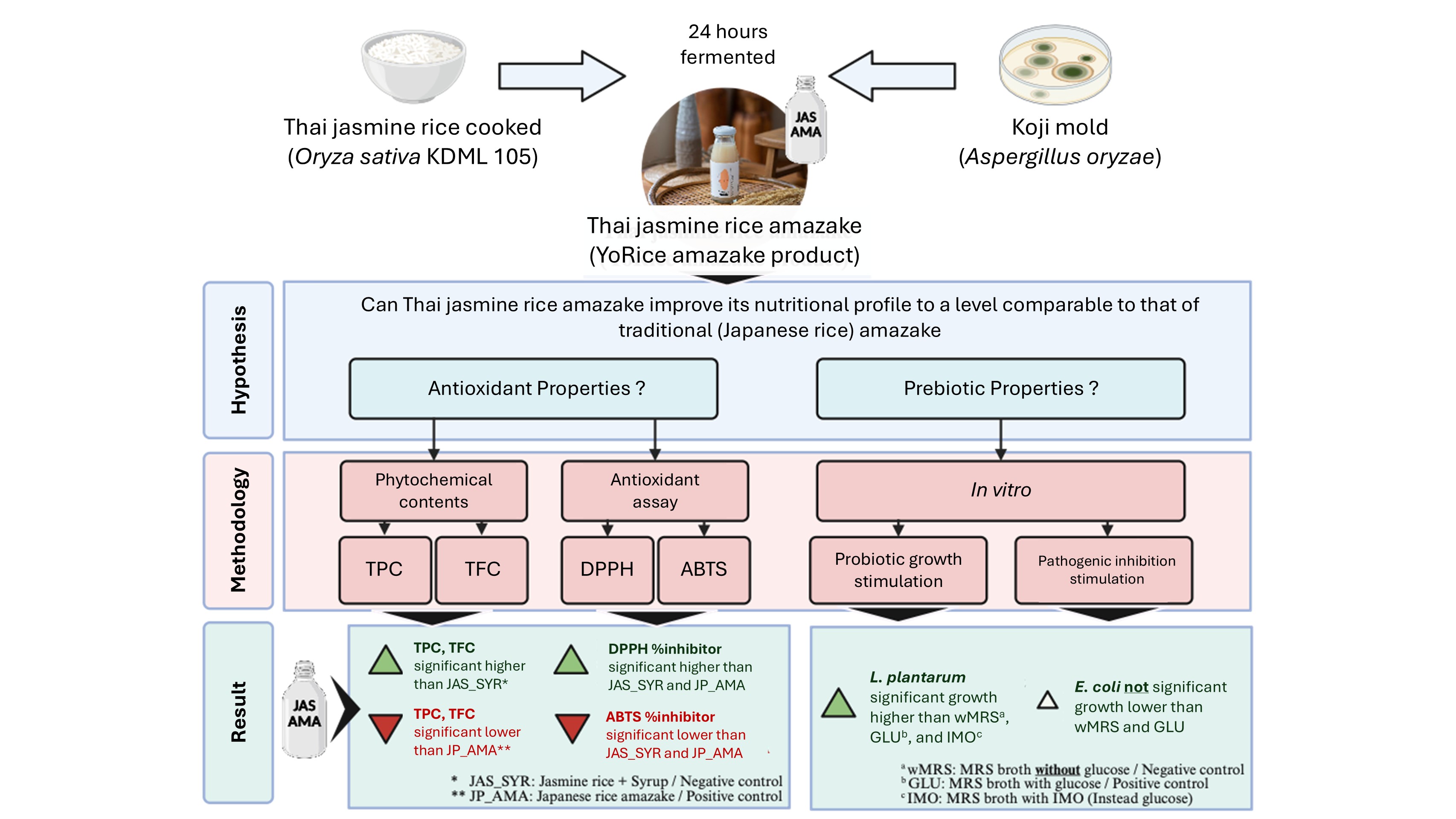
Objectives: To investigate the health-promoting properties of fermented Jasmine rice amazake (JAS-AMA), focusing on phenolic and flavonoid content, antioxidant capacity, prebiotic effects, and antipathogenic activity against bacteria.
Materials and methods: An in vitro study compared JAS-AMA with nonfermented Thai jasmine rice (JAS-SYR) and traditional Japanese amazake (JP-AMA). Total phenolic content, total flavonoid content, DPPH and ABTS antioxidant assays, and prebiotic activity against Lactobacillus plantarum and Escherichia coli were evaluated using isomaltooligosaccharide (IMO) as a prebiotic reference.
Results: The total phenolic content of JAS-AMA was significantly higher than that of JAS-SYR (28±0.44 compared with 3.0±0.24×10⁻³ mg GAE/μL extract, p<0.05), but comparable to that of JP-AMA (34±1.3×10⁻³ mg GAE/μL extract). However, the total flavonoid content of both JAS-AMA and JAS-SYR was significantly lower than JP-AMA (63±6.80 and 12±1.7, respectively, compared with 128±22 x 10-7 mg CE/μL extract, p<0.05). DPPH assay showed comparable antioxidant activity between JAS-AMA and JP-AMA (70.34% and 65.71% inhibition, respectively), both significantly higher than JAS-SYR (20.14% inhibition, p<0.05), whereas ABTS assay revealed significantly lower antioxidant activity in both JAS-AMA and JAS-SYR, lower than JP-AMA (53.57% and 66.05% compared with 95.42% inhibition, p<0.05). The maximum OD600 of L. plantarum grown with JAS-AMA (2.0025±0.10) was comparable to that of glucose (1.8050±0.1882) and significantly higher than that of IMO alone (1.4213±0.0925, p<0.05), suggesting a notable prebiotic effect. No significant differences in E. coli growth were observed across any substrate condition (p>0.05).
Conclusion: Jasmine rice amazake demonstrates comparable phenolic content and partial antioxidant activity to traditional Japanese amazake, supporting its potential as a functional beverage and encouraging further development using other rice varieties.
Article Details

This work is licensed under a Creative Commons Attribution-NonCommercial-NoDerivatives 4.0 International License.
Personal views expressed by the contributors in their articles are not necessarily those of the Journal of Associated Medical Sciences, Faculty of Associated Medical Sciences, Chiang Mai University.
References
Gabriel AS, Ninomiya K, Uneyama H. The role of the Japanese traditional diet in healthy and sustainable dietary patterns around the world. Nutrients. 2018; 10(2): 173. doi: 10.3390/nu10020173.
Hamajima H, Matsunaga H, Fujikawa A, et al. Japanese traditional dietary fungus koji Aspergillus oryzae functions as a prebiotic for
Blautia coccoides through glycosylceramide: Japanese dietary fungus koji is a new prebiotic. SpringerPlus. 2016; 5(1): 1321. doi: 10.1186/s40064-016-2950-6.
Hamajima H, Fujikawa A, Yamashiro M, et al. Chemical analysis of the sugar moiety of monohexosylceramide contained in koji, Japanese traditional rice fermented with Aspergillus. Fermentation. 2016; 2(1): 2. doi: 10.3390/fermentation2010002.
Kurahashi A. Ingredients, functionality, and safety of the Japanese traditional sweet drink amazake. J Fungi (Basel). 2021; 7(6): 469. doi: 10.3390/jof7060469.
hoareaup. The prebiotics market forecast to 2023 and beyond [Internet]. Gnosis by Lesaffre; 2022 Mar 9 [cited 2025 Dec 27]. Available from: https://gnosisbylesaffre.com/blog/the-prebiotics-marketforecast-to-2023-and-beyond/.
Oguro Y, Nishiwaki T, Shinada R, Kobayashi K, Kurahashi A. Metabolite profile of koji amazake and its lactic acid fermentation product by Lactobacillus sakei UONUMA. J Biosci Bioeng. 2017; 124(2): 178-83. doi: 10.1016/j.jbiosc.2017.03.011.
Schwanz Goebel JT, Kaur L, Colussi R, Elias MC, Singh J. Microstructure of indica and japonica rice influences their starch digestibility: a study using a human digestion simulator. Food Hydrocolloids. 2019; 94: 191-8. doi: 10.1016/j.foodhyd.2019.02.038.
Yang Y, Zhu K, Xia H, Chen L, Chen K. Comparative proteomic analysis of indica and japonica rice varieties. Genet Mol Biol. 2014; 37(4): 652-61. doi: 10.1590/S1415-47572014005000015.
Soto C. Effect of isomaltooligosaccharide and gentiooligosaccharide on the growth and fatty acid profile of Lactobacillus plantarum. Electron J Biotechnol [ Internet]. 2013 [ cited 2025 Sep 10];16(4). Available from: https://www.ejbiotechnology.info/index.php/ejbiotechnology/article/view/v16n4-9.
Chantorn S, Piyapittayanun C, Dangpram P. Bioconversion of agricultural wastes to mannooligosaccharides and their prebiotic potential. Chiang Mai J Sci. 2018; 45(1): 60-7.
Oguro Y, Nishiwaki T, Shinada R, Kobayashi K, Kurahashi A. Metabolite profile of koji amazake and its lactic acid fermentation product by Lactobacillus sakei UONUMA. J Biosci Bioeng. 2017; 124(2): 178-83. doi: 10.1016/j.jbiosc.2017.03.011.
Mehmood A, Javid S, Khan MF, Ahmad KS, Mustafa A. In vitro total phenolics, total flavonoids, antioxidant and antibacterial activities of selected medicinal plants using different solvent systems. BMC Chem. 2022; 16(1): 64. doi: 10.1186/s13065-022-00858-2.
Zengin G, Sarikurkcu C, Uyar P, et al. Crepis foetida L. subsp. rhoeadifolia (Bieb.) Celak. as a source of multifunctional agents: cytotoxic and phytochemical evaluation. J Funct Foods. 2015; 17: 698-708. doi: 10.1016/j.jff.2015.06.041.
Re R, Pellegrini N, Proteggente A, Pannala A, Yang M, Rice-Evans C. Antioxidant activity applying an improved ABTS radical cation decolorization assay. Free Radic Biol Med. 1999; 26(9-10): 1231-7. doi: 10.1016/S0891-5849(98)00315-3.
Rurangwa E, Laranja JL, Van Houdt R, et al. Selected nondigestible carbohydrates and prebiotics support the growth of probiotic fish bacteria mono-cultures in vitro. J Appl Microbiol. 2009; 106(3): 932-40. doi: 10.1111/j.1365-2672.2008.04034.x.
Kerdsup P, Hattayapichat P, Silva JL, Tantratian S. Survival of potential probiotic isolated from fermented tea leaf and encapsulated in multilayer beads stored in makiang (Cleistocalyx nervosum var. paniala) juice. Food Biosci. 2022; 50: 102015. doi: 10.1016/j.fbio.2022.102015.
Saelim K. Transfer of Escherichia coli TISTR527 from surface to fresh-cut cantaloupe [ Internet]. Published online 2020. doi: 10.14458/RSU.RES.2020.223.
Montesinos-Cruz V, Somerville GA. Shining a light on spectrophotometry in bacteriology. Antibiotics. 2024; 13(12): 1164. doi: 10.3390/antibiotics13121164.
Yan H. Biocatalytic aldol addition reactions by lipase from Aspergillus oryzae. Chiang Mai J Sci. 2025; 52(2). doi: 10.12982/CMJS.2025.019.
Kumar S, Tissopi T, Mutturi S. The successful synthesis of industrial isomaltooligosaccharides lies in the use of transglycosylating -glucosidases: a review. Carbohydr Polym Technol Appl. 2023; 5: 100325. doi: 10.1016/j.carpta.2023.100325.
Saharan P, Sadh PK, Singh Duhan J. Comparative assessment of effect of fermentation on phenolics, flavanoids and free radical scavenging activity of commonly used cereals. Biocatal Agric Biotechnol. 2017; 12: 236-40. doi: 10.1016/j.bcab.2017.10.013.
Cai Y, Luo Q, Sun M, Corke H. Antioxidant activity and phenolic compounds of 112 traditional Chinese medicinal plants associated with anticancer. Life Sci. 2004; 74(17): 2157-84. doi: 10.1016/j.lfs.2003.09.047.
Choi Y, Jeong HS, Lee J. Antioxidant activity of methanolic extracts from some grains consumed in Korea. Food Chem. 2007; 103(1): 130-8. doi: 10.1016/j.foodchem.2006.08.004.
Xu Z, Hua N, Godber JS. Antioxidant activity of tocopherols, tocotrienols, and -oryzanol components from rice bran against cholesterol oxidation accelerated by 2,2’-azobis(2-methyl propionamidine) dihydrochloride. J Agric Food Chem. 2001; 49(4): 2077-81. doi: 10.1021/jf0012852.
Rumpf J, Burger R, Schulze M. Statistical evaluation of DPPH, ABTS, FRAP, and Folin-Ciocalteu assays to assess the antioxidant capacity of lignins. Int J Biol Macromol. 2023; 233: 123470. doi: 10.1016/j.ijbiomac.2023.123470.
Plamada D, Vodnar DC. Polyphenols—gut microbiota interrelationship: a transition to a new generation of prebiotics. Nutrients. 2021; 14(1): 137. doi: 10.3390/nu14010137.
Sawangwan T, Saman P. Prebiotic synthesis from rice using Aspergillus oryzae with solid state fermentation. Agric Nat Resour. 2016; 50(4): 227-31. doi: 10.1016/j.anres.2016.02.004.
Fuloria S, Mehta J, Talukdar MP, et al. Synbiotic effects of fermented rice on human health and wellness: a natural beverage that boosts immunity. Front Microbiol. 2022; 13: 950913. doi: 10.3389/fmicb.2022.950913.
Davani-Davari D, Negahdaripour M, Karimzadeh I, et al. Prebiotics: definition, types, sources, mechanisms, and clinical applications. Foods. 2019; 8(3): 92. doi: 10.3390/foods8030092.
Son SY, Lee S, Singh D, Lee NR, Lee DY, Lee CH. Comprehensive secondary metabolite profiling toward delineating the solid and submerged-state fermentation of Aspergillus oryzae KCCM 12698. Front Microbiol. 2018; 9: 1076. doi: 10.3389/fmicb.2018.01076.
Tu Z, Choi D, Chen Y, Yu JH, Huynh TN. The food fermentation fungus Aspergillus oryzae is a source of natural antimicrobials against Listeria monocytogenes. J Dairy Sci. 2025; 108(4): 3444-54. doi: 10.3168/jds.2024-25719.
