
Association of serum Interleukin-13 and arginase-1 with disease severity and control in patients with asthma: A biomarker-based study
Article Sidebar
Main Article Content
Abstract
Background: Asthma is a heterogeneous chronic inflammatory airway disease characterized by variable clinical severity and control status. Among these, Interleukin-13 (IL-13) and arginase-1 have emerged as potential biomarkers reflecting immune dysregulation and airway remodeling.
Objectives: This study was designed to examine the correlation between serum Interleukin-13 and arginase-1 levels with asthma severity and control status in Iraqi patients, as well as to assess their viability as biomarker-based indicators of disease activity.
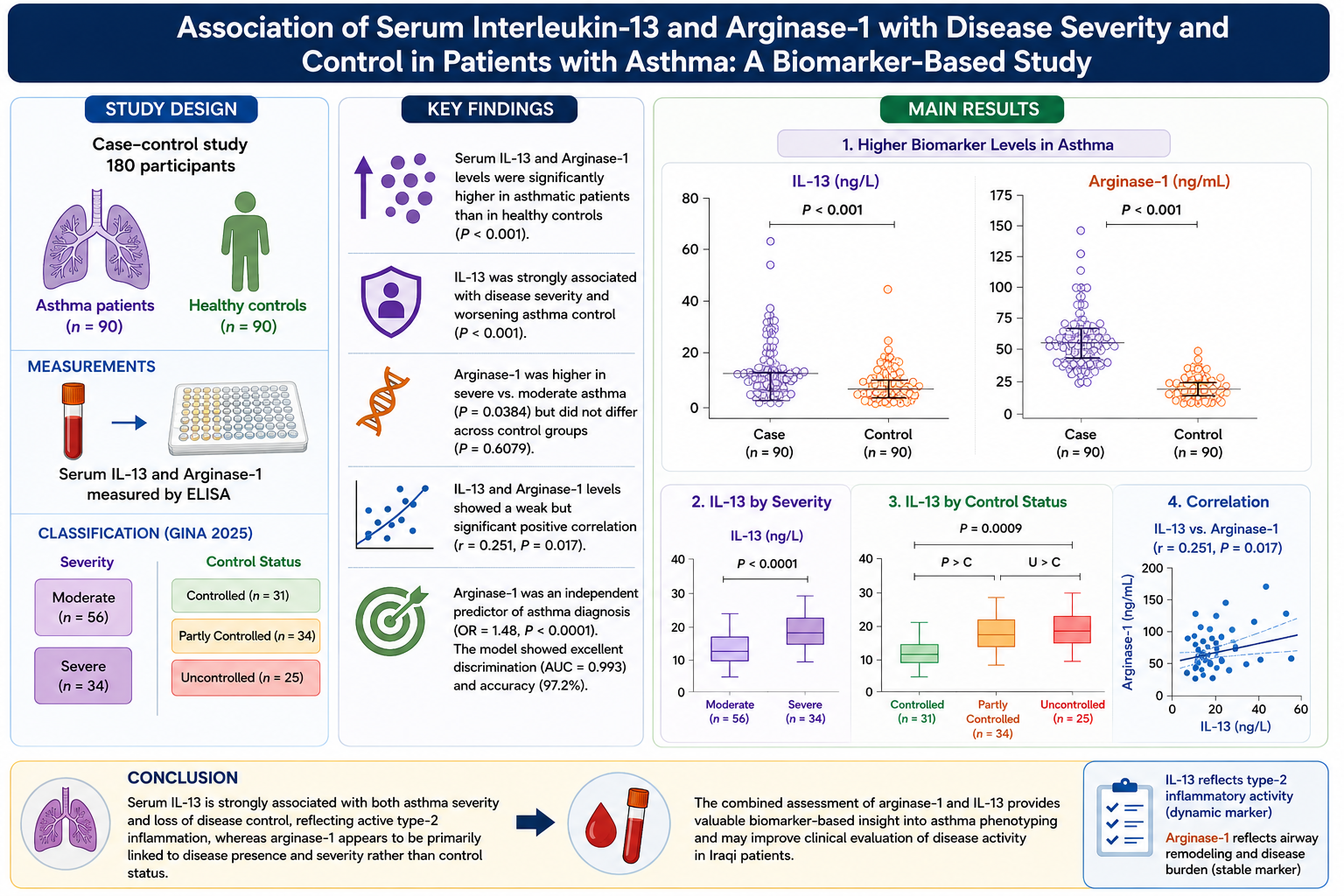
Materials and methods: A case-control study was conducted involving 180 participants, comprising 90 individuals with asthma and 90 healthy controls, from April 2025 to January 2026. According to GINA standards, asthma severity and control were divided into groups. We employed an enzyme-linked immunosorbent assay (ELISA) to quantify the concentrations of arginase-1 and IL-13 in serum and analyzed the data using nonparametric statistical methods to evaluate the findings.
Results: The levels of serum arginase-1 and IL-13 were significantly higher in asthmatic patients than in healthy controls (p<0.001). IL-13 was strongly associated with the severity of the disease, with levels being much higher in severe asthma than in moderate asthma (p<0.0001) and rising steadily as control status got worse (p=0.0009). On the other hand, arginase-1 levels were much higher in people with severe asthma (p=0.0384), but they didn’t differ much across asthma control groups (p=0.6079). Correlation analysis demonstrated a weak but statistically significant positive association between IL-13 and arginase-1 levels (r=0.251, p=0.017). Binary logistic regression showed that the overall model was highly significant (χ²=212.18, p<0.0001) and had excellent explanatory power (Nagelkerke R²=0.923).
Conclusion: Serum IL-13 is strongly associated with both asthma severity and loss of disease control, reflecting active type-2 inflammation, whereas arginase-1 appears to be primarily linked to disease presence and severity rather than control status. The combined assessment of arginase-1 and IL-13 provides valuable biomarker-based insight into asthma phenotyping and may improve clinical evaluation of disease activity in Iraqi patients.
Article Details

This work is licensed under a Creative Commons Attribution-NonCommercial-NoDerivatives 4.0 International License.
Personal views expressed by the contributors in their articles are not necessarily those of the Journal of Associated Medical Sciences, Faculty of Associated Medical Sciences, Chiang Mai University.
References
Global Initiative for Asthma (GINA). Global Strategy for Asthma Management and Prevention (2025 Update). Available from: https://ginasthma.org/.
Li W, Gao P, Zhi Y, Xu W, Wu Y, Yin J, et al. Periostin: Its role in asthma and its potential as a diagnostic or therapeutic target. Respir Res. 2015;16(1):1-11. doi: 10.1186/s12931-015-0218-2.
Refaat MM, El Sayed E, Abd El-Fattah W, Elbanna AH, Sayed HME. Relationship between sputum periostin level and inflammatory asthma phenotypes in Egyptian patients. J Asthma. 2021; 58(10): 1285-91. doi: 10.1080/02770903.2020.1786111.
Muhsen SA, AL-Saeed HH, ALOmrani AAA. Study of the association between prolidase enzyme kinetics and severity of asthma in children. Indian J Public Health Res Dev. 2019; 10(6): 836-42. doi: 10.5958/0976-5506.2019.01383.4.
Vos T, Lim SS, Abbafati C, Abbas KM, Abbas M, Abbasifard M, et al. Global burden of 369 diseases and injuries in 204 countries and territories, 1990-2019: a systematic analysis for the global burden of disease study 2019. Lancet. 2020; 396(10258): 1204-22. doi: 10.1016/S0140-6736(20)30925-9.
Baldo DC, Romaldini JG, Pizzichini MMM, Cançado JED, Dellavance A, Stirbulov R. Periostin as an important biomarker of inflammatory phenotype T2 in Brazilian asthma patients. J Bras Pneumol. 2023; 49(1): 1-8. doi: 10.36416/1806-3756/e20220040.
Burgess JK, Jonker MR, Berg M, Hacken NTHT, Meyer KB, Van Den Berge M, et al. Periostin: Contributor to abnormal airway epithelial function in asthma? Eur Respir J. 2021; 57(2): 1-12. doi: 10.1183/13993003.01286-2020.
Ono J, Takai M, Kamei A, Ohta S, Nair P, Izuhara K, et al. A novel assay for improved detection of sputum periostin in patients with asthma. PLoS One. 2023; 18(2): e0281356. doi: 10.1371/journal.pone.0281356.
Al-Aaraji AJ, Al-Qaysi SA, Baay AS. Role of periostin in Iraqi asthmatic patients. Med J Babylon. 2019; 16(3): 256-60. doi: 10.4103/MJBL.MJBL_39_19.
Kazaal M, Habeeb AA, Hasan HN. Evaluation role of IL-13 and eosinophils in adult asthmatic patients. J Biomed Biochem. 2023; 2(2): 17-25. doi: 10.57238/jbb.2023.6940.1033.
Sahnoon L, Bajbouj K, Mahboub B, Hamoudi R, Hamid Q. Targeting IL-13 and IL-4 in asthma: Therapeutic implications on airway remodeling in severe asthma. Clin Rev Allergy Immunol. 2025;68(1):44. doi: 10.1007/s12016-025-09045-2.
Francisco D, Wang Y, Conway M, Hurbon AN, Dy ABC, Addison KJ, et al. Surfactant protein-A protects against IL-13-induced inflammation in asthma. J Immunol. 2020; 204(10): 2829-39. doi: 10.4049/jimmunol.1901227.
Corren J. Role of Interleukin-13 in asthma. Curr Allergy Asthma Rep. 2013; 13(5): 415-20. doi: 10.1007/s11882-013-0373-9.
Wu G, Morris SM. Arginine metabolism: nitric oxide and beyond. Biochem J. 1998; 336(1): 1-17. doi: 10.1042/bj3360001.
Ogino K, Obase Y, Takahashi N, Shimizu H, Takigawa T, Wang DH, et al. High serum arginase I levels in asthma: Its correlation with highsensitivity C-reactive protein. J Asthma. 2011; 48(1): 1-7. doi: 10.3109/02770903.2010.528496.
Hussain HAK, Muftin NQ, Al-jibouri MN, Ben Salah G. Study of the arginase activity and other biochemical parameters in patients with coronary artery disease in Baghdad Governorate-Iraq. Al-Mustansiriyah J Sci. 2023; 34(1): 37-44. doi: 10.23851/mjs.v34i1.1251.
Maarsingh H, Dekkers BGJ, Zuidhof AB, Bos IST, Menzen MH, Klein T, et al. Increased arginase activity contributes to airway remodelling in chronic allergic asthma. Eur Respir J. 2011; 38(2): 318-28. doi: 10.1183/09031936.00057710.
Amin Said AM, Al-Naqshbandi AA, Amin YK, Ali RJ. Association of the arginase Ι with bronchial asthma. J Univ Babylon Pure Appl Sci. 2019; 27(2): 238-43. doi: 10.29196/jubpas.v27i2.2092.
Meurs H, Maarsingh H, Zaagsma J. Arginase and asthma: Novel insights into nitric oxide homeostasis and airway hyperresponsiveness. Trends Pharmacol Sci. 2003; 24(9): 450-5. doi: 10.1016/S0165-6147(03)00227-X.
Spadaro A, Rinaldi T, Riccieri V, Valesini G, Taccari E. Interleukin 13 in synovial fluid and serum of patients with psoriatic arthritis. Ann Rheum Dis. 2002; 61(2): 174-6. doi: 10.1136/ard.61.2.174.
Eleftheriadis T, Liakopoulos V, Antoniadi G, Stefanidis I, Galaktidou G. Arginase type I as a marker of coronary heart disease in hemodialysis patients. Int Urol Nephrol. 2011; 43(4): 1187-94. doi: 10.1007/s11255-010-9842-4.
Khaleel FM, Oda NN, Abed BA. Disturbance of arginase activity and nitric oxide levels in Iraqi type 2 diabetes mellitus. Baghdad Sci J. 2018; 15(2): 189-91. doi: 10.21123/bsj.2018.15.2.0189.
Raju P, Sundar S, Suresh P, Thulukanam J, Padmanaban S. A comparative study on the utility of biomarkers – serum Interleukin-13 against serum immunoglobulin E in assessing the severity of asthma. Eur J Clin Exp Med. 2025; 23(2): 445-52. doi: 10.15584/ejcem.2025.2.27.
Yasui H. Using biomarkers and independent predictors of therapy response to optimize treatment of uncontrolled severe asthma in the biologic era. Front Allergy. 2025; 6: 1719820. doi: 10.3389/falgy.2025.1719820.
Jebur MS, Saud AM. Serum levels of total IgE and Interleukin-13 in a sample of allergic asthma patients in Baghdad. Iraqi J Sci. 2020; 61(12): 3208-14. doi: 10.24996/ijs.2020.61.12.8.
Jia Y, Fang X, Zhu X, Bai C, Zhu L, Jin M, et al. IL-13+ Type 2 innate lymphoid cells correlate with asthma control status and treatment response. Am J Respir Cell Mol Biol. 2016; 55(5): 675-83. doi: 10.1165/rcmb.2016-0099OC.
Tsilogianni Z, Hillas G, Bakakos P, Aggelakis L, Konstantellou E, Papaioannou AI, et al. Sputum Interleukin-13 as a biomarker for the evaluation of asthma control. Clin Exp Allergy. 2016; 46(7): 923-31. doi: 10.1111/cea.12729.
Awopeju OF, Salawu L, Adedeji TA. The relationship of serum Interleukin-13 to asthma control in Nigerian population. IP Indian J Immunol Respir Med. 2025; 5(4): 205-10. doi: 10.18231/j.ijirm.2020.059.
Morris CR, Poljakovic M, Lavrisha L, Machado L, Kuypers FA, Morris SM. Decreased arginine bioavailability and increased serum arginase activity in asthma. Am J Respir Crit Care Med. 2004; 170(2): 148-53. doi: 10.1164/rccm.200309-1304oc.
Liu Y, Zhang M, Wang T, Zhang J. Reactive oxygen species in asthma: Regulators of macrophage polarization and therapeutic implications: A narrative review. J Asthma Allergy. 2025; 18: 1129-46. doi: 10.2147/JAA.S529371.
North M, Meurs H, Zaagsma J, Scott J, Maarsingh H. Arginase in asthma-Recent developments in animal and human studies. Open Nitric Oxide J. 2009; 2: 20-36.
