
Landscape of fungal diagnosis in Thailand: A national survey in 2024-2025
Article Sidebar
Main Article Content
Abstract
Background: Fungal infections pose a significant global health threat, particularly in Asia, with Thailand experiencinghigh prevalence due to its tropical climate. Increased capacity for fungal diagnosis leads to the appropriate diagnosis and treatment, and most importantly, a reduction in illness and death.
Objectives: To assess and update the current status of fungal diagnosis capacity in Thailand.
Materials and methods: This study utilized an online platform to conduct a survey. The questionnaires collected the relevant information of the laboratory capacity including the capability of the on-site fungal identification, methods for fungal identification, the most commonly identified fungal pathogen and the availability of antifungal susceptibility testing (AFST).
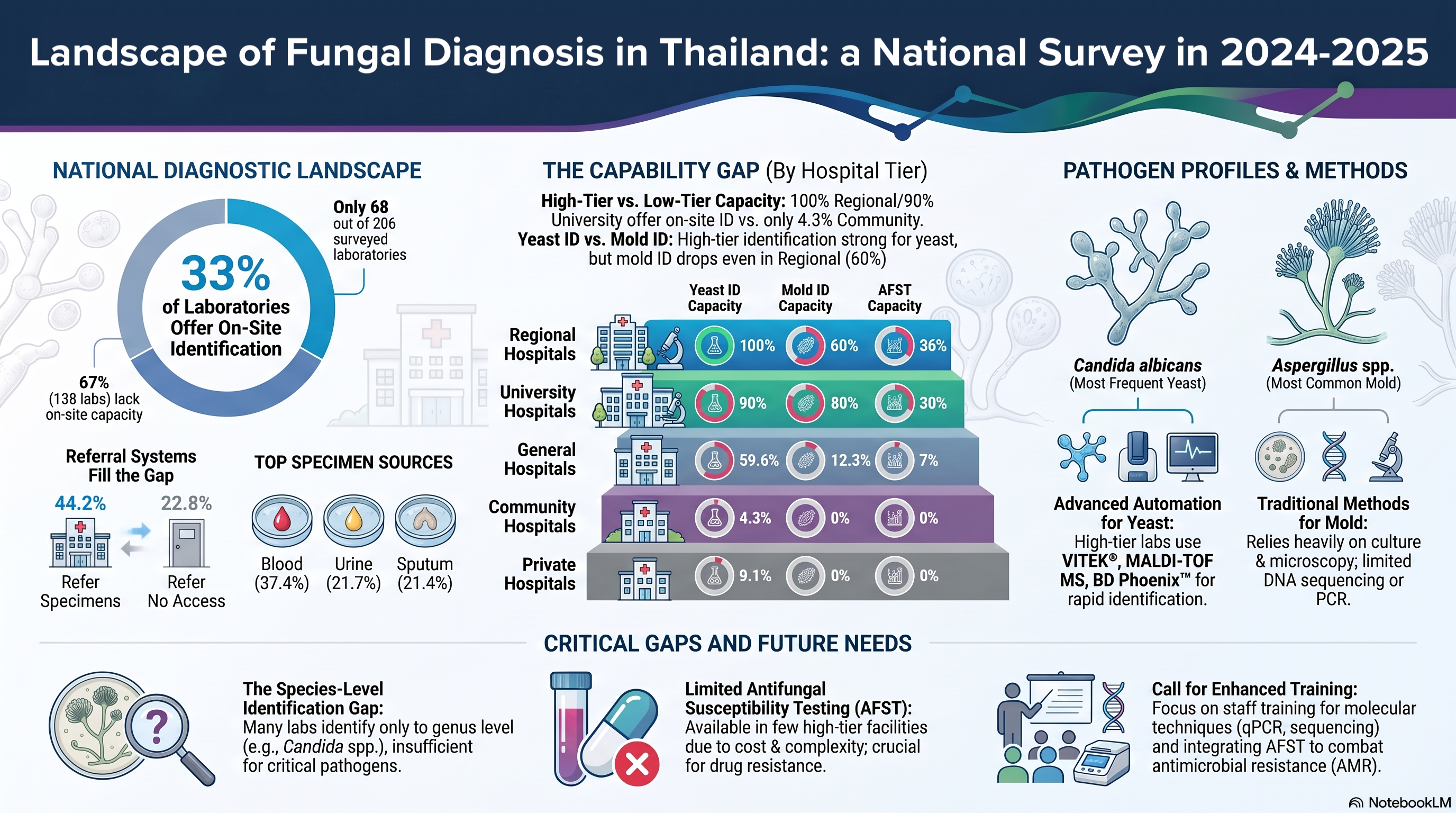
Results: There were 206 healthcare facilities across country participated in this survey, including both government and private hospitals, as well as one reference laboratory. Nearly all high-tier hospitals utilized advanced automated systems for yeast identification; however, mold identification remained limited, primarily relying on traditional culture and microscopy methods. According to the survey results, the most commonly identified yeast was Candida albicans, while the most commonly identified mold was Aspergillus spp. Although many laboratories could identify fungal pathogens, they often struggled to specify the species, which is essential for effective treatment and managing antifungal resistance. AFST was accessible in high-tier hospitals, but low-tier hospitals did not have this capability.
Conclusion: These findings underscore the importance of enhancing the capacity for fungal diagnosis, which will help elucidate the national burden of fungal diseases and improve resource allocation in Thailand.
Article Details

This work is licensed under a Creative Commons Attribution-NonCommercial-NoDerivatives 4.0 International License.
Personal views expressed by the contributors in their articles are not necessarily those of the Journal of Associated Medical Sciences, Faculty of Associated Medical Sciences, Chiang Mai University.
References
Bongomin F, Gago S, Oladele RO, Denning DW. Global and Multi-National Prevalence of Fungal Diseases-Estimate Precision. J Fungi (Basel). 2017;3(4).
Firacative C. Invasive fungal disease in humans: are we aware of the real impact? Memórias do Instituto Oswaldo Cruz. 2020;115:e200430.
WHO. WHO fungal priority pathogens list to guide research, development and public health action. Geneva; 2022 25 October 2022.
Chindamporn A, Chakrabarti A, Li R, Sun P-L, Tan B-H, Chua M, et al. Survey of laboratory practices for diagnosis of fungal infection in seven Asian countries: an Asia Fungal Working Group (AFWG) initiative. Medical mycology. 2018;56(4):416-25.
Chayakulkeeree M, Denning DW. Serious fungal infections in Thailand. Eur J Clin Microbiol Infect Dis. 2017;36(6):931-5.
Hieu VN, Hiep NL, Hang LM, Lau-Goodchild BA, Van Duong N, Linh NT, et al. Mycology laboratory diagnostic capacity for invasive fungal diseases in public hospitals in Vietnam. Medical Mycology. 2024;62(8):myae082.
Dhiman N, Hall L, Wohlfiel SL, Buckwalter SP, Wengenack NL. Performance and cost analysis of matrix-assisted laser desorption ionization–time of flight mass spectrometry for routine identification of yeast. Journal of clinical microbiology. 2011;49(4):1614-6.
Melhem M, Bertoletti A, Lucca H, Silva R, Meneghin F, Szeszs M. Use of the VITEK 2 system to identify and test the antifungal susceptibility of clinically relevant yeast species. Brazilian Journal of Microbiology. 2013;44(4):1257-66.
Posteraro B, Martucci R, La Sorda M, Fiori B, Sanglard D, De Carolis E, et al. Reliability of the Vitek 2 yeast susceptibility test for detection of in vitro resistance to fluconazole and voriconazole in clinical isolates of Candida albicans and Candida glabrata. Journal of clinical microbiology. 2009;47(6):1927-30.
Chakrabarti A, Singh R. The emerging epidemiology of mould infections in developing countries. Current opinion in infectious diseases. 2011;24(6):521-6.
Onchan T, Langsiri N, Thammahong A. Clinical and Genomic Insights into Antifungal Resistance in Aspergillus Isolates from Thailand. Microorganisms. 2025;13(11):2495.
Huet MAL, Muzahid NH, Lee CZ, Goh CBS, Dwiyanto J, Rahman S, et al. Molecular typing of multi-drug resistant Candida albicans isolated from the Segamat community, Malaysia. Brazilian Journal of Microbiology. 2021;52(4):2351-6.
Dhasarathan P, AlSalhi MS, Devanesan S, Subbiah J, Ranjitsingh A, Binsalah M, et al. Drug resistance in Candida albicans isolates and related changes in the structural domain of Mdr1 protein. Journal of infection and public health. 2021;14(12):1848-53.
Biagi MJ, Wiederhold NP, Gibas C, Wickes BL, Lozano V, Bleasdale SC, et al., editors. Development of high-level echinocandin resistance in a patient with recurrent Candida auris candidemia secondary to chronic candiduria. Open forum infectious diseases; 2019: Oxford University Press US.
Ademe M, Girma F. Candida auris: From multidrug resistance to pan-resistant strains. Infection and drug resistance. 2020:1287-94.
Opassathian K, Boonmee N, Swangkaew S, Jenjaroenpun P, Wongsurawat T, Kruasuwan W, et al. A study of genomic complexity underlying multidrug resistance in Candida auris strains in Thailand. Scientific Reports. 2025;15(1):41478.
