Evaluation of changes in diabetes distress, resilience, and self-care behavior following Occupational Therapy Diabetes Self-Management (OTDSM) among adults with type 2 diabetes: A preliminary Quasi-experimental study
Article Sidebar
Main Article Content
Abstract
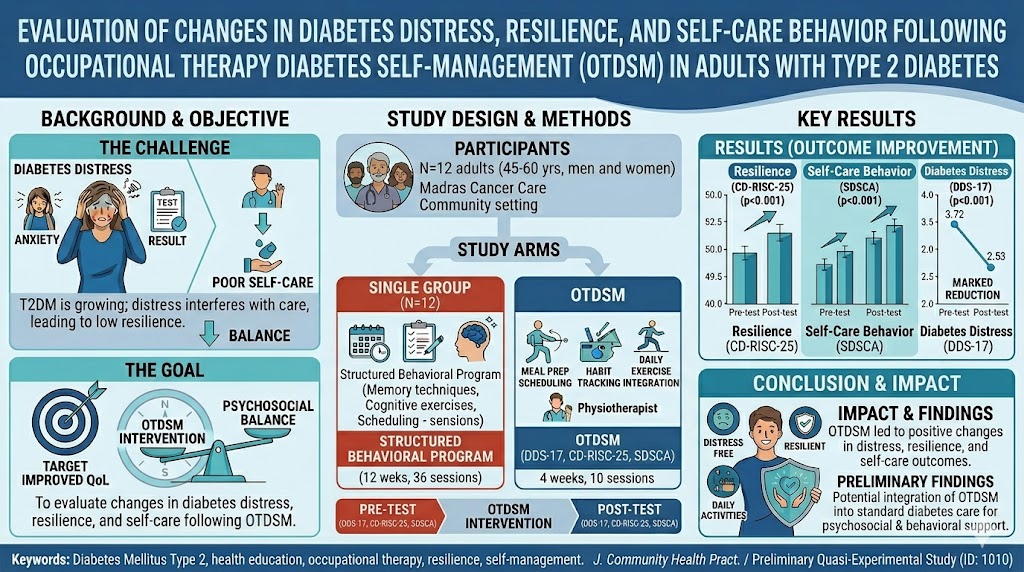
Background: Type 2 diabetes mellitus (T2DM) is a growing health concern that necessitates consistent self-management practices to avoid complications and maintain health. Psychological factors like diabetes distress and poor resilience levels frequently interfere with self-care practices of individuals, resulting in less than adequate diabetes related self-care. By integrating selfmanagement into daily routines, occupational therapy plays a major role in preventing secondary complications of diseases.
Objectives: To find the changes in diabetes distress, resilience, and self-care behavior following the Occupational Therapy Diabetes Self-Management (OTDSM) intervention among adults with type 2 diabetes.
Materials and methods: A quasi-experimental single-group pre-test posttest study was conducted in a community setting, with 12 adults diagnosed with type 2 diabetes. The Occupational Therapy Diabetes Self-Management (OTDSM) intervention was provided for 4 weeks in 10 sessions. Outcomes were assessed using the Diabetes Distress Scale (DDS -17), the Connor-Davidson Resilience Scale (CD-RISC-25), and the Summary of Diabetes Self-Care Activities Questionnaire (SDSCA). Pre- and post-intervention data were analyzed using Paired t-tests and Repeated Measures ANOVA.
Results: Diabetes distress showed marked reduction from 3.72±0.25 to 2.53±0.28 (p<0.001). Resilience scores improved from 42.91±3.53 to 49.45±3.24 (p<0.001). Self-care behavior also showed improvements across multiple domains (p<0.001).
Conclusion: The OTDSM intervention was associated with positive changes in diabetes distress, resilience, and self-care outcomes among adults with T2DM. These preliminary findings may suggest the potential integration of OTDSM into diabetes care to address both psychosocial and behavioral aspects of disease management.
Article Details

This work is licensed under a Creative Commons Attribution-NonCommercial-NoDerivatives 4.0 International License.
Personal views expressed by the contributors in their articles are not necessarily those of the Journal of Associated Medical Sciences, Faculty of Associated Medical Sciences, Chiang Mai University.
References
Banday MZ, Sameer AS, Nissar S. Pathophysiology of diabetes: An overview. Avicenna J Med. 2020; 10(4): 174-88. doi: 10.4103/ajm.ajm_53_20.
Pradeepa R, Mohan V. Epidemiology of type 2 diabetes in India. Indian J Ophthalmol. 2021; 69(11): 2932-8. doi: 10.4103/ijo.IJO_1627_21.
Roglic G. WHO global report on diabetes: A summary. Int J Noncommunicable Dis. 2016; 1(1): 3-8. doi: 10.4103/2468-8827.184853.
Fisher L, Hessler DM, Polonsky WH, Mullan J. When is diabetes distress clinically meaningful? Establishing cut points for the Diabetes Distress Scale. Diabetes Care. 2012; 35(2): 259-64. doi: 10.2337/dc11-1572.
Morales-Brown LA, Algorta GP, Salifu Y. Understanding experiences of diabetes distress: A systematic review and thematic synthesis. J Diabetes Res. 2024; 2024: 3946553. doi: 10.1155/2024/3946553.
Khashayar P, Shirzad N, Zarbini A, Esteghamati A, Hemmatabadi M, Sharafi E. Diabetes-related distress and its association with complications of diabetes in Iran. J Diabetes Metab Disord. 2022; 21: 1569-75. doi: 10.1007/s40200-022-01103-2.
Skinner TC, Joensen L, Parkin T. Twenty-five years of diabetes distress research. Diabet Med. 2020; 37(3): 393-400. doi: 10.1111/dme.14157.
Kim GM, Lim JY, Kim EJ. Resilience of patients with chronic diseases: A systematic review. Health Soc Care Community. 2019; 27(6): e460-72. doi: 10.1111/hsc.12620.
Jin Y, Bhattarai M, Kuo WC, Bratzke LC. Relationship between resilience and self-care in people with chronic conditions: A systematic review and meta-analysis. J Clin Nurs. 2022; 31(15-16): 2121-37. doi: 10.1111/jocn.16258.
Chew BH, Shariff-Ghazali S, Fernandez A. Psychological aspects of diabetes care: Effecting behavioral change in patients. World J Diabetes. 2014; 5(6): 796-808. doi: 10.4239/wjd.v5.i6.796.
Newman S, Steed L, Mulligan K. Self-management interventions for chronic illness. Lancet. 2004; 364(9444): 1523-37. doi: 10.1016/S0140-6736(04)17277-2.
Maina PM, Pienaar M, Reid M. Self-management practices for preventing complications of type II diabetes mellitus in low- and middle-income countries: A scoping review. Univ Free State Fac Health Sci Sch Nurs. 2022. doi: 10.38140/ufs.17206751.
Oluchina S, Karanja S. Barriers to diabetes self-management in primary care settings-patient perspectives: A phenomenological design. Int J Afr Nurs Sci. 2022; 18: 100465. doi: 10.1016/j.ijans.2022.100465.
Shen X, Shen X. The role of occupational therapy in secondary prevention of diabetes. Int J Endocrinol. 2019; 2019: 3424727. doi: 10.1155/2019/3424727.
Binesh M, Mehraban AH, Shahboulaghi FM, Aghili R, Shafaroodi N. Development and preliminary feasibility evaluation of an occupationcentered diabetes self-management intervention. Br J Occup Ther. 2021; 84(12): 734-42. doi: 10.1177/03080226211030100.
Binesh M, Motaharinezhad F, Shafaroodi N, et al. A randomized controlled trial for evaluating an occupational therapy self-management intervention in adults with type 2 diabetes. Sci Rep. 2023; 13: 10128. doi: 10.1038/s41598-023-37231-9.
Gregg JA, Callaghan GM, Glenn-Lawson JL, Hayes SC. Improving diabetes self-management through acceptance, mindfulness, and values: A randomized controlled trial. J Consult Clin Psychol. 2007; 75(2): 336-43. doi: 10.1037/0022-006X.75.2.336.
Polonsky WH, Fisher L, Earles J, et al. Assessing psychosocial distress in diabetes: Development of the Diabetes Distress Scale. Diabetes Care. 2005; 28(3): 626-31. doi: 10.2337/diacare.28.3.626.
Connor KM, Davidson JRT. Development of a new resilience scale: The Connor-Davidson Resilience Scale (CD-RISC). Depress Anxiety. 2003; 18(2): 76-82. doi: 10.1002/da.10113.
Toobert DJ, Hampson SE, Glasgow RE. The Summary of Diabetes Self-Care Activities measure: Results from 7 studies and a revised scale. Diabetes Care. 2000; 23(7): 943-50. doi: 10.2337/diacare.23.7.943.
Brewer LC, Cooper LA, Patten CA. Diabetes self-management education for special populations: The social determinants of health matter. J Gen Intern Med. 2020; 35(Suppl 2): 555-61. doi: 10.1177/0033354919830968.
Fernández-Suárez I, López-Goñi JJ, Haro B. Profiles of women who have suffered occupational accidents in cleaning: Perceived health, psychosocial risks, and personality variables. Int Arch Occup Environ Health. 2022; 96(2): 331-40. doi: 10.1007/s00420-022-01927-8.
Baroni I, Caruso R, Dellafiore F, et al. Self-care and type 2 diabetes mellitus: A literature review on sex-related differences. Acta Biomed. 2022; 93(4): e2022277. doi: 10.23750/abm.v93i4.13324.
Delahanty LM, Grant RW, Wittenberg E, et al. Association of diabetes-related emotional distress with diabetes treatment in primary care patients with type 2 diabetes. Diabet Med. 2007; 24(1): 48-54. doi: 10.1111/j.1464-5491.2007.02028.x.
Guo X, Wong PNF, Koh YLE, Tan NC. Factors associated with diabetes-related distress among Asian patients with poorly controlled type 2 diabetes mellitus. BMC Prim Care. 2023; 24: 54. doi: 10.1186/s12875-023-02012-w.
Perrin N, Bodicoat DH, Davies MJ, Robertson N, Snoek FJ, Khunti K. Effectiveness of psychoeducational interventions for diabetes-specific emotional distress and glycaemic control in people with type 2 diabetes: A systematic review and meta-analysis. Prim Care Diabetes. 2019; 13(4): 289-307. doi: 10.1016/j.pcd.2019.04.001.
Misra R, Shawley-Brzoska S, Khan R, et al. Addressing diabetes distress in self-management programs: Results of a randomized feasibility study. J Appalach Health. 2021; 3(3): 68-85. doi: 10.13023/jah.0303.06.
Mathiesen AS, Egerod I, Jensen T, et al. Psychosocial interventions for reducing diabetes distress in vulnerable people with type 2 diabetes mellitus: A systematic review and meta-analysis. Diabetes Metab Syndr Obes. 2019; 12: 19-33. doi: 10.2147/DMSO.S179301.
Hessler D, Strycker L, Fisher L. Reductions in management distress following a randomized distress intervention are associated with improved diabetes behavioral and glycemic outcomes over time. Diabetes Care. 2021; 44(6): 1472-9. doi: 10.2337/dc20-2724.
Wilson AL, McNaughton D, Meyer SB, Ward PR. Understanding the links between resilience and type 2 diabetes self-management: A qualitative study in South Australia. Arch Public Health. 2017; 75: 56. doi: 10.1186/s13690-017-0222-8.
Dubois SK, Lehrer HM. A resilience intervention for adults with type 2 diabetes: Proof-of-concept in community health centers. Int J Behav Med. 2020;
Pyatak EA, Carandang K, Vigen CLP, Blanchard J, Diaz J, Concha-Chavez A, et al. Occupational therapy intervention improves glycemic control and quality of life among young adults with diabetes: The REAL Diabetes randomized controlled trial. Diabetes Care. 2018; 41(4): 696-704. doi: 10.2337/dc17-1634.
