Wideband acoustic immittance (WAI) normative data in Thai normal hearing adults
Article Sidebar
Main Article Content
Abstract
Background: The evaluation of middle ear function is important for accurately diagnosing middle ear disorders. However, conventional single-frequency tympanometry provided insufficient information to differentiate pathologies, especially in cases with normal otoscopic findings, such as otosclerosis or ossicular chain discontinuity.
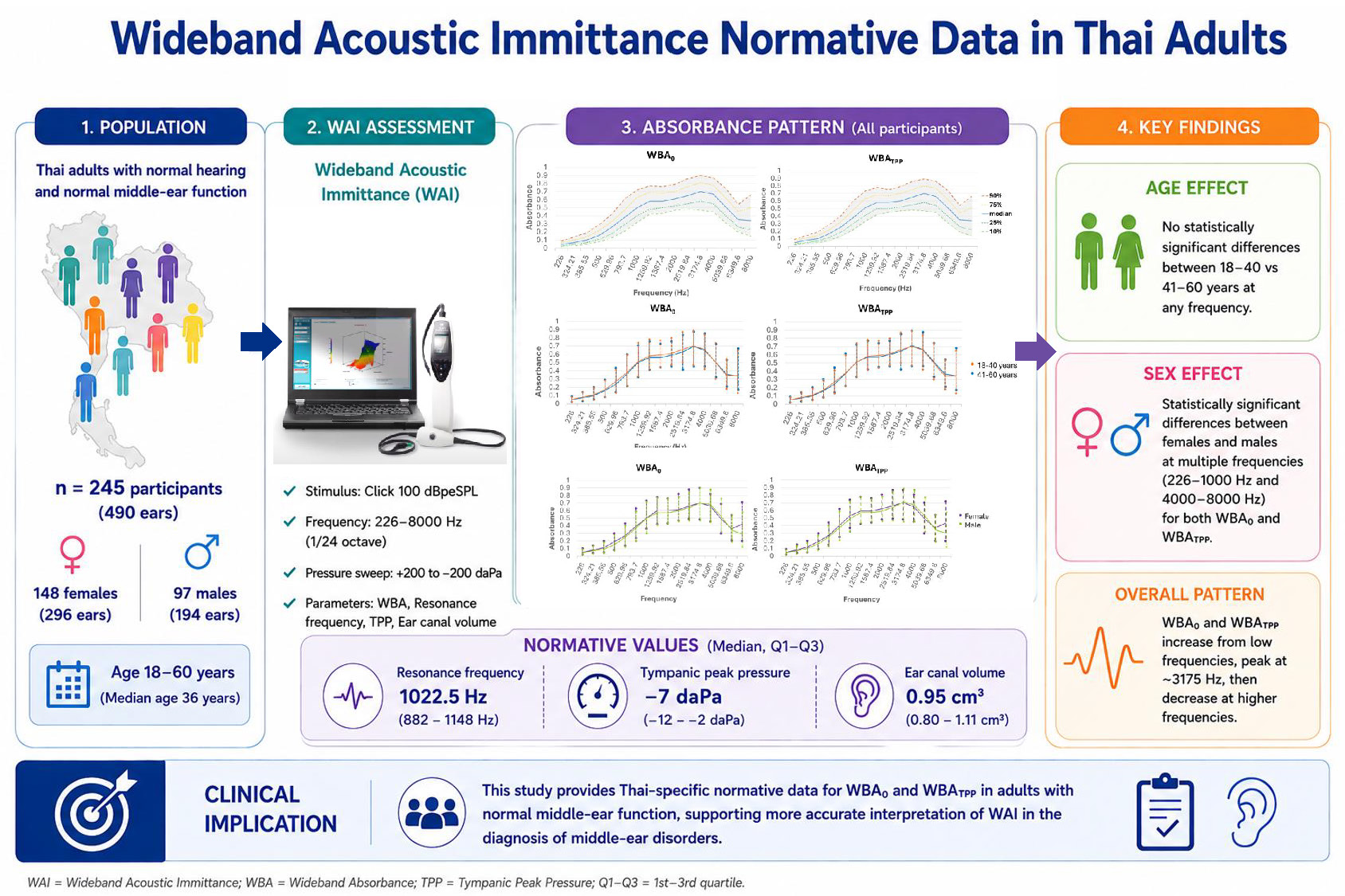
Objectives: This study aimed to establish normative data for wideband acoustic immittance (WAI) measurements using stimuli across a wideband frequency range.
Materials and methods: The study focused on a Thai population with normal hearing aged 18-60 years and compared two age groups: 18-40 years and 41-60 years. A total of 245 participants were included in this study. WAI measurements were performed for wideband absorbance (WBA), resonance frequency, tympanic peak pressure, and ear canal volume.
Results: The WBA0 and WBATPP gradually increased from the lowest value at 226 Hz to the highest at 3174.8 Hz. The analysis revealed no statistically significant differences in WBA0 and WBATPP between the two age groups. However, statistically significant differences were observed in WBA0 and WBATPP between sexes.
Conclusion: This study provides normative data for WBA0 and WBATPP in adults with normal middle ear function. The overall absorbance patterns were generally comparable to those reported in previous studies.
Article Details

This work is licensed under a Creative Commons Attribution-NonCommercial-NoDerivatives 4.0 International License.
Personal views expressed by the contributors in their articles are not necessarily those of the Journal of Associated Medical Sciences, Faculty of Associated Medical Sciences, Chiang Mai University.
References
Heidemann CH, Lailach S, Lieu JEC, Phillips JS, Venekamp RP, Surgery M, et al. Panel 5: Impact of otitis media on quality of life and development. Int J Pediatr Otorhinolaryngol. 2021; 130(Suppl 1): 1-19. doi: 10.1016/j.ijporl.2019.109837.
Dedeoglu S, Toprak SF, Sırma E. When Sound Fades: Depression and anxiety in adults with hearing loss - A cross-sectional study. Healthcare. 2025; 13(3320): 1-11. doi: 10.3390/healthcare13243320.
Choi Y, Go J, Chung JW. Association between hearing level and mental health and quality of fife in adults aged > 40 years. J Audiol Otol. 2024; 28(1): 52-8. doi: 10.7874/jao.2023.00213.
Hunter LL, Sanford CA. Tympanometry and wideband acoustic immittance. In: Katz J, Chasin M, English K, Hood LJ TK, editor. Handbook of Clinical Audiology. 7th Ed. Philadelphia, PA: Wolters Kluwer Health; 2015. pp 137-63.
Voss SE, Merchant GR, Horton NJ. Effects of middleear disorders on power reflectance measured in cadaveric ear canals. Ear Hear. 2012; 33(2): 195-208. doi: 10.1097/AUD.0b013e31823235b5.
Karuppannan A, Barman A. Wideband absorbance pattern in adults with otosclerosis and ossicular chain discontinuity. Auris Nasus Larynx. 2020; 48: 583-9. doi: 10.1016/j.anl.2020.10.019.
Wang S, Hao W, Xu C, Ni D, Gao Z, Shang Y. A study of wideband energy reflectance in patients with otosclerosis: data from a Chinese population. Biomed Res Int. 2019; 2019: 1-8. doi: 10.1155/2019/2070548.
Śliwa L, Kochanek K, Jedrzejczak WW, Mrugała K, Skarżyński H. Measurement of wideband absorbance as a test for otosclerosis. J Clin Med. 2020; 9(6): 1908. doi: 10.3390/jcm9061908.
Shahnaz N, Feeney MP, Schairer KS. Wideband acoustic immittance normative data: ethnicity, gender, aging, and instrumentation. Ear Hear. 2013; 34(Supplement 1): 27S-35S. doi: 10.1097/AUD.0b013e31829d5328.
Mazlan R, Kei J, Ya CL, Yusof WNHM, Saim L, Zhao F. Age and gender effects on wideband absorbance in adults with normal outer and middle ear function. J Speech, Lang Hear Res. 2015; 58: 1377-86. doi: 10.1044/2015_JSLHR-H-14-0199.
Shahnaz N, Davies D. Standard and multifrequency tympanometric norms for Caucasian and Chinese young adults. Ear Hear. 2006; 27(1): 75-90. doi: 10.1097/01.aud.0000194516.18632.d2.
Gelfand SA. Acoustic immittance assessment. In: Sydor A, editor. Essentials of audiology. 4th Ed. New York: Thieme Medical Publishers, Inc.; 2016. pp 182-214.
Camp KJ Van, Creten WL, van de Heyning PH, Decraemer WF, Vanpeperstraete PM. A search for the most suitable immittance components and probe tone frequency in tympanometry a search for the most suitable immittance components and probe tone frequency in tympanometry. Scand Audiol. 1983; 12(1): 27-34. doi: 10.3109/01050398309076221.
Kavruk H, Öztürk B. Investigation of age and gender effects on the middle ear with wideband tympanometry in adults. Ear Hear. 2024; 45(2): 476-85. doi: 10.1097/AUD.0000000000001444.
Simić D. Wideband acoustic immittance (WAI) measurements: normative clinical data for adults [master’s thesis]. Örebro: Örebro University; 2021.
Özgür A, Müjdeci B, Terzi S, Coşkun ZÖ, Yiğit E, Dursun E. Wideband tympanometry normative data for different age groups in Turkish population. J Int Adv Otol. 2016; 12(1): 82-6. doi: 10.5152/iao.2015.1408.
Downing C, Kei J, Driscoll C, Choi R, Scott D. Wideband tympanometry findings in school-aged children: effects of age, gender, ear laterality, and ethnicity. Ear Hear. 2021; 43(4): 1245-55. doi: 10.1097/AUD.0000000000001197.
Wan IKK, Wong LLN. Tympanometric norms for Chinese young adults. Ear Hear. 2002; 23(5): 416-21. doi: 10.1097/00003446200210000-00003.
Sinha SK, Neupane AK, Gururaj K. Effect of aging on tympanometric findings in Indian population. Ann Otol Neurotol. 2021; 4(01): 1-5. doi: 10.1055/s-0041-1731921.
Wei De KC. A preliminary analysis of tympanometric parameters in a local multiethnic population. Audiol Res. 2020; 10(2): 77-82. doi: 10.3390/audiolres10020013.
Polat Z, Baş B, Hayır D, Bulut E, Ataş A. Wideband tympanometry normative data for Turkish young adult population. J Int Adv Otol. 2015; 11(2): 157-62. doi:10.5152/iao.2015.809.
Downing C. Wideband tympanometry in schoolaged children with and without conductive hearing loss and middle ear dysfunction [doctoral dissertation]. The University of Queensland; 2022.
Humes L. Development and application of a reference interval approach to wideband absorbance norms using U.S. population data for ages 6 to 80+ years. J Speech, Lang Hear Res. 2023; 66(November): 4590-617. doi: 10.1044/2023_JSLHR-23-00313.
Beers AN, Shahnaz N, Westerberg BD, Kozak FK. Wideband Reflectance in Normal Caucasian and Chinese school-aged children and in children with otitis media with effusion. Ear Hear. 2010; 31(2): 221-33. doi: 10.1097/AUD.0b013e3181c00eae.
Nakajima HH, Pisano D V, Roosli C, Hamade MA, Merchant GR, Mahfoud L, et al. Comparison of earcanal reflectance and umbo velocity in patients with conductive hearing loss: a preliminary study. Ear Hear. 2012; 33(1): 35-43. doi: 10.1097/AUD.0b013e31822ccba0.
AlMakadma H, Kei J, Yeager D, Feeney MP. Fundamental concepts for assessment and interpretation of wideband acoustic immittance measurements. Semin Hear. 2023; 44(1): 17-28. doi: 10.1055/s-0043-1763293.
Aithal S, Kei J, Driscoll C. Wideband absorbance in Australian Aboriginal and Caucasian neonates. J Am Acad Audiol. 2014; 25(5): 482-94. doi: 10.3766/jaaa.25.5.7.
Shanks J, Lilly DJ. An evaluation of tympanometric estimates of ear canal volume. J Speech Hear Res. 1981; 24(4): 557-66. doi: 10.1044/jshr.2404.557.
Sun X-M. Wideband acoustic immittance: normative study and test-retest reliability of tympanometric measurements in adults. J Speech, Lang Hear Res. 2016; 59: 819-34. doi: 10.1044/2016_JSLHR-H-14-0322.
Zhao F, Suresh SC, Jones E, Cao Z, Wang J, Grais EM, et al. Age effect on wideband absorbance in people with normal middle ear function: a systematic review. Int J Audiol [Internet]. 2025; 0(0): 1-21. doi: 10.1080/14992027.2025.2590546.
Şahin M, Aksoy S. Examination of wideband tympanometry (WBT) parameters in individuals with healthy middle ear. Hacettepe Univ Fac Health Sci J. 2021; 8(1): 77-90. doi: 10.21020/husbfd.858576.
Carhart R, Jerger JF. Preferred method for clinical determination of pure-tone thresholds. J Speech Hear Disord. 1959; 24(4): 330-45. doi: 10.1044/jshd.2404.330.
Jeffrey S. Comparison of wideband energy reflectance and tympanometric measures obtained with Reflwin interacoustics, Mimosa acoustics, and GSI Tympstar systems [master’s thesis]. Vancouver: The University of British Columbia; 2009.
Habibi Z, Sepehrnejad M, Rahimi Ghooradel F, Nilforoush MH. Wideband tympanometry: normative data for young Iranian adults. Audiol Neurotol. 2023; 28(1): 22-31. doi: 10.1159/000526380.
Mishra SK, Dinger Z, Renken L. Maturation of middle ear transmission in children. Hear Res. 2017; 344(1): 62-7. doi: 10.1016/j.heares.2016.10.029.
Kenny S. Clinical application of the Interacoustics Reflwin system wideband energy reflectance machine in the assessment of the eustachian tube [master’s thesis]. Vancouver: The University of British Columbia; 2011.
Feeney MP, Stover B, Keefe DH, Garinis AC, Day JE, Seixas N. Sources of variability in wideband energy reflectance measurements in adults. J Am Acad Audiol. 2014; 25(5): 449-61. doi: 10.3766/jaaa.25.5.4.
