
Analysis of associations between personal attributes, emotional state, and functional performance after stroke
Article Sidebar
Main Article Content
Abstract
Background: Emotional problems such as depression, anxiety, and apathy frequently occur after stroke and can negatively impact the functional recovery process. However, most previous studies have focused on specific emotional factors or examined the relationship between emotional and functional variables in a predominantly one-directional manner. Because emotional management is also important in stroke rehabilitation, further research is needed to clarify the complex associations among emotional, functional, and personal variables.
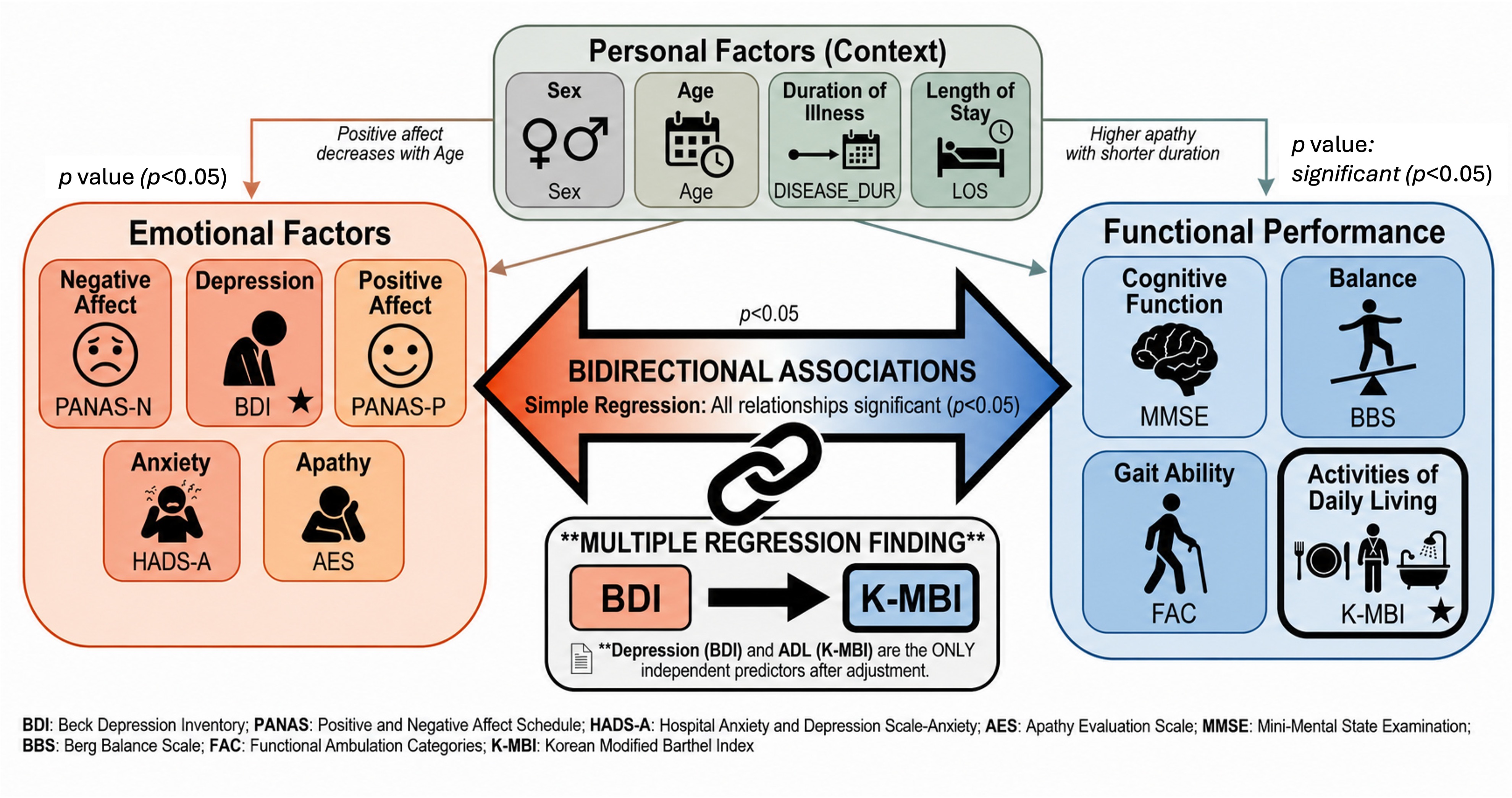
Objectives: The purpose of this study was to examine the bidirectional associations between emotional factors and functional performance in stroke patients undergoing inpatient rehabilitation and to explore the role of personal factors in emotional status.
Materials and methods: The study was conducted with 102 stroke patients hospitalized in a rehabilitation hospital. Emotion was assessed using the Korean version of the Positive and Negative Affect Schedule (PANAS), the Beck Depression Inventory (BDI), the Hospital Anxiety and Depression Scale-Anxiety (HADS-A), and the Apathy Evaluation Scale (AES). Function was measured by cognitive function (MMSE), balance ability (BBS), gait ability (FAC), and activities of daily living (K-MBI). Personal factors included sex, age, duration of illness (DISEASE_DUR), and length of stay (LOS). Statistical analyses included simple and multiple regression.
Results: Simple regression analysis showed that better functional performance was associated with lower negative affect, depression, and anxiety. Conversely, higher negative affect, depression, and anxiety were associated with poorer cognitive function, balance, gait ability, and activities of daily living. Apathy showed a limited positive association with cognitive function. Among personal factors, positive affect decreased slightly with increasing age, and apathy was higher in patients with a shorter illness duration. Multiple regression analysis showed that most relationships disappeared, but depression remained independently associated with functional performance after adjustment for other emotional variables. Among functional domains, only activities of daily living independently explained emotional state.
Conclusion: Emotional state and functional performance in stroke patients were significantly associated, particularly with respect to negative emotions and depression. These findings suggest that a functional-focused rehabilitation approach alone may be insufficient, highlighting the potential need for rehabilitation strategies that integrate emotional interventions with functional training. This study can serve as foundational data for developing integrated rehabilitation models to promote recovery in stroke patients.
Article Details

This work is licensed under a Creative Commons Attribution-NonCommercial-NoDerivatives 4.0 International License.
Personal views expressed by the contributors in their articles are not necessarily those of the Journal of Associated Medical Sciences, Faculty of Associated Medical Sciences, Chiang Mai University.
References
Feigin VL, Norrving B, Mensah GA. Global burden of stroke. Circ Res. 2017; 120(3): 439-48. doi: 10.1161/CIRCRESAHA.116.308413
Stineman MG, Bates BE, Kurichi JE, Kwong PL, Ripley DC, Vogel WB, et al. Initial physical grades and cognitive stages after acute stroke: who receives comprehensive rehabilitation services? PM R. 2013; 5(12): 1007-18. doi: 10.1016/j.pmrj.2013.07.008.
Wade DT, Wood VA, Hewer RL. Recovery after stroke--the first 3 months. J Neurol Neurosurg Psychiatry.1985; 48(1): 7-13. doi: 10.1136/jnnp.48.1.7.
Kang JH, Bae HJ, Choi YA, Lee SH, Shin HI. Length of hospital stay after stroke: A Korean nationwide study. Ann Rehabil Med. 2016; 40(4): 675-81. doi: 10.5535/arm.2016.40.4.675.
Kim MK, Park YJS, Choi EH. Effect of mirror therapy combined with lower extremity muscle strength exercise on gait and balance of patients with chronic stroke. J Korean Soc Phys Med. 2018; 13(1): 81-8. doi: 10.13066/ksep.2018.13.1.81.
Tyson SF, Hanley M, Chillala J, Selley A, Tallis RC. Balance disability after stroke. Phys Ther. 2006; 86(1): 30-8. doi: 10.1093/ptj/86.1.30.
Sturm JW, Donnan GA, Dewey HM, Macdonell RA, Gilligan AK, Srikanth V, et al. Quality of life after stroke: the North East Melbourne Stroke Incidence Study (NEMESIS). Stroke. 2004; 35(10): 2340-5. doi: 10.1161/01.STR.0000141977.18520.3b.
Suzuki A, Mutai H, Furukawa T, Wakabayashi A, Hanihara T. The prevalence and course of neuropsychiatric symptoms in stroke patients impact functional recovery during in-hospital rehabilitation. Top Stroke Rehabil.2022; 29(1): 1-8. doi: 10.1080/10749357.2020.1863261.
Nemani K, Gurin L. Neuropsychiatric Complications after Stroke. Semin Neurol. 2021; 41(1): 85-100. doi: 10.1055/s-0040-1722223.
Medeiros GC, Roy D, Kontos N, Beach SR. Poststroke depression: A 2020 updated review. Gen Hosp Psychiatry.2020; 66: 70-80. doi: 10.1016/j.genhosppsych.2020.06.011.
Isuru A, Hapangama A, Ediriweera D, Samarasinghe L, Fonseka M, Ranawaka U. Prevalence and predictors of new onset depression in the acute phase of stroke. Asian J Psychiatr. 2021; 59: 102636. doi: 10.1016/j.ajp.2021.102636.
Cumming TB, Blomstrand C, Skoog I, Linden T. The high prevalence of anxiety disorders after stroke. Am J Geriatr Psychiatry. 2016; 24(2): 154-60. doi: 10.1016/j.jagp.2015.06.003.
Knapp P, Dunn-Roberts A, Sahib N, Cook L, Astin F, Kontou E, et al. Frequency of anxiety after stroke: An updated systematic review and meta-analysis of observational studies. Int J Stroke. 2020; 15(3): 244-55. doi: 10.1177/1747493019896958.
Carnes-Vendrell A, Deus J, Molina-Seguin J, Pifarre J, Purroy F. Depression and apathy after transient ischemic attack or minor stroke: Prevalence, evolution and predictors. Sci Rep. 2019; 9(1): 16248. doi: 10.1038/s41598-019-52711-2.
Shi Y, Yang D, Zeng Y, Wu W. Risk factors for poststroke depression: A meta-analysis. Front Aging Neurosci.2017; 9: 218. doi: 10.3389/fnagi.2017.00218.
Schmaal L, Veltman DJ, van Erp TG, Samann PG, Frodl T, Jahanshad N, et al. Subcortical brain alterations in major depressive disorder: findings from the ENIGMA Major Depressive Disorder working group. Mol Psychiatry.2016; 21(6): 806-12. doi: 10.1038/mp.2015.69.
Kvael LAH, Bergland A, Telenius EW. Associations between physical function and depression in nursing home residents with mild and moderate dementia: a cross-sectional study. BMJ Open. 2017; 7(7): e016875. doi: 10.1136/bmjopen-2017- 016875.
Robinson RG, Jorge RE. Post-stroke depression: A review. Am J Psychiatry. 2016; 173(3): 221-31. doi: 10.1176/appi.ajp.2016.15030363.
Kutlubaev MA, Hackett ML. Part II: predictors of depression after stroke and impact of depression on stroke outcome: an updated systematic review of observational studies. Int J Stroke. 2014; 9(8): 1026-36. doi: 10.1111/ijs.12356.
Shi Y, Lenze EJ, Mohr DC, Lee JM, Hu L, Metts CL, et al. Post-stroke depressive symptoms and cognitive performances: A network analysis. Arch Phys Med Rehabil. 2024; 105(5): 892-900. doi: 10.1016/j.apmr.2023.12.012.
Lee Y, Nicholas ML, Connor LT. Identifying emotional contributors to participation poststroke. Top Stroke Rehabil.2023; 30(2): 180-92. doi: 10.1080/10749357.2021.2010834.
Choe YW, Kim MK. Could self-control and emotion influence physical ability and functional recovery after stroke? Medicina (Kaunas). 2021; 57(10):1038. doi: 10.3390/medicina57101038.
Schuch F, Vancampfort D, Firth J, Rosenbaum S, Ward P, Reichert T, et al. Physical activity and sedentary behavior in people with major depressive disorder: A systematic review and meta-analysis. J Affect Disord. 2017; 210: 139-50. doi: 10.1016/ j.jad.2016.12.011.
Kim M, Lee YH. Gender Differences in the risk of depression in community-dwelling stroke survivors compared to the general population without stroke. Chonnam Med J. 2023; 59(2): 134-9. doi: 10.4068/ cmj.2023.59.2.134.
Xiao W, Liu Y, Huang J, Huang LA, Bian Y, Zou G. Analysis of factors associated with depressive symptoms in stroke patients based on a national cross-sectional study. Sci Rep. 2024; 14(1): 9268. doi: 10.1038/s41598-024-60124-x.
Gular K, Sivasubramanian V, Reddy RS, Tedla JS, Dixit S. The mediating effect of age, gender, and post-stroke duration on the association between trunk and upper limb recovery in subacute stroke population: A cross-sectional study with mediation analysis. Int J Environ Res Public Health. 2022; 19(23): 15644. doi: 10.3390/ijerph192315644.
Aderinto N, AbdulBasit MO, Olatunji G, Adejumo T. Exploring the transformative influence of neuroplasticity on stroke rehabilitation: a narrative review of current evidence. Ann Med Surg (Lond). 2023; 85(9): 4425-32. doi: 10.1097/MS9.0000000000001152.
Butsing N, Zauszniewski JA, Ruksakulpiwat S, Griffin MTQ, Niyomyart A. Association between post-stroke depression and functional outcomes: A systematic review. PLoS One. 2024; 19(8): e0309158. doi: 10.1371/journal.pone.0309158.
Lee HH, Kim EJ, Lee MG. A validation study of Korean positive and negative affect schedule: The PANAS Scales. Korean J Clin Psychol. 2003; 22(4): 935-46. doi: 10.15842/kjcp.2003.22.4.014.
Lee EH, Lee SJ, Hwang ST, Hong SH, Kim JH. Reliability and validity of the Beck Depression Inventory-II among Korean adolescents. Psychiatry Investig. 2017; 14(1): 30-6. doi: 10.4306/pi.2017.14.1.30.
Choi JH, Jeon S, Hong S, Kim A, Park JY, Yang HJ. The Reliability and validity of the Korean version of hospital anxiety and depression scale using Rasch Measurement Theory in patients with Parkinson’s disease. J Korean Neurol Assoc. 2021; 39(4): 312-21. doi: 10.17340/jkna.2021.4.3.
Lee YM, Park IH, Koo MS, Ko SH, Kang HM, Song JE. The reliability and validity of the Korean versionof apathy evaluation scale and its application in patients with schizophrenia. J Korean Neuropsychiatr Assoc. 2013; 16(2): 80-5. doi: 10.12934/jkpmhn.2013.22.2.80.
Folstein MF, Folstein SE, McHugh PR. “Mini-mental state”. A practical method for grading the cognitive state of patients for the clinician. J Psychiatr Res. 1975; 12(3): 189-98. doi: 10.1016/0022-3956(75)90026-6.
Kim TH, Jhoo JH, Park JH, Kim JL, Ryu SH, Moon SW, et al. Korean version of mini mental status examination for dementia screening and its’ short form. Psychiatry Investig. 2010; 7(2): 102-8. doi: 10.4306/pi.2010.7.2.102.
Berg KO, Wood-Dauphinee SL, Williams JI, Maki B. Measuring balance in the elderly: validation of an instrument. Can J Public Health. 1992;83 Suppl 2:S7-11. (PMID: 1468055).
Holden MK, Gill KM, Magliozzi MR, Nathan J, Piehl-Baker L. Clinical gait assessment in the neurologically impaired. Reliability and meaningfulness. Phys Ther. 1984; 64(1): 35-40. doi: 10.1093/ptj/64.1.35.
Jung HY, Park BK, Shin HS, Kang YK, Pyun SB, Paik NJ, et al. Development of the Korean version of Modified Barthel Index (K-MBI): Multi-center study for subjects with stroke. Ann Rehabil Med. 2007; 31(3): 283-97.
Xu L, An L, Lin Q, Liu M. Early personalized care in stroke patients improves the cognitive function and promotes the recovery process of disease. Int J Clin Exp Med. 2020; 13(4): 2466-73. (ISSN: 1940-5901).
Ayerbe L, Ayis S, Wolfe CD, Rudd AG. Natural history, predictors and outcomes of depression after stroke: systematic review and meta-analysis. Br J Psychiatry. 2013; 202(1): 14-21. doi: 10.1192/bjp.bp.111.107664.
Ayerbe L, Ayis S, Rudd AG, Heuschmann PU, Wolfe CD. Natural history, predictors, and associations of depression 5 years after stroke: the South London Stroke Register. Stroke. 2011; 42(7): 1907-11. doi: 10.1161/STROKEAHA.110.605808.
Schweizer S, Stretton J, Van Belle J, Price D, Calder AJ, Cam CAN, et al. Age-related decline in positive emotional reactivity and emotion regulation in a population-derived cohort. Soc Cogn Affect Neurosci. 2019; 14(6): 623-31. doi: 10.1093/scan/nsz 038.
Chen J, Li Y, Liu J, Zhang Y, Zeng Y, Chen M, et al. Symptom clusters of early-stage poststroke depression: A mixed-methods study. Nurs Open. 2021; 8(5): 2488-97. doi: 10.1002/nop2.894.
