
Complications of hyaluronic acid fillers in HIV-positive patients: A narrative review
Article Sidebar
Main Article Content
Abstract
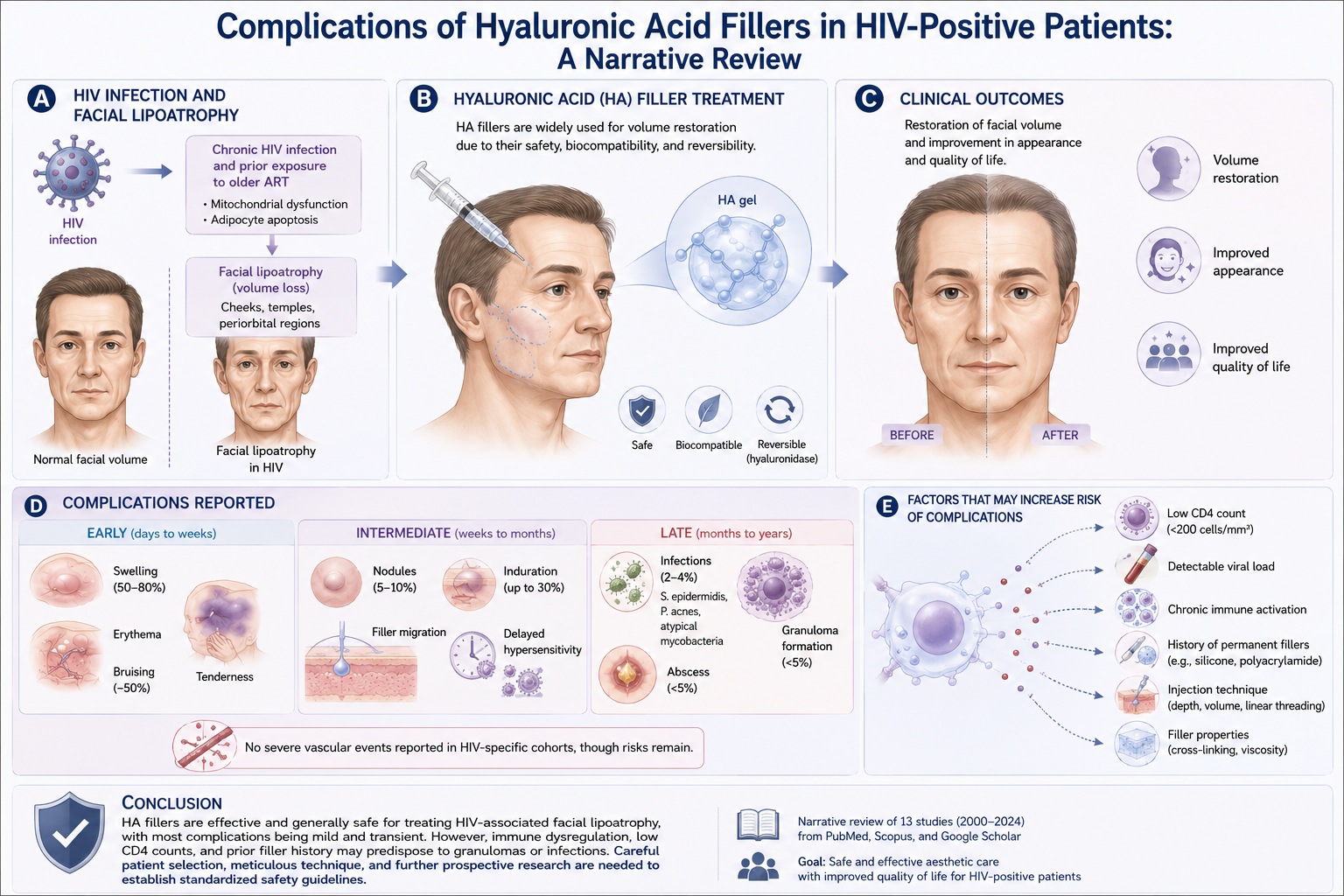
Background: The introduction of antiretroviral therapy (ART) has improved the survival of people living with HIV, yet facial lipoatrophy remains a visible and stigmatizing complication. Hyaluronic acid (HA) fillers are widely used for volume restoration due to their safety, biocompatibility, and reversibility.
Objectives: This narrative review focuses exclusively on HA fillers in HIV-positive patients, aiming to clarify their complication profile.
Materials and methods: A comprehensive search of PubMed, Scopus, and Google Scholar (2000-2024) identified 120 records. After screening and eligibility assessment, 13 studies were included. Data on study design, population, filler type, complications, and management were extracted and narratively synthesized, with results summarized in tabular form.
Results: Early adverse events, such as swelling and erythema, occurred in 50-80% of patients, and bruising in ~50%. Intermediate complications included nodules in 5-10% and indurations up to 30%, usually resolving with conservative management or hyaluronidase. Delayed infections (2-4%) were most often due to Staphylococcus epidermidis, Propionibacterium acnes, or atypical mycobacteria and required antibiotics or drainage. Granulomatous reactions and abscesses were rare (<5%) and typically occurred in patients with prior permanent filler exposure. No severe vascular events were reported in HIV-specific cohorts, though such risks remain relevant.
Conclusion: HA fillers are effective and generally safe for treating HIV-associated facial lipoatrophy, with most complications being mild and transient. However, immune dysregulation, low CD4 counts, and prior filler history may predispose to granulomas or infections. This review highlights the need for careful patient selection, meticulous technique, and further prospective research to establish standardized safety guidelines.
Article Details

This work is licensed under a Creative Commons Attribution-NonCommercial-NoDerivatives 4.0 International License.
Personal views expressed by the contributors in their articles are not necessarily those of the Journal of Associated Medical Sciences, Faculty of Associated Medical Sciences, Chiang Mai University.
References
Weber J. The pathogenesis of HIV-1 infection. Br Med Bull. 2001; 58(1): 61-72. doi:10.1093/bmb/58.1.61.
van Schalkwyk C, Mahy M, Johnson LF, Imai-Eaton JW. Updated data and methods for the 2023 UNAIDS HIV estimates. J Acquir Immune Defic Syndr. 2024; 95(1S): e1-e4. doi:10.1097/QAI.0000000000003344.
Carr A, Samaras K, Burton S, Law M, Freund J, Chisholm DJ, et al. A syndrome of peripheral lipodystrophy, hyperlipidaemia and insulin resistance in patients receiving HIV protease inhibitors. AIDS. 1998; 12(7): F51-F58. doi: 10.1097/00002030-199807000-00003.
Mallewa JE, Wilkins E, Vilar J, Mallewa M, Doran D, Back D, et al. HIV-associated lipodystrophy: a review of underlying mechanisms and therapeutic options. J Antimicrob Chemother. 2008; 62(4): 648-60. doi:10.1093/jac/dkn251.
Koethe JR, Lagathu C, Lake JE, Domingo P, Calmy A, Falutz J, et al. HIV and antiretroviral therapyrelated fat alterations. Nat Rev Dis Primers. 2020; 6(1): 48. doi:10.1038/s41572-020-0181-1.
Oette M, Juretzko P, Kroidl A, Sagir A, Wettstein M, Siegrist J, et al. Lipodystrophy syndrome and self-assessment of well-being and physical appearance in HIV-positive patients. AIDS Patient Care STDS. 2002;16(9):413-7. doi:10.1089/108729102760330254.
Kraus CN, Chapman LW, Korta DZ, Zachary CB. Quality of life outcomes associated with treatment of human immunodeficiency virus (HIV) facial lipoatrophy. Int J Dermatol. 2016; 55(12): 1311-20. doi:10.1111/ijd.13374.
Beasley KL, Weiss MA, Weiss RA. Hyaluronic acid fillers: a comprehensive review. Facial Plast Surg. 2009; 25(2): 86-94. doi:10.1055/s-0029-1220647.
De Boulle K, Glogau R, Kono T, Nathan M, Tezel A, Roca-Martinez J-X, et al. A review of the metabolism of 1,4-butanediol diglycidyl ether-crosslinked hyaluronic acid dermal fillers. Dermatol Surg. 2013; 39(12): 1758-66. doi:10.1111/dsu.12301.
Jung H. Hyaluronidase: An overview of its properties, applications, and side effects. Arch Plast Surg. 2020; 47(4): 297-300. doi:10.5999/aps.2020.00752.
Rzany B, Becker-Wegerich P, Bachmann F, Erdmann R, Wollina U. Hyaluronidase in the correction of hyaluronic acid-based fillers: a review and a recommendation for use. J Cosmet Dermatol. 2009; 8(4): 317-23. doi:10.1111/j.1473-2165.2009.00462.x.
Rzany B, DeLorenzi C. Understanding, avoiding, and managing severe filler complications. Plast Reconstr Surg. 2015; 136(5S): 196S-203S. doi:10.1097/PRS.0000000000001760.
Gooderham M, Solish N. Use of hyaluronic acid for soft tissue augmentation of HIV-associated facial lipodystrophy. Dermatol Surg. 2005; 31(1): 104-8. doi:10.1111/j.1524-4725.2005.31020.
Denton AB, Tsaparas Y. Injectable hyaluronic acid for the correction of HIV-associated facial lipoatrophy. Otolaryngol Head Neck Surg. 2007; 136(4): 563-7. doi:10.1016/j.otohns.2006.11.049.
Skeie L, Bugge H, Negaard A, Bergersen B. Large particle hyaluronic acid for the treatment of facial lipoatrophy in HIV-positive patients: 3-year follow-up study. HIV Med. 2010; 11(3): 170-7. doi:10.1111/j.1468-1293.2009.00761.x.
Pignatti M, Pedone A, Baccarani A, Guaraldi G, Orlando G, Lombardi M, et al. High-density hyaluronic acid for the treatment of HIV-related facial lipoatrophy. Aesthet Plast Surg. 2012; 36(1): 180-5. doi:10.1007/s00266-011-9771-3.
Becker M, Balagué N, Montet X, Calmy A, Salomon D, Toutous-Trellu L. Hyaluronic acid filler in HIV-associated facial lipoatrophy: evaluation of tissue distribution and morphology with MRI. Dermatology. 2015; 230(4): 367-74. doi:10.1159/000379747.
Ho D, Jagdeo J. Safety and efficacy of a volumizing hyaluronic acid filler for treatment of HIV-associated facial lipoatrophy. JAMA Dermatol. 2017; 153(1): 61-5. doi:10.1001/jamadermatol.2016.3827.
Pünchera J, Salomon D, Tshikung O, Becker M, Toutous-Trellu L. Hyaluronic acid filler in HIV-associated facial lipoatrophy: Clinical and MRI evaluation of long-term durability. J Eur Acad Dermatol Venereol. 2022; 36(12): e1068-e1070. doi:10.1111/jdv.18455.
Mashiko T, Tsukada K, Shirado T, Oka S, Yoshimura K. Correction of HIV-associated facial lipoatrophy: autologous fat grafting versus hyaluronic acid fillers. Plast Reconstr Surg. 2023; 153(1): 222e-225e. doi:10.1097/PRS.0000000000010872.
Jagdeo J, Ho D, Lo A, Carruthers A. A systematic review of filler agents for aesthetic treatment of HIV facial lipoatrophy (FLA). J Am Acad Dermatol. 2015; 73(6): 1040-54.e14. doi:10.1016/j.jaad.2015.08.040.
Sturm LP, Cooter RD, Mutimer KL, Graham JC, Maddern GJ. A systematic review of permanent and semipermanent dermal fillers for HIV
