
Efficacy of digital gaming vs traditional Indian gaming on memory and attention in patients with persistent post-concussion syndrome: A feasibility study
Article Sidebar
Main Article Content
Abstract
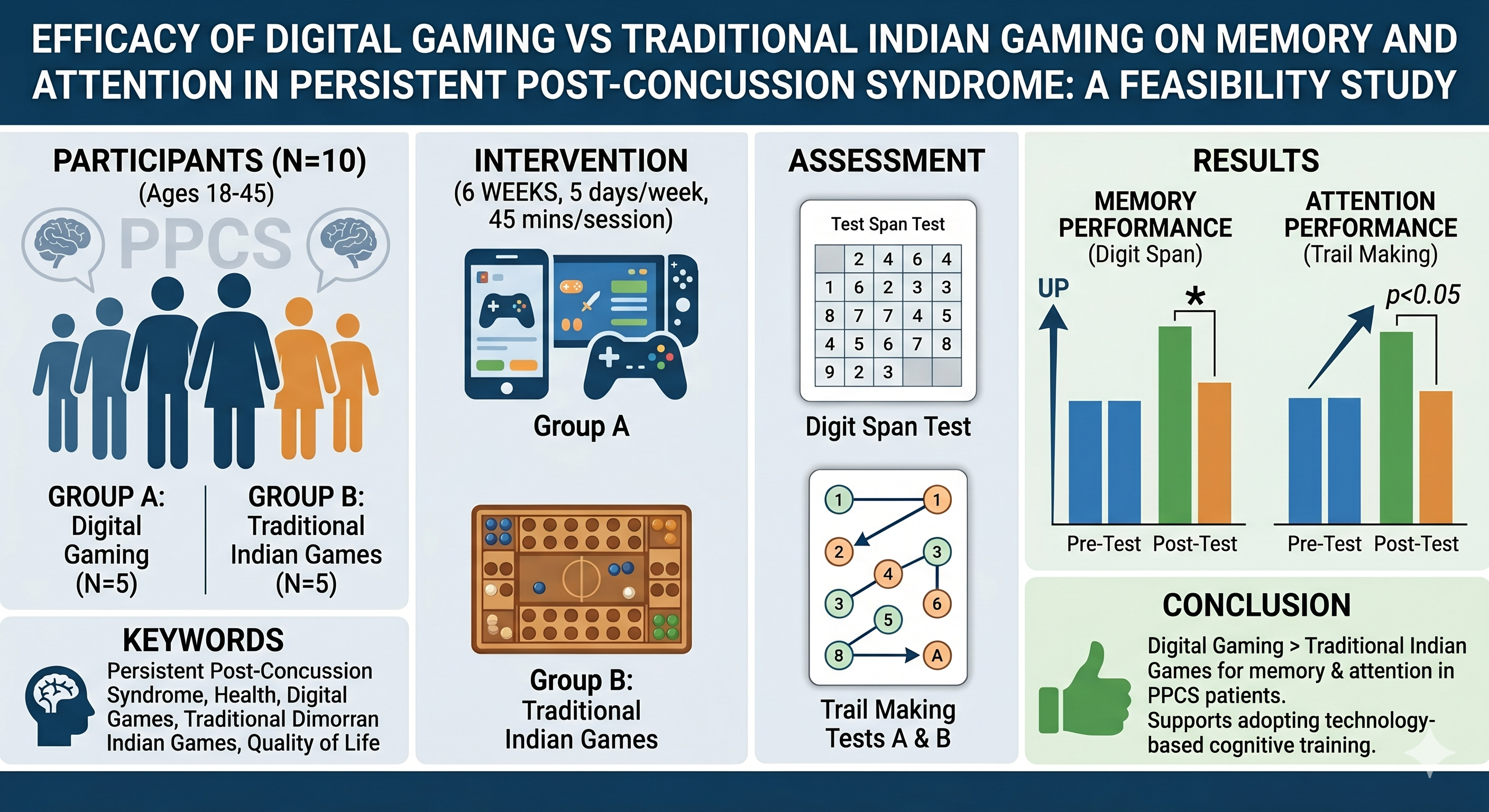
Background: Persistent post-concussion syndrome (PPCS) often presents long-lasting cognitive impairments such as memory and attention deficits, impacting daily life. Traditional cognitive rehabilitation faces challenges in patient engagement and personalization. Digital cognitive training games and culturally relevant traditional Indian games offer promising yet under-explored options for rehabilitation in PPCS patients.
Objectives: This research study aims to compare the effectiveness of digital gaming and traditional Indian games in enhancing memory and attention among individuals with PPCS.
Materials and methods: An experimental study was conducted with 10 PPCS patients aged 18-45 years, divided equally into two groups. Group A (N=5) received a digital gaming intervention, while group B (N=5) engaged in traditional Indian games. Both interventions consisted of 45-minute sessions, five days per week, over six weeks. Cognitive performance was evaluated using the Digit Span Test and Trail-Making Tests A and B. However, the sample size was small, within-group differences were analyzed using the Wilcoxon signed-rank test, and between-group comparisons were performed using the Mann–Whitney U test, with statistical significance set at p<0.05.
Results: Post-intervention analysis revealed that both groups experienced statistically significant gains in memory and attention performance (p<0.05). However, Group A exhibited significantly greater gains than group B in post-Digit Span Test scores and Trail-Making Test performance, indicating superior efficacy of digital gaming.
Conclusion: Digital gaming was more effective than traditional Indian games in improving attention and memory in PPCS patients. These findings support adopting technology-based cognitive training in rehabilitation while considering cultural relevance and patient preferences.
Article Details

This work is licensed under a Creative Commons Attribution-NonCommercial-NoDerivatives 4.0 International License.
Personal views expressed by the contributors in their articles are not necessarily those of the Journal of Associated Medical Sciences, Faculty of Associated Medical Sciences, Chiang Mai University.
References
Mavroudis I, Chatzikonstantinou S, Petridis F, Palade OD, Ciobica A, Balmus IM. Functional overlay model of persistent post-concussion syndrome. Brain Sci. 2023; 13(7): 1028. doi: 10.3390/brainsci13071028.
Carroll L, Cassidy JD, Peloso P, Borg J, Von Holst H, Holm L, et al. Prognosis for mild traumatic brain injury: results of the WHO collaborating centre task force on mild traumatic brain injury. J Rehabil Med. 2004; 36(0): 84-105. doi: 10.1080/16501960410023859.
Santhana Lakshmi S, Patra D, Annadura B, Das P. The effect of long-term use of virtual reality training on cognitive deficits in post-traumatic brain injury patients: case report. Texila Int J Public Health. 2025; 25(2): Art.019. doi: 10.21522/tijph.2013.se.25.02.art019.
Kumar A, Shabil M, Sah S. Comment on “depression after traumatic brain injury: A systematic review and meta-analysis.” Am J Emerg Med. 2024; 86: 170. doi: 10.1016/j.ajem.2024.10.018.
Suwaryo PAW, Kadir F, Omar A, Singh SKD. Prevalence of persistent post-concussion syndrome in adults after mild traumatic brain injury. Nurse Media J Nurs. 2024; 14(2): 199-209. doi: 10.14710/nmjn.v14i2.56529.
Pauhl AN, Kells AM, MacNeill CLW, MacKenzie HM, Christie AD. Effects of persistent post-concussion symptoms on neurocognitive, motor, and neurophysiological outcomes. Brain Inj. 2026; 40(4): 260-9. doi: 10.1080/02699052.2026.2614067.
Oldenburg C, Lundin A, Edman G, Boussard CND, Bartfai A. Cognitive reserve and persistent post-concussion symptoms-A prospective mild traumatic brain injury (mTBI) cohort study. Brain Inj. 2015; 30(2): 146-55. doi: 10.3109/02699052.2015.1089598.
Sathishkumar K. Letter to the editor: Brain tissue oxygen partial pressure monitoring and prognosis of patients with traumatic brain injury: a metaanalysis. Neurosurg Rev. 2024; 47(1): 378. doi: 10.1007/s10143-024-02628-1.
Wolinsky FD, Mahncke HW, Weg MWV, Martin R, Unverzagt FW, Ball KK, et al. The ACTIVE cognitive training interventions and the onset of and recovery from suspected clinical depression. J Gerontol B Psychol Sci Soc Sci. 2009; 64B(5): 577-85. doi: 10.1093/ geronb/gbp061.
Nie L, He J, Wang J, Wang R, Huang L, Jia L, et al. Environmental enrichment for stroke and traumatic brain injury: mechanisms and translational implications. Compr Physiol. 2023; 14(1): 5291-323. doi: 10.1002/cphy.c230007.
Lampit A, Hallock H, Valenzuela M. Computerized cognitive training in cognitively healthy older adults: a systematic review and meta-analysis of effect modifiers. PLoS Med. 2014; 11(11): e1001756. doi: 10.1371/journal.pmed.1001756.
Svaerke K, Pyke SB, Tjoernlund M, Humle F, Mogensen J. Effects of computer-based cognitive rehabilitation on working memory in patients with acquired brain injury in the chronic phase, a pilot-study. Brain Inj. 2022; 36(4): 503-13. doi: 10.1080/02699052.2022.2034965.
Vasanthi RK, Li BCJ, Purushothaman VK, A K, Chinnusamy S, Karuppaiyan RK, et al. Perceived usefulness and ease of using virtual reality during physiotherapy - a cross-sectional survey from physiotherapists perspective. Electron J Gen Med. 2023; 20(6): em530. doi: 10.29333/ejgm/13519.
Verghese J, Lipton RB, Katz MJ, Hall CB, Derby CA, Kuslansky G, et al. Leisure activities and the risk of dementia in the elderly. N Engl J Med. 2003; 348(25): 2508-16. doi: 10.1056/nejmoa022252.
Rahman M, Raja K, Rashid M, Kumar J. Listing of Indian folk games for potential therapeutic benefits in children with neurodevelopmental disability. Games Health J. 2020; 9(6): 453-60. doi: 10.1089/g4h.2019.0191.
Chi K, Chen J, Zhou S, Han Z. The effectiveness of digital cognitive intervention in patients with traumatic brain injury: systematic review and meta-analysis. Front Neurol. 2025; 16:1651443. doi: 10.3389/fneur.2025.1651443.
Välimäki M, Mishina K, Kaakinen JK, Holm SK, Vahlo J, Kirjonen M, et al. Digital gaming for improving the functioning of people with traumatic brain injury: randomized clinical feasibility study. J Med Internet Res. 2018; 20(3): e77. doi: 10.2196/jmir.7618.
Nithianantharajah J, Hannan AJ. Enriched environments, experience-dependent plasticity and disorders of the nervous system. Nat Rev Neurosci. 2006; 7(9): 697-709. doi: 10.1038/nrn1970.
Shen Y, Jiang L, Lai J, Hu J, Liang F, Zhang X, et al. A comprehensive review of rehabilitation approachesfor traumatic brain injury: efficacy and outcomes. Front Neurol. 2025; 16: 1608645. doi: 10.3389/fneur.2025.1608645.
Lynch JM, Anderson M, Benton B, Green SS. The gaming of concussions: a unique intervention in postconcussion syndrome. J Athl Train. 2015; 50(3): 270-6. doi: 10.4085/1062-6050-49.3.78.
Rioux M. A novel intervention for persistent memory symptoms after concussion: a pilot randomized controlled trial [dissertation]. Vancouver: University of British Columbia; 2025.
Moser N, Popovic MR, Kalsi-Ryan S. Complexity of post-concussion syndrome assessment and management: a case for customizing rehabilitation. Biomed Eng Online. 2025; 24(1): 48. doi: 10.1186/s12938-025-01380-x.
