
Association of Intron 22 inversion and HLA-DRB1*15:01 allele with inhibitor development in hemophilia A: A genetic analysis of risk factors
Article Sidebar
Main Article Content
Abstract
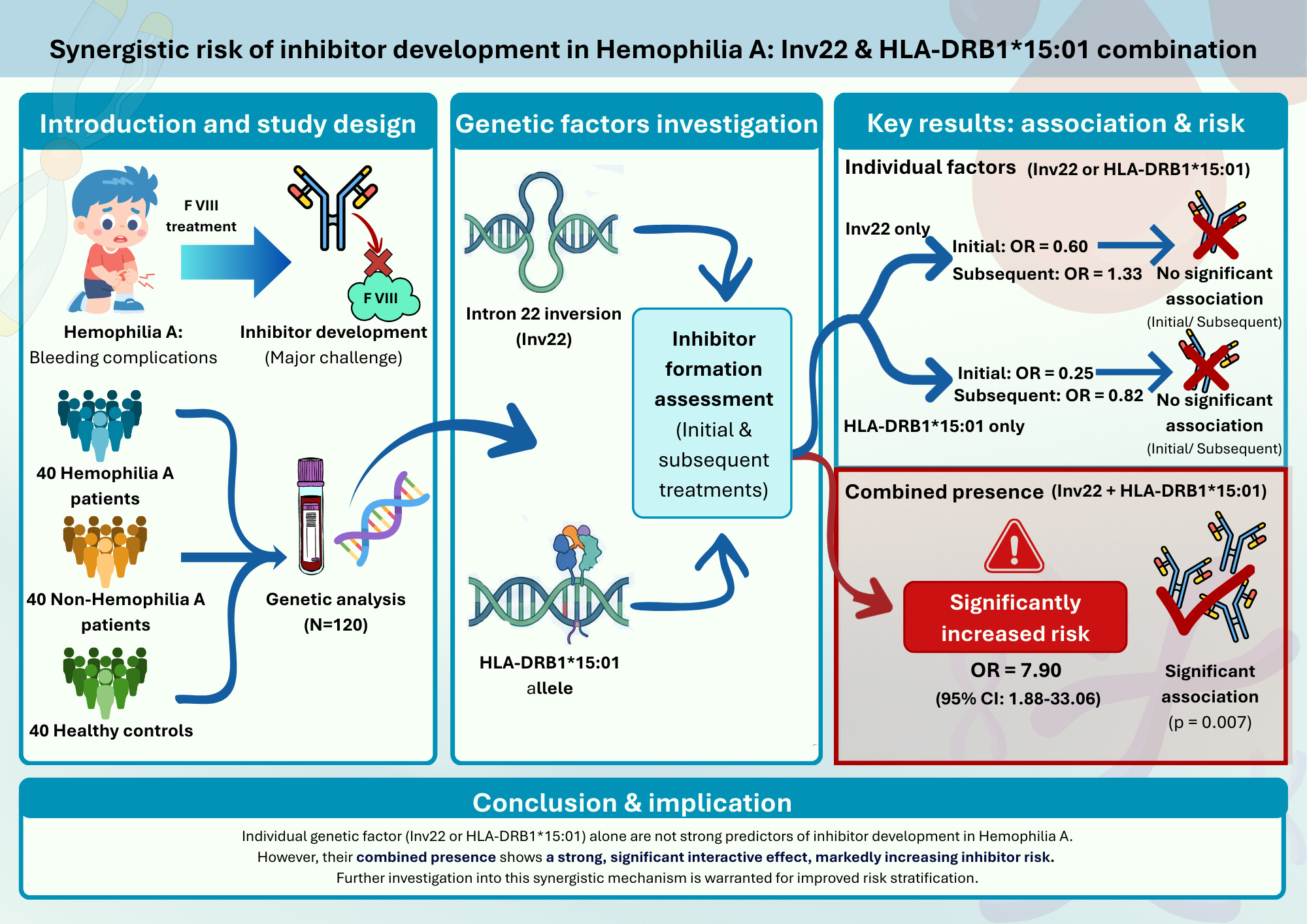
Background: Inhibitor development in hemophilia A is a major clinical challenge, leading to severe bleeding complications and reduced quality of life. This multifactorial process is influenced by genetic, immunological, and treatmentrelated factors.
Objectives: To determine the association between intron 22 inversion (Inv22) and the HLA-DRB1*15:01 allele with inhibitor development.
Materials and methods: This study investigated inhibitor development during initial and subsequent treatments, assessing the association between Inv22 and HLA-DRB1*15:01 with inhibitor formation in 40 hemophilia A patients, 40 non-hemophilia A patients, and 40 healthy controls.
Results: The study found no significant association between Inv22 or HLADRB1*15:01 allele and inhibitor development during initial (odds ratio (OR): 0.60, 95% CI: 0.11-3.43, p=0.697) or subsequent treatments (OR: 1.33, 95% CI: 0.30-5.93, p=1.000). Similarly, HLA-DRB1*15:01 allele showed no significant correlation (initial: OR: 0.25, 95% CI: 0.06-1.13, p=0.089; subsequent: OR: 0.82, 95% CI: 0.24-2.84, p=1.000). However, patients with both genetic factors had a significantly higher risk of developing inhibitors (OR: 7.90, 95% CI: 1.88-33.06, p=0.007).
Conclusion: This study found no significant association between Inv22 or the HLA-DRB1*15:01 allele and inhibitor development in hemophilia A patients during initial or subsequent treatments. However, their combined presence significantly increased the risk of inhibitor formation, suggesting a potential interactive effect requiring further investigation.
Article Details

This work is licensed under a Creative Commons Attribution-NonCommercial-NoDerivatives 4.0 International License.
Personal views expressed by the contributors in their articles are not necessarily those of the Journal of Associated Medical Sciences, Faculty of Associated Medical Sciences, Chiang Mai University.
References
Witmer C, Young G. Factor VIII inhibitors in hemophilia A: etiology and treatment. Ther Adv Hematol. 2013; 4(1): 59-72. doi: 10.1177/2040620712464379.
El-Sheikh A, El-Ghamrawy M, Ibrahim M. Evaluation of factor VIII inhibitors among children with hemophilia A: a single-center study. Zagazig Univ Med J. 2024; 30(8.1): 4104-9. doi: 10.21608/zumj.2023.210924.2821.
Chuansumrit A, Sosothikul D, Rungrungtham T, Sasanakul P, Tapaneeyakorn S, On-Takrai J, et al. The success of the national universal health coverage for hemophilia care in Thailand. Haemophilia. 2021; 27(1): 69-80. doi: 10.1111/hae.14144.
Gouw SC, van den Berg HM, Oldenburg J, Astermark J, de Groot PG, Margaglione M, et al. F8 gene mutation type and inhibitor development in patients with severe hemophilia A: systematic review and meta-analysis. Blood. 2012; 119(12): 2922-34. doi: 10.1182/blood-2011-09-379453.
Oldenburg J, Picard JK, Schwaab R, Brackmann HH, Tuddenham EG, Simpson E. HLA genotype of patients with severe Haemophilia A due to Intron 22 inversion with and without inhibitors of Factor VIII. Thromb Haemost. 1997; 77(2): 238-42. doi: 10.1055/s-0038-1655945
Nathalang O, Sinsiriwong S, Pan-in T, O-charoen R, Chuansumrit A. Association between HLADRB1 alleles and FVIII inhibitors in Thai patients with severe hemophilia A. Turk J Hematol. 2012; 29(1): 34-9. doi: 10.5505/tjh.2012.87126.
Satapornpong P, Jantararoungtong T, Konyoung P, Khunkaew S, Sukasem C. Epidemiology of HLAB*15:02 and other HLA alleles as pharmacogenetic markers in Thais. Front Pharmacol. 2020; 11: 78. doi: 10.3389/fphar.2020.00078.
Astermark J, Oldenburg J, Pavlova A, Berntorp E, Lefvert AK. Polymorphisms in the IL10 and TNFalpha gene promoters and inhibitor development in patients with hemophilia A. Blood. 2006; 107(8): 3167-72. doi: 10.1182/blood-2005-09-3811.
Mancuso ME, Santagostino E. The role of emicizumab in hemophilia A patients with inhibitors. J Thromb Haemost. 2012; 10(5): 781-90. doi: 10.1111/ j.1538-7836.2012.04683.x.
Verbruggen B. Diagnosis and quantification of factor VIII inhibitors. Haemophilia. 2010; 16(102): 20-4. doi: 10.1111/j.1365-2516.2010.02261.x.
Rossetti LC, Radic CP, Larripa IB, De Brasi CD. Genotyping of hemophilia A rearrangements using long-distance PCR. J Thromb Haemost. 2008; 6(5): 830-6. doi: 10.1111/j.1538-7836.2008.02927.x.
Delfan N, Galehdari H, Kazeminejad SR, Alikamali M, Ahmadi M. Analysis of HLA-DRB1*15:01 in multiple sclerosis patients: a case-control study. Zahedan J Res Med Sci. 2017; 19(3): e5647. doi: 10.5812/zjrms.5647.
Pavlova A, Delev D, Lacroix-Desmazes S, Schwaab R, Mende M, Fimmers R, et al. Impact of polymorphisms of the major histocompatibility complex class II on inhibitor development in severe hemophilia A. J Thromb Haemost. 2009; 7(12): 2006-15. doi: 10.1111/j.1538-7836.2009.03636.x.
Abu Arra CM, Arra IA, El-Gharbawy FA, Mansour S. Factor VIII intron 22 inversion in severe hemophilia A patients in Palestine. Scientifica (Cairo). 2020; 2020: 3428648. doi: 10.1155/2020/3428648.
Chuansumrit A, Sasanakul P, Seksarn P, Sosothikul D, Rungrungtham T, Tapaneeyakorn S, et al. Genotype and phenotype of haemophilia A in Thai patients. Haemophilia. 2003; 9(2): 179-86. doi: 10.1046/j.1365-2516.2003.00727.x.
Romphruk AV, Romphruk A, Incheun R, Butthep P, Buaklee N, Jatuasitha S, et al. HLA class I and II alleles and haplotypes in ethnic Northeast Thais. Tissue Antigens. 2010; 75(6): 701-11. doi: 10.1111/j.1399-0039.2010.01449.x.
Abdulqader AMR, Mohammed AI, Rachid S, Ghoraishizadeh P, Mahmood SN. Identification of the intron 22 and intron 1 inversions of the factor VIII gene in Iraqi Kurdish patients with hemophilia A. Clin Appl Thromb Hemost. 2020; 26: 1076029619888293. doi: 10.1177/1076029619888293.
Hay CR, Ollier W, Pepper L, Cumming A, Keeney S, Goodeve AC, et al. HLA class II profile: a weak determinant of factor VIII inhibitor development in severe haemophilia A. Thromb Haemost. 1997; 77(2): 234-7. doi: 10.1055/s-0038-1655944.
