Blood donation and blood components utilization in Suratthani Hospital
Article Sidebar
Main Article Content
Abstract
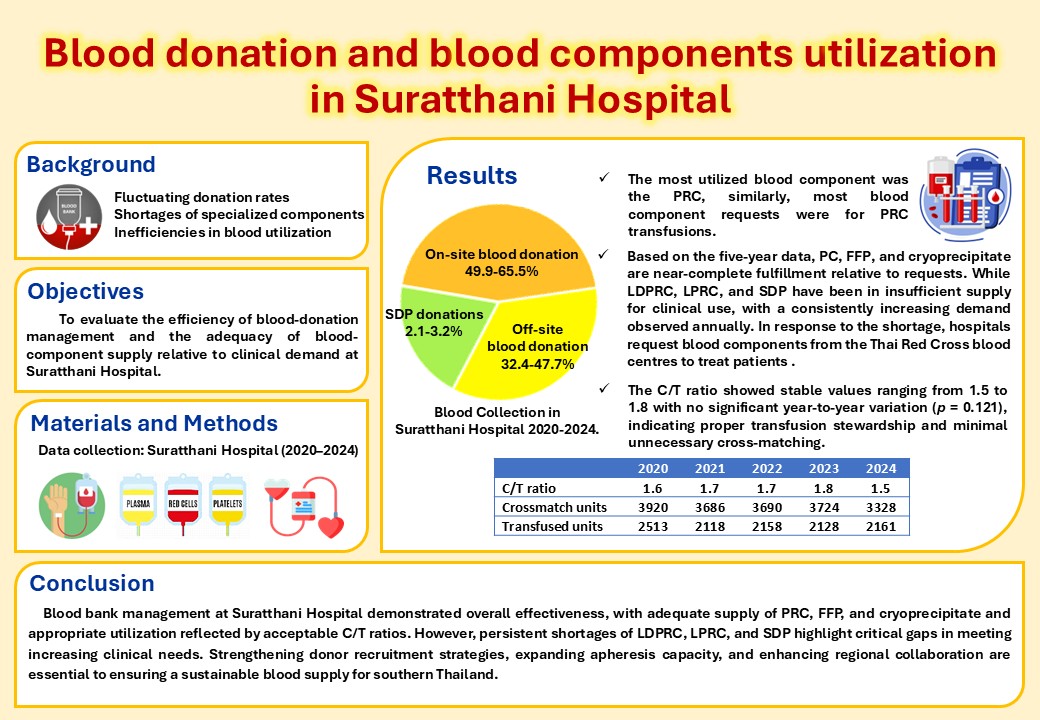
Background: Blood and its components are essential, irreplaceable biological resources required for a wide range of medical interventions, including surgery, trauma care, and chronic disease management. Despite ongoing improvements in blood services, many hospitals continue to experience challenges related to fluctuating donation rates, shortages of specialized components, and inefficiencies in blood utilization such as excessive crossmatching without transfusion.
Objectives: This study aimed to evaluate the efficiency of blood-donation management and the adequacy of blood-component supply relative to clinical demand at Suratthani Hospital. Additionally, it assessed the appropriateness of blood utilization using the crossmatch-to-transfusion (C/T) ratio as a key performance indicator.
Materials and methods: A retrospective descriptive study was conducted using data collected at Suratthani Hospital from January 1, 2020, to December 31, 2024. Information on blood donation types, blood-component preparation, utilization patterns, and C/T ratios was analyzed to assess supply-demand dynamics and rational use of blood products.
Results: On-site donation was the primary source of blood supply (49.9-65.5%), followed by off-site donation (32.4-47.7%) and single-donor platelet (SDP) donations (2.1-3.2%). Both blood donations and component utilization increased notably in 2024. Packed red cells (PRC) were the most frequently used component (37.6-44.7%) and constituted most transfusion requests (38.0-43.9%). Over five years, platelet concentrate (PC), fresh frozen plasma (FFP), and cryoprecipitate were consistently adequate, whereas leukocytedepleted
PRC (LDPRC), leukocyte-poor PRC (LPRC), and SDP remained insufficient, requiring additional units from the Thai Red Cross blood center. A total of 18,348 units were crossmatched, with annual C/T ratios ranging from 1.5 to 1.8 and showing no significant variation (p=0.121), indicating appropriate utilization..
Conclusion: Blood bank management at Suratthani Hospital demonstrated overall effectiveness, with adequate supply of PRC, FFP, and cryoprecipitate and appropriate utilization reflected by acceptable C/T ratios. However, persistent shortages of LDPRC, LPRC, and SDP highlight critical gaps in meeting increasing clinical needs. Strengthening donor recruitment strategies, expanding apheresis capacity, and enhancing regional collaboration are essential to ensuring a sustainable blood supply for southern Thailand.
Article Details

This work is licensed under a Creative Commons Attribution-NonCommercial-NoDerivatives 4.0 International License.
Personal views expressed by the contributors in their articles are not necessarily those of the Journal of Associated Medical Sciences, Faculty of Associated Medical Sciences, Chiang Mai University.
References
Gasparovic Babic S, Krsek A, Baticic L. Voluntary blood donation in modern healthcare: trends, challenges, and opportunities. Epidemiologia (Basel). 2024; 5(4): 770-84. doi: 10.3390/epidemiologia5040052.
Gammon RR, Dubey R, Gupta GK, Hinrichsen C, Jindal A, Lamba DS, et al. Patient blood management and its role in supporting blood supply. J Blood Med. 2023; 14: 595-611. doi: 10.2147/JBM.S387322.
Chien JH, Yao CY, Chen HF, Ho TF. Trends in blood transfusion and causes of blood wastage: a retrospective analysis in a teaching hospital. BMC Health Serv Res. 2025; 25(1): 67-72. doi: 0.1186/s12913-024-12170-x.
Joon V, Robins RDL, Haran AH, I SK, James S. Evaluating the crossmatch-to-transfusion ratio as a tool for analyzing and optimizing blood bank resource utilization: a retrospective observational study. Cureus. 2024; 16(9): e69862. doi: 10.7759/cureus.69862.
Chaiwuttisak P, Honora S, Yue W, Chris P, Sakuldamrongpanich T, Pathomsiri S. Location of low-cost blood collection and distribution centres in Thailand. Operations Research for Health Care. 2015; 10: 14-18.
Thai Red Cross Society, National Blood Centre. Annual Report 2023-2024: Blood Donation and Transfusion Services in Thailand. Bangkok: TRCS; 2024.
World Health Organization. Global status report on blood safety and availability 2021. Geneva: WHO; 2022.
Hasarin WYaS. Blood and blood reserve management before and after the COVID-19 pandemic: experiences from Songklanagarind Hospital. J Hematol Transfus Med. 2024; 34: 8-12.
Narkpetch S, Neamkul N, Prapanwong P, Jiwbunchu T, Rattanapan Y. Recruitment and retention of voluntary blood donors during the COVID-19 pandemic. J Hematol Transfus Med. 2023; 33: 8-13.
Carson JL, Guyatt G, Heddle NM, Grossman BJ, Cohn CS, Fung MK, et al. Clinical Practice Guidelines from the AABB: red blood cell transfusion thresholds and storage. JAMA. 2016; 316(19): 2025-35. doi: 10.1001/jama.2016.9185.
Lertpaisankul S, Rodwihok T, Phomsila R, Tadsomboon S. Evaluation of donor recruitment integrated plan and blood component distribution effectiveness of the five lower-northern provinces of Thailand in 2018. J Hematol Transfus Med. 2020; 30: 6-11.
Watanaboonyongcharoen P, Santipong S, Jaipian J, Siriaksorn J, Rojnuckarin P. Safety and efficacy of the Thai red cross society albumin replacement for therapeutic plasma exchange. J Med Assoc Thai. 2018; 101(11): 4-9.
Nonsee N, Kidhen B, Chawalchitiporn S. Efficacies and cost evaluation of double dose plateletpheresis in additive solution by blood cell separator between continuous and intermittent flow system. Cancer Sci Res. 2020; 3(2): 6-10. doi: 10.33425/2639-8478.1048.
