
Development of the Occupational Therapy Cognitive Outcome Measure-Computer-Based Assessment (OTCOM-CA) for older adults with cognitive impairment: A prototype mobile application
Article Sidebar
Main Article Content
Abstract
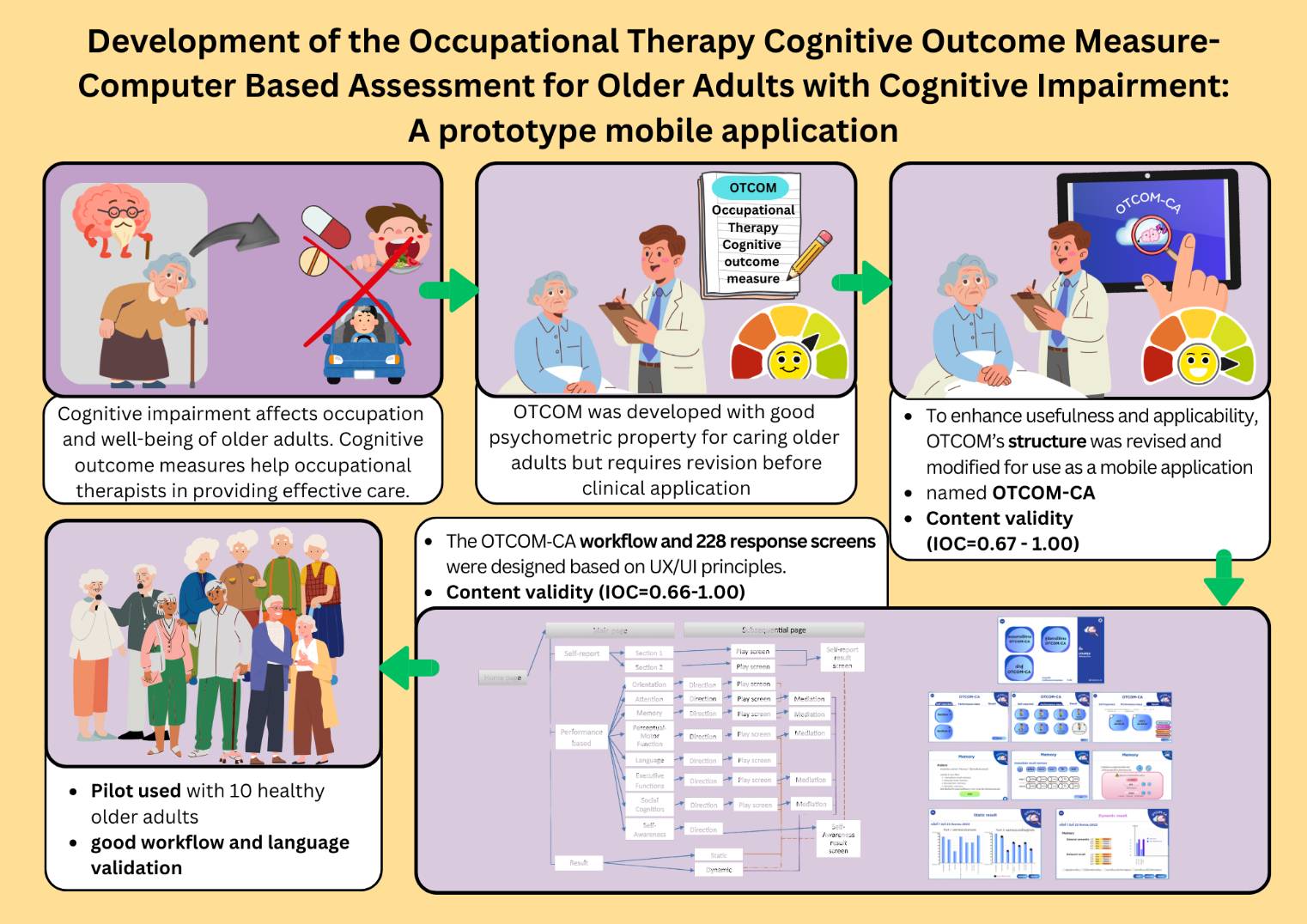
Background: Cognitive impairment is common in older adults and increases with age. It affects independence in daily activities, such as financial management, meal preparation, medication management, and driving. In healthcare, outcome measurement tools are essential for evaluating a patient’s status, establishing baseline performance, guiding intervention planning, and monitoring intervention effectiveness. Computer-based assessments are feasible and well-accepted by patients, providing immediate and accurate scoring, real-time feedback, and automated reporting of results. However, in the Thai context, the availability of standardized assessment tools specifically designed for older adults with cognitive impairment remains limited. Consequently, occupational therapists require comprehensive and contextually appropriate instruments to effectively guide cognitive interventions throughout the continuum of care. To address this gap, a new assessment tool was developed and implemented as an Android tablet-based application to facilitate evidence-based practice.
Objectives: To develop the Occupational Therapy Cognitive Outcome Measure-Computer-Based Assessment (OTCOM-CA) for older adults with cognitive impairment and evaluate its content validity and feasibility.
Materials and methods: This study employed a research and development (R&D) design to establish the content and workflow structure of OTCOM-CA. Following the content validity evaluation, the application’s workflow and interface were designed in accordance with established user experience (UX) and user interface (UI) principles and subsequently validated. A pilot study involving 10 healthy older adults was conducted to evaluate the clarity of the workflow and the appropriateness of the language used within the application.
Results: Content validity evaluation of the OTCOM-CA’s structure, workflow, and screen design showed acceptable ratings for all items (IOC=0.66-1.00). Most participants understood the workflow and test instructions.
Conclusion: OTCOM-CA demonstrated acceptable content validity. The prototype Android version shows a good workflow and language validation. Once revisions are made, its psychometric properties should be evaluated.
Article Details

This work is licensed under a Creative Commons Attribution-NonCommercial-NoDerivatives 4.0 International License.
Personal views expressed by the contributors in their articles are not necessarily those of the Journal of Associated Medical Sciences, Faculty of Associated Medical Sciences, Chiang Mai University.
References
United Nations Department of Economic and Social Affairs. World population aging 2020 highlights: living arrangements of older persons. New York: Population Division; 2020.
Department of Older Persons. Elderly statistics 2024 [Internet]. 2024 [cited 2026 Apr 30]. Available from: https://www.dop.go.th/en/statistics_page?cat= 1&id=2559
Foundation of Thai Gerontology Research and Development Institute (TGRI). Situation of the Thai older persons 2021. Nakhon Pathom: Institute for Population and Social Research, Mahidol University; 2022.
Eshkoor SA, Hamid TA, Mun CY, Ng CK. Mild cognitive impairment and its management in older people. Clin Interv Aging. 2015; 10: 687-93. doi: 10.2147/CIA.S73922.
O’Sullivan G, Hocking C. Translating action research into practice: seeking occupational justice for people with dementia. OTJR Occup Particip Health. 2013; 33(3): 168-76. doi: 10.3928/15394492-20130614-02.
Lincoln N, das Nair R. Outcome measurement in cognitive neurorehabilitation. In: Cognitive neurorehabilitation: evidence and application [Internet]. 2nd ed. New York: Cambridge University Press; 2010 [cited 2026 Apr 30]. pp 91-105. doi: 10.1017/CBO9780511782015.007.
Chaiwong P, Rattakorn P, Sungkarat S, Kattiya N, Tuttle D, Munkhetvit P. Psychometric properties of a new occupational therapy cognitive outcome measure for Thai older adults with cognitive impairments. J Assoc Med Sci. 2023; 56(1): 26-34. doi: 10.14456/jams.2023.4.
Cantillon P, Irish B, Sales D. Using computers for assessment in medicine. BMJ. 2004; 329(7466): 606-9. doi: 10.1136/bmj.329.7466.606.
Wilson AS, Kitas GD, Carruthers DM, Reay C, Skan J, Harris S, et al. Computerized informationgathering in specialist rheumatology clinics: an initial evaluation of an electronic version of the Short Form 36. Rheumatology (Oxford). 2002; 41(3): 268-73. doi: 10.1093/rheumatology/41.3.268.
National Statistical Office. The 2024 household survey on the use of information and communication technology (Quarter 3). Bangkok: Ministry of Digital Economy and Society; 2024.
Hogue RJ, editor. Tablet use within medicine. In: IADIS International Conference on Mobile Learning; 2013 Mar 14-16; Lisbon, Portugal.
Ramprasad C, Tamariz L, Garcia-Barcena J, Nemeth Z, Palacio A. The use of tablet technology by older adults in health care settings-is it effective and satisfying? A systematic review and metaanalysis. Clin Gerontol. 2019; 42(1): 17-26. doi: 10.1080/07317115.2018.1457030.
Statista. Market share of mobile operating systems worldwide from 2009 to 2024, by quarter 2025 [Internet]. 2025 [cited 2026 Apr 30]. Available from: https://www.statista.com/statistics/272698/global-market-share-held-by-mobile-operatingsystems-since-2009/
Nasreddine Z. MoCA clinic data 2024 [Internet].2024 [cited 2026 Apr 30]. Available from: https://www.mocatest.org/moca-clinic-data/
Furr RM. Scale construction and psychometrics for social and personality psychology. New Delhi: Sage Publications; 2011. doi: 10.4135/9781446287910.
DeVellis RF. Scale development: theory and applications. 4th Ed. Thousand Oaks (CA): SAGE Publications; 2016.
Figma. Seven essential UI design principles + how to use them [Internet]. 2024 [cited 2026 Apr 30].Available from: https://www.figma.com/resourcelibrary/ui-design-principles/
Hazzard L. The 6 key UX design principles to follow [Internet]. Falmouth: Falmouth University; 2024 [cited 2026 Apr 30]. Available from: https://www.falmouth.ac.uk/news/6-key-ux-design-principlesfollow
Teaching and Learning Innovation Center (TLIC). Knowing Canva [Internet]. Chiang Mai: Chiang Mai University [cited 2026 Apr 30]. Available from: https://docs.tlic.cmu.ac.th/canva-for-education
Ketchaikosol V. A study of action-button size on mobile applications for elderly [master’s thesis]. Bangkok: Bangkok University; 2016.
