
Fabrication and evaluation of 3D-printed customizable boluses for optimized radiotherapy applications
Article Sidebar
Main Article Content
Abstract
Background: Commercial radiotherapy boluses often fail to conform accurately to patient anatomy, resulting in air gaps and surface dose inaccuracy. Threedimensional (3D) printing using fused deposition modeling with polylactic acid (PLA) offers a customizable alternative, but clinical implementation requires a reproducible fabrication workflow that ensures both radiological consistency and geometric conformity.
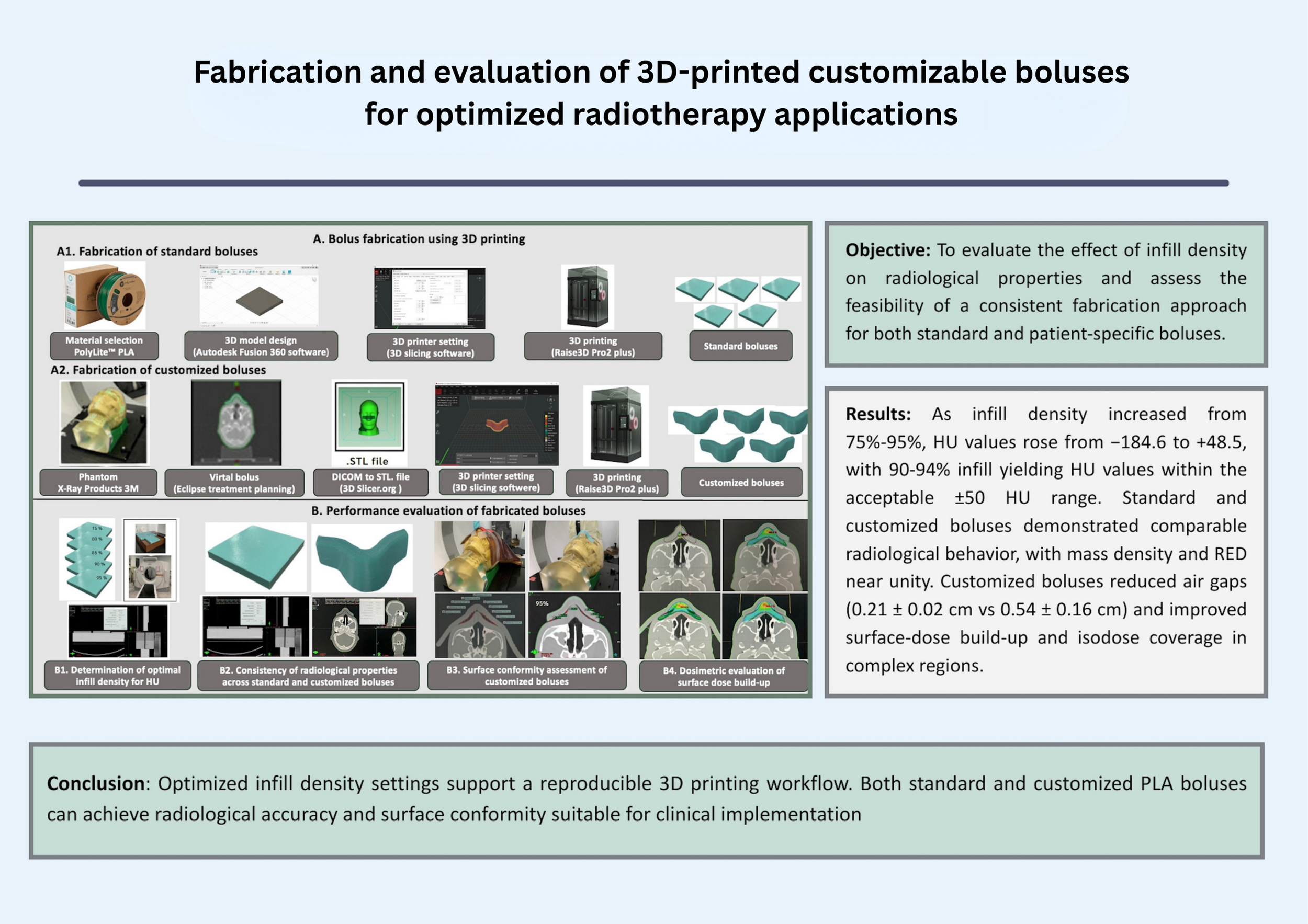
Objectives: To evaluate the effect of infill density on radiological properties and assess the feasibility of a consistent fabrication approach for both standard and patient-specific boluses.
Materials and methods: Standard PLA boluses (10×10×1 cm) were fabricated at 75-95% infill density using a line infill pattern, while customized boluses were created from a head-and-neck phantom and printed at 90-95% infill density. All boluses underwent CT imaging and were analyzed in the Eclipse treatment planning system (TPS) to determine Hounsfield unit (HU), mass density, and relative electron density (RED). Air gap measurements and dose distributions were evaluated in the TPS with a 6 MV photon beam.
Results: As infill density increased from 75%-95%, HU values rose from -184.6 to +48.5, with 90–94% infill yielding HU values within the acceptable ±50 HU range. Standard and customized boluses demonstrated comparable radiological behavior, with mass density and RED near unity. Customized boluses reduced air gaps (0.21±0.02 cm vs 0.54±0.16 cm) and improved surface-dose build-up and isodose coverage in complex regions.
Conclusion: Optimized infill density settings support a reproducible 3D printing workflow. Both standard and customized PLA boluses can achieve radiological accuracy and surface conformity suitable for clinical implementation.
Article Details

This work is licensed under a Creative Commons Attribution-NonCommercial-NoDerivatives 4.0 International License.
Personal views expressed by the contributors in their articles are not necessarily those of the Journal of Associated Medical Sciences, Faculty of Associated Medical Sciences, Chiang Mai University.
References
Bernier J, Hall EJ, Giaccia A. Radiation oncology: a century of achievements. Nat Rev Cancer. 2004; 4: 737-47. doi:10.1038/nrc1451.
Garibaldi C, Jereczek-Fossa BA, Marvaso G, Dicuonzo S, Rojas DP, Cattani F, et al. Recent advances in radiation oncology. Ecancermedicalscience. 2017; 11: 785. doi:10.3332/ecancer.2017.785.
Khan FM, Gibbons JP Jr. Khan’s. The physics of radiation therapy. Philadelphia: Lippincott Williams & Wilkins; 2014: pp 584.
Dogan N, Glasgow GP. Surface and build-up region dosimetry for obliquely incident intensity modulated radiotherapy 6 MV X-rays. Med Phys. 2003; 30: 3091-6. doi:10.1118/1.1625116.
Turner JY, Zeniou A, Williams A, Jyothirmayi R. Technique and outcome of post-mastectomy adjuvant chest wall radiotherapy—the role of tissueequivalent bolus in reducing risk of local recurrence. Br J Radiol. 2016; 89(1064): 20160060. doi:10.1259/bjr.20160060.
Hsu SH, Roberson PL, Chen Y, Marsh RB, Pierce LJ, Moran JM. Assessment of skin dose for breast chest wall radiotherapy as a function of bolus material. Phys Med Biol. 2008; 53: 2593-606. doi:10.1088/0031-9155/53/10/010.
Healy E, Anderson S, Cui J, Beckett L, Chen AM, Perks J, et al. Skin dose effects of postmastectomy chest wall radiation therapy using brass mesh as an alternative to tissue-equivalent bolus. Pract Radiat Oncol. 2013; 3: e45-e53. doi:10.1016/j.prro.2012.05.009.
Vyas V, Palmer L, Mudge R, Jiang R, Fleck A, Schaly B, et al. On bolus for megavoltage photon and electron radiation therapy. Med Dosim. 2013; 38: 268-73. doi:10.1016/j.meddos.2013.02.007.
McCallum S, Maresse S, Fearns P. Evaluating 3D-printed bolus compared to conventional bolus types used in external beam radiation therapy. Curr Med Imaging Rev. 2021; 17: 820-31. doi:10.2174/1573405617666210202114336.
Pollmann S, Toussaint A, Flentje M, Wegener S, Lewitzki V. Dosimetric evaluation of commercially available flat vs. self-produced 3D-conformal silicone boluses for the head and neck region. Front Oncol. 2022; 12: 881439. doi:10.3389/fonc.2022.881439.
Davis TM, Luca K, Sudmeier LJ, Buchwald ZS, Khan MK, Yang X, et al. Total scalp irradiation: A study comparing multiple types of bolus and VMAT optimization techniques. J Appl Clin Med Phys. 2024; 25: e14260. doi:10.1002/acm2.14260.
Kairn T, Talkhani S, Charles PH, Chua B, Lin CY, Livingstone AG, et al. Determining tolerance levels for quality assurance of 3D printed bolus for modulated arc radiotherapy of the nose. Phys Eng Sci Med. 2021; 44: 1187-99. doi:10.1007/s13246-021-01054-7.
Fujimoto K, Shiinoki T, Yuasa Y, Hanazawa H, Shibuya K. Efficacy of patient-specific bolus created using three-dimensional printing technique in photon radiotherapy. Phys Med. 2017; 38: 1-9. doi:10.1016/j.ejmp.2017.04.023.
Pugh R, Lloyd K, Collins M, Duxbury A. The use of 3D printing within radiation therapy to improve bolus conformity: a literature review. J Radiother Pract. 2017; 16: 319-25. doi:10.1017/S146039 6917000115.
Phantawong K, Singthuan N, Pinichsai K, Taertulakarn S. The feasibility of fabricated 3Dprinted immobilization masks for radiotherapy: mechanical and dosimetric analysis. J Assoc Med Sci. 2025; 58(3): 361-75.
Lu Y, Song J, Yao X, An M, Shi Q, Huang X. 3D printing polymer-based bolus used for radiotherapy. Int J Bioprint. 2021; 7: 414. doi:10.18063/ijb.v7i4.414.
Van Der Walt M, Crabtree T, Albantow C. PLA as a suitable 3D printing thermoplastic for use in external beam radiotherapy. Australas Phys Eng Sci Med. 2019; 42: 1165-76. doi:10.1007/s13246-019-00818-6.
Ricotti R, Ciardo D, Pansini F, Bazani A, Comi S, Spoto R, et al. Dosimetric characterization of 3D-printed bolus at different infill percentage for external photon beam radiotherapy. Phys Med. 2017; 39: 25-32. doi:10.1016/j.ejmp.2017.06.004.
Ashenafi M, Jeong S, Wancura JN, Gou L, Webster MJ, Zheng D. A quick guide on implementing
and quality assuring 3D printing in radiation oncology. J Appl Clin Med Phys. 2023; 24: e14102. doi:10.1002/acm2.14102.
Şahin T, Çavdar Karaçam S, Tunçman D, Şahin Ş, Ergen ŞA, Çolpan Öksüz D, et al. Thermal, dosimetric and thermo-mechanical characterization of ABS and PLA polymer materials via plastic injection molding for innovative bolus materials in radiotherapy applications. Radiat Phys Chem. 2024; 223: 111901. doi:10.1007/s42247-024-00706-0.
Jreije A, Keshelava L, Ilickas M, Laurikaitiene J, Urbonavicius BG, Adliene D. Development of patientspecific conformal 3D-printed devices for dose verification in radiotherapy. Appl Sci. 2021; 11: 8657. doi:10.3390/app11188657.
Ciobanu AC, Petcu LC, Járai-Szabó F, Bálint Z. Exploring the impact of filament density on the responsiveness of 3D-printed bolus materials for high-energy photon radiotherapy. Phys Med. 2024; 127: 104849. doi:10.1016/j.ejmp.2024.104849.
3DTechSupplies. PolyLite™ PLA. Available from: http://www.3dtechsupplies.com.au/Products/PolyMaker/PolyLite-PLA. Accessed 6 Jan 2026.
Canters RA, Lips IM, Wendling M, Kusters M, Van Zeeland M, Gerritsen RM, et al. Clinical implementation of 3D printing in the construction of patient-specific bolus for electron beam radiotherapy for non-melanoma skin cancer. Radiother Oncol. 2016; 121: 148-53. doi:10.1016/j.radonc.2016.07.011.
Olch AJ, Gerig L, Li H, Mihaylov I, Morgan A. Dosimetric effects caused by couch tops and immobilization devices: report of AAPM Task Group 176. Med Phys. 2014; 41(6 Part 1): 061501. doi:10.1118/1.4876299.
Mutic S, Palta JR, Butker EK, Das IJ, Huq MS, Loo LND, et al. Quality assurance for computedtomography simulators and the computedtomography-simulation process: Report of the AAPM Radiation Therapy Committee Task Group No. 66. Medical Physics. 2003; 30(10): 2762-92.
Burleson S, Baker J, Hsia AT, Xu Z. Use of 3D printers to create a patient-specific 3D bolus for external beam therapy. J Appl Clin Med Phys. 2015; 16(3): 5247. doi: 10.1120/jacmp.v16i3.5247.
Savi M, Potiens MPA, Cechinel CM, Silveira LC, Soares FAP. Relationship between infill patterns in 3D printing and Hounsfield Unit. In: Proceedings of the International Joint Conference RADIO 2017: Goiania 30 Years Later; 2017 Oct; Goiania, Brazil.
Biltekin F, Yazici G, Ozyigit G. Characterization of 3D-printed bolus produced at different printing parameters. Med Dosim. 2021; 46: 157-63. doi:10. 1016/j.meddos.2020.10.005.
Jeong S, Yoon M, Chung WK, Kim DW. Preliminary study of the dosimetric characteristics of 3D-printed materials with megavoltage photons. J Korean Phys Soc. 2015; 67(1): 189-94. doi:10.3938/jkps.67.189.
Albantow C, Hargrave C, Brown A, Halsall C. Comparison of 3D-printed nose bolus to traditional wax bolus for cost-effectiveness, volumetric accuracy and dosimetric effect. J Med Radiat Sci. 2020; 67: 54-63. doi:10.1002/jmrs.378.
Kim SW, Shin HJ, Kay CS, Son SH. A customized bolus produced using a 3-dimensional printer for radiotherapy. PLoS One. 2014; 9: e110746. doi:10.1371/journal.pone.0110746.
Dancewicz OL, Sylvander SR, Markwell TS, Crowe SB, Trapp JV. Radiological properties of 3D-printed materials in kilovoltage and megavoltage photon beams. Phys Med. 2017; 38: 111-8. doi:10.1016/j.ejmp.2017.05.051.
Burleson S, Baker J, Hsia AT, Xu Z. Use of 3D printers to create a patient-specific 3D bolus for external beam therapy. J Appl Clin Med Phys. 2015; 16: 166-78. doi:10.1120/jacmp.v16i3.5247.
Park SY, Choi CH, Park JM, Chun M, Han JH, Kim JI. A patient-specific polylactic acid bolus made by a 3D printer for breast cancer radiation therapy. PLoS One. 2016; 11: e0168063. doi:10.1371/journal.pone.0168063.
Dipasquale G, Poirier A, Sprunger Y, Uiterwijk JWE, Miralbell R. Improving 3D-printing of megavoltage X-rays radiotherapy bolus with surface-scanner. Radiat Oncol. 2018; 13(1): 203. doi: 10.1186/s13014-018-1148-1.
Gugliandolo SG, Pillai SP, Rajendran S, Vincini MG, Pepa M, Pansini F, et al. 3D-printed boluses for radiotherapy: influence of geometrical and printing parameters on dosimetric characterization and air gap evaluation. Radiol Phys Technol. 2024; 17(2): 347-59. doi: 10.1007/s12194-024-00782-1.
Łukowiak M, Boehlke M, Lewocki M, Jezierska K, Piatek-Hnat M, Lewocki M, et al. Use of a 3D printer to create a bolus for patients undergoing tele-radiotherapy. Int J Radiat Res. 2016; 14: 287-95. doi:10.18869/acadpub.ijrr.14.4.287.
Łukowiak M, Jezierska K, Boehlke M, Więcko M, Łukowiak A, Podraza W, et al. Utilization of a 3D printer to fabricate boluses used for electron therapy of skin lesions of the eye canthi. J Appl Clin Med Phys. 2017; 18: 76-81. doi:10.1002/acm2.12013.
Sasaki DK, McGeachy P, Alpuche Aviles JE, McCurdy B, Koul R, Dubey A. A modern mold room: Meshing 3D surface scanning, digital design, and 3D printing with bolus fabrication. J Appl Clin Med Phys. 2019; 20: 78-85. doi:10.1002/acm2.12703.
Basaula D, Hay B, Wright M, Hall L, Easdon A, McWiggan P, Yeo A, Ungureanu E, Kron T. Additive manufacturing of patient-specific bolus for radiotherapy: large-scale production and quality assurance. Phys Eng Sci Med. 2024;47:551–61. doi:10.1007/s13246-024-01385-1.
Ehler E, Sterling D, Dusenbery K, Lawrence J. Workload implications for clinic workflow with implementation of three-dimensional printed customized bolus for radiation therapy: a pilot study. PLoS One. 2018;13(10):e0204944. doi:10.1371/journal.pone.0204944.
Stephens B, Azimi P, El Orch Z, Ramos T. Ultrafine particle emissions from desktop 3D printers. Atmos Environ. 2013; 79: 334–339. doi: 10.1016/j.atmosenv.2013.06.050.
