
Examination of the validity and reliability of the Perceive, Recall, Plan, and Perform-long COVID (PRPP-Long COVID) self-report assessment for Thai adults with long COVID
Article Sidebar
Main Article Content
Abstract
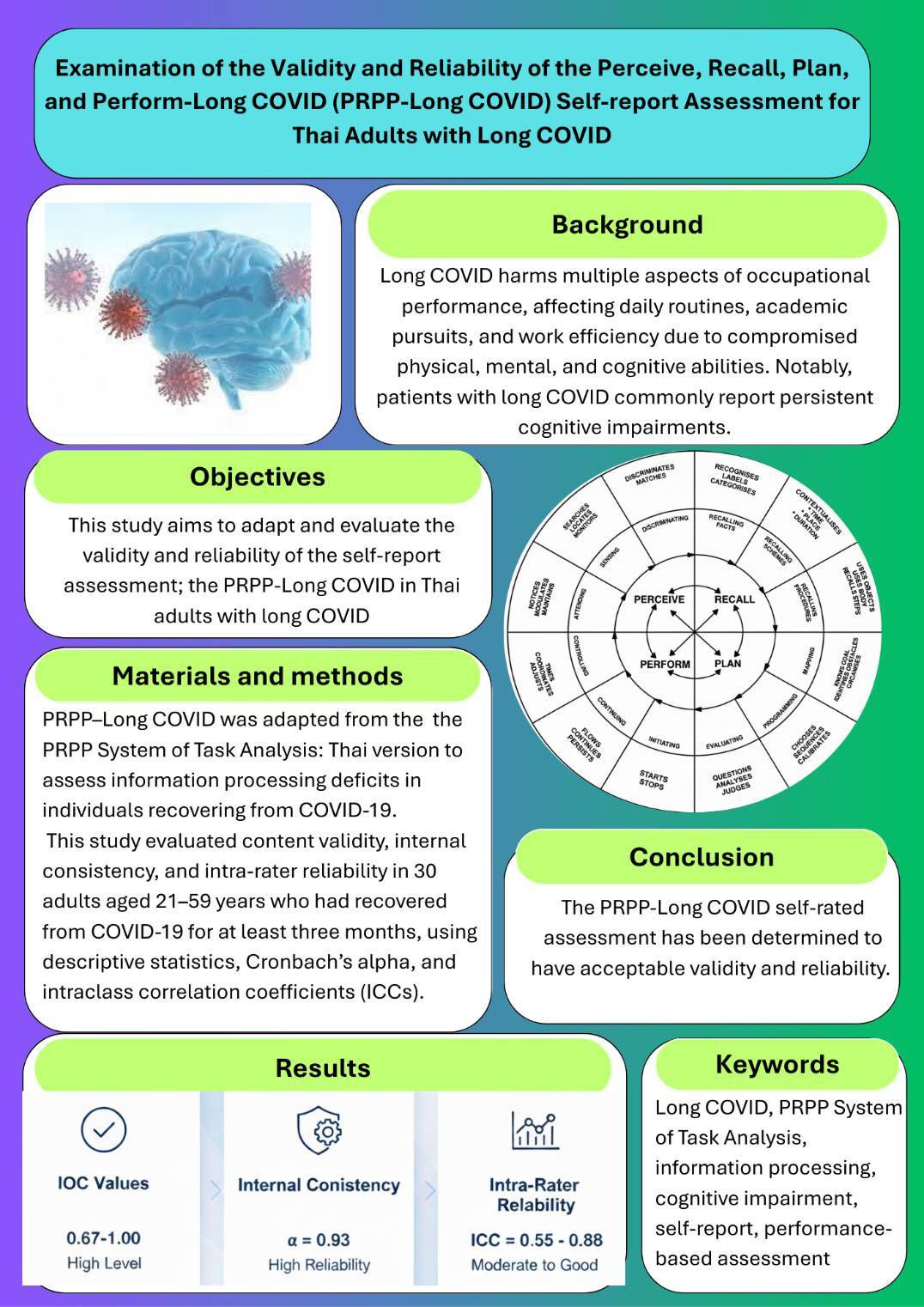
Background: Long COVID harms multiple aspects of occupational performance, affecting daily routines, academic pursuits, and work efficiency due to compromised physical, mental, and cognitive abilities. Notably, patients with long COVID commonly report persistent cognitive impairments.
Objectives: This study aims to adapt and evaluate the validity and reliability of the self-report assessment; the PRPP-Long COVID in Thai adults with long COVID.
Materials and methods: The Perceive, Recall, Plan, and Perform-Long COVID (PRPP-Long COVID) was adapted from the perceive, recall, plan, and perform (PRPP) System of Task Analysis: Thai version. This self-report assessment is used to assess the deficits of information processing capacity in individuals recovering from COVID-19. The psychometric properties of the PRPP-Long COVID were investigated, including content validity, internal consistency, and intra-rater reliability. Thirty individuals aged between 21 and 59 years had previously tested positive for COVID-19 by RT-PCR or Antigen Test Kit (ATK) and had recovered at least three months before participating in this study. All of them had an education level of at least secondary school. The PRPP-Long COVID was sent to three experts to examine for the Index of Item Objective Congruence (IOC). After that, the revised version of the PRPP-Long COVID was distributed to the participants. They were given the Google form link submission in 2 rounds, seven days apart, to test intra-rater reliability. For data analysis, descriptive statistics were utilized to calculate demographic characteristics, while the Cronbach alpha coefficient and the Intra-class Correlation Coefficients (ICCs) were used to estimate the internal consistency and intra-rater reliability of the PRPP-Long COVID, respectively.
Results: The IOC values for each question demonstrated a high level of agreement (IOC=0.67-1.00). The internal consistency of the 34 questions in the PRPP-Long COVID indicated a high level of reliability, with α=0.93. The intrarater
reliability of the PRPP-Long COVID was moderate to good (ICC=0.55-0.88).
Conclusion: The PRPP-Long COVID self-rated assessment has been determined to have acceptable validity and reliability.
Article Details

This work is licensed under a Creative Commons Attribution-NonCommercial-NoDerivatives 4.0 International License.
Personal views expressed by the contributors in their articles are not necessarily those of the Journal of Associated Medical Sciences, Faculty of Associated Medical Sciences, Chiang Mai University.
References
World Health Organization. WHO Coronavirus (COVID-19) Dasboard. 2023. Available from: https://dashboards-dev.sprinklr.com.
Soriano JB, Murthy S, Marshall JC, Relan P, Diaz JV; WHO Clinical Case Definition Working Group on Post-COVID-19 Condition. A clinical case definition of post-COVID-19 condition by a Delphi consensus. Lancet Infect Dis. 2022; 22(4): e102-e7. doi: 10.1016/S1473-3099(21)00703-9.
Crook H, Raza S, Nowell J, Young M, Edison P. Long covid-mechanisms, risk factors, and management. BMJ. 2021; 374: n1648. doi: 10.1136/bmj.n1648.
Taquet M, Dercon Q, Luciano S, Geddes JR, Husain M, Harrison PJ. Incidence, co-occurrence, and evolution of long-COVID features: A 6-month retrospective cohort study of 273,618 survivors of COVID-19. PLoS Med. 2021; 18: e1003773. doi: 10.1371/journal.pmed.1003773.
Poletti S, Palladini M, Mazza MG, De Lorenzo R, COVID-19 BioB Outpatient Clinic Study group, Furlan R, et al. Long-term consequences of COVID-19 on cognitive functioning up to 6 months after discharge: role of depression and impact on quality of life. Eur Arch Psychiatry Clin Neurosci. 2022; 272: 773-82. doi: 10.1007/s00406-021-01346-9.
Almeria M, Cejudo JC, Sotoca J, Deus J, Krupinski J. Cognitive profile following COVID-19 infection: Clinical predictors leading to neuropsychological impairment. Brain Behav Immun Health. 2020; 9: 100163. doi:10.1016/j.bbih.2020.100163.
Méndez R, Balanzá-Martínez V, Luperdi SC, Estrada I, Latorre A, González-Jiménez P,et al. Short-term neuropsychiatric outcomes and quality of life in COVID-19 survivors. J Intern Med.2021; 290: 621-31. doi: 10.1111/joim.13262.
Davis HE, Assaf GS, McCorkell L, Wei H, Low RJ, Re’em Y, et al. Characterizing long COVID in an international cohort: 7 months of symptoms and their impact. ECM. 2021; 38: 101019. doi: 10.1016/j.eclinm.2021.101019.
Fisher AG, Jones KB. Assessment of motor and process skills: Development, standardization, and administration manual. United States: Three Star Press; 2012 .
Baum CM, Connor LT, Morrison T, Hahn M, Dromerick AW, Edwards DF. Reliability, validity, and clinical utility of the executive function performance test: a measure of executive function in a sample of people with stroke. Am J Occup Ther. 2008; 62:446-55. doi: 10.5014/ajot.62.4.446.
Burns T, Mortimer JA, Merchak P. Cognitive Performance Test: a new approach to functional assessment in Alzheimer’s disease. J Geriatr Psychiatry Neurol.1994; 7: 46-54. doi: 10.1177/089198879400700109
Chapparo C, Ranka J. The PRPP system of task analysis: User’s training manual: Available from the Discipline of Occupational Therap. Faculty of Health Sciences, University of Sydney, Lidcombe, Australia. 2005
Nott MT, Chapparo C, Heard R. Effective occupational therapy intervention with adults demonstrating agitation during post-traumatic amnesia. Brain Inj.2008; 22: 669-83. doi: 10.1080/02699050802227170.
Munkhetvit P. Cognitive assessment in patients with acquired brain injury in Thailand [Unpublished thesis]. University of Sydney, NSW, Australia. 2005
Munkhetvit P. Types of cognitive deficits during the performance of ADL and IADL in persons with CVA. JOTAT. 2008; 11: 19-30.
Bunyachatakul S, Munkhetvit P, Srikamjak T, Sarakam A. Cognitive deficits during the performance of activities of daily living in Schizophrenic patients. Bulletin of Suan Prung. 2010; 26: 15-24.
Juntorn S, Sriphetcharawut S, Munkhetvit P. Effectiveness of information processing strategy training on academic task performance in children with learning disabilities: A pilot study. Occup Ther Int. 2017: 6237689.doi:10.1155/2017/6237689.
Lowe S. Cognitive strategies and school participation for students with learning difficulties [Dissertation on the Internet]. University of Sydney, NSW, Australia; 2010. Available from: https://ses.library.usyd.edu.au/handle/2123/7170.
Montag C, Dagum P, Hall B, Elhai J. Do we still need psychological self-report questionnaires in the age of the Internet of Things? Discov Psychol. 2021; 2(1). doi: 10.1007/s44202-021-00012-4.
Demetriou A, Kazi S. Self-awareness in g (with processing efficiency and reasoning). Intell. 2006;34: 297-317. doi: 10.1016/j.intell.2005.10.002.
Aubin G, Stip E, Gelinas I, Rainville C, Chapparo C. Assessment of information-processing skills during daily task performance in persons with schizophrenia: usefulness of the Perceive, Recall, Plan, and Perform (PRPP) System of Task Analysis. In Proceedings of the 15th World Conference of the Federation of Occupational Therapists. 2010.
Boland K. Assessing information processing in the context of pretend play. University of Sydney, NSW, Australia. 2004
Chapparo C,Ranka J. Development of an information processing task analysis to identify errors in selfmaintenance performance of brain injured clients: Final Category B Grants Research Report. 1992.
Fordham M. Perceive, Recall, Plan, Perform (PRPP) rating scales (parent and teacher): reliability and validity [Unpublished thesis]. University of Sydney, NSW, Australia. 2001.
Lohri J. Information and sensory processing abilities of young children with autism spectrum disorder [Unpublished thesis]. University of Sydney, NSW, Australia. 2005.
Nott MT, Chapparo C. Measuring information processing in a client with extreme agitation following traumatic brain injury using the Perceive, Recall, Plan and Perform system of task analysis. Aust Occup Ther J. 2008; 55: 188-98. doi: 10.1111/j.1440-1630.2007.00685.x.
Still M, Beltran R, Catts S, Chapparo C. Cognitive and functional assessment of patients with early psychosis. Acta Neurol Scand Suppl. 2002; 413:40-41. Published abstracts from 3rd International Conference on Early Psychosis, Copenhagen, Denmark, September.
Ranka JL, Chapparo CJ. Assessment of productivity performance in men with HIV associated neurocognitive disorder (HAND). Work. 2010; 36: 193-206. doi: 10.3233/wor-2010-1020 .
Joshi A, Kale S, Chandel S,Pal D. Likert Scale: Explored and explained. Br J Appl Sci Technol. 2015; 7: 396-403. doi: 10.9734/BJAST/2015/14975.
Wolak ME, Fairbairn DJ, Paulsen YR. Guidelines for estimating repeatability. Methods Ecol Evol. 2012; 3: 129-37. doi: 10.1111/j.2041-210X.2011.00125.x.
Marinus J, Visser M, Stiggelbout AM, Rabey JM, Martínez-Martín P, Bonuccelli U, et al. A short scale for the assessment of motor impairments and disabilities in Parkinson’s disease: the SPES/SCOPA. J Neurol Neurosurg Psychiatry.2004; 75: 388-95. doi: 10.1136/jnnp.2003.017509.
Ahdika A. Improvement of quality, interest, critical, and analytical thinking ability of students through the application of research-based learning (RBL) in introduction to stochastic processes subject. Int Elect J Math Ed.2017; 12(2): 167-91. doi: 10.29333/iejme/608.
Van Keulen-Rouweler BJ, Sturkenboom IH, Kottorp A, Graff MJ, Nijhuis-Van der Sanden MW, Steultjens EM. The Perceive, Recall, Plan and Perform (PRPP) system for persons with Parkinson’s disease: a psychometric study. Scand J Occup Ther. 2017; 24: 65-73. doi: 10.1080/11038128.2016.1233291.
Streiner DL, Norman GR, Cairney J. Health measurement scales: A practical guide to their development and use. New York: Oxford University Press; 2014.
Marx RG, Menezes A, Horovitz L, Jones EC, Warren RF. comparison of two time intervals for test-retest reliability of health status instruments. J Clin Epidemiol. 2003; 56(8): 730-35. doi: 10.1016/s0895-4356(03)00084-2.
Aubin G, Chapparo C, Gélinas I, Stip E, Rainville C. Use of the Perceive, Recall, Plan and Perform System of Task Analysis for persons with schizophrenia: a preliminary study. Aust Occup Ther J. 2009; 56: 189-99. doi: 10.1111/j.1440-1630.2007. 00725.x.
Lindenschot M, Groot IJM, Nijhuis-van der Sanden MWG, Steultjens EMJ, Graff MJL, Koene S. Perceive, Recall, Plan and Perform (PRPP)-assessment based on parent-provided videos of children with mitochondrial disorder: Action design research on implementation challenges. Phys Occup Ther Pediatr. 2023; 43: 74-92. doi: 10.1080/01942638.2022.2086024.
