
Comparative evaluation and interpretability analysis of modern CNN architectures for brain tumor MRI classification
Article Sidebar
Main Article Content
Abstract
Background:Accurate and interpretable brain tumor classification from MRI images remains a key challenge in medical image analysis, particularly when using publicly available datasets of moderate size.
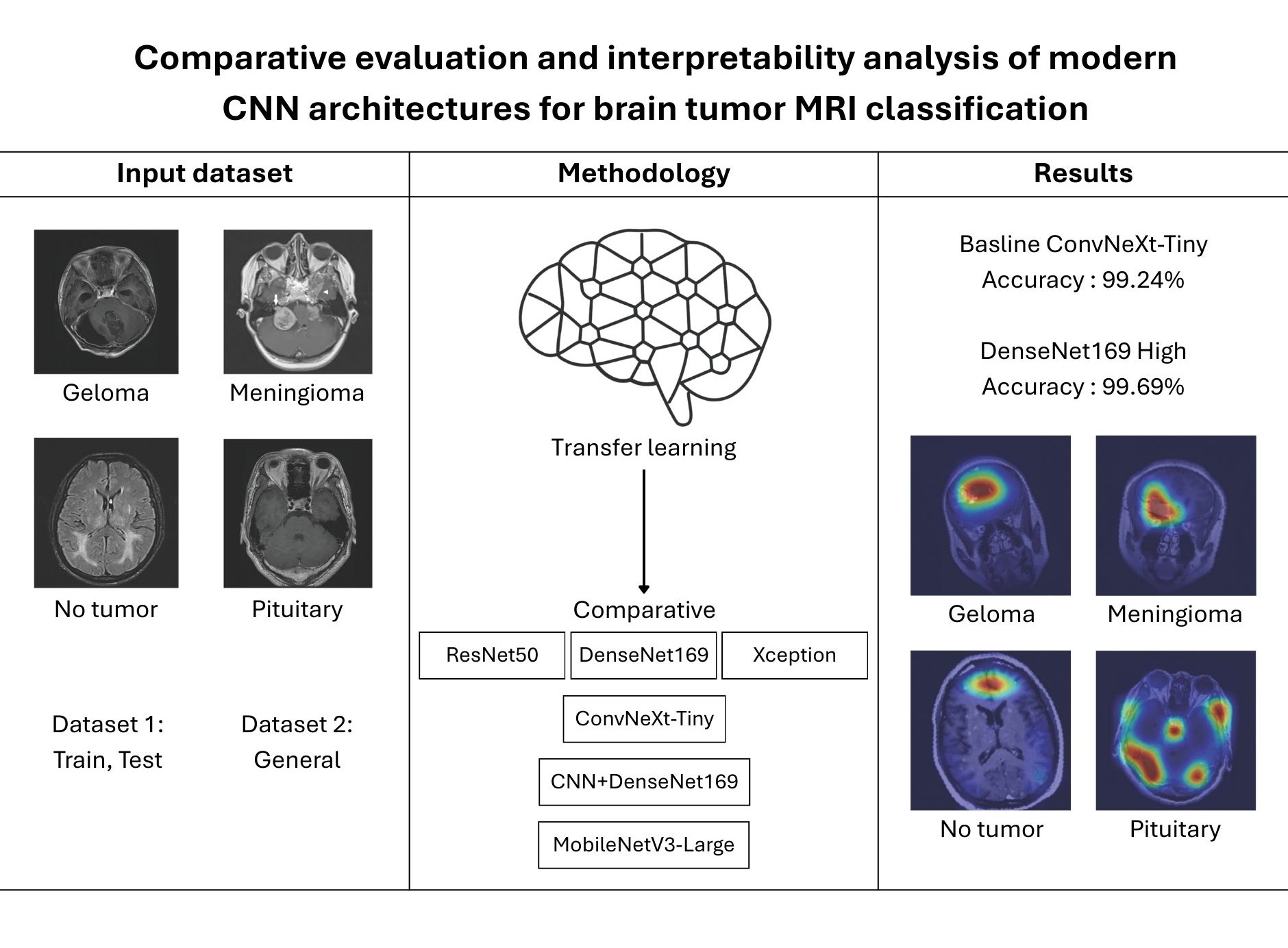
Objectives:This study investigates the performance of a ConvNeXt-Tiny based framework for four-class brain tumor classification glioma, meningioma, pituitary tumor, and no tumor and compares it with established convolutional architectures.
Materials and methods:Using transfer learning and identical experimental settings, ConvNeXt-Tiny was evaluated against DenseNet169, Xception, MobileNetV3-Large, CNN+DenseNet169, and ResNet50. Standard evaluation metrics (accuracy, precision, recall, and F1-score) were used, and Grad-CAM was applied to visualize model attention for interpretability. Generalization was further assessed using an independent dataset.
Results:ConvNeXt-Tiny achieved high overall performance (accuracy = 0.9924, F1-score = 0.9918), comparable to DenseNet169 and Xception but with lower computational cost. The model maintained stable learning behavior, minimal overfitting, and consistent accuracy on unseen data. Grad-CAM visualizations confirmed that the network focused on clinically relevant tumor regions, improving transparency and reliability of predictions.
Conclusion:ConvNeXt-Tiny provides a strong and efficient baseline for interpretable brain tumor classification, balancing accuracy and computational efficiency. While the results are promising, differences among recent architectures were modest, and clinical validation using multi-center MRI datasets is necessary to confirm broader applicability.
Article Details

This work is licensed under a Creative Commons Attribution-NonCommercial-NoDerivatives 4.0 International License.
Personal views expressed by the contributors in their articles are not necessarily those of the Journal of Associated Medical Sciences, Faculty of Associated Medical Sciences, Chiang Mai University.
References
Deepa P, Narain P, Sreena V. Performance analysis of deep transfer learning approaches in detecting and classifying brain tumor from magnetic resonance images. Intelligent Data Analysis. 2023; 27(6):1759-80. doi:10.3233/ida-227321.
Younis A, Li Q, Afzal Z, Adamu M, Kawuwa H, Hussain F, et al. Abnormal brain tumors classification using ResNet50 and its comprehensive evaluation. IEEE Access. 2024; 12: 78843-53. doi:10.1109/access.2024.3403902.
Chen W, Sun P, Zhang Y. A brain tumor diagnosis approach based on deep separable convolutional networks and attention mechanisms. Applied and Computational Engineering. 2024; 67(1): 60-9. doi:10.54254/2755-2721/67/20240629.
Oladimeji O, Ibitoye A. Brain tumor classification using ResNet50-convolutional block attention module. Applied Computing and Informatics. 2023. doi:10.1108/aci-09-2023-0022.
Khan M, Khan A, Alhaisoni M, Alqahtani A, Alsubai S, Alharbi M, et al. Multimodal brain tumor detection and classification using deep saliency map and improved dragonfly optimization algorithm. Int J Imaging Syst Technol. 2023; 33(2): 572-87.doi: 10.1002/ima.22831.
Rastogi D, Johri P, Donelli M, Kumar L, Bindewari S, Raghav A, et al. Brain tumor detection and prediction in MRI images utilizing a fine-tuned transfer learning model integrated within deep learning frameworks. Life. 2025; 15(3): 327. doi:10.3390/life15030327.
Li S. Classification of brain tumors based on magnetic resonance imaging using deep learning models. Applied and Computational Engineering. 2024; 40(1): 247-54. doi:10.54254/2755-2721/40/20230660.
Türkoğlu M. Brain tumor detection using a combination of Bayesian optimization based SVM classifier and fine-tuned deep features. Eur J Sci Technol. 2021; 27: 251-258. doi:10.31590/ejosat.963609.
Rehman A, Khan M, Saba T, Mehmood Z, Tariq U, Ayesha N. Microscopic brain tumor detection and classification using 3D CNN and feature selection architecture. Microsc Res Tech. 2021; 84(1): 133-49. doi:10.1002/jemt.23597.
Murugesan G, Nagendran P, Natarajan J. Advancing brain tumor diagnosis: deep Siamese convolutional neural network as a superior model for MRI classification. Brain-x. 2025; 3(2): e70028. doi:10.1002/brx2.70028.
Kumar P, Bonthu K, Meghana B, Vani K, Chakrabarti P. Multi-class brain tumor classification and segmentation using hybrid deep learning network model. Scalable Comput Pract Exp. 2023; 24(1): 69-80. doi:10.12694/scpe.v24i1.2088.
Ullah M, Khan M, Almujally N, Alhaisoni M, Akram T, Shabaz M. BrainNet: a fusion-assisted novel optimal framework of residual blocks and stacked autoencoders for multimodal brain tumor classification. Sci Rep. 2024; 14(1): 5895. doi:10.1038/s41598-024-56657-3.
Joshi A, Aziz R. Deep learning approach for brain tumor classification using metaheuristic optimization with gene expression data. Int J Imaging Syst Technol. 2024; 34(2): e23007. doi:10.1002/ima.23007.
Pei L, Vidyaratne L, Rahman M, Iftekharuddin K. Context-aware deep learning for brain tumor segmentation, subtype classification, and survival prediction using radiology images. Sci Rep. 2020;10(1): 19726. doi:10.1038/s41598-020-74419-9.
Bacak A, Şenel M, Günay O. Convolutional neural network prediction on meningioma and glioma with TensorFlow. Int J Comput Exp Sci Eng. 2023; 9(2): 197-204. doi:10.22399/ijcesen.1306025.
Ullah N, Hassan M, Khan J, Anwar M, Aurangzeb K. Enhancing explainability in brain tumor detection: a novel DeepEBTDNet model with LIME on MRI images. Int J Imaging Syst Technol. 2024; 34(1): e23012. doi:10.1002/ima.23012.
Esmaeili M, Vettukattil R, Banitalebi H, Krogh N, Geitung J. Explainable artificial intelligence for human-machine interaction in brain tumor localization. J Pers Med. 2021; 11(11): 1213. doi:10.3390/jpm11111213.
Goyal D, Sharma H. Brain tumor detection system using neural networks. Int J Commun Inf Technol. 2023; 4(1): 59-63. doi:10.33545/2707661x.2023. v4.i1a.61.
Tonni S, Sheakh M, Tahosin M, Hasan M, Shuva T, Bhuiyan T, et al. A hybrid transfer learning framework for brain tumor diagnosis. Adv Intell Syst. 2025; 7(3): 2400495. doi:10.1002/aisy.202400495.
Alanazi M, Ali M, Hussain S, Zafar A, Mohatram M, Irfan M, et al. Brain tumor/mass classification framework using MRI-based isolated and developed transfer deep-learning model. Sensors. 2022; 22(1): 372. doi:10.3390/s22010372.
Nickparvar M. Brain tumor MRI dataset [Internet]. Kaggle; 2021 [cited 2025 Jan 3]. Available from: https://www.kaggle.com/datasets/masoudnickparvar/brain-tumor-mri-dataset
Rostami A. Labeled MRI Brain Tumor Dataset Computer Vision Model [Internet]. Roboflow Universe; 2024 [cited 2025 Jan 3]. Available from: https://universe.roboflow.com/ali-rostami/labeled-mri-brain-tumor-dataset
Mehmood Y, Bajwa UI. Brain tumor grade classification using the ConvNeXt architecture. Digit Health. 2024; 10: 20552076241284920. doi:10.1177/20552076241284920.
Aamir M, Namoun A, Munir S, Aljohani N, Alanazi MH, Alsahafi Y, et al. Brain tumor detection and classification using an optimized convolutional neural network. Diagnostics. 2024; 14(16): 1714. doi:10.3390/diagnostics14161714.
