
[Retracted] Altered visfatin and adiponectin levels and their interaction with HEGF in the metabolic dyslipidemia of overt hypothyroidism: A case-control study
Article Sidebar
Main Article Content
Abstract
Background: Hypothyroidism is a common endocrine disorder associated with significant metabolic dysregulation, including dyslipidemia. Adipokines such as visfatin and adiponectin are key regulators of metabolism, but their specific roles and potential as markers of metabolic dysfunction in overt, treatment-naive hypothyroidism require further elucidation.
Objectives: This study aimed to investigate the association of visfatin and adiponectin levels with hypothyroidism, assess their potential utility for metabolic risk assessment, and explore their associations with metabolic parameters and human epidermal growth factor (HEGF).
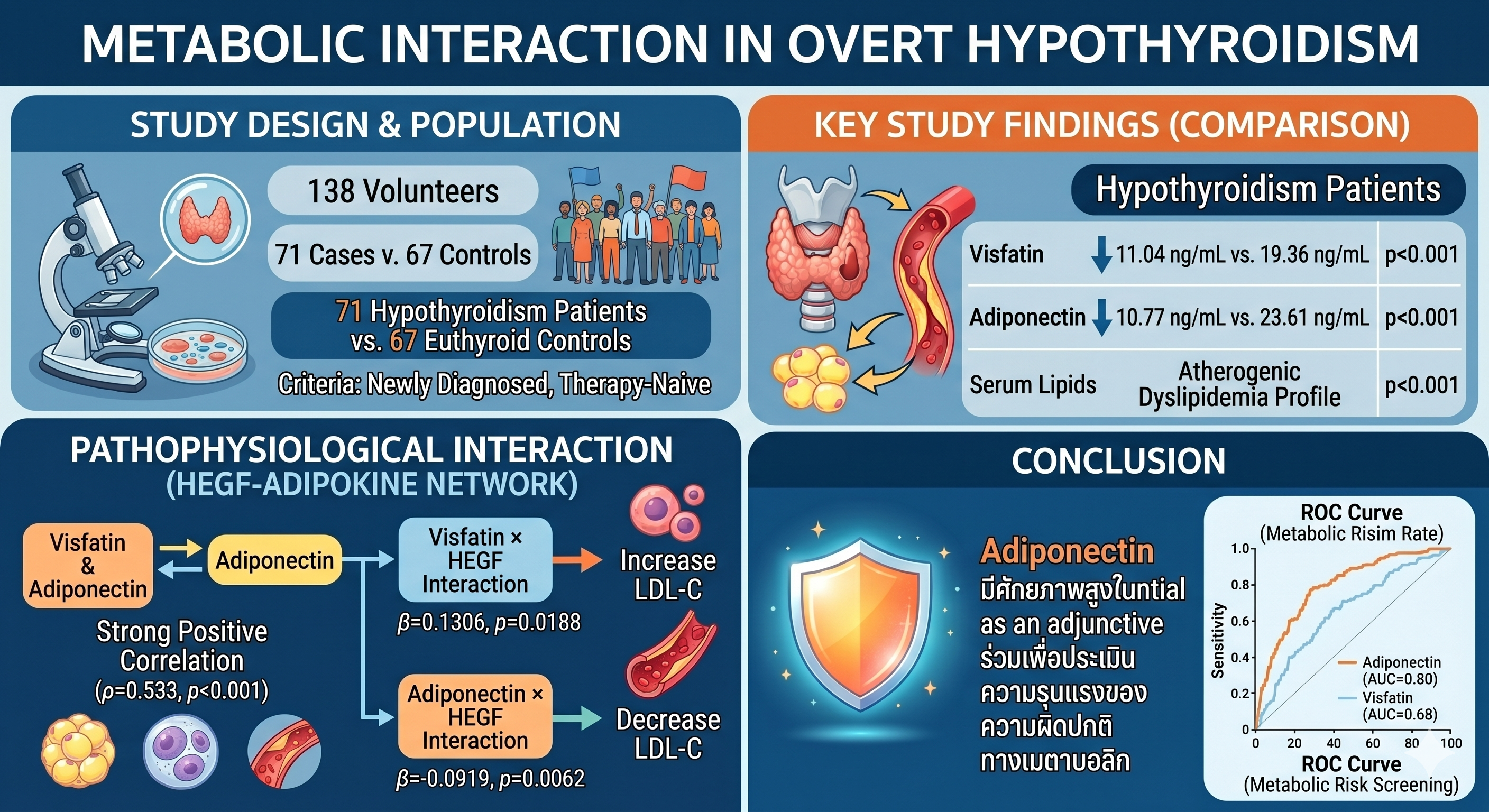
Materials and methods: This case-control study included 71 hypothyroid patients and 67 frequency-matched euthyroid controls. All patients were newly diagnosed and therapy‑naive. Serum levels of adipokines (visfatin, adiponectin), HEGF, thyroid hormones, and lipids were assessed. Statistical analyses included ROC curves, Spearman’s correlation, multivariate regression, and ANCOVA to adjust for BMI and age.
Results: After adjusting for BMI and age, hypothyroid patients had significantly lower visfatin (adjusted LS mean: 11.04±1.56 vs 19.36±1.59 ng/mL, p<0.001) and adiponectin (10.77±2.04 vs 23.61±2.09 ng/mL, p<0.001) compared to controls and exhibited atherogenic dyslipidemia (all p<0.001). A strong positive correlation was observed between visfatin and adiponectin (ρ=0.533 and p<0.001). Regression analysis revealed significant interactions in the hypothyroid group: visfatin×HEGF was associated with an increased LDL-C (β=0.1306, p=0.0188), while adiponectin×HEGF was associated with decreased LDL-C (=-0.0919, p=0.0062). Adiponectin showed a good screening for metabolic risk in hypothyroidism (AUC=0.80) compared to visfatin (AUC=0.68).
Conclusion: Hypothyroidism is associated with altered adipokine levels and a specific interplay with HEGF that influences LDL-C. Adiponectin shows promise as adjunctive marker for assessing metabolic dysfunction severity in hypothyroidism, and the HEGF-adipokine network represent
Article Details

This work is licensed under a Creative Commons Attribution-NonCommercial-NoDerivatives 4.0 International License.
Personal views expressed by the contributors in their articles are not necessarily those of the Journal of Associated Medical Sciences, Faculty of Associated Medical Sciences, Chiang Mai University.
References
Verma DP, Chaudhary SC, Singh A, Sawlani KK, Gupta KK, Usman K, et al. Hypothyroidism in metabolic syndrome. Ann Afr Med. 2024; 23(4): 717-22. doi: 10.4103/aam.aam_25_24. Epub 2024 Sep 14.
Taylor PN, Medici MM, Hubalewska-Dydejczyk A, Boelaert K. Hypothyroidism. Lancet (London, England). 2024; 404(10460): 1347-64. doi: 10.1016/S0140-6736(24)01614-3.
Jonklaas J. Hypothyroidism, lipids, and lipidomics. Endocrine. 2024; 84(2): 293-300. doi:10.1007/s12020-023-03420-9 .
Duntas LH, Brenta G. A renewed focus on the association between thyroid hormones and lipid metabolism. Front Endocrinol (Lausanne). 2018; 9: 511. doi: 10.3389/fendo.2018.00511.
Sinha RA, You SH, Zhou J, Siddique MM, Bay BH, Zhu X, et al. Thyroid hormone stimulates hepatic lipid catabolism via activation of autophagy. J Clin Invest. 2012; 122(7): 2428-38. doi: 10.1172/JCI60580
Gagnon A, Antunes TT, Ly T, Pongsuwan P, Gavin C, Lochnan HA, et al. Thyroid-stimulating hormone stimulates lipolysis in adipocytes in culture and raises serum free fatty acid levels in vivo. Metabolism. 2010; 59(4): 547-53. doi: 10.1016/j.metabol.2009.08.018.
Yan F, Wang Q, Lu M, Chen W, Song Y, Jing F, et al. Thyrotropin increases hepatic triglyceride content through upregulation of SREBP-1c activity. J Hepatol. 2014; 61(6): 1358-64. doi: 10.1016/j.jhep.2014.06.037.
Beukhof CM, Massolt ET, Visser TJ, Korevaar TIM, Medici M, de Herder WW, et al. Effects of thyrotropin on peripheral thyroid hormone metabolism and serum lipids. Thyroid. 2018; 28(2): 168-74. doi: 10.1089/thy.2017.0330.
Kirichenko T V, Markina Y V, Bogatyreva AI, Tolstik T V, Varaeva YR, Starodubova A V. The role of adipokines in inflammatory mechanisms of obesity. Int J Mol Sci. 2022; 23(23): 14982. doi: 10.3390/ijms232314982.
Yao J, Wu D, Qiu Y. Adipose tissue macrophage in obesity-associated metabolic diseases. Front Immunol. 2022; 13: 977485. doi: 10.3389/fimmu.2022.977485.
Dakroub A, Nasser SA, Kobeissy F, Yassine HM, Orekhov A, Sharifi-Rad J, et al. Visfatin: An emerging adipocytokine bridging the gap in the evolution of cardiovascular diseases. J Cell Physiol. 2021; 236(9): 6282-96. doi: 10.1002/jcp.30345.
Caixàs A, Tirado R, Vendrell J, Gallart L, Megía A, Simón I, et al. Plasma visfatin concentrations increase in both hyper and hypothyroid subjects after normalization of thyroid function and are not related to insulin resistance, anthropometric or inflammatory parameters. Clin Endocrinol (Oxf). 2009; 71(5): 733-8. doi:10.1111/j.1365-2265.2009.03546.x.
Brochu-Gaudreau K, Rehfeldt C, Blouin R, Bordignon V, Murphy BD, Palin MF. Adiponectin action from head to toe. Endocrine. 2010; 37(1): 11-32. doi: 10.1007/s12020-009-9278-8.
Ozdemir D, Dagdelen S, Usman A. Serum adiponectin levels and changes in glucose metabolism before and after treatment for thyroid dysfunction. Intern Med. 2015; 54(15): 1849-57. doi: 10.2169/internalmedicine.54.0668.
Bhushan B, Michalopoulos GK. Role of epidermal growth factor receptor in liver injury and lipid metabolism: Emerging new roles for an old receptor. Chem Biol Interact. 2020; 324: 109090. doi: 10.1016/j.cbi.2020.109090.
Vishwakarma J, Gupta K, Mishra J, Garg A, Malik R, Kashyap A, et al. Hypothyroidism induces motor deficit via altered cerebellar HB-EGF/EGFR and autophagy. J Endocrinol. 2023; 257(1). doi: 10.1530/JOE-22-0338.
Schiff BA, McMurphy AB, Jasser SA, Younes MN, Doan D, Yigitbasi OG, et al. Epidermal growth factor receptor (EGFR) is overexpressed in anaplastic thyroid cancer, and the EGFR inhibitor gefitinib inhibits the growth of anaplastic thyroid cancer. Clin cancer Res an Off J Am Assoc Cancer Res. 2004; 10(24): 8594-602. doi: 10.1158/1078-0432.CCR-04-0690.
Mukku VR. Regulation of epidermal growth factor receptor levels by thyroid hormone. J Biol Chem. 1984; 259(10): 6543-7. PMID: 6327683.
Kaji H, Hinkle PM. Epidermal growth factor decreases thyroid hormone receptors and attenuates thyroid hormone responses in GH4C1 cells. Endocrinology. 1987; 120(2): 537-43. doi: 10.1210/endo-120-2-537.
Ekinci I. Metabolic Syndrome In Thyroid Disease. In: Metabolic syndrome: A comprehensive update with new insights. Bentham Science Publishers; 2025. pp 402-20.
Kar K, Sinha S. Variations of adipokines and insulin resistance in primary hypothyroidism. J Clin Diagnostic Res. 2017; 11(8): BC07-9. doi: 10.7860/JCDR/2017/26666.10345.
Lozanov LB, Gorcheva D, Lozanov BS, Argirova R, Koleva V, Kostova B, et al. Role of Thyroid deficiency on adiponectin, leptin, and metabolic status in visceral obesity: A cross-sectional study. Horm Metab Res. 2017; 49(9): 667-72. doi: 10.1055/s-0043-115532.
Kokkinos S, Papazoglou D, Zisimopoulos A, Papanas N, Tiaka E, Antonoglou C, et al. Retinol binding protein-4 and adiponectin levels inthyroid overt and subclinical dysfunction. Exp Clin Endocrinol Diabetes. 2015; 124(2): 87-92. doi: 10.1055/s-0035-1564199.
Ozkaya M, Sahin M, Cakal E, Yuzbasioglu F, Sezer K, Kilinc M, et al. Visfatin plasma concentrations in patients with hyperthyroidism and hypothyroidism before and after control of thyroid function. J Endocrinol Invest. 2009; 32(5): 435-9. doi: 10.1007/BF03346482.
Sawicka-Gutaj N, Zybek-Kocik A, Klimowicz A, Kloska M, Mańkowska-Wierzbicka D, Sowiński J, et al. Circulating visfatin in hypothyroidism is associated with free thyroid hormones and antithyroperoxidase antibodies. Int J Endocrinol. 2016; 2016(1): 7402469. doi:10.1155/2016/7402469.
Qiao L, Zou C, van der Westhuyzen DR, Shao J. Adiponectin reduces plasma triglyceride by increasing VLDL triglyceride catabolism. Diabetes. 2008; 57(7): 1824-33. doi: 10.2337/db07-0435.
Wang F, Tan Y, Wang C, Zhang X, Zhao Y, Song X, et al. Thyroid-stimulating hormone levels within the reference range are associated with serum lipid profiles independent of thyroid hormones. J Clin Endocrinol Metab. 2012; 97(8): 2724–31. doi: 10.1210/jc.2012-1133.
Rizos C V, Elisaf MS, Liberopoulos EN. Effects of thyroid dysfunction on lipid profile Open Cardiovasc Med J. 2011; 5: 76. doi: 10.2174/1874192401105010076.
Zhang X, Song Y, Feng M, Zhou X, Lu Y, Gao L, et al. Thyroid-stimulating hormone decreases HMG-CoA reductase phosphorylation via AMPactivated protein kinase in the liver. J Lipid Res. 2015; 56(5): 963-71. doi: 10.1194/jlr.M047654.
Zakaria I, Rizk MN, Rakha M, Shehaby A. Visfatin and adiponectin as early markers of atherosclerosis in type 2 diabetes mellitus. Egypt J Intern Med. 2013; 25: 143-8. doi: 10.7123/01.EJIM.0000433121.61723.90.
Fantuzzi G. Adiponectin and inflammation: Consensus and controversy. J Allergy Clin Immunol. 2008; 121(2): 326-30. doi: 10.1016/j.jaci.2007.10.018.
Souvannavong-Vilivong X, Sitticharoon C, Klinjampa R, Keadkraichaiwat I, Sripong C, Chatree S, et al. Placental expressions and serum levels ofadiponectin, visfatin, and omentin in GDM. Acta Diabetol. 2019; 56: 1121-31. doi: 10.1007/s00592-019-01355-0.
Abdalla MMI. Therapeutic potential of adiponectin in prediabetes: strategies, challenges, and future directions. Ther Adv Endocrinol Metab. 2024; 15: 20420188231222372. doi: 10.1177/20420188231222371.
Al-rubaye AAH, Mohsin AA, Jasim WE. Circulating myokines and apelin-13 levels as predictive biomarkers for newly diagnosed type 2 diabetes mellitus. Indian J Biochem Biophys. 2025; 62: 798-805. doi: 10.56042/ijbb.v62i7.17204.
Tomas A, Futter CE, Eden ER. EGF receptor trafficking: consequences for signaling and cancer. Trends Cell Biol. 2014; 24(1): 26-34. doi: 10.1016/j.tcb.2013.11.002.
