
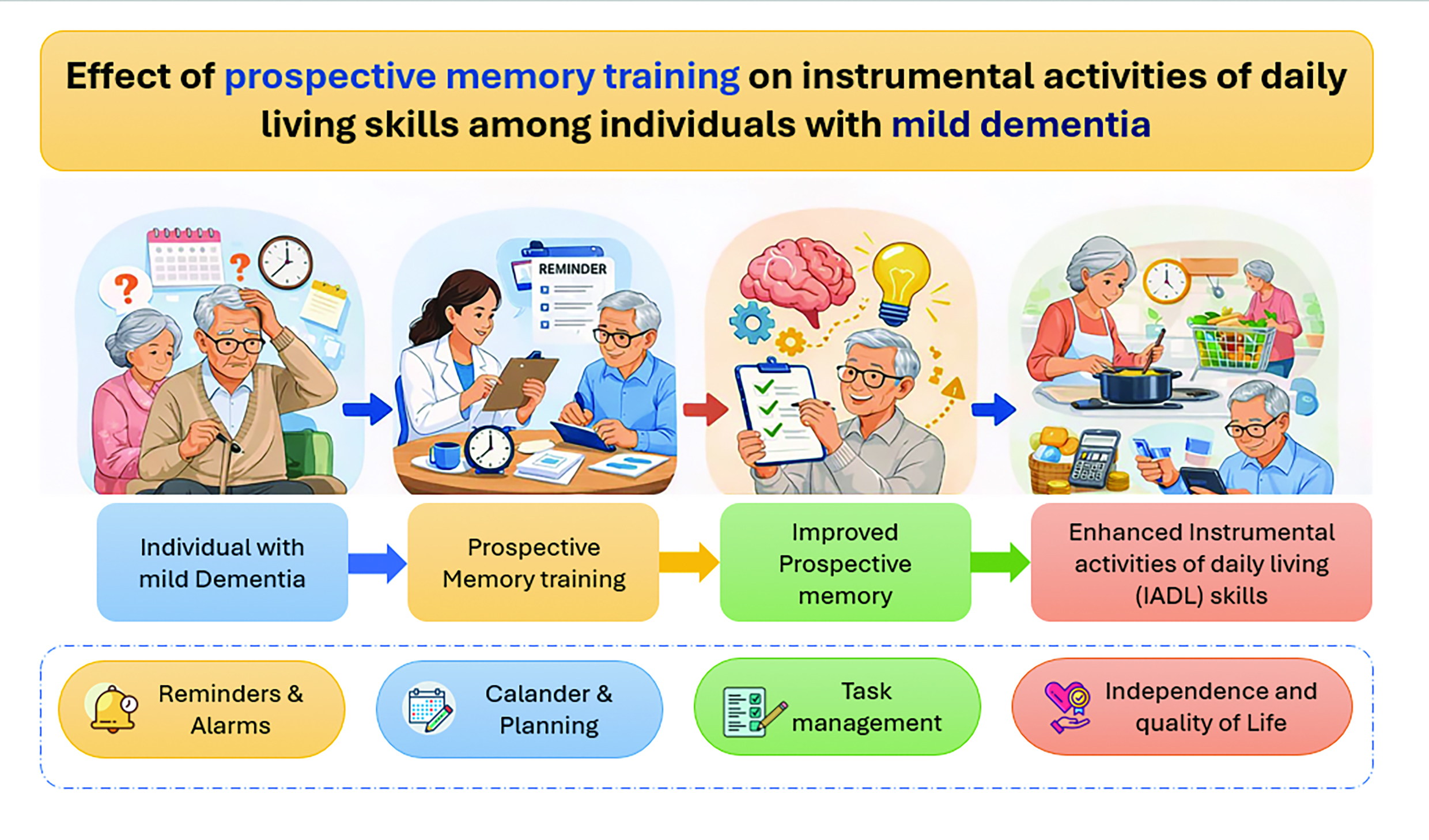
Effect of prospective memory training on instrumental activities of daily living skills among individuals with mild dementia
Article Sidebar
Main Article Content
Abstract
Background: Dementia is a neurodegenerative disease brought on by a longterm, progressive illness that impairs decision-making, behavior, emotions, memory, and other brain processes that interfere with day-to-day functioning. Mild dementia is an early stage of cognitive decline that interferes with daily activities but allows for independent function in many areas. Prospective memory (PM), which enables one to remember to carry out delayed intentions, is crucial for everyday functioning.
Objectives: This study aims to determine the effect of prospective memory training on instrumental activities of daily living skills among individuals with mild dementia.
Materials and methods: A True experimental study was conducted. A total of 45 participants were initially screened using the Mini-Mental State Examination (MMSE). Based on the inclusion criteria, 30 participants with mild dementia were selected. Through simple randomization, 30 participants were divided into two groups: the experimental group (N=15) and the control group (N=15). The Lawton and Brody Instrumental Activities of Daily Living (IADL) Scale was used to assess functional performance. The experimental group received prospective memory training focused on improving instrumental activities of daily living, while the control group underwent conventional occupational therapy for 3 months, with sessions held 3 days per week (36 sessions), each lasting 45 minutes. Data analysis was performed using IBM SPSS version 23.0 with paired and independent t-test.
Results: Post-test scores showed statistically significant improvements in the experimental group for instrumental activities of daily living skills (p=0.000, which p<0.001). The results of this study showed that prospective memory training was effective in enhancing instrumental activities of daily living skills among individuals with mild dementia.
Conclusion: This study found that prospective memory training improves instrumental activities of daily living among individuals with mild dementia.
Article Details

This work is licensed under a Creative Commons Attribution-NonCommercial-NoDerivatives 4.0 International License.
Personal views expressed by the contributors in their articles are not necessarily those of the Journal of Associated Medical Sciences, Faculty of Associated Medical Sciences, Chiang Mai University.
References
Mendrofa FAM, Iswanti DI, Hani U. Efficacy of brain gym on the cognitive function improvement of people with dementia. J Keperawatan Jiwa. 2020; 8(4): 557.
Jones KC. Update on major neurocognitive disorders. FOCUS. 2021; 19: No. 3. doi: 10.1176/appi.focus.20210004.
Yuill N, and Hollis V. A systematic review of cognitive stimulation therapy for older adults with mild to moderate dementia: An occupational therapy perspective. Occup Ther Int. 2011; 18(4): 163-86. doi: 10.1002/oti.315.
Guo HJ, Sapra A. (2020). Instrumental Activity of Daily Living (IADL). In StatPearls [Internet]. Treasure Island (FL): StatPearls Publishing. Updated December 18, 2019. Retrieved from https://www.ncbi.nlm.nih.gov/books/NBK557863/.
Moon SH, Oh E, Chung D, Hong GRS. Changes in instrumental activities daily living limitations and their associated factors according to gender in community-residing older adults: A longitudinal cohort study. PLoS ONE. 2024; 19(1): e0296796. doi: 10.1371/journal.pone.0296796.
Knopman DS, Petersen RC. Mild cognitive impairment and mild dementia: A clinical perspective. Mayo Clin Proc. 2014; 89(10): 1452-9. doi: 10.1016/j.mayocp.2014.06.019.
Tse ZCK, Cao Y, Ogilvie JM, Chau BHC, Ng DHC, Shum DHK. Prospective memory training in older adults: A systematic review and meta-analysis. Neuropsychol Rev. 2023; 33; 347-72. doi: 10.1007/s11065-022-09536-5.
Hering A, Rendell PG, Rose NS, Schnitzspahn KM, Kliegel M. Prospective memory training in older adults and its relevance for successful aging. Psychol Res. 2014; 78(6): 892-904. doi: 10.1007/s00426-014-0566-4.
Graf C. The Lawton Instrumental Activities of Daily Living Scale. Am J Nurs, 2008; 108(4): 52-62. doi: 10.1097/01.NAJ.0000314810.46029.74.
Punitha P, Jessy J. Effect of meta-cognitive strategy-based activities on executive functioning, social networking, and instrumental activities of daily living among women. Cureus. 2024; 16(4): e58698. doi: 10.7759/cureus.58698.
Punitha P, Shrishte AS. The efficacy of prospective memory and metacognitive skills training in improving the cognitive skills and the quality of life of elderly persons with dementia. Cureus. 2024; 16(8): e67454. doi: 10.7759/cureus.67454.
Martínez-Campos A, Compañ-Gabucio LM, Torres- Collado L, García-de la Hera M. Occupational therapy interventions for dementia caregivers: Scoping review. Healthcare (Basel). 2022; 10(9): 1764. doi: 10.3390/healthcare10091764.
Dinesh E, Surya Vishnuram. Effect of memory relay game-based training on dementia among elderly individuals. Psychitr Danub. 2024; 36( 3-4): 403-3. doi: 10.24869/psyd.2024.402.
Moore S, Sandman CA, McGrady K, Kesslak JP. Memory training improves cognitive ability in patients with dementia. Neuropsychol Rehabil. 2001; 11(3-4): 245-61. doi: 10.1080/09602010042000222.
Xin Zhao, Wenjia Liang, Maes JHR. Associations between self- and informant-reported abilities of instrumental activities of daily living and cognitive functions in older adults with mild cognitive impairment. Arch Clin Neuropsychol. 2021; 36(5): 723-33. doi: 10.1093/arclin/acaa110.
Wadley VG, Okonkwo O, Crowe M, Ross-Meadows LA. Mild cognitive impairment and everyday function: Evidence of reduced speed in performing instrumental activities of daily living. Am J Geriatr Psychiatry. 2008; 16(5): 416-24. doi: 10.1097/JGP.0b013e31816b7303.
