
Comparison of carotid intima media thickness and high sensitive c-reactive protein with hemostasis model assessment for insulin resistance in prediabetes and normoglycemic patients: A case-control study
Article Sidebar
Main Article Content
Abstract
Background: Hyperglycaemia and insulin resistance (IR) are two significant risk factors for atherosclerotic cardiovascular disease (ASCVD). While the relationship between diabetes and atherosclerosis has been extensively studied and well established, data on prediabetes are scarce. The carotid artery intima-media thickness (CIMT) and high-sensitivity C-reactive protein (hs-CRP) are both well-established markers of subclinical atherosclerosis.
Objectives: The purpose of this study was to compare homeostasis model assessment-IR (HOMA-IR) levels in prediabetic and normoglycemic subjects, as well as to assess the relationship between HOMA-IR with hs-CRP and CIMT levels between these two groups.
Materials and methods: This case-control study enrolled 52 prediabetic patients and 52 normoglycemic controls. Glycaemic profile and hs-CRP were determined and HOMA-IR were calculated using fasting glucose and insulin values and bilateral CIMT measurements were taken. SPSS (ver_24.0) was used for analysis and based on the distribution of data analysis was performed.
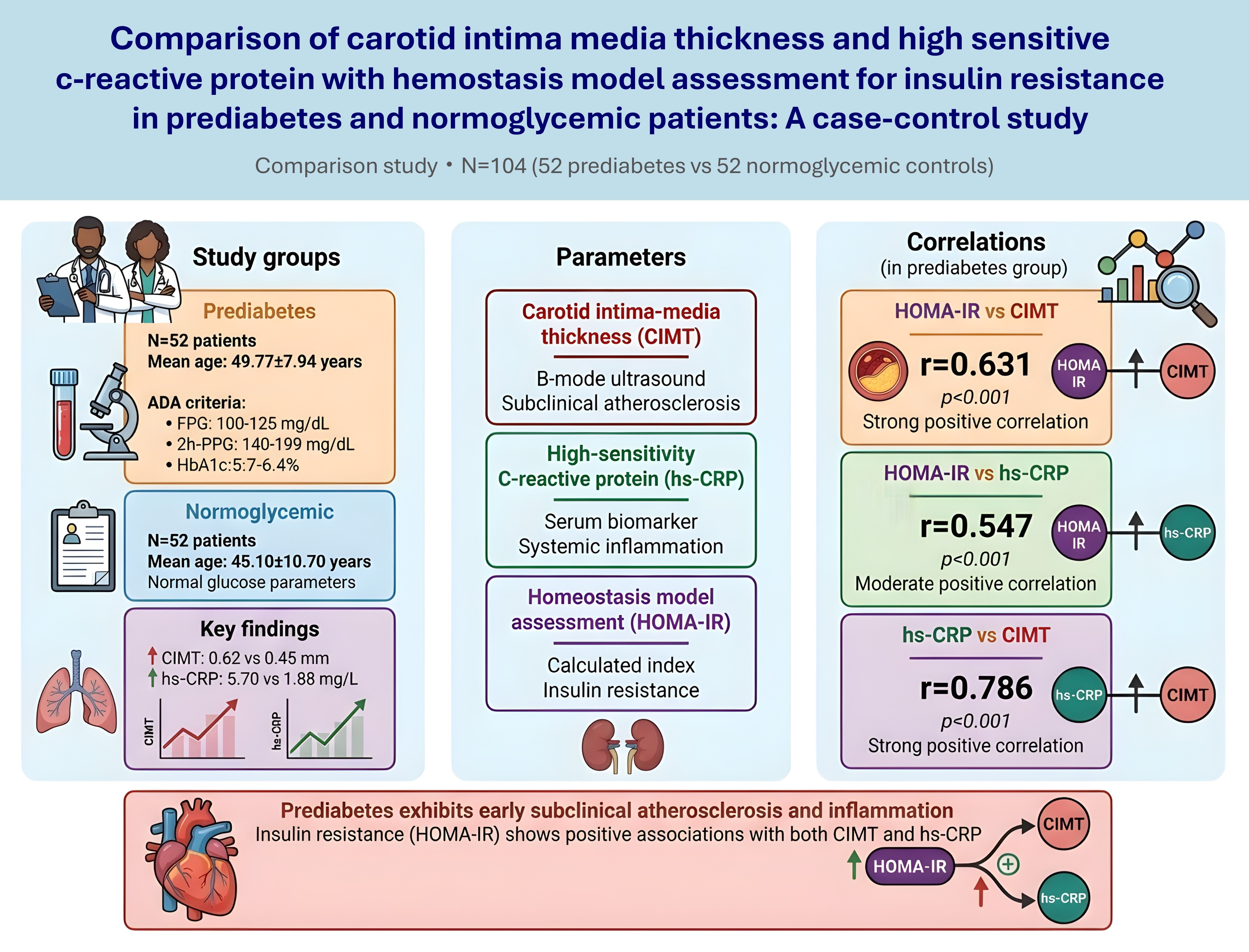
Results: In both cases and controls, the mean serum fasting insulin level was 13.92±4.27 mIU/mL and 5.21±2.46 mIU/mL, respectively (p<0.001). The mean HOMA-IR values were 3.70±1.1 and 1.21±0.58, respectively (p<0.001). The mean CIMT was significantly greater in prediabetics (0.62±0.07mm) than in controls (0.45±0.08 mm) (p<0.001). Additionally, prediabetics had significantly higher serum-levels (5.70±3.35 mg/L) tan controls (1.88±1.35 mg/L) (p<0.001). A positive correlation of HOMA-IR existed between mean CIMT (p<0.001; r=0.631), and hs-CRP (p<0.001; r=0.498).
Conclusion: Prediabetic adults had higher CIMT and hs-CRP than normoglycemic controls, and HOMA-IR correlated positively with both, indicating greater subclinical atherosclerosis burden. These associations suggest IR may aid ASCVD risk stratification in prediabetes, though longitudinal studies are needed to confirm prognostic value.
Article Details

This work is licensed under a Creative Commons Attribution-NonCommercial-NoDerivatives 4.0 International License.
Personal views expressed by the contributors in their articles are not necessarily those of the Journal of Associated Medical Sciences, Faculty of Associated Medical Sciences, Chiang Mai University.
References
Magliano DJ, Boyko EJ, Committee IDA 10th Edition scientific. Global picture. In: IDF DIABETES ATLAS 10th Edition [Internet]. International Diabetes Federation; 2021 [cited 2025 Jan 27]. Available from: https://www.ncbi.nlm.nih.gov/books/NBK581940/
Yadi H. IDF Diabetes Atlas estimates for the global diabetes prevalence of adults older than 60 years. 2017 Nov 10; Available from: doi.org/10.26226/morressier.59d51843d462b80296ca3751.
American Diabetes Association Professional Practice Committee. 2. Diagnosis and Classification of Diabetes: Standards of Care in Diabetes-2024. Diab Care. 2023; 47(Suppl_1): S20-42. doi: 10.2337/dc24-S002.
Cai X, Zhang Y, Li M, Wu JH, Mai L, Li J, et al. Association between prediabetes and risk of all-cause mortality and cardiovascular disease: updated meta-analysis. BMJ. 2020;370: m2297. doi: 10.1136/bmj.m2297.
Ohiagu FO, Chikezie PC, Chikezie CM. Pathophysiology of diabetes mellitus complications: Metabolic events and control. Biomed Res Ther. 2021; 8(3): 4243-57. doi:10.15419/bmrat.v8i3.663.
Yip WCY, Sequeira IR, Plank LD, Poppitt SD. Prevalence of pre-diabetes across ethnicities: A review of impaired fasting glucose (IFG) and impaired glucose tolerance (IGT) for classification of dysglycaemia. Nutrients. 2017; 9(11): 1273. doi.org/10.3390/nu9111273.
Neves JS, Newman C, Bostrom JA, Buysschaert M, Newman JD, Medina JL, et al. Management of dyslipidemia and atherosclerotic cardiovascular risk in prediabetes. Diabetes Res Clin Pract. 2022; 190: 109980. doi: 10.1016/j.diabres.2022.109980.
Chauhan A, Ramesh P, Goyal P, Jilowa S, Singh A, Singhal A, et al. Carotid Intima Media Thickness and High Sensitivity C-Reactive Protein Levels in Prediabetes and its Correlation with Homeostatic Model Assessment for Insulin Resistance. J Clin Diagn Res. 2019; 13(9): 10-14. doi: 10.7860/JCDR/2019/42480.13157.
Willeit P, Tschiderer L, Allara E, Reuber K, Seekircher L, Gao L, et al. Carotid intima-media thickness progression as surrogate marker for cardiovascular risk: Meta-analysis of 119 clinical trials involving 100,667 patients. Circulation. 2020;142(7): 621-42. doi: 10.1161/CIRCULATIONAHA.120.046361.
Tschiderer L, Seekircher L, Izzo R, Mancusi C, Manzi MV, Baldassarre D, et al. Association of intima‐media thickness measured at the common carotid artery with incident carotid plaque: Individual participant data meta‐analysis of 20 prospective studies. J Am Heart Assoc. 2023; 12(12): e027657. doi: 10.1161/JAHA.122.027657.
Randolph W, Dains JE. Ultrasound evaluation of carotid artery intima-media thickness: Effective early marker of carotid artery disease in adult head and neck cancer patients after neck radiation? J Adv Pract Oncol. 2022; 13(7): 683-94. doi: 10.6004/jadpro.2022.13.7.4
Ge J, Jing F, Ji R, Tian A, Su X, Li W, et al. Agerelated trends in the predictive value of carotid intima‐media thickness for cardiovascular death: A prospective population‐based cohort study. J Am Heart Assoc. 2023; 12(13): e029656. doi: 10.1161/JAHA.123.029656.
Holland Z, Ntyintyane LM, Raal FJ, Gill GV. Carotid intima–media thickness is a predictor of coronary artery disease in South African black patients. Cardiovasc J Afr. 2009; 20(4): 237-9.
Sun H, Yang J, Ma L, Wu Y. Association between hs-CRP/HDL-C ratio and risk of prediabetes or diabetes: a cross-sectional study based on NHANES 2015-2023. BMC Endocr Disord. 2025; 25(1): 183. doi: 10.1186/s12902-025-02004-0.
Basil B, Mohammed JA, Mba IN, Myke-Mbata BK, Akujieze JC. High-sensitivity C-reactive protein and cardiovascular disease risk assessment in a population of type 2 diabetes mellitus patients. BMC Cardiovasc Disord. 2025; 25(1): 498. doi: 10.1186/s12872-025-04975-3.
Yang X, Tao S, Peng J, Zhao J, Li S, Wu N, et al. High-sensitivity C-reactive protein and risk of type 2 diabetes: A nationwide cohort study and updated meta-analysis. Diabetes Metab Res Rev. 2021; 37(8): e3446. doi: 10.1002/dmrr.3446.
Liu Y, He W, Ji Y, Wang Q, Li X. A linear positive association between high-sensitivity C-reactive protein and the prevalence of cardiovascular disease among individuals with diabetes. BMC Cardiovasc Disord. 2024; 24(1): 411. doi: 10.1186/s12872-024-04091-8.
Sajja V, Jeevarathnam D, James S, Rathinasamy J. A study on carotid artery intima-media thickness and metabolic risk factors in overweight and obese Indian children. Diabetol Int. 2019; 11(2): 142-9.
Singh RP, Chauhan K, Tripathi A, Choudhary R. Association of adipokines and CIMT in metabolic syndrome in Western Uttar Pradesh population: a cross-sectional s tudy. Mædica. 2024;19(3): 494-501. doi: 10.26574/maedica.2024.19.3.494.
Santos IS, Bittencourt MS, Goulart AC, Schmidt MI, Diniz M de FHS, Lotufo PA, et al. Insulin resistance is associated with carotid intima-media thickness in non-diabetic subjects. A cross-sectional analysis of the ELSA-Brasil cohort baseline. Atherosclerosis. 2017; 260: 34-40.
Field N, Cohen T, Struelens MJ, Palm D, Cookson B, Glynn JR, et al. Strengthening the reporting of molecular epidemiology for infectious diseases (STROME-ID): an extension of the STROBE statement. Lancet Infect Dis. 2014; 14(4): 341-52. doi: 10.1016/S1473-3099(13)70324-4.
Johri AM, Nambi V, Naqvi TZ, Feinstein SB, Kim ESH, Park MM, et al. Recommendations for the assessment of carotid arterial plaque by ultrasound for the characterization of atherosclerosis and evaluation of cardiovascular risk: From the American Society of Echocardiography. J Am Soc Echocardiogr. 2020; 33(8): 917-33. doi: 10.1016/j.echo.2020.04.021.
Horton WB, Love KM, Gregory JM, Liu Z, Barrett EJ. Metabolic and vascular insulin resistance: partners in the pathogenesis of cardiovascular disease in diabetes. Am J Physiol-Heart Circ Physiol. 2025; 328(6): H1218-36. doi: 10.1152/ajpheart.00826.2024.
Liu AB, Lin YX, Meng TT, Tian P, Chen JL, Zhang XH, et al. Associations of the cardiometabolic index with insulin resistance, prediabetes, and diabetes in U.S. adults: a cross-sectional study. BMC Endocr Disord. 2024; 24: 217. doi: 10.1186/s12902-024-01676-4.
Mashaba RG, Phoswa W, Maimela E, Mokgalaboni K. Association of carotid intima–media thickness and dyslipidaemia in patients with type 2 diabetes: a protocol for systematic review and meta-analysis. BMJ Open. 2024; 14(1): e079209. doi:10.1136/bmjopen-2023-079209.
Cheng ZJ, Wang YF, Jiang XY, Ren WY, Lei SF, Deng FY, et al. High sensitivity C-reactive protein and prediabetes progression and regression in middleaged and older adults: A prospective cohort study. J Diabetes Investig. 2024; 15(1): 78-86. doi: 10.1111/jdi.14090.
Mahat RK, Singh N, Rathore V, Gupta A, Shah RK. Relationship between atherogenic indices and carotid intima-media thickness in prediabetes: A cross-sectional study from Central India. Med Sci (Basel). 2018; 6(3): 55. doi: 10.3390/medsci6030055.
Groop PH, Forsblom C, Thomas MC. Mechanisms of disease: Pathway-selective insulin resistance and microvascular complications of diabetes. Nat Clin Pract Endocrinol Metab. 2005; 1(2): 100-10.
Bhinder HPS, Kamble TK. The study of carotid intima-media thickness in prediabetes and its correlation with cardiovascular risk factors. J Datta Meghe Inst Med Sci Univ. 2018; 13(2): 79.
Bulut A, Avci B. Carotid intima-media thickness values are significantly higher in patients with prediabetes compared to normal glucose metabolism. Medicine (Baltimore). 2019; 98(44): e17805. doi: 10.1097/MD.0000000000017805.
Gateva A, Assyov Y, Karamfilova V, Kamenov Z. Common carotid artery intima media thickness (CIMT) in patients with prediabetes and newly diagnosed type 2 diabetes mellitus. J Diabetes Complications. 2024; 38(7): 108766.
Parildar H, Gulmez O, Cigerli O, Dogruk Unal A, Erdal R, Guvener Demirag N. Carotid artery intima media thickness and hsCRP; Predictors for atherosclerosis in prediabetic patients? Pak J Med Sci. 2013; 29(2): 495-9. doi: 10.12669/pjms.292.3133.
Ghule A, Kamble TK, Talwar D, Kumar S, Acharya S, Wanjari A, et al. Association of serum high sensitivity C-reactive protein with Pre-diabetes in rural population: A Two-Year Cross-Sectional Study. Cureus. 2025; 13(10): e19088. doi: 10.7759/cureus.19088.
Jaiswal A, Tabassum R, Podder A, Ghosh S, Tandon N, Bharadwaj D. Elevated level of C-reactive protein is associated with risk of prediabetes in Indians. Atherosclerosis. 2012; 222(2): 495-501. doi: 10.1016/j.atherosclerosis.2012.02.034.
Sun H, Yang J, Ma L, wu Y. Association between hs-CRP/HDL-C ratio and risk of prediabetes or diabetes: a cross-sectional study based on NHANES 2015-2023. BMC Endocr Disord. 2025; 25(1): 183. doi: 10.1186/s12902-025-02004-0.
Sabanayagam C, Shankar A, Lim SC, Lee J, Tai ES, Wong TY. Serum C-reactive protein level and prediabetes in two Asian populations. Diabetologia. 2011; 54(4): 767-75. doi: 10.1007/s00125-011-2052-5.
Pfützner A, Forst T. High-sensitivity C-reactive protein as cardiovascular risk marker in patients with diabetes mellitus. Diabetes Technol Ther. 2006; 8(1): 28-36. doi: 10.1089/dia.2006.8.28.
Huang Y, Cai X, Mai W, Li M, Hu Y. Association between prediabetes and risk of cardiovascular disease and all-cause mortality: systematic review and meta-analysis. BMJ. 2016; 355: i5953. doi: 10.1136/bmj.i5953.
Liu AB, Lin YX, Meng TT, Tian P, Chen JL, Zhang XH, et al. Associations of the cardiometabolic index with insulin resistance, prediabetes, and diabetes in U.S. adults: a cross-sectional study. BMC Endocr Disord. 2024; 24: 217. doi: 10.1186/s12902-024-01676-4.
Willeit P, Tschiderer L, Allara E, Reuber K, Seekircher L, Gao L, et al. Carotid intima-media thickness progression as surrogate marker for cardiovascular risk. Circulation. 2020; 142(7): 621-42. doi: 10.1161/CIRCULATIONAHA.120.046361.
