
Interprofessional education and collaboration in health professions: A narrative review of global evidence and lessons from the Philippines
Article Sidebar
Main Article Content
Abstract
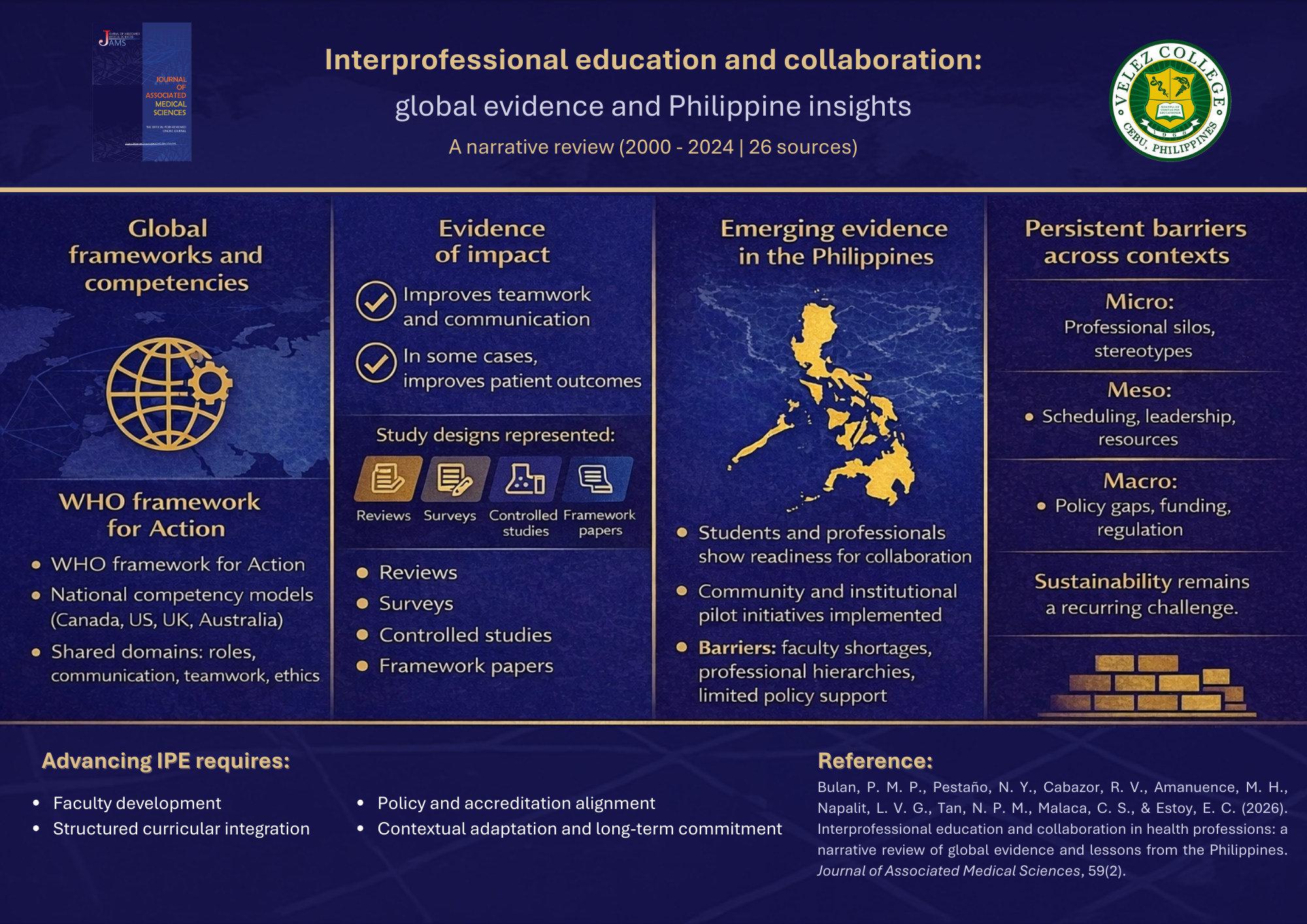
Background: Interprofessional education (IPE) and interprofessional collaboration (IPC) are globally recognized as strategies for strengthening health systems and improving patient outcomes. Although frameworks and evidence have been well established in high-income countries, insights from low- and middle-income contexts remain limited. In the Philippines, studies on IPE and IPC are emerging but remain fragmented across disciplines and institutions.
Objectives: This review aimed to synthesize international and Philippine literature on IPE and IPC, identify key frameworks, experiences, and challenges, and discuss implications for education, practice, and policy development in the Philippine context.
Materials and methods: A narrative review approach was used to integrate diverse forms of evidence on IPE and IPC. Sources were identified through PubMed, Scopus, Google Scholar, and relevant organizational reports using the keywords “interprofessional education,” “interprofessional collaboration,” “health professions,” and “Philippines.” Articles published in English between 2000 and 2024 were included if they discussed definitions, frameworks, implementation strategies, challenges, or outcomes. Extracted data were synthesized thematically to operationalize the review objectives, focusing on conceptual and policy foundations of IPE and IPC, evidence of effectiveness, international experiences, the Philippine context and local evidence, and challenges, barriers, and sustainability.
Results: Global literature shows that IPE enhances teamwork, communication, and, in some cases, patient outcomes, though findings are often constrained by methodological heterogeneity. International frameworks from Australia, Canada, the United Kingdom, and the United States establish shared competency domains but highlight challenges in assessment and curriculum integration. Philippine studies demonstrate readiness among students and professionals, pilot initiatives in community and institutional settings, and recurring barriers such as faculty shortages, professional hierarchies, and limited policy support. Sustainability emerged as a major concern in both global and local contexts.
Conclusion: IPE and IPC hold significant potential to advance collaborative health professions education in the Philippines and similar low- and middleincome countries. To strengthen sustainability, contextual adaptation of global frameworks, investment in faculty development, alignment of accreditation and policy standards, and longitudinal research are essential to building enduring models that enhance interprofessional collaboration and health system outcomes.
Article Details

This work is licensed under a Creative Commons Attribution-NonCommercial-NoDerivatives 4.0 International License.
Personal views expressed by the contributors in their articles are not necessarily those of the Journal of Associated Medical Sciences, Faculty of Associated Medical Sciences, Chiang Mai University.
References
World Health Organization. Framework for action on interprofessional education and collaborative practice [Internet]. Geneva: WHO; 2010 [cited 2024 Jan 6]. Available from: https://www.who.int/hrh/resources/framework_action/en/
Canadian Interprofessional Health Collaborative. A national interprofessional competency framework. Vancouver: University of British Columbia; 2010.
Interprofessional Education Collaborative Expert Panel. Core competencies for interprofessional collaborative practice: report of an expert panel. Washington (DC): Interprofessional Education Collaborative; 2011.
Thistlethwaite JE, Forman D, Matthews LR, Rogers GD, Steketee C, Yassine T. Competencies and frameworks in interprofessional education: a comparative analysis. Acad Med. 2014; 89(6): 869-75. doi: 10.1097/ACM.0000000000000249.
Reeves S, Pelone F, Harrison R, Goldman J, Zwarenstein M. Interprofessional collaboration to improve professional practice and healthcare outcomes. Cochrane Database Syst Rev. 2017; (6): CD000072. doi: 10.1002/14651858.CD000072.pub3.
Berger-Estilita J, Fuchs A, Hahn M, Chiang H, Greif R. Attitudes towards interprofessional education in the medical curriculum: a systematic review of the literature. BMC Med Educ. 2020; 20(1): 254. doi: 10.1186/s12909-020-02120-6.
Lieneck C, Wang T, Gibbs D, Russian C, Ramamonjiarivelo Z, Ari A. Interprofessional education and research in the health professions: a systematic review and supplementary topic modeling. Educ Sci. 2022; 12(12): 850. doi: 10.3390/educsci12120850.
Bogossian F, New K, George K, Barr N, Dodd N, Hamilton AL, et al. The implementation of interprofessional education: a scoping review. Adv Health Sci Educ Theory Pract. 2023; 28(1): 243-77. doi: 10.1007/s10459-022-10132-4.
Cervantes-Sudio MG, Ganotice FA, Navarro AT. Are Filipino students ready to collaborate? Comparing the readiness of healthcare students for interprofessional education in the Philippines. J Interprof Care. 2021; 35(5): 718-25. doi: 10.1080/13561820.2020.1819241.
Sy MP. Filipino therapists’ experiences and attitudes of interprofessional education and collaboration: a cross-sectional survey. J Interprof Care. 2017; 31(6): 761-70. doi: 10.1080/13561820.2017.1345873.
Sy M, Pineda RC, Sumulong RA, Navarro A. Establishing a pilot interprofessional education program in a higher education institution in the Philippines. J Health Caring Sci. 2020;2(2):180-91. doi: 10.37719/jhcs.2020.v2i2.rna004.
Paterno E, Opina-Tan LA. Developing communityengaged interprofessional education in the Philippines. In: Gilbert J, Editor. Leadership development for interprofessional education and collaborative practice. London: Palgrave Macmillan; 2014: pp162-78.
Sadikan MZ. A step-by-step guide to writing a review paper in medical education. Int J Transform Health Prof Educ. 2025; (1): 24-37. doi: 10.71354/ ijthpe.03.01.48.
Sukhera J. Narrative reviews: flexible, rigorous, and practical. J Grad Med Educ. 2022; 14(4): 414-7. doi: 10.4300/JGME-D-22-00400.1.
Green BN, Johnson CD, Adams A. Writing narrative literature reviews for peer-reviewed journals: secrets of the trade. J Chiropr Med. 2006; 5(3): 101-17.
Elo S, Kääriäinen M, Kanste O, Pölkki T, Utriainen K, Kyngäs H. Qualitative content analysis. SAGE Open. 2014; 4(1): 215824401452263. doi: 10. 1177/2158244014522633.
Brewer M. Curtin interprofessional capability framework [Internet]. Perth: Curtin University; 2013 [cited 2024 Jan 6]. Available from: https://www.curtin.edu.au/resources/file/faculty/hs/interprofessional_A5_broch_1-29072015.pdf
Walsh CL, Gordon MF, Marshall M, Wilson F, Hunt T. Interprofessional capability: a developing framework for interprofessional education. Nurse Educ Pract. 2005; 5(4): 230-7. doi: 10.1016/j.nepr. 2004.12.003.
Rawlinson C, Carron T, Cohidon C, Arditi C, Hong QN, Pluye P, et al. An overview of reviews on interprofessional collaboration in primary care: barriers and facilitators. Int J Integr Care. 2021; 21(2): 32. doi: 10.5334/ijic.5589.
Schot E, Tummers L, Noordegraaf M. Working on working together: a systematic review on how healthcare professionals contribute to interprofessional collaboration. J Interprof Care. 2020; 34(3): 332-42. doi: 10.1080/13561820.2019.1636007.
Van Wyk R, Labuschagne MJ, Joubert G. Simulation as an educational strategy to deliver interprofessional education. Afr J Health Prof Educ. 2020; 12(2): 74. doi: 10.7196/AJHPE.2020.v12i2.1213
El-Awaisi A, Awaisu A, Jaam M, El Hajj MS, Verjee MA. Does the delivery of interprofessional education have an effect on stereotypical views of healthcare students in Qatar? J Interprof Care. 2020; 34(1): 44-9. doi: 10.1080/13561820.2019.1612332.
Curran VR, Heath O, Kearney A, Button P. Evaluation of an interprofessional collaboration workshop for postgraduate residents, nursing and allied health professionals. J Interprof Care. 2010; 24(3): 315-8. doi: 10.3109/13561820903163560.
Ford M, Martin P, Sy M. Twelve tips to support healthcare teams to incorporate interprofessional education and collaborative practice into dayto- day workplace practices. J Pract Teach Learn. 2022; 19(3): 183-90. doi: 10.1921/jpts.v19i3.1835.
Ulrich G, Homberg A, Karstens S, Mahler C. Attitudes towards interprofessional collaboration in young healthcare professionals. J Interprof Care. 2019; 33(6): 768-73. doi: 10.1080/13561820.2019.1612333.
Heinemann GD, Schmitt MH, Farrell MP, Brallier SA. Development of an attitudes toward health care teams scale. Eval Health Prof. 1999; 22(1): 123-42. doi: 10.1177/01632789922034202.
Moncatar TRT, Nakamura K, Siongco KLL, Seino K, Carlson R, Canila CC, et al. Interprofessional collaboration and barriers among health and social workers caring for older adults: a Philippine case study. Hum Resour Health. 2021; 19(1): 52. doi: 10.1186/s12960-021-00601-8.
Nakamura K, Siongco KLL, Moncatar TRT, Tejero LMS, De La Vega SAF, Bonito SR, et al. In-service training programme for health and social care workers in the Philippines to strengthen interprofessional collaboration in caring for older adults: a mixed-methods study. Health Res Policy Syst. 2022; 20(S1): 111. doi: 10.1186/s12961-022-00914-2.
Sy MP, Martinez PGV, Labung FFT, Medina MAKG, Mesina AS, Vicencio MRE, et al. Baseline assessment on the quality of interprofessional collaboration among Filipino mental health professionals. J Interprof Educ Pract. 2019; 14: 58-66. doi: 10.1016/j.xjep.2018.10.002.
Causapin AKV, Sy MP, Grageda MEM. Attitudes of Filipino health profession students toward interprofessional education: a descriptive study. J Interprof Care. 2022; 36(6): 856-63. doi: 10.1080/13561820.2021.1971448.
