
Effect of a behavioral strategy program on quality of life: A quasiexperimental study in women with cognitive impairment receiving chemotherapy
Article Sidebar
Main Article Content
Abstract
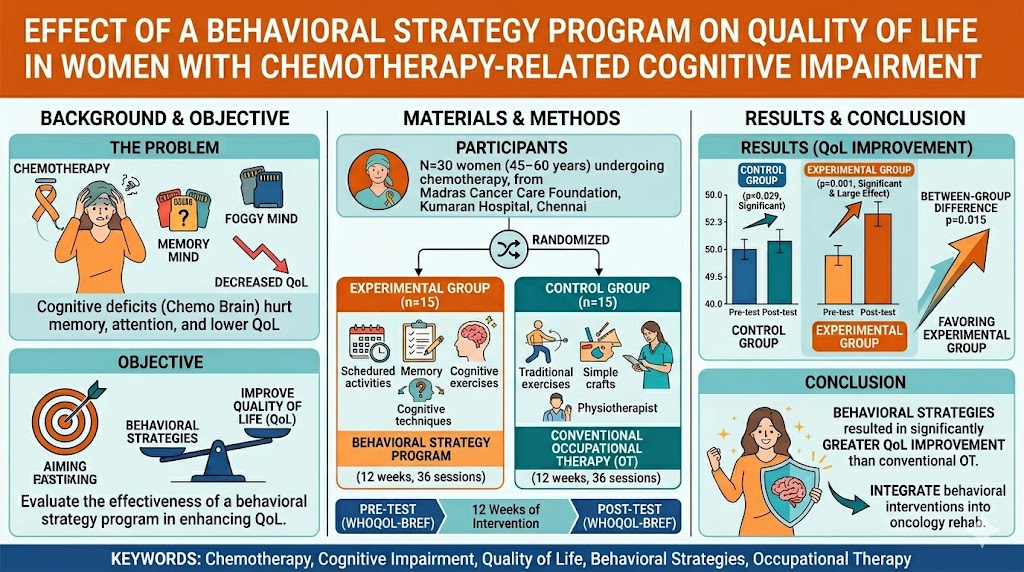
Background: Women who undergo chemotherapy for cancer frequently develop cognitive problems referred to as chemo brain. These cognitive deficits harm memory functions and attention skills as well as processing speed, which leads to decreased quality of life (QoL). Behavioral approaches are non-drug solutions that show promise in enhancing cognitive abilities and everyday functioning in this specific group.
Objectives: To evaluate the effectiveness of a behavioral strategy program compared with conventional occupational therapy in improving quality of life among women with chemotherapy-related cognitive impairment.
Materials and methods: A quasi-experimental pre- post study design was employed. Thirty women aged 45-60 years undergoing chemotherapy were recruited from Madras Cancer Care Foundation, Kumaran Hospital, Chennai. Participants were allocated into two groups (N=15 each): an experimental group receiving structured behavioral strategies and a control group receiving conventional occupational therapy for 12 weeks (36 sessions). Quality of life was measured using the WHOQOL-BREF. Data were analyzed using non-parametric tests (Wilcoxon signed-rank test and Mann-Whitney U test).
Results: Both groups demonstrated significant improvement in quality of life following intervention. The control group improved from 49.53±6.14 to 52.27±7.36 (p=0.029), while the experimental group improved from 47.33±5.58 to 59.73±6.58 (p=0.001). Between-group comparison showed a statistically significant difference in favor of the experimental group (p=0.015). Effect size analysis demonstrated large improvements in the experimental group.
Conclusion: Behavioral strategies showed greater improvement in quality of life compared with conventional occupational therapy among women with chemotherapy-related cognitive impairment. Integrating structured behavioral interventions into oncology rehabilitation may enhance patient outcomes.
Article Details

This work is licensed under a Creative Commons Attribution-NonCommercial-NoDerivatives 4.0 International License.
Personal views expressed by the contributors in their articles are not necessarily those of the Journal of Associated Medical Sciences, Faculty of Associated Medical Sciences, Chiang Mai University.
References
Ahles TA, Root JC. Cognitive effects of cancer and cancer treatments. Annu Rev Clin Psychol. 2018; 14: 425-51. doi: 10.1146/annurev-clinpsy-050817-084903.
Wefel JS, Schagen SB. Chemotherapy-related cognitive dysfunction. Curr Neurol Neurosci Rep. 2012; 12(3): 267-75. doi: 10.1007/s11910-012-0264-9.
Pandey M, Thomas BC, SreeRekha P, Ramdas K, Ratheesan K, Parameswaran S. Quality of life determinants in cancer patients undergoing chemotherapy in India. Qual Life Res. 2005; 14(7):1701-8. doi: 10.1007/s11136-005-4338-z.
World Health Organization. WHOQOL-BREF: introduction, administration, scoring and generic version of the assessment. Geneva: World Health Organization; 1996.
Saxena S, Chandiramani K, Bhargava R. WHOQOLHindi: a questionnaire for assessing quality of life in health care settings in India. Natl Med J India. 1998; 11(4): 160-5.
Skevington SM, Lotfy M, O’Connell KA. The World Health Organization’s WHOQOL-BREF quality of life assessment: psychometric properties and results of the international field trial. Qual Life Res. 2004; 13(2): 299-310. doi: 10.1023/B:QURE.0000018471.01307.31.
Christiansen CH, Baum CM. Occupational therapy: performance, participation, and well-being. 4th Ed. Thorofare (NJ): SLACK Incorporated; 2014.
Michie S, van Stralen MM, West R. The behaviour change wheel: a new method for characterising and designing behaviour change interventions. Implement Sci. 2011; 6: 42. doi: 10.1186/1748-5908-6-42.
King BR, Boswell JF. Therapeutic strategies and techniques in early cognitive-behavioral therapy. Psychotherapy (Chic). 2019; 56(1): 35-40. doi: 10.1037/pst0000202.
Mounier NM, Abdel-Maged AE, Wahdan SA, Gad AM, Azab SS. Chemotherapy-induced cognitive impairment: an overview of etiology and pathogenesis. Life Sci. 2020; 258: 118071. doi: 10.1016/j.lfs.2020.118071.
Chao D, Hale A, Henry NL, Kratz AL, Gabel NM. Cancer-related cognitive impairment or “chemobrain”: emerging assessments, treatments, and targets for intervention. Curr Phys Med Rehabil Rep. 2021; 9(3): 108-18. doi: 10.1007/s40141-021-00322-1.
Chachamovich E, Fleck MP, Trentini CM, Power M. Brazilian WHOQOL-BREF normative data. Qual Life Res. 2008; 17(2): 297-306. doi: 10.1007/s11136-007-9280-3.
Gangane N, Khairkar P, Hurtig AK, San Sebastian M. Quality of life determinants in breast cancer patients in central India. Asian Pac J Cancer Prev. 2017; 18(12): 3325-32. doi: 10.22034/APJCP.2017.18.12.3325.
Montazeri A. Health-related quality of life in breast cancer patients: a bibliographic review. J Exp Clin Cancer Res. 2008; 27: 32. doi: 10.1186/1756-9966-27-32.
González-Santos Á, López-Garzón M, Sánchez-Salado C, Postigo-Martin P, Lozano-Lozano M, Galiano-Castillo N, et al. A telehealth-based cognitive-adaptive training (e-OTCAT) to prevent cancer and chemotherapy-related cognitive impairment in women with breast cancer: protocol for a randomized controlled trial. Int J Environ Res Public Health. 2022; 19(12): 7147. doi: 10.3390/ijerph19127147.
Folstein MF, Folstein SE, McHugh PR. "Mini-mental state". A practical method for grading the cognitive state of patients for the clinician. J Psychiatr Res. 1975;12(3):189-198.
Fiel Peres F. Effect sizes for nonparametric tests. Biochem Med (Zagreb). 2026; 36(1): 010101. doi.org/10.11613/BM.2026.010101.
