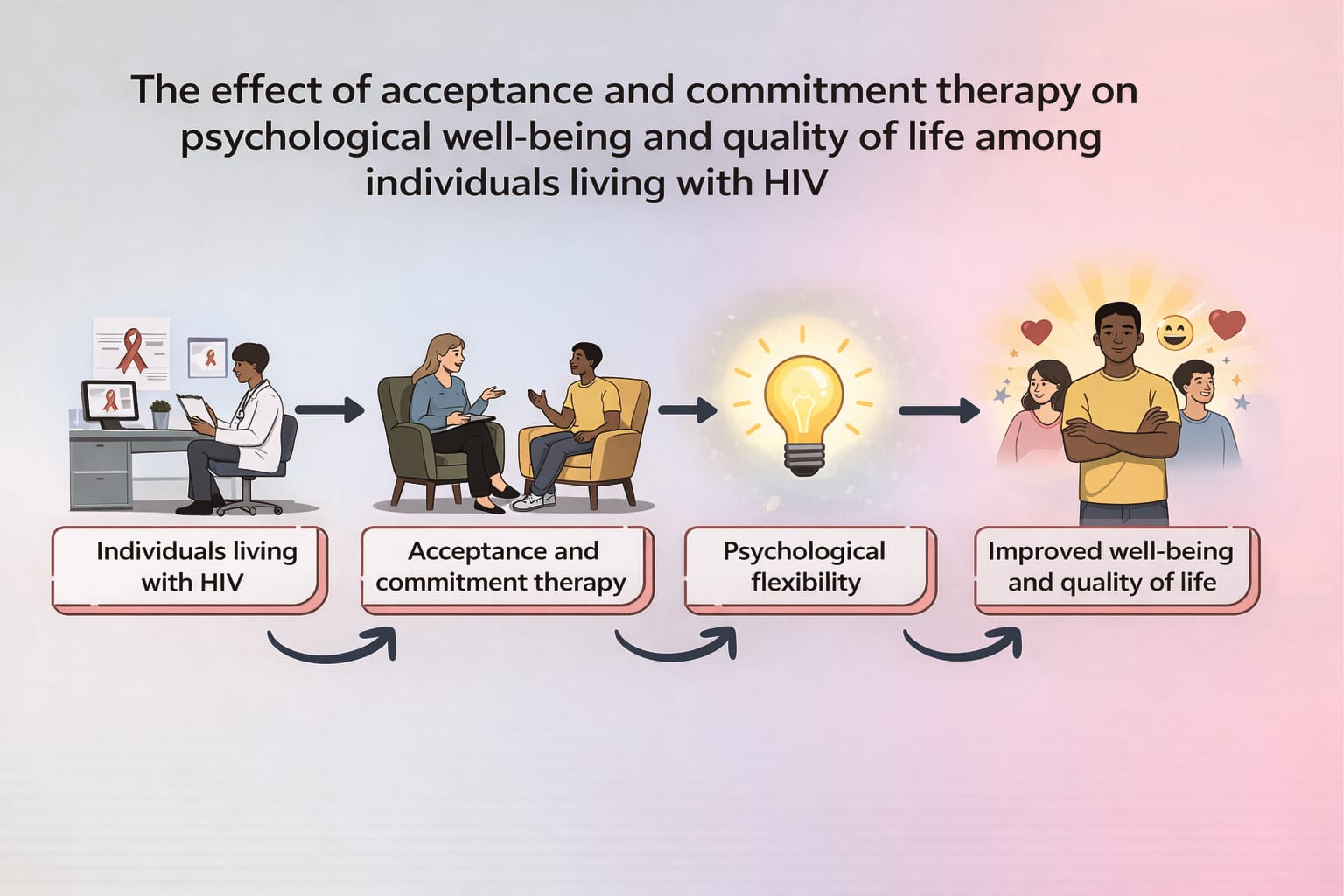
Effect of acceptance and commitment therapy on psychological well-being and quality of life among individuals living with HIV
Article Sidebar
Main Article Content
Abstract
Background: Psychiatric issues are notably common among individuals with HIV, heavily impacting the overall quality of life and the success of their treatment. Acceptance and Commitment Therapy (ACT) is a recent cognitivebehavioural therapy that puts great emphasis on psychological flexibility. However, while the model has been extensively studied in clinical settings, research on its application for psychological well-being and quality of life among individuals with HIV remains limited.
Objectives: This study aimed to evaluate the effect of acceptance and commitment therapy on psychological well-being and quality of life among individuals living with HIV.
Materials and methods: A total of 55 individuals with HIV met the inclusion criteria, from which 33 individuals with HIV provided consent to participate in the study. Before the randomization of the groups, 3 participants were dropped out of the study due to relocation from their living facility. The remaining 30 individuals with HIV were selected and assigned to either the experimental group (N=15) or the control group (N=15) through simple randomization using the lottery method in which participants retrieved sequentially numbered opaque sealed envelopes. The quality of life and psychological well-being were assessed using the WHOQOL HIV-BREF and Ryff’s psychological well-being scale. The experimental group received Acceptance and Commitment Therapy, while the control group underwent conventional occupational therapy for three months. Data analysis was performed using SPSS version 23.0, with paired and independent t-tests applied.
Results: Post-test scores showed statistically significant improvements in the experimental group than in the control group in both quality of life (p<0.001) and psychological well-being (p<0.001). The results of this study showed that Acceptance and Commitment Therapy was effective in enhancing both quality of life and psychological well-being among individuals with HIV.
Conclusion: The findings indicate that Acceptance and Commitment Therapy effectively enhanced quality of life and psychological well-being of Individuals living with HIV positive following intervention in experimental group.
Article Details

This work is licensed under a Creative Commons Attribution-NonCommercial-NoDerivatives 4.0 International License.
Personal views expressed by the contributors in their articles are not necessarily those of the Journal of Associated Medical Sciences, Faculty of Associated Medical Sciences, Chiang Mai University.
References
Remien RH, Stirratt MJ, Nguyen N, Robbins RN, Pala AN, Mellin CA. Mental health and HIV/AIDS: the need for an integrated response. AIDS. 2019; 33(9): 1411-20. doi:10.1097/QAD.0000000000002227.
Hu FH, Liu P, Jia YJ, Ge MW, Shen LT, Xia XP, et al. Prevalence of mental health problems in people living with HIV: a systematic review and metaanalysis. Psychol Health Med. 2025; 30(3): 397-413. doi:10.1080/13548506.2024.2424998.
Nedelcovych MT, Manning AA, Semenova S, Gamaldo C, Haughey NJ, Slusher BS. The psychiatric impact of HIV. ACS Chem Neurosci. 2017; 8(7): 1432-4. doi:10.1021/acschemneuro.7b00169.
Ryff CD, Keyes CL. The structure of psychological well-being revisited. J Pers Soc Psychol. 1995; 69(4): 719-27. doi:10.1037/0022-3514.69.4.719.
Fathi M, Abdolmaleki L, Alamdari SM, Kamal SHM. Effectiveness of cognitive behavioural therapy for quality of life among women with HIV. Iran J Health Psychol. 2023; 6(15): 9-18. doi:10.30473/ijohp.2023.63309.1240.
Gonzalez-Garcia M, Ferrer MJ, Borras X, Muñoz-Moreno JA, Miranda C, Puig J, et al. Effectiveness of mindfulness-based cognitive therapy on the quality of life, emotional status, and CD4 cell count of patients aging with HIV infection. AIDS Behav. 2014; 18(4): 676-85. doi:10.1007/s10461-013-0612-z.
van der Heijden I, Abrahams N, Sinclair D. Psychosocial group interventions to improve psychological well-being in adults living with HIV. Cochrane Database Syst Rev. 2017; 3(3): CD010806. doi: 10.1002/14651858.CD010806.pub2.
Feliu-Soler A, Montesinos F, Gutiérrez-Martínez O, Scott W, McCracken LM, Luciano JV. Current status of acceptance and commitment therapy for chronic pain: a narrative review. J Pain Res. 2018; 11: 2145-59. doi:10.2147/JPR.S144631.
Rider JV, Laverdure AE. Exploring the application of acceptance and commitment therapy by occupational therapy practitioners: a scoping review protocol. JBI Evid Synth. 2025; 23(5): 10307. doi:10.11124/JBIES-24-00232.
Hayes SC, Strosahl KD, Wilson KG. Acceptance and commitment therapy: The process and practice of mindful change. 2nd Ed. New York: Guilford Press; 2012.
Hayes SC, Luoma JB, Bond FW, Masuda A, Lillis J. Acceptance and commitment therapy: Model, processes and outcomes. Behav Res Ther. 2006; 44(1): 1-25. doi: 10.1016/j.brat.2005.06.006.
Harris R. ACT made simple: An easy-to-read primer on acceptance and commitment therapy. Oakland (CA): New Harbinger Publ Inc; 2019.
Hayes SC, Pistorello J, Levin ME. Acceptance and commitment therapy as a unified model of behaviour change. Couns Psychol. 2012; 40(7): 976-1002. doi:10.1177/0011000012460836.
Wilson KG, Murrell AR, Hayes BT, Follette VM, Linehan MM. Values-centred interventions: Setting a course for behavioural treatment. In: Hayes SC, Follette VM, Linehan MM, Editors. Mindfulness and acceptance: Expanding the cognitive-behavioral tradition. New York: Guilford Press; 2004.
Moitra E, Stein MD, Busch AM, Pinkston MM, Abrantes AM, Baker JV, et al. Acceptance of chronic pain in depressed patients with HIV: correlations with activity, functioning, and emotional distress. AIDS Care. 2022; 34(10): 1338-46. doi:10.1080/09540121.2021.1981819.
WHOQOL-HIV Group. Preliminary development of the World Health Organization’s Quality of Life HIV instrument (WHOQOL-HIV): analysis of the pilot version. Soc Sci Med. 2003; 57(7): 1259-75. doi:10.1016/S0277-9536(02)00506-3.
Aikat R, Gomes O. Effect of occupational therapy intervention on the quality of life of HIV positive clients and study of knowledge about HIV on clients and occupational therapists. Int J Health Sci Res. 2015; 5(8): 369-76.
Skafi Sabet Z, Ghorban Shiroodi S, Zarbakhsh-Bahri M, Aminian K. The effectiveness of acceptance and commitment group therapy on disease severity, quality of life and psychological well-being of patients with irritable bowel syndrome. Salamat Ijtimai. 2022; 9(1): 36-46. doi:10.22037/ch.v9i1.31290.
Ebrahimpour G, Mirzaeian B, Hasanzade R. Effectiveness of acceptance and commitment therapy on psychological well-being, quality of life and depression in patients with epilepsy. J Shahid Sadoughi Univ Med Sci. 2019; 27(2): 1262-79 doi:10.18502/ssu.v27i2.1046. (in Persian)
