
Effectiveness of guided imagery to improve sleep quality among young adults with post-traumatic stress disorder (PTSD)
Article Sidebar
Main Article Content
Abstract
Background: Post-traumatic stress disorder often leads to ongoing sleep difficulties such as insomnia and nightmares, which can interfere with mood, concentration, and daily activities. Guided imagery, a relaxation method that uses calming, multisensory visualizations, has shown potential to improve sleep and reduce distress in people experiencing high stress or trauma. This study evaluates the effectiveness of guided imagery in improving sleep quality among young adults with post-traumatic stress disorder (PTSD) compared to conventional occupational therapy.
Objectives: To evaluate and compare the effectiveness of guided imagery and conventional occupational therapy in improving sleep quality among young adults (18-25 years) with post-traumatic stress disorder.
Materials and methods: A quasi experimental design was conducted with 30 young adults aged 18-25 years, recruited through convenience sampling and divided into two groups: experimental (guided imagery intervention) and control (conventional occupational therapy). The potential of the post-traumatic stress disorder was accomplished by the diagnosis of PTSD using Clinician-
Administered PTSD Scale for DSM-5, Past-Month version. Both interventions were delivered over three months, with 36 sessions held three times per week, each lasting 45 minutes. The state of sleep prior to intervention and right after the intervention was critically explained with the aid of the Pittsburgh Sleep Quality Index (PSQI). Statistical analysis was performed to compare pre- and post-test scores within and between groups.
Results: The experimental group (N=15) had a mean pre-test PSQI score of 14.40 (SD=2.41) and a post-test score of 8.73 (SD=2.05), showing a highly significant improvement (t=15.707, p=0.000). The control group (N=15) had a mean pre-test PSQI score of 14.07 (SD=1.53) and a post-test score of 13.47 (SD=1.60), also showing significant improvement (t=2.358, p=0.033). Post-test scores between the groups revealed a significantly greater improvement in the experimental group compared to the control group (t=7.050, p=0.000).
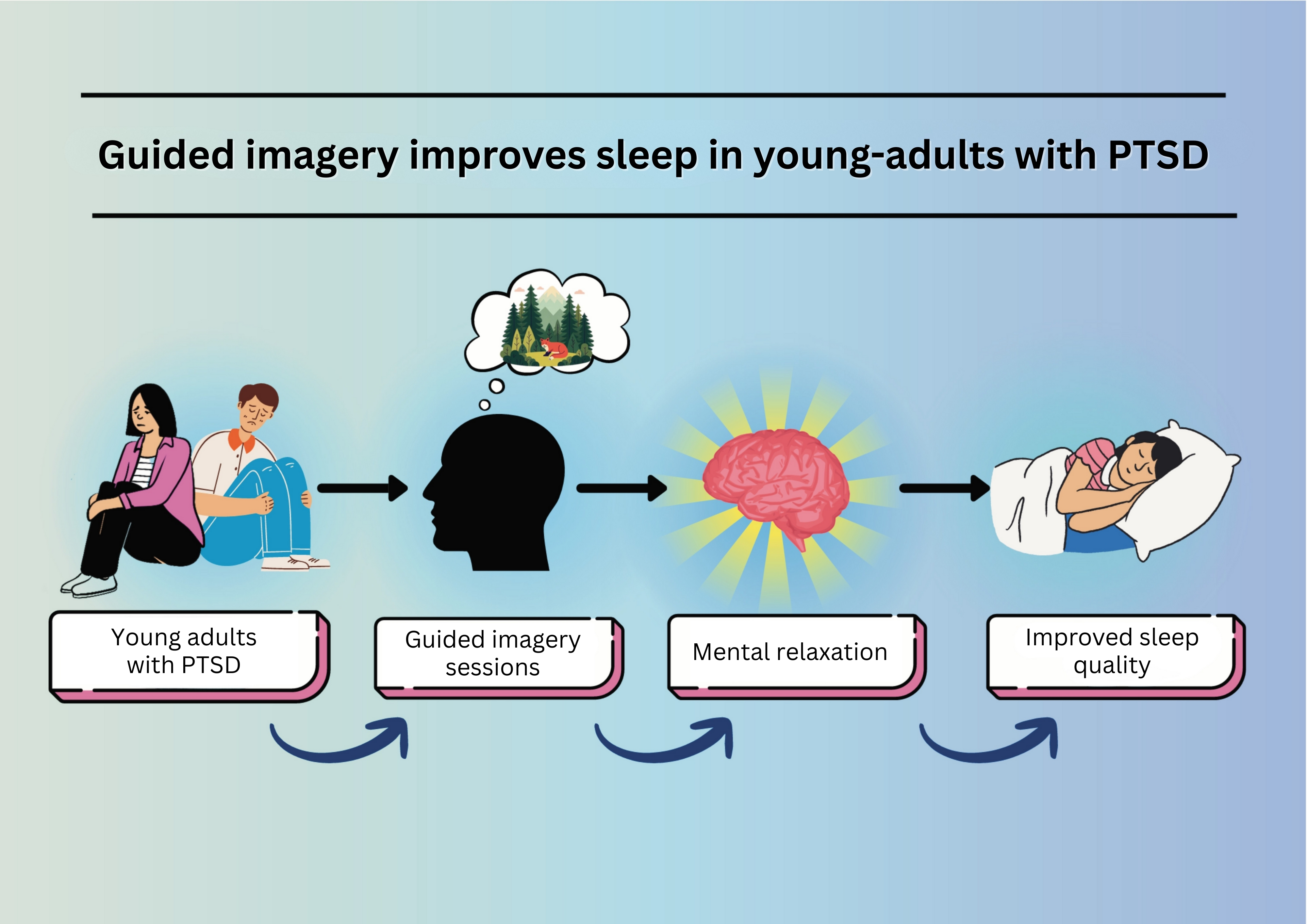
Conclusion: Guided imagery was found to greatly improve sleep quality in young adults living with post-traumatic stress disorder, offering better results than conventional occupational therapy. These results highlight the value of using gentle, non-drug approaches like guided imagery to ease sleep difficulties and support overall well-being in this group.
Article Details

This work is licensed under a Creative Commons Attribution-NonCommercial-NoDerivatives 4.0 International License.
Personal views expressed by the contributors in their articles are not necessarily those of the Journal of Associated Medical Sciences, Faculty of Associated Medical Sciences, Chiang Mai University.
References
American Psychiatric Association. Posttraumatic stress disorder (PTSD) [Internet]. 2023 [cited 2025 Sep 11]. Available from: https://www.psychiatry.org/patients-families/ptsd.
Capaldi VF 2nd, Guerrero ML, Killgore WDS. Sleep disruptions among returning combat veterans from Iraq and Afghanistan. Mil Med. 2011; 176(8): 879-88. doi: 10.7205/milmed-d-10-00440.
World Federation of Occupational Therapists. Definition of occupational therapy [Internet]. 2012 [cited 2025 Sep 11]. Available from: https://wfot.org/about/about-occupational-therapy.
Fisher AG. Occupation-centred, occupation-based, occupation-focused: Same, same or different? Scand J Occup Ther. 2013; 20(3): 162-73. doi: 10.3109/11038128.2012.754492.
Petersen KS, Bjørkedal STB, Torsting AM, Eplov LF. Occupational therapy interventions in mental health: A scoping review of recent evidence. Int J Ther Rehabil. 2017; 24(1): 30-40. doi: 10.12968/ijtr.2016.0070.
Eklund M. Mental health – An area of high priority in occupational therapy. Br J Occup Ther. 2021; 84(12): 733-5. doi: 10.1177/03080226211037864.
Freeman D, Sheaves B, Waite F, Harvey AG, Harrison PJ. Sleep disturbance and psychiatric disorders. Lancet Psychiatry. 2020; 7(7): 628-37. doi: 10.1016/S2215-0366(20)30136-X.
Lucchesi LM, Pradella-Hallinan M, Lucchesi M, Moraes WA dos S. Sleep in psychiatric disorders. Rev Bras Psiquiatr. 2005; 27(5): 333-9. doi: 10.1590/s1516-44462005000500006.
Yehuda R, Hoge CW, McFarlane AC, Vermetten E, Lanius RA, Nievergelt CM, et al. Post-traumatic stress disorder. Nat Rev Dis Primers. 2015; 1: 15057. doi: 10.1038/nrdp.2015.57.
Koenen KC, Ratanatharathorn A, Ng L, McLaughlin KA, Bromet EJ, Stein DJ, et al. Posttraumatic stress disorder in the world mental health surveys. Psychol Med. 2017; 47(13): 2260-74. doi: 10.1017/s0033291717000708.
Shalev A, Liberzon I, Marmar C. Post-traumatic stress disorder. N Engl J Med. 2017; 376(25): 2459-69. doi: 10.1056/nejmra1612499.
Javidi H, Yadollahie M. Post-traumatic stress disorder. Int J Occup Environ Med. 2012; 3(1): 2-9. Available from: https://pubmed.ncbi.nlm.nih.gov/23022845/
Maher MJ, Rego SA, Asnis GM. Sleep disturbances in patients with post-traumatic stress disorder: Epidemiology, impact and approaches to management. CNS Drugs. 2006; 20(7): 567-90. doi: 10.2165/00023210-200620070-00003.
Miller KE, Brownlow JA, Gehrman PR. Sleep in PTSD: Treatment approaches and outcomes. Curr Opin Psychol. 2019; 34: 12-7. doi: 10.1016/j.copsyc.2019.08.017.
Belleville G, Guay S, Marchand A. Impact of sleep disturbances on PTSD symptoms and perceived health. J Nerv Ment Dis. 2009; 197(2): 126-32. doi: 10.1097/NMD.0b013e3181961d8e.
Germain A. Sleep disturbances as the hallmark of PTSD: Where are we now? Am J Psychiatry. 2013; 170(4): 372-82. doi: 10.1176/appi.ajp.2012.12040432.
Krau SD. The multiple uses of guided imagery. Nurs Clin North Am. 2020; 55(4): 467-74. doi: 10.1016/j.cnur.2020.06.013.
Hart J. Guided imagery. Altern Complement Ther. 2008; 14(6): 295-9. doi: 10.1089/act.2008.14604.
Srivastava A, Chattoraj T. Exploring guided imagery, mindfulness meditation and cognitive restructuring as therapeutic techniques for treating post-traumatic stress disorder. In: The Asian Conference on Psychology & the Behavioral Sciences; 2023 Apr; Tokyo, Japan. doi: 10.22492/issn.2187-4743.2023.9.
Zehetmair C, Tegeler I, Kaufmann C, Klippel A, Reddemann L, Junne F, et al. Stabilizing techniques and guided imagery for traumatized male refugees in a German state registration and reception center: A qualitative study on a psychotherapeutic group intervention. J Clin Med. 2019; 8(6): 894. doi: 10.3390/jcm8060894.
Jain S, McMahon GF, Hasen P, Kozub MP, Porter V, King R, et al. Healing touch with guided imagery for PTSD in returning active duty military: A randomized controlled trial. Mil Med. 2012; 177(9): 1015-21. doi: 10.7205/MILMED-D-11-00290.
Weathers FW, Bovin MJ, Lee DJ, Sloan DM, Schnurr PP, Kaloupek DG, et al. The clinician-administered PTSD scale for DSM–5 (CAPS-5): Development and initial psychometric evaluation in military veterans. Psychol Assess. 2018; 30(3): 383-95. doi: 10.1037/pas0000486.
Germain A, Hall MH, Krakow B, Shear MK, Buysse DJ. A brief sleep scale for posttraumatic stress disorder: Pittsburgh Sleep Quality Index addendum for PTSD. J Anxiety Disord. 2005; 19(2): 233-44. doi: 10.1016/j.janxdis.2004.02.001.
Ho ECM, Siu AMH. Evaluation of an occupationbased sleep programme for people with insomnia. Hong Kong J Occup Ther. 2022; 35(2): 168-79. doi.org/10.1177/15691861221136261.
Schaffer L, Jallo N, Howland L, James K, Glaser D, Arnell K. Guided imagery: An innovative approach to improving maternal sleep quality. J Perinat Neonatal Nurs. 2013; 27(2): 151-9. doi: 10.1097/JPN.0b013e3182870426.
Afshar M, Mohsenzadeh A, Gilasi H, Sadeghi-Gandomani H. The effects of guided imagery on state and trait anxiety and sleep quality among patients receiving hemodialysis: A randomized controlled trial. Complement Ther Med. 2018; 40:116-21. doi: 10.1016/j.ctim.2018.07.006.
Seda G, Sanchez-Ortuno MM, Welsh CH, Halbower AC, Edinger JD. Comparative meta-analysis of prazosin and imagery rehearsal therapy for nightmare frequency, sleep quality, and posttraumatic stress. J Clin Sleep Med. 2015; 11(1): 11-22. doi: 10.5664/jcsm.4354.
Casement MD, Swanson LM. A meta-analysis of imagery rehearsal for post-trauma nightmares: Effects on nightmare frequency, sleep quality, and posttraumatic stress. Clin Psychol Rev. 2012; 32(6): 566-74. doi: 10.1016/j.cpr.2012.06.002.
Cook JM, Harb GC, Gehrman PR, Cary MS, Gamble GM, Forbes D, et al. Imagery rehearsal for posttraumatic nightmares: A randomized controlled trial. J Trauma Stress. 2010; 23(5): 553-63. doi: 10.1002/jts.20569.
Harb GC, Cook JM, Phelps AJ, Gehrman PR, Forbes D, Localio R, et al. Randomized controlled trial of imagery rehearsal for posttraumatic nightmares in combat veterans. J Clin Sleep Med. 2019; 15(5): 757-67. doi: 10.5664/jcsm.7770.
Lancee J, Effting M, Kunze AE. Telephone-guided imagery rehearsal therapy for nightmares: Efficacy and mediator of change. J Sleep Res. 2021; 30(3): e13123. doi: 10.1111/jsr.13123.
Krakow B, Hollifield M, Johnston L, Koss M, Schrader R, Warner TD, et al. Imagery rehearsal therapy for chronic nightmares in sexual assault survivors with posttraumatic stress disorder: A randomized controlled trial. JAMA. 2001; 286(5): 537-45. doi: 10.1001/jama.286.5.537.
Sandahl H, Jennum P, Baandrup L, Mortensen EL, Carlsson J. Imagery rehearsal therapy and/or mianserin in treatment of refugees diagnosed with PTSD: Results from a randomized controlled trial. J Sleep Res. 2021; 30(4): e13276. doi: 10.1111/jsr.13276.
Beck BD, Messel C, Meyer SL, Cordtz TO, Søgaard U, Simonsen E, et al. Feasibility of trauma-focused guided imagery and music with adult refugees diagnosed with PTSD: A pilot study. Nord J Music Ther. 2018; 27(1): 67-86. doi: 10.1080/08098131.2017.1286368.
Story KM, Beck BD. Guided imagery and music with female military veterans: An intervention development study. Arts Psychother. 2017; 55: 93-102. doi: 10.1016/j.aip.2017.05.003.
