
Fall risk, fear of falling and their association with depressive symptoms among institutionalized older adults: A cross-sectional study
Article Sidebar
Main Article Content
Abstract
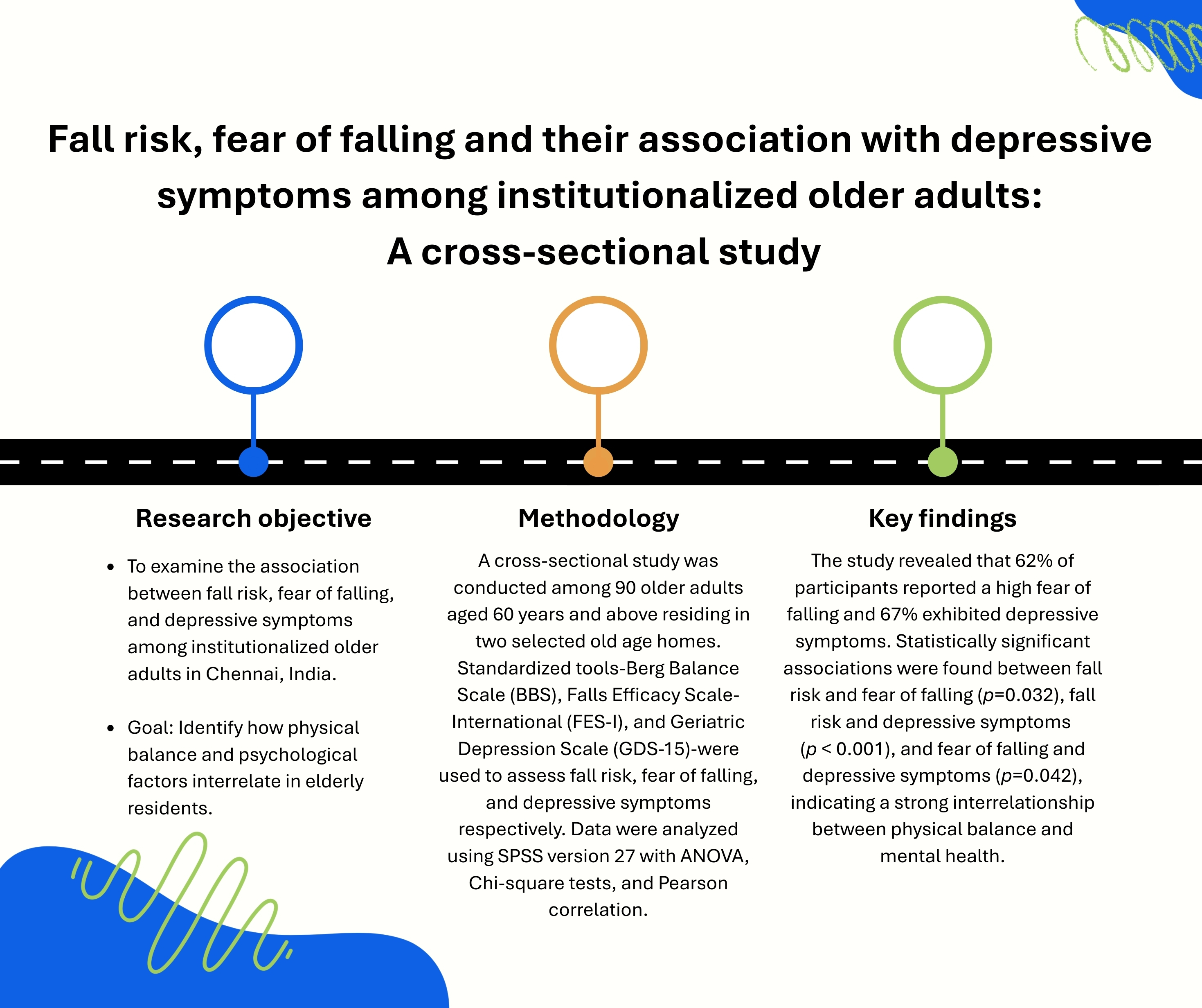
Background: Falls, fear of falling, and depression are major geriatric syndromes that threaten independence and overall well-being. Older people living in institutions may be particularly vulnerable due to physical, environmental, and psychosocial factors. This study aimed to examine the association among fall risk, fear of falling and depressive symptoms among Institutionalized Older Adults.
Materials and methods: A cross-sectional study was carried out among 90 residents from two selected old age homes in Chennai. Participants aged more than 60 years were recruited using purposive sampling. Fall risk, fear of falling and depressive symptoms were assessed using the Berg Balance Scale (BBS), Falls Efficacy Scale-International (FES-I) and Geriatric Depression Scale (GDS-15), respectively. The data was analyzed with IBM SPSS Statistics version 27, employing descriptive statistics, ANOVA, Chi-Square test and Pearson correlation.
Results: High fear of falling was reported by 62% of participants while 67% were presented with depressive symptoms. The results obtained were statistically significant associations between fall risk and fear of falls (p=0.032), fall risk and depressive symptoms (p<0.001), and fear of falls and depressive symptoms (p=0.042). Age showed a significant association with fall risk and fear of falling,
but not with depression.
Conclusion: The study shows that fall risk and fear of falling are highly prevalent among the institutionalized older adults and are closely linked to depressive symptoms. These findings emphasize the need for integrated intervention addressing both physical balance and psychological well-being to reduce fall risk, alleviate fear of falling, and improve mental health in residential care settings.
Article Details

This work is licensed under a Creative Commons Attribution-NonCommercial-NoDerivatives 4.0 International License.
Personal views expressed by the contributors in their articles are not necessarily those of the Journal of Associated Medical Sciences, Faculty of Associated Medical Sciences, Chiang Mai University.
References
World Health Organization. Ageing and health [Internet]. Geneva: World Health Organization; 2024 Oct 1 [cited 2025 Sep 16]. Available from: https://www.who.int/news-room/fact-sheets/detail/ageing-and-health
Kinsella KG, He W. An aging world: 2008 [Internet] International Population Reports P95/09-1. Washington (DC): U.S. Census Bureau; 2009 [cited 2025 Sep 21]. Available from: https://www.census.gov/library/publications/2009/demo/p95-09-1.html
Channon A, Matthews Z, Van Lerberghe W. Will there be enough people to care? Notes on workforce implications of demographic change 2005-2050. Geneva: World Health Organization; 2006.
Del Duca GF, Silva SG, Thumé E, Santos IS, Hallal PC. Predictive factors for institutionalization of the elderly: a case-control study. Rev Saude Publica. 2012; 46(1): 147-53. English, Portuguese. doi: 10.1590/s0034-89102012000100018.
Beekman AT, Deeg DJ, van Tilburg T, Smit JH, Hooijer C, van Tilburg W. Major and minor depression in later life: a study of prevalence and risk factors. J Affect Disord. 1995; 36(1-2): 65-75. doi: 10.1016/0165-0327(95)00061-5.
Carreira L, Botelho MR, Matos PCB, Torres MM, Salci MA. Prevalence of depression in institutionalized elderly. Rev Enferm UERJ. 2011; 19(2): 268-73.
Milos V, Bondesson Å, Magnusson M, Jakobsson U, Westerlund T, Midlöv P. Fall risk-increasing drugs and falls: a cross-sectional study among elderly patients in primary care. BMC Geriatr. 2014; 14: 40. doi: 10.1186/1471-2318-14-40.
Brouwer B, Musselman K, Culham E. Physical function and health status among seniors with and without a fear of falling. Gerontology. 2004; 50(3): 135-41. doi:10.1159/000076771.
Pereira MEA, Santos GS, Almeida CR, Nunes KCS, Silva MCM, José H, et al. Association between falls, fear of falling and depressive symptoms in community-dwelling older adults. Healthcare (Basel). 2024; 12(16): 1638. doi:10.3390/healthcare12161638.
Ellmers TJ, Ventre JP, Freiberger E, Hauer K, Hogan DB, Lim ML, et al. Does concern about falling predict future falls in older adults? A systematic review and meta-analysis. Age Ageing. 2025; 54(4): afaf089. doi:10.1093/ageing/afaf089.
Martínez-Arnau FM, Prieto-Contreras L, Pérez-Ros P. Factors associated with fear of falling among frail older adults. Geriatr Nurs. 2021; 42(5): 1035-41. doi:10.1016/j.gerinurse.2021.06.007.
Biderman A, Cwikel J, Fried AV, Galinsky D. Depression and falls among community-dwelling elderly people: a search for common risk factors. J Epidemiol Community Health. 2002; 56(8): 631-6. doi:10.1136/jech.56.8.631.
Hoffman GJ, Hays RD, Wallace SP, Shapiro M, Ettner SL. Depressive symptomatology and fall risk among community-dwelling older adults. Soc Sci Med. 2017; 178: 206-13. doi:10.1016/j.socscimed.2017.02.020.
Lee TH, Kim W. Is fear of falling and the associated restrictions in daily activity related to depressive symptoms in older adults? Psychogeriatrics. 2021; 21(3): 304-10. doi:10.1111/psyg.12664.
Gazibara T, Kurtagić Pećanin I, Kišić-Tepavčević D, Nurković S, Kovačević N, et al. Falls, risk factors and fear of falling among persons older than 65 years of age. Psychogeriatrics. 2017; 17(4): 215-23. doi:10.1111/psyg.12217.
Gale CR, Cooper C, Sayer AA. Prevalence and risk factors for falls in older men and women: the English Longitudinal Study of Ageing. Age Ageing. 2016; 45(6): 789-94. doi:10.1093/ageing/afw129.
Trevisan FK, Silva RH, Reis SFA, Giehl MWC. Prevalence of depressive symptoms and associated factors in Brazilian older adults: 2019 Brazilian National Health Survey. Cad Saude Publica. 2024;40(12):e00006124.
